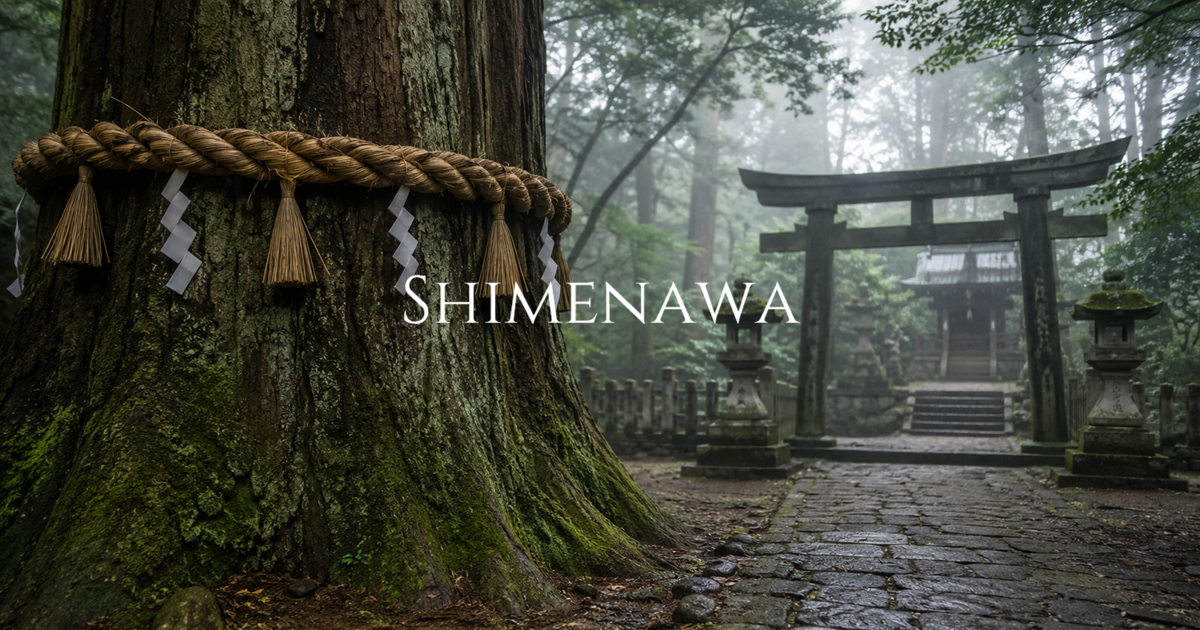
Shimenawa does not divide space the way a wall does. A cord looped around a trunk leaves the bark exposed; a rope strung across a gate can be stepped under without resistance. What changes is not access but status — once the rope appears, the object it touches is no longer read as ordinary.
That shift happens through material, not enforcement. Straw, paper, and placement announce that a threshold now exists, that behavior may need to adjust, and that whatever lies beyond deserves a different kind of attention. The barrier is physically thin. Its cultural weight is not.
For more stories like this, explore our Sacred & Taboo collection.
Shimenawa as a Material Boundary
Shimenawa is a length of twisted rope used across Japanese ritual practice to set a place, object, or temporary zone apart from its surroundings; its function is not to physically block entry but to make a change in ritual status visible from a distance. Where other forms of sacred and forbidden space in Japan rely on distance, purification, or inherited custom to communicate restriction, shimenawa gives that logic a shape that can be seen before it needs to be explained — a distinction that separates it from the broader category of boundary-marking discussed elsewhere on this site.
Most commonly encountered at Shinto shrines, the rope is traditionally twisted from rice straw and often paired with shide, the folded white paper strips that hang from sacred markers. It appears strung across gateways, wrapped around a trunk or boulder, suspended above a place of worship, or woven into a household’s seasonal decoration. Scale ranges from a slender cord to a rope heavy enough to reshape the visual weight of the structure it crosses.
What unites these applications is an act of selection. A tree indistinguishable from the grove around it becomes a tree that asks to be noticed. A patch of ground becomes ritual space. A doorway becomes a threshold through which a renewed order is expected to pass.
The rope’s instruction is not fixed. At a shrine it may signal sacred presence while leaving the ground open to any worshipper. Around a rock it may ask only for restraint, not avoidance. During a ceremony it may define a zone that exists for an hour and then dissolves. What holds constant across these settings is narrower than a rule: this should not be treated as ordinary.
No prior knowledge is required to register that. Before a visitor learns the deity’s name or the tree’s history, straw and folded paper have already interrupted the visual field.
The Rope in Myth and Ritual History
The mythological reference point for sacred rope in Japan is the story of Amaterasu’s withdrawal into the heavenly rock cave. When the sun deity is drawn back out, a rope is stretched across the cave mouth so that return to darkness is no longer possible. The gesture does not seal the cave by force — the opening remains physically unchanged — but it fixes the boundary between what has ended and what has begun.
That structure carried forward into practice. Ritual boundaries in Japan tend to appear at moments of transition: before a ceremony begins, during purification, when a kami is received, when ordinary use of a space is suspended. The rope does not create the transition. It stabilizes it, giving an otherwise invisible shift a visible edge.
Sacred rope entered shrine ritual, agricultural rites, festival preparation, construction ceremonies, and seasonal observance without ever standardizing into one form. Twisting method, hanging style, and replacement schedule varied by region and by the materials a community had at hand.
Rice straw tied the practice to agricultural life directly. In rice-growing communities, straw already belonged to the field, the tool shed, the storehouse, and the household — an unremarkable material handled daily. Turning it into shimenawa did not import something foreign into ritual space. It reorganized something familiar so that it could carry a weight it hadn’t carried before.
That reorganization is the substance of its meaning. The rope’s authority does not come from rarity or scale. It comes from the deliberate handling of ordinary matter according to an inherited form — cutting, drying, twisting, binding, hanging, eventually replacing. The boundary is not simply believed into existence. It is built, by hand, on a schedule.
Straw, Twist, and Shide: Making Distinction Visible
The rope’s form is what gives the boundary its presence. Loose strands of straw are gathered and twisted until they gain thickness and a coherent line — a shape that can stretch across a gate, curve around a trunk, or trace the edge of a temporary ritual zone.
Twisting does more than construct. It converts scattered material into continuous form. What was loose becomes ordered; what belonged to fieldwork becomes capable of marking sacred difference. The rope reads as deliberate before any explanation reaches the viewer.
Its surface never fully conceals what it’s made of. Individual fibers stay visible, the twist is irregular, and the bound ends often carry the visible trace of hands. Shimenawa does not aim for a finished, polished look. Its authority is communicated through raw material shaped with evident care, not through material that hides its own making.
Shide sharpen the effect. Their folded white paper breaks against the brown of the straw and the darker tones of bark, stone, or timber behind it. Their angular cut contrasts with the rope’s horizontal pull, and because they are light, they can shift in wind while the rope itself stays still. That small, irregular movement gives the boundary a living quality without ever turning it into a solid wall.
Scale changes how the marker reads without changing what it does. A heavy rope suspended above a shrine gate can make the entrance feel weighted with ritual authority. A slim cord around a roadside stone does something closer to the opposite — it draws a small, easily overlooked object back into visibility. In either case, placement carries more of the meaning than size does. The rope is positioned to identify exactly what deserves attention, framing an object or opening without sealing it off.
This restraint is part of what makes shimenawa effective. It offers no explanatory text and lists no rules. It simply places a recognizable form where ordinary perception is expected to stop.
Trees, Rocks, and Entrances: Sacredness Without Enclosure
Shimenawa’s logic is clearest around natural features. A tree wrapped at the trunk continues into the same canopy as every unmarked tree beside it. A rock encircled by rope stays fully exposed to weather and passersby. Nothing about the physical setting changes — only the terms under which it can be approached.
The tree remains, biologically, part of the forest. Culturally, it stops being interchangeable with its neighbors. The rope does this by selection rather than concealment: it gathers attention onto one feature within a landscape that otherwise reads as continuous, and it quietly withdraws certain actions — leaning, touching, cutting — from the category of acceptable behavior, even where nothing physically prevents them.
This is why shimenawa resists being read as decoration. Ornament changes appearance without changing the rules that surround an object. Shimenawa’s visual presence is secondary to its classificatory function — it marks a difference in status and lets that difference organize conduct.
At shrine entrances the same logic governs movement rather than objects. A rope strung above a gate marks the passage from one part of the precinct into another; visitors can still walk through, but the marker asks that the crossing be made with more attention than an ordinary doorway would require. Shrine space is rarely organized around a single barrier. Torii, water basins, steps, changes in ground surface, and shimenawa all contribute to a gradual narrowing from public approach toward ritual center, and the rope is often the most immediately legible signal within that sequence that something has changed.
Its meaning is relational rather than self-contained. Detached from the tree it wraps or the gate it crosses, the rope keeps its symbolic associations but loses the specific spatial work it was built to do. The marker needs the marked object as much as the object, once marked, needs the rope to communicate its new status outward.
Sacredness handled this way stays visible rather than sealed away. The rope does not hide what it marks. It changes the conditions under which that thing continues to be seen.
Temporary Boundaries in New Year and Ceremony
Not every shimenawa is permanent. Many are installed for a season or a single ritual sequence and removed once that period closes — a pattern that shows sacred space in Japan is not always treated as a fixed property of location.
Shimekazari, the New Year decorations that incorporate sacred rope, are the most familiar domestic version. Hung at entrances during the year-end and New Year period, their forms vary by region and household, but their placement follows shimenawa’s underlying logic: the doorway is marked as a point of transition, not merely decorated.
A doorway already divides inside from outside. The seasonal rope layers a second distinction onto that architecture, reorienting the entrance around purification and reception rather than ordinary passage. The building does not change. Its threshold, for a defined stretch of the calendar, does.
Once the season ends, the decoration comes down — and its removal does not undo what it accomplished. The limited duration is structural to the practice, not incidental. A shimekazari left up indefinitely would detach from the cycle that gave it meaning in the first place.
The same temporary logic appears in festival preparation, purification rites, and construction ceremonies, where a stretch of ordinary ground is marked, used for a defined ritual purpose, and then returned to everyday circulation. Sacredness here is not inherited from a distant past; it is produced, for the duration of a specific act, and then allowed to lapse.
What keeps the boundary functional in the meantime is shared conduct. A ritual specialist may install the rope, but the distinction only becomes socially real through how everyone present adjusts where they stand, how they move, what they touch. A boundary that lasts an afternoon can be exact for the duration it holds, even without leaving any trace once the rope comes down.
Material impermanence — straw weakening, paper weathering, decorations taken down on schedule — makes renewal a structural requirement rather than a maintenance afterthought. The boundary persists culturally not because a single rope endures, but because the form is remade each time it’s needed.
Why a Rope Still Commands Attention
Shimenawa continues to function because it asks little of the observer while communicating something exact. A passerby need not know a shrine’s ritual calendar or a particular tree’s history for the rope to register: ordinary treatment no longer applies here.
Its meaning operates on several levels at once. A priest or regular worshipper may read it within an explicit religious framework. A household hanging a shimekazari may sustain the practice through seasonal habit more than doctrine. A stranger passing by may register nothing more than a moment’s restraint — don’t touch this casually. None of these responses needs to match the others for the boundary to hold. Japanese ritual practice often runs on overlapping layers of belief, habit, aesthetic convention, and social expectation rather than one shared explanation, and shimenawa requires only enough recognition across those layers to keep working.
Its visual consistency lets it travel across very different settings — major shrines and neighborhood sanctuaries, monumental trees and roadside stones, formal ceremony and ordinary shopfronts — while adjusting its scale and specific instruction to each. Photography and tourism have amplified its recognizability further, sometimes flattening local particulars into a general shorthand for “sacred Japan.” But that flattening hasn’t hollowed the practice out; ropes are still cut, twisted, hung, and replaced according to local custom, and it’s that continued handling — not just the recognizable image — that keeps the marker functional.
Shimenawa belongs to a larger pattern of boundary communication in Japan that depends on cooperation rather than obstruction: changes of footwear, curtains, shifts in floor level, small signs, adjustments in posture. What distinguishes the rope within that pattern is how openly it declares itself. A wall separates whether or not its logic is understood. Shimenawa marks the line and then leaves recognition to complete the work — the boundary is only as real as the conduct it produces in the person standing in front of it.
Conclusion
Shimenawa shows how a boundary can be materially slight without being culturally thin. Straw and folded paper don’t wall a place off from the world; they change the terms on which the marked space is encountered.
Around a tree, the rope reorders how nature gets approached. Across a gate, it converts ordinary movement into a crossing. Above a household doorway, it folds daily architecture into a seasonal cycle. In a temporary ritual zone, it lets sacred order surface for a set span and then recede without leaving a structure behind.
None of that happens through the rope alone. Material, placement, and conduct have to align for the marking to hold. Shimenawa does not remove the sacred from daily life or hide it away — it keeps the marked object in plain view while withdrawing it from ordinary treatment. The boundary lives half in the straw and half in whoever stops to recognize it.
Related Articles
- Kegare — Frames impurity as a condition requiring ritual purification, where the boundary is maintained through response and process rather than a fixed marker attached to place.
- Death and Avoidance — Traces how distance from death is produced through language and conduct, without relying on any visible object to signal the line.
- Sacred and Forbidden — Maps the wider structure through which spaces become restricted in Japanese practice, the broader logic that shimenawa renders into a specific material and visual form.
Sources and Further Reading
These works provide grounding in Shinto ritual practice, the structure of sacred space, and the everyday religious life through which boundary-marking customs like shimenawa persist.
- Breen, John, and Mark Teeuwen. A New History of Shinto. Wiley-Blackwell, 2010.
- Hardacre, Helen. Shinto: A History. Oxford University Press, 2017.
- Nelson, John K. A Year in the Life of a Shinto Shrine. University of Washington Press, 1996.
- Ono, Sokyō. Shinto: The Kami Way. Tuttle Publishing, 1962.
- Reader, Ian, and George J. Tanabe Jr. Practically Religious: Worldly Benefits and the Common Religion of Japan. University of Hawai’i Press, 1998.
Author’s Note
In Japanese life, no one stops to explain what a shimenawa means — not at a shrine, not around the waist of a sumo yokozuna, not above the small kamidana in the kendo dojo where I trained as a student. The rope and its purpose are simply there, absorbed rather than taught. Writing about it in English forced me to unpack something that had never needed a sentence before.