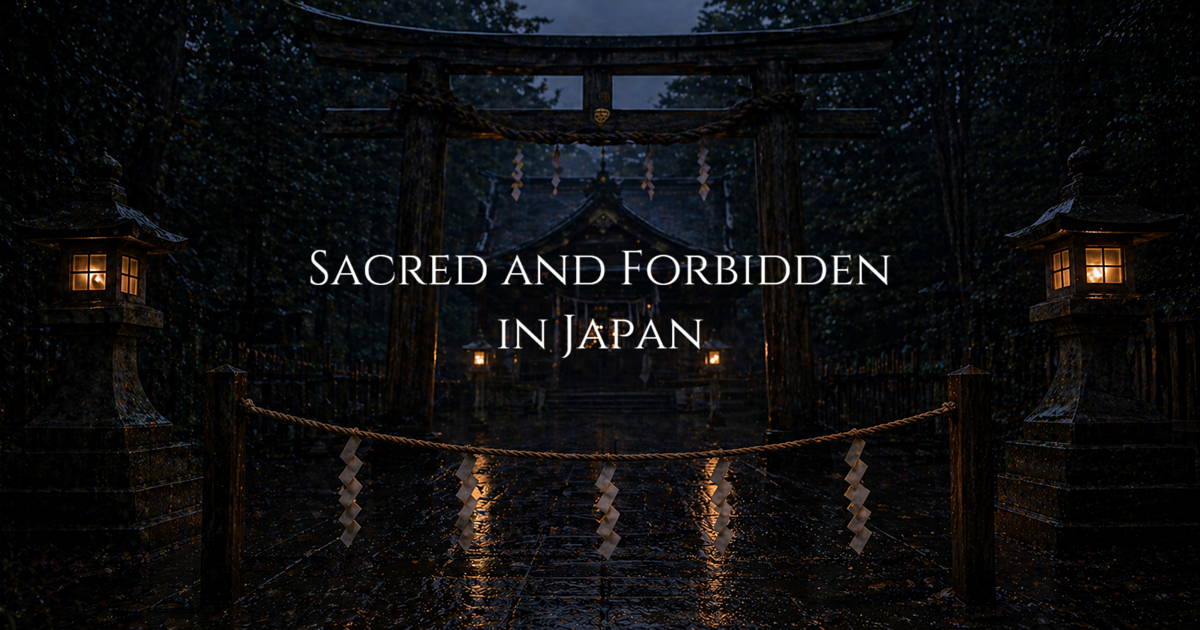
Sacredness in Japan tends to surface as a change in conduct rather than a statement of belief. Shoes come off before an interior is entered. A rope or gate marks the end of casual passage. After contact with death, participation in ordinary life may pause for a time. These practices differ in origin, yet each one marks a point where movement, access, or contact has to be reconsidered.
The line between sacred and forbidden is therefore less a fixed opposition between holy and sinful than a way of managing proximity. It asks where a person may go, when approach becomes appropriate, what preparation is required, and how ordinary relations resume once they have been disrupted. Boundaries give that regulation physical and behavioral form.
For more stories like this, explore our Sacred & Taboo collection.
Sacred and Forbidden as a Cultural Boundary System
Sacred and forbidden distinctions in Japan function less as a single doctrine than as a broad framework for organizing access, contact, and movement. What sets this framework apart from a fixed system of holy and sinful is that it regulates conditions of approach rather than issuing a stable verdict on right and wrong. A place, object, or period may be treated as set apart at one moment and rejoin ordinary use once the right conditions are met.
Within that framework, the sacred is something removed from everyday circulation: a site associated with kami, an object prepared for ritual use, a period marked by observance, or an area whose entry requires a change in behavior. The forbidden, by contrast, does not always describe something morally wrong. More often it identifies an approach considered inappropriate under specific circumstances.
Some restrictions hold permanently, but many are conditional. A space may be entered only by certain participants. An action may be set aside during mourning. An object may be handled after purification but not before. The boundary rarely rejects contact outright; it determines when contact becomes legitimate.
This is why prohibition in Japan so often takes the shape of restraint rather than punishment. A person waits, prepares, takes another route, or keeps a temporary distance. The rule may be marked by a gate, rope, sign, or architectural division, or it may be sustained through shared understanding with no explanation attached.
These distinctions draw on different sources: Shinto practice, Buddhism, household custom, local tradition, and modern institutions. Reducing them to one religious system would flatten what connects them, which is a recurring concern with preserving order by keeping spaces, conditions, and social roles from becoming interchangeable.
Purity, Kegare, and the Management of Contact
One significant source of boundary-making lies in ideas of purity and kegare. The word is often translated as impurity or pollution, though neither term captures its cultural function well. Kegare does not correspond to moral guilt. It describes a disturbed condition tied to death, blood, illness, birth, disaster, or another break in ordinary continuity.
A person affected by kegare is not necessarily held responsible for it. The condition can arise through unavoidable contact and is generally treated as temporary. What matters is how the altered state is managed: through purification, limited participation, spatial distance, or the passage of time.
This helps explain why so many Japanese restrictions resist a sin-and-punishment model. The concern is not that someone has committed an evil act, but that contact has unsettled an existing relation. Purification does not erase wrongdoing; it restores a workable alignment between the person, the community, and the surrounding environment.
Kegare represents one specific mechanism within this larger boundary system rather than its full expression. It concerns how disruption changes a condition and how ordinary relations are recovered afterward. Sacred and forbidden boundaries extend well beyond that, into spatial access, ritual authority, domestic thresholds, and forms of social restraint that are not framed in terms of impurity at all.
Purification at shrines offers a visible case. Visitors commonly rinse their hands, sometimes their mouths, before approaching the main sanctuary. The gesture does not suggest a moral offense. It marks a shift from ordinary movement into a space where approach has become formalized.
Water makes that shift perceptible through the body. Salt plays a comparable role in some customs surrounding death, while other restrictions rely on time rather than substance: a period passes before participation resumes. The methods vary, but the underlying principle stays consistent — contact can alter a condition, and the return to ordinary relations deserves acknowledgment rather than assumption.
Thresholds Made Visible
Some boundaries take architectural form. A torii marks entry into shrine space, though its function is not simply to divide one piece of land from another. Passing beneath it signals that the visitor’s position has changed. The path beyond may remain physically continuous with the road outside, yet movement is expected to become more deliberate.
Shrine compounds often deepen this transition through successive layers. Gates, purification basins, paths, fences, offering areas, and inner sanctuaries regulate how close a visitor may come and in what sequence. Access does not move directly from ordinary space to the most sacred point; it unfolds gradually, and the sequence itself teaches the visitor how to approach.
The innermost sanctuary is frequently the least accessible part of the site. Ordinary visitors may not enter it, or even see it clearly. Sacredness is maintained partly through distance — the presence of the kami is acknowledged without requiring unrestricted visibility or physical access.
Shimenawa gives another form to the same principle. The rope may encircle a tree, hang across an entrance, or mark a rock, object, or ritual area as set apart. It rarely functions as a physical barrier. Its force lies in recognition: the viewer understands that an ordinary relation to the marked place or object has been suspended.
Domestic space depends on thresholds as well, though its logic differs from shrine practice. The genkan separates the exterior from the raised interior of the home. Removing shoes responds to cleanliness, but it also changes the body’s relation to space — the street does not continue unchanged into the house.
That pause shapes movement and social position. A visitor removes footwear, waits to be received, and enters on the household’s terms. The threshold distinguishes outside from inside, public circulation from domestic belonging, and guest from resident.
A boundary, then, does not need to be monumental or explicitly religious to organize behavior. It may be a gate, rope, step, curtain, line, or small area where movement slows. Its meaning lies in the difference it creates between one side and the other.
Death, Mourning, and Temporary Restriction
Death places unusual pressure on cultural boundaries. The deceased is no longer part of ordinary social life, yet the relationship with the living does not disappear at once. The body, the household, and the mourners all enter a transitional condition managed through time, ritual, and restraint.
Japanese funerary practice draws on overlapping Buddhist, Shinto, household, and regional traditions. Buddhism has long supplied much of the formal structure surrounding funerals, memorial services, posthumous names, and ancestral care. At the same time, associations between death and kegare have shaped patterns of avoidance, particularly around shrines and communal observance.
Some mourners refrain from shrine visits or celebratory events for a period after a death. The length and strictness of this restraint vary, and not every family observes it the same way. The underlying logic is not that grief is dangerous or that the bereaved carry moral taint; mourning marks a condition in which ordinary participation has been interrupted.
Temporary distance gives that interruption a recognizable form. It allows the bereaved household to remain connected to the community while acknowledging that its position has changed. Reintegration happens gradually, through time, memorial observance, and the return of ordinary routines.
The use of salt after a funeral shows how such practices can persist even when their meanings are disputed. Some households use purification salt before reentering the home. The custom is often linked to the pollution of death, yet some Buddhist traditions reject the idea that the deceased should be treated as defiling. Its survival points not to a single shared theology but to an overlap between ritual habit, religious interpretation, and social expectation.
This section also marks the distinction between the present overview and a more focused treatment of death avoidance. That subject concerns the language, gestures, and social practices through which mortality is kept at a careful distance. Here, death appears as one revealing case within a wider system that also governs sacred space, domestic thresholds, ritual objects, and authorized access.
Death makes the structure especially visible because ordinary classifications become unstable. A person is absent yet socially present through memory and memorial obligation. A household belongs to the community yet is temporarily set apart. Boundaries offer a way to inhabit that uncertainty without forcing it to resolve immediately.
Access as a Position of Authority
Sacred boundaries do more than separate places — they also assign roles. Priests, participants, residents, pilgrims, visitors, and observers do not necessarily approach a sanctuary, ritual object, or restricted area in the same capacity.
Restricted access is sometimes read simply as secrecy, but concealment is only one part of the structure. Proximity may require preparation, authorization, or ritual responsibility. The most sacred object may be hidden, displayed only on particular occasions, or approached only by designated specialists. Distance helps preserve its status.
Access therefore carries obligations along with privilege. A person permitted to cross a boundary may be expected to purify, wear specific clothing, follow a prescribed sequence, or act on behalf of others. Entry is not merely freedom of movement; it is a position within an ordered relationship.
Comparable structures appear in secular institutions. Hospitals, laboratories, school offices, backstage areas, and private rooms all regulate entry according to purpose, vulnerability, expertise, or responsibility. Their restrictions do not arise from sacred doctrine, yet they share a similar spatial grammar: certain forms of access must be controlled because unrestricted contact would disrupt the conditions the space is meant to protect.
The comparison does not make a hospital ward sacred in the sense a shrine sanctuary is sacred; their meanings remain distinct. What they share is the use of boundaries to determine who may enter, when entry is appropriate, and what procedures make approach legitimate.
Japanese public environments often rely on this logic without much verbal enforcement. Curtains, counters, floor markings, indoor footwear, partitions, and waiting areas indicate how a person should position the body. The boundary works best when it is recognized before correction becomes necessary.
Prohibition in such settings is relational rather than absolute. The question is not only whether a space is forbidden, but forbidden to whom, at what time, and under what conditions. A closed boundary may later open. A visitor may become a participant. Preparation may change what kind of approach is permitted.
Boundary Awareness in Contemporary Japan
Modernization has not removed boundary-based behavior; it has changed the materials through which boundaries are expressed. Security cards, automatic gates, numbered queues, restricted floors, sanitation zones, and reservation systems now regulate movement alongside ropes, thresholds, and ritual observances.
Urban density makes these systems especially functional. Large numbers of people move through trains, stations, offices, shops, hospitals, and apartment buildings while continually negotiating proximity. Order depends partly on knowing where to stand, when to move, how much space to occupy, and which areas are not open to casual entry.
These habits are not all survivals of traditional religion. Many arise from modern infrastructure, institutional design, or ordinary consideration for others. Treating every rule of conduct in Japan as an extension of sacred practice would erase real historical differences. The continuity lies less in direct origin than in the repeated use of boundaries to make relationships manageable.
A railway platform line, for instance, does not descend from shrine ritual. It belongs to a technological system of safety and crowd control. Yet it still asks people to respond collectively to a visible division, organizing bodies before the train arrives and turning potential disorder into a shared pattern of waiting.
Digital spaces have introduced further forms of restricted access. Passwords, membership systems, private accounts, invitation-only groups, and platform permissions determine who may enter, what may be seen, and how identity must be established. These boundaries lack the physical presence of a gate or rope, but they perform a comparable function.
Traditional restrictions have also become subjects of debate. Questions arise over gendered access, hereditary authority, regional custom, tourism, and the opening of sacred sites to wider publics. A boundary once treated as self-evident may now require explanation or defense.
Tourism creates a particular tension. Sacred places are made visible through photography, promotion, and online circulation, while the sites themselves may depend on silence, restraint, or limited access. Visitors are invited to approach, but not without conditions — barriers before sanctuaries, requests for quiet, and restrictions on photography attempt to preserve distinctions within a culture of constant visibility.
The continued importance of boundaries does not mean Japanese society operates under an unchanging preference for separation. Boundaries are moved, weakened, contested, and redrawn. Part of their usefulness lies in that flexibility: they allow access to be negotiated without forcing every distinction to become absolute.
Conclusion
Sacred and forbidden distinctions in Japan organize cultural space by changing the terms of approach. Entry may require preparation, contact may alter a condition, and participation may depend on time, role, or permission.
Kegare, shimenawa, mourning restrictions, and domestic thresholds are not identical expressions of one doctrine. Each belongs to its own context. What connects them is an attention to relation — where a person stands, what condition they carry, and whether the moment is appropriate for crossing.
A gate may stand open and still require a pause. A rope may be easy to step over and still hold someone back. The boundary becomes culturally meaningful at the point where physical access and appropriate action cease to mean the same thing.
Related Articles
- Kegare — Examines impurity as a temporary disturbance of condition, tracing how purification and reintegration restore relations after contact with death, blood, illness, or disruption.
- Death and Avoidance — Focuses on the language, restraint, and temporary exclusions through which death is acknowledged without being allowed to enter ordinary life without mediation.
- Mount Osore — Gives spatial form to the boundary between the living and the dead through pilgrimage, volcanic terrain, and a landscape understood as a place of passage rather than simple separation.
Sources and Further Reading
These works provide anthropological and historical grounding for the ideas of purity, boundary, and Shinto practice discussed above.
- Douglas, Mary. Purity and Danger: An Analysis of Concepts of Pollution and Taboo. Routledge, 1966.
- Hardacre, Helen. Shinto: A History. Oxford University Press, 2017.
- Ono, Sokyō. Shinto: The Kami Way. Tuttle Publishing, 1962.
- Reader, Ian. Religion in Contemporary Japan. University of Hawai’i Press, 1991.
- Reader, Ian, and George J. Tanabe Jr. Practically Religious: Worldly Benefits and the Common Religion of Japan. University of Hawai’i Press, 1998.
- Turner, Victor. The Ritual Process: Structure and Anti-Structure. Aldine Publishing, 1969.
Author’s Note
At school, the boundary announced itself through nothing more than a change of shoes — indoor shoes began at the entryway, and outdoor shoes never stepped up onto the corridor floor beyond it. The rule was explained as hygiene, but the enforcement felt like something else: getting it wrong earned a scolding, not a lesson about cleanliness. Only later did it seem worth asking why a floor could carry that much authority.