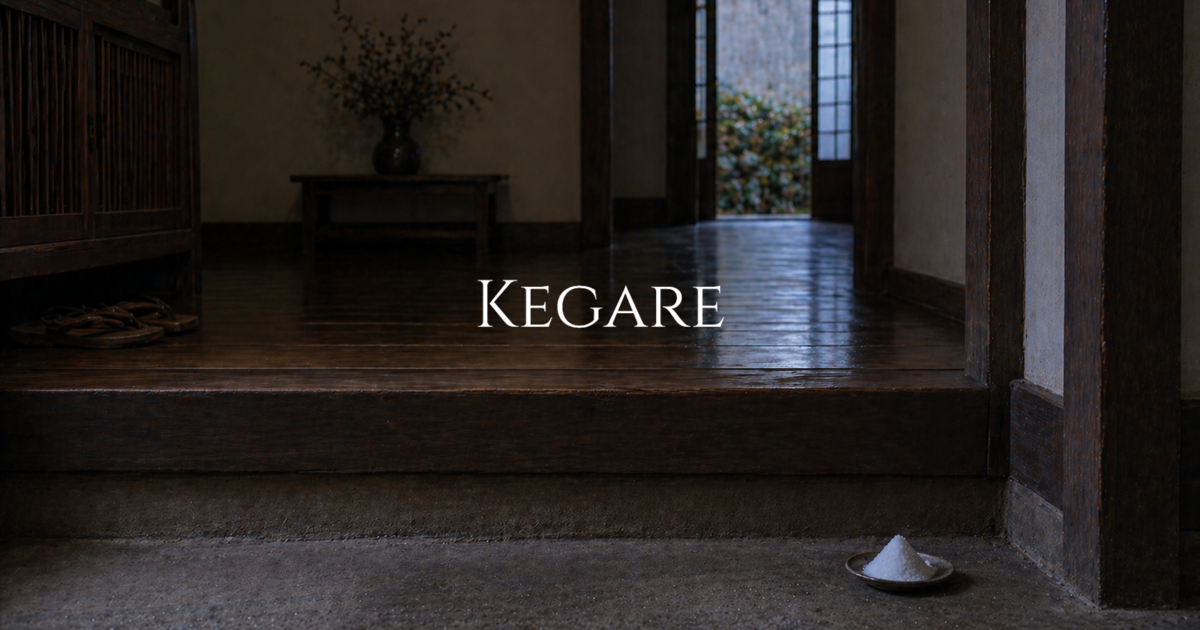
Kegare (穢れ) is not easily translated. “Impurity” comes closest, yet the word carries connotations of moral failure or dirtiness that the Japanese concept never intended. Kegare belongs to a different order of meaning — one concerned less with wrongdoing than with the recognition that certain moments in human life disturb the ordinary arrangement of things. Death, birth, illness, bodily exposure: these are not transgressions. They are thresholds, points at which the stability that ordinary social life depends upon becomes temporarily uncertain, requiring acknowledgment before it can be restored.
The concept operates quietly in contemporary Japan. Salt scattered at the entrance after a funeral, the brief pause at a shrine’s purification basin, the careful avoidance of certain words in hospital corridors — these gestures are rarely explained in religious terms today. They persist as etiquette, as habit, as something felt rather than articulated. What they preserve is the older awareness that some experiences cannot be folded immediately back into ordinary life, and that transition itself demands a form of care.
For more stories like this, explore our Sacred & Taboo collection.
Transition, Not Moral Failure
The first thing to understand about kegare is what it is not. It does not describe a person who has done something wrong. It does not attach permanent stigma to a body or a place. The condition it names is temporary by definition — a disturbance in the relational fabric of everyday life that can be acknowledged, managed, and ultimately released.
This distinction separates kegare from pollution concepts found in other cultural systems, where contamination can carry moral weight or even ontological permanence. Within the Japanese framework shaped by Shinto sensibility, the concern is structural rather than ethical. A mourner returning from a funeral is not morally compromised — but the encounter with death has altered something in the relationship between that person and the social world they are re-entering, and that alteration requires recognition. Similarly, a woman after childbirth is not diminished — but the exposure of bodily interior, the passage through pain and blood, marks a threshold that ordinary life does not routinely cross.
What matters is the idea of ke — ordinary daily vitality, the stable energy that sustains the rhythms of work, community, and domestic life. Kegare, in its older etymological reading, names the diminishment or disruption of that vitality. It is less a substance clinging to a person than a description of a state: something has shifted, some boundary has become uncertain, and the usual order of relationships no longer holds with quite its ordinary clarity. The path back requires not punishment, but passage — ritual acknowledgment that a threshold was crossed and that ordinary life is being deliberately resumed.
Why Did Blood and Death Become the Central Markers?
Among all the experiences associated with kegare, death and blood carry the heaviest symbolic weight, and this emphasis is not arbitrary. Both conditions share a structural logic: they expose what ordinarily remains bounded and contained, making visible what daily life depends upon remaining invisible.
Death presents the most extreme case. The body ceases to be a living presence — yet for a time it remains physically present, occupying space, requiring attention, demanding that those close to it remain in proximity to a condition that exceeds the ordinary categories of presence and absence. The bereaved household becomes a threshold space, situated between the world of the living and whatever lies beyond it. This is why contact with funerary spaces traditionally required a period of separation from ordinary activities, not as punishment, but as recognition that the boundaries of daily life had been temporarily suspended. The mourner needed to re-cross a threshold before ordinary social participation could meaningfully resume.
Blood carries a related logic. In childbirth and bodily injury, the interior of the body — which is normally sealed, protected, invisible — becomes exposed. The inside becomes outside. The contained becomes visible. This is not grotesque in the context of kegare; it is simply a recognition that such exposure unsettles the ordinary organization of the body as a bounded, self-contained unit. The blood of childbirth announces new life while simultaneously crossing a boundary that ordinary daily existence does not cross — which is precisely why birth, like death, could place a household in a condition of temporary ritual restriction.
These associations did not emerge from disgust or fear of nature. They emerged from a system of thought that treated distinctions — between inside and outside, living and dead, ordinary and threshold conditions — as the very structure through which human community maintains its coherence. When those distinctions become uncertain, even naturally and unavoidably, some form of acknowledgment is required before the structure can stabilize again.
Spatial Grammar at the Threshold of Everyday Life
Kegare does not reside only in the body or in personal experience. It organizes space — and understanding this spatial dimension reveals how thoroughly the concept has shaped the architecture of Japanese everyday life, from domestic routines to the layout of ritual sites.
Thresholds are the key unit. The entrance to a home marks the transition from public exterior space — where exposure, movement, and contact with unknown conditions cannot be controlled — to the interior domestic sphere, which requires protection. Removing shoes before crossing this threshold is often explained as cleanliness, but its structure is also that of kegare management: the outside remains outside, and the interior is protected from whatever the outside carries. Purification basins at shrine entrances perform the same gesture on a grander scale, ritually marking the passage from ordinary secular territory into a space where proximity to the kami demands a different quality of presence.
Funerary customs make the spatial logic even more explicit. After a funeral, mourners commonly receive small packets of salt before departing — a gesture that marks the act of crossing back from a death-associated space into the domestic world. The salt does not neutralize grief, nor does it pretend that death has been erased. What it does is create a symbolic threshold, a deliberate act of crossing that allows the mourner to re-enter ordinary life with the awareness that a passage has taken place. The home, once re-entered through this frame, can reassume its ordinary character.
Hospitals have developed their own quiet vocabulary of kegare-adjacent avoidance. Room numbers associated with the words for death or suffering may be omitted from floor plans entirely. Gifts connected to cutting, termination, or numerical associations with mortality are avoided. Language shifts around suffering patients — certain verbs are replaced with others, and the ordinary lexicon of vigorous health gives way to a careful, attentive vocabulary of indirect approach. None of this is systematic doctrine. It is the persistence of a spatial and linguistic grammar that organizes vulnerability through symbolic care rather than direct confrontation.
How Does the Concept Persist Without Being Named?
Contemporary Japan does not widely discuss kegare as a formal religious category. The word itself may be unfamiliar to many people who nonetheless carry out practices organized by its logic every day. This is not contradiction — it is how deeply embedded cultural structures tend to operate, persisting as gesture and etiquette long after their explicit doctrinal framing has receded.
The modernization of institutional life has changed the contexts in which kegare is managed without eliminating the underlying sensitivity. Where village communities once held collective mourning rituals that organized the transition from death-space back to ordinary social life, contemporary Japan delegates this management largely to specialized institutions — funeral halls, hospitals, crematoria — that contain and regulate unstable states within professional frameworks. The structure of containment persists; only its social form has changed. Death is still separated from ordinary domestic space. Illness is still managed in designated zones. The mourner still crosses a threshold when returning home, even if salt is no longer always waiting at the door.
Popular media occasionally treats kegare as the source of curses or supernatural contamination — a misreading that flattens the concept into horror-genre logic. This is an effective simplification for fiction, but it inverts the original cultural reasoning. Kegare is not primarily about hostile force or supernatural danger. The condition it describes is one of imbalance and uncertainty, not malevolence. The fear that sometimes attaches to kegare in contemporary narrative is less about what kegare is than about what happens when its management is neglected — when transition goes unacknowledged, when the threshold crossing is skipped, when ordinary life resumes without recognition that something has changed.
This is why the pattern endures even when the vocabulary does not. A person who scatters salt without knowing the word kegare, or who hesitates before a certain hospital room number without being able to explain why, is nonetheless responding to a structure of perception that the concept names. The gesture precedes the explanation — and in many cases, the gesture survives the explanation entirely.
Conclusion
Kegare endures because the experiences it addresses are not historical. Death still interrupts ordinary life without warning. Illness still moves bodies across thresholds of vulnerability. Mourning still leaves people standing at the boundary between two states, uncertain how to resume. The concept does not pretend these conditions can be resolved simply or quickly. What it offers instead is a structure — a way of recognizing that certain moments alter the arrangement of things, and that the return to ordinary life is a passage that must be made deliberately, not assumed.
This is the quiet durability of the concept: not that it prohibits or condemns, but that it acknowledges. The threshold must be marked. The crossing must be made with awareness. Some experiences cannot be folded immediately back into the texture of daily life — and kegare names this not as a warning, but as a form of cultural honesty about what human life actually contains.
Related Articles
- Mount Osore — A volcanic landscape in Aomori where geography and ritual converge: the mountain’s sulfurous terrain, its associations with the realm of the dead, and the itako mediums who work there make it one of the most physically legible sites of boundary-crossing in Japan.
- Hadaka Matsuri — A purification festival in which collective exposure and ritual movement suspend ordinary social hierarchy, making the body itself the instrument through which symbolic cleansing is performed.
- Death and Avoidance in Japan — A study of how mourning practices, linguistic substitution, and spatial etiquette organize the relationship between the living and the culturally sensitive terrain of death.
Sources and Further Reading
The following works provide cultural and academic grounding for understanding ritual purity, symbolic boundaries, and religious practice in Japan. Preference is given to scholarly sources with verifiable bibliographic records.
- Ono, Sokyō. Shinto: The Kami Way. Tuttle Publishing, 1962.
- Blacker, Carmen. The Catalpa Bow: A Study of Shamanistic Practices in Japan. Routledge, 1999.
- Douglas, Mary. Purity and Danger: An Analysis of Concepts of Pollution and Taboo. Routledge, 1966.
- Hardacre, Helen. Shinto: A History. Oxford University Press, 2017.
- Reader, Ian, and George J. Tanabe Jr. Practically Religious: Worldly Benefits and the Common Religion of Japan. University of Hawai’i Press, 1998.
Author’s Note
I held my dog as she left, wanting her to go from my arms rather than from somewhere I could not reach. When an earlier dog died, I later found myself standing in the garden on New Year’s Day, thinking of her, when the lead she had used slipped from where it hung on the wall and fell to the ground.
I did not perform any ritual afterward. I did not need to. The boundary had already been marked — not by salt or ceremony, but by the fall of a leash and the sudden sense that something had crossed over, leaving a trace behind.