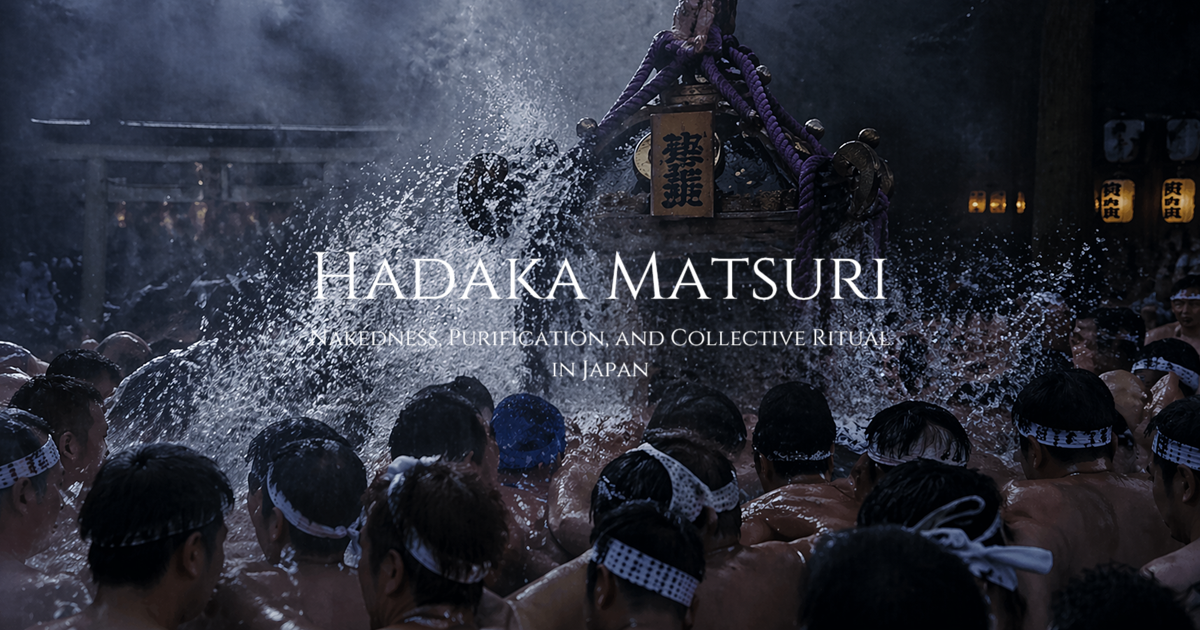
Hadaka Matsuri is most often introduced through a single image: winter air, exposed skin, thousands of bodies pressing against one another in the dark. That image is not false, but it is incomplete. What takes place within Hadaka Matsuri is not primarily about the body’s visibility — it is about what the body becomes when ordinary protective layers are stripped away and pressed into collective motion. The festival does not place participants on display. It places them inside a condition shaped by cold, contact, fatigue, and the particular intensity of movement that only a crowd of shared purpose can generate. The meaning lies not in what observers see from outside the crowd, but in what participants experience from within it.
For more stories like this, explore our Strange Festivals & Rituals collection.
Why Exposure Becomes Ritual Purification
Hadaka Matsuri belongs to a group of winter festivals organized around purification through bodily exposure and collective participation. The phrase is commonly translated as “naked festival,” though this translation flattens what is structurally a more precise condition. Participants are not naked in the sense of unguarded or unregulated. They wear fundoshi loincloths or comparably reduced garments — enough to mark the ritual boundary, not enough to insulate the body from its surroundings. The reduction is deliberate and categorical: clothing is removed not as an act of liberation but as a form of ritual preparation, a step that places the body in a state capable of entering what follows.
What follows is compression. Participants move into tightly bounded spaces — temple courtyards, narrow corridors, shrine precincts — where physical distance collapses and individual motion becomes partially subordinate to the motion of the crowd itself. Bodily contact, which ordinary social life in Japan carefully regulates through spatial convention and behavioral restraint, becomes unavoidable and, within the ritual framework, expected. The crowd does not merely surround the individual; it absorbs them. Movement becomes communal rather than personal, and the sensation of that transition — from self-directed body to body-within-a-body — is one of the ritual’s central experiences.
This is not disorder. Hadaka Matsuri operates through a framework shaped by years of communal repetition, established spatial sequences, and expectations that participants inherit before they enter the crowd. What external observers often interpret as chaos is, from the inside, a highly regulated intensity — one in which pressure and restraint operate simultaneously, neither fully canceling the other out.
Kegare, Exposure, and the Physical Logic of Purification
Hadaka Matsuri developed within a wider framework of purification practice that has shaped Japanese religious life across centuries. Central to that framework is the concept of kegare — a condition of ritual impurity associated not with moral failure but with disruption, exhaustion, contact with death, illness, or any state in which the normal balance of a person or community has been disturbed. Purification rituals, including Hadaka Matsuri, function as processes of restoration: mechanisms through which accumulated imbalance is acknowledged and redistributed.
What distinguishes the logic of Hadaka Matsuri within this broader purification culture is its insistence on the body as the primary medium. Many purification practices involve separation — withdrawal from ordinary life, periods of fasting, ritual abstinence, spatial removal from the contaminated condition. Hadaka Matsuri moves in the opposite direction. Rather than retreating from discomfort, participants enter it directly. The cold is not avoided. The compression is not minimized. The exhaustion is not treated as a side effect of ritual but as one of its functional mechanisms. Imbalance is not symbolically acknowledged; it is physically worked through.
This places Hadaka Matsuri within a longer tradition of ascetic practice in Japanese religious culture — one in which bodily hardship does not interrupt spiritual process but constitutes it. Cold-water ablutions, endurance practices associated with mountain training, physical exertion within shrine contexts: these share with Hadaka Matsuri the underlying premise that the body’s engagement with difficulty is not a preparation for purification but a form of purification itself. The ritual creates conditions in which kegare can be discharged through sustained collective endurance rather than symbolic gesture.
Winter is not incidental to this structure. The cold months intensify the relationship between exposure and purification in ways that a warmer season could not. Discomfort that might otherwise be managed or rationalized becomes undeniable. Participants cannot partially enter the condition the ritual requires — they are either in it or they are not.
Collective Compression and the Temporary Loss of Boundary
Every Hadaka Matsuri reconstitutes, for a limited and bounded time, a particular relationship between the individual body and the communal body — one in which the boundary between them becomes unstable.
In ordinary social life, the body functions as a frontier. Clothing, movement, spatial positioning, and behavioral convention all cooperate to maintain a regulated distance between people — a distance that signals, simultaneously, individuality and social legibility. Hadaka Matsuri systematically dismantles those signals. The fundoshi erases the visual codes of profession, rank, and personal history that clothing ordinarily encodes. The crowd eliminates the spatial buffer that daily life preserves. Contact between strangers’ bodies — chest to back, shoulder to shoulder, skin to skin — becomes structurally unavoidable rather than socially transgressive.
The result is not anonymity in the modern, alienated sense. It is something older: a temporary absorption of the individual into a shared bodily condition. Participants move together, endure together, and are pressed together into a unity that the body registers before the mind can frame it. Purification, within this structure, is not something one receives or observes. It is something one undergoes as part of a mass — something that happens to the crowd as a whole and is distributed across every body within it.
That distribution is the point. Hadaka Matsuri does not select individuals for purification or rank participants by their degree of exposure. Everyone within the crowd enters the same condition, endures the same pressure, absorbs the same cold. The ritual proposes, through its physical structure, that purification is a collective rather than individual achievement — that balance is restored not to isolated persons but to communities, and that the community must therefore assemble its bodies in one place and experience the restoration together.
Ritual Space, Architecture, and the Movement of Bodies
One of the most widely recognized forms of Hadaka Matsuri takes place at Saidaiji Kannon-in Temple in Okayama Prefecture, where thousands of participants gather in the hours after midnight — a timing that is itself a ritual condition, removing the event from ordinary daylight and placing it at the threshold between the ending year and the one beginning. What makes the Saidaiji form instructive is not simply the scale of its crowd but the architectural precision with which the temple grounds produce the conditions the ritual requires. The compound’s narrow passages and bounded courtyards do not merely contain the crowd; they determine its behavior — compressing movement, preventing lateral dispersal, and channeling bodies into densities that the participants themselves could not sustain in open space. The layout is not incidental to the ritual. It is one of its primary mechanisms.
The release of shingi — sacred wooden sticks — into this already-compressed space initiates a focal convergence, but the convergence itself is less the product of individual decision than of the spatial logic the temple has already imposed. Participants move not because they have chosen a direction but because the architecture has narrowed the options available to them. The crowd forms as a structural consequence of the grounds, and the sacred object — functioning less as a prize than as a point of maximum pressure — intensifies a compression that the buildings have been quietly engineering since the participants entered the gate.
Many Hadaka Matsuri festivals begin with cold-water purification before the central gathering, marking the passage from ordinary social space into ritual space. This preparatory stage is not ceremonial formality. It establishes the body’s awareness of itself — through cold, through discomfort, through deliberate exposure — before the crowd absorbs that awareness into something collective. The individual body enters the architectural field of the temple already stripped of ordinary insulation, already attuned to the conditions that the spatial structure will then intensify. Different regional forms distribute these elements differently — some centering the sacred object, others the procession, others the cold-water endurance itself — but the underlying logic persists: enclosed space and compressed bodies cooperate to produce an experience that neither element could generate alone.
Contemporary Participation and the Problem of Spectacle
The difficulty that media coverage consistently encounters with Hadaka Matsuri is not a failure of accuracy but a failure of register. Exposed bodies, winter cold, crowd density — these elements are real, and they photograph well. What they cannot communicate is the relationship between physical exposure and the ritual logic that gives exposure its function. A body pressed into a crowd of thousands is doing something that a body photographed in a crowd is not — and the gap between those two states is precisely what Hadaka Matsuri is about. Media coverage of the festival tends to operate entirely within the second register while believing itself to be representing the first. The result is not misrepresentation in the ordinary sense; it is a faithful account of the wrong thing.
What this framing displaces is the obligatory structure that makes the festival work as a communal mechanism rather than a spectacle. For the communities that sustain Hadaka Matsuri, participation is not an individual act of cultural enthusiasm — it is a claim made on the participant by family, neighborhood, and generational continuity. The person who enters the crowd is not choosing an experience; they are fulfilling a position within a communal structure that precedes them and will outlast their participation in any given year. That obligatory character is precisely what the festival’s internal logic requires: purification distributed across a community cannot be achieved by individuals who have opted in for personal reasons. It requires bodies that belong, in some durable sense, to the crowd.
The modifications that some festivals have introduced in recent years — adjusted participation requirements, accommodation of spectators, safety protocols responsive to changing demographics — represent a genuine structural pressure on this logic. The question is not whether the outward forms can adapt, but whether the obligatory character of participation can survive its transformation into something closer to voluntary attendance. A ritual whose internal mechanism depends on the participant’s prior belonging to the community does not function identically when the crowd includes people who arrived by choice. That substitution may be imperceptible from outside the crowd. From within the logic of the ritual, it is the difference that matters most.
Conclusion
Hadaka Matsuri does not ask participants to contemplate purification. It places them inside a physical process that enacts it — through cold that cannot be moderated, through contact that cannot be refused, through exhaustion that accumulates across the body without exception. The individual enters a crowd and is, for a bounded period, partially dissolved into it: not erased, but redistributed. What returns at the end of the ritual is a body that has undergone something alongside other bodies, and a community that has restored its collective balance through the shared endurance of that process.
The festival’s persistence is not simply a matter of cultural conservation — a form preserved because it has always been there. Hadaka Matsuri endures because the logic it embodies continues to address something that other forms of purification, conducted in private or in symbolic registers, do not: the need for balance to be restored collectively, through bodies assembled together, in conditions that would not be sought by any individual left to their own comfort.
Purification through proximity is a different proposition than purification through withdrawal. Hadaka Matsuri makes that difference physical, seasonal, and impossible to observe from a distance without missing its meaning.
Related Articles
- Kanamara Matsuri — A festival where fertility symbolism and social taboo are transformed into public ritual through display, humor, and symbolic inversion — organized around visibility and transgression rather than physical compression and endurance.
- Naki Sumo — A ritual in which the crying of infants becomes a structured expression of vitality and communal protection, transmitting collective hopes for healthy growth through sound rather than collective bodily movement.
- Onbashira Festival — A ritual centered on shared danger and coordination, in which controlled physical risk reinforces communal obligation and collective identity through cooperation across steep terrain rather than through bodily compression.
Sources and Further Reading
The following sources provide anthropological and religious-studies perspectives on purification practice, communal ritual, and embodied religious experience within Japanese cultural traditions.
- Earhart, H. Byron. Japanese Religions: Unity and Diversity. Wadsworth Publishing, 2004.
- Kasulis, Thomas P. Shinto: The Way Home. University of Hawai’i Press, 2004.
- Reader, Ian. Religion in Contemporary Japan. University of Hawai’i Press, 1991.
- Reader, Ian, and George J. Tanabe Jr. Practically Religious: Worldly Benefits and the Common Religion of Japan. University of Hawai’i Press, 1998.
Author’s Note
What I remember from the news footage is the expressions — faces caught in a state that had no clear name from the outside. But I have been inside a version of that state once, and it was not at a festival. It was December 1990, at Nakayama Racecourse, in a crowd of 177,779 people watching Oguri Cap run his last race. When he came through in the final straight, something happened that I have not found the right word for since: not noise exactly, not movement, but a single eruption in which 177,779 bodies became one thing for a moment — heat and sound and forward motion fusing into a force that felt less like emotion than physics. I was part of it. I did not decide to be.