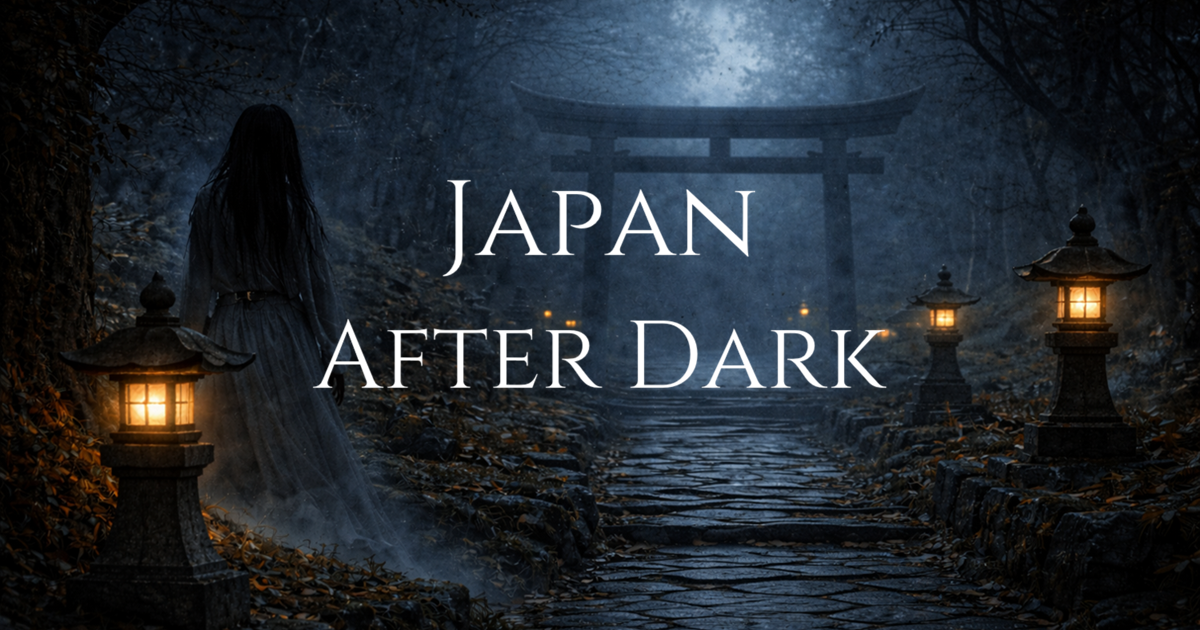
There is a version of Japan that is well documented — its architecture, its aesthetics, its carefully preserved traditions. This site is not about that version.
Japan After Dark examines the stories that run beneath the surface: the ghost beliefs that shaped how communities process grief, the supernatural figures that encode moral logic centuries old, the urban legends that reveal what modern Japan cannot say plainly, the haunted places whose reputations grew from events no one wanted to remember but no one could forget.
These narratives are not curiosities. They are evidence. Of how a society thinks about death, guilt, the unknown, and the space between what happened and what can be spoken aloud.
The subject here is never the supernatural itself. It is always the people — and what the stories they tell reveal about them.
Main Themes
Yokai & Supernatural Folklore
Yokai do not fit neatly into any single category. Some are animal spirits that have lived long enough to change shape. Some are objects — a worn sandal, an old umbrella — that have accumulated enough time to develop will. Some are disturbances in landscape: a river that takes people, a mountain that does not want to be crossed.
What connects them is not appearance but function. Yokai mark the places where human understanding runs out — where nature becomes unpredictable, where behavior crosses a line, where something happened that a community needed to name without fully explaining. They have been doing this for over a thousand years.
Explore Yokai & Supernatural Folklore
Folklore & Ghost Culture
In Japan, ghosts are not figures of horror. They are figures of attachment — spirits who remain because something was left unresolved: a death that came too soon, a grief that was never acknowledged, a betrayal that no one answered for. The horror, when it exists, is incidental. The weight is emotional.
This distinction has shaped Japanese ghost stories for centuries — from the kaidan collections of the Edo period to the visual grammar of yūrei that continues to appear in contemporary film and fiction. The tradition endures not because Japan is preoccupied with death, but because these stories offer a way to speak about loss that ordinary language does not easily allow.
Explore Folklore & Ghost Culture
Urban Legends in Japan
Every generation produces its own folklore. In modern Japan, urban legends move through schools, workplaces, and online spaces with the same structural logic as stories told centuries earlier — a specific location, an unnamed figure, an encounter that follows rules the listener somehow already knows.
The content changes. The architecture does not. And the anxieties encoded in these stories — about institutional spaces, about visibility, about what happens in the moments no one witnesses — are worth examining carefully. They reveal something about contemporary Japan that more direct forms of expression tend to leave unsaid.
Explore Urban Legends in Japan
Haunted Places in Japan
A location does not become haunted by accident. The reputation develops over time — through historical events that left something unresolved, through local memory that needed a form, through stories that changed slightly each time they were passed on until the place itself became inseparable from what people believed happened there.
This section is less interested in whether those beliefs are justified than in what produced them. The history behind the reputation. The distance between what occurred and what is now remembered. That gap is usually where the most interesting material lives.
Explore Haunted Places in Japan
Strange Festivals & Rituals
Japan holds thousands of local festivals, many preserving ritual forms that outside observers find difficult to place — not quite religious ceremony, not quite performance, occupying some older category that modern frameworks do not easily accommodate.
The strangeness, for those encountering these traditions without context, is real. But strangeness is a starting point, not a conclusion. Behind the masks, the fire, the processions, the offerings, lie belief systems that are internally coherent and historically traceable. This section examines what those systems are, and how the rituals came to take the forms they did.
Explore Strange Festivals & Rituals
Sacred & Taboo
Japanese culture draws a clear line between the pure and the polluted — not as metaphor, but as a practical framework that has governed how people relate to death, illness, misfortune, and sacred space for centuries. The categories are rooted in Shinto and Buddhist thought, but their influence extends well beyond formal religious practice into the rhythms of everyday life.
What makes this system worth examining is its internal logic. The boundaries are not arbitrary. They reflect a coherent way of thinking about contamination, restoration, and the conditions under which ordinary life can continue after contact with something that disrupts it. Understanding that logic changes how a great deal of Japanese behavior — in ritual, in architecture, in social custom — becomes legible.
Explore Sacred & Taboo
Featured Stories
Japanese narrative tradition does not separate the frightening from the meaningful. A story can function as warning, memorial, and cultural inheritance simultaneously — often without distinguishing between them.
The articles below are entry points. Each introduces a theme explored in depth elsewhere on this site. They are best read not as isolated pieces but as openings into a larger conversation about what Japanese storytelling has always been doing beneath the surface.
What Are Yokai? Understanding Japan’s Supernatural Folklore
Why Ghost Stories Became Popular in Japan
The Origins of Japan’s Urban Legends
How Haunted Places Become Cultural Memory
Strange Festivals That Surprise Visitors to Japan
About Japan After Dark
Japan After Dark is a cultural analysis site, not a horror site. The stories discussed here — ghosts, supernatural figures, urban legends, unusual rituals — are treated as cultural artifacts: evidence of how a society thinks, not proof of what exists.
Folklore encodes belief. Ghost stories carry grief that has no other form. Urban legends articulate anxieties that more direct expression cannot reach. Each tradition examined on this site has a history, a function, and a logic. The goal is to make that logic visible.
To learn more about the editorial approach behind this project, visit the About Japan After Dark page.
Explore the Darker Side of Japan
Every culture preserves stories about what resists explanation. Japan’s tradition is unusually rich in this regard — not because the country is more mysterious than others, but because it has developed particularly precise ways of giving form to uncertainty.
Some of these stories are centuries old. Others emerged last decade, traveling through social media in patterns that earlier storytellers would have recognized immediately. What connects them across time is not subject matter but function: they allow communities to think through things that direct language cannot easily hold.
Taking these narratives seriously does not mean taking them literally. It means recognizing that a story people have told for generations — about a place, a figure, an encounter — is never only a story. It is a record of something a society needed to say.
Readers looking for sensationalism will not find it here. Readers looking for understanding might.