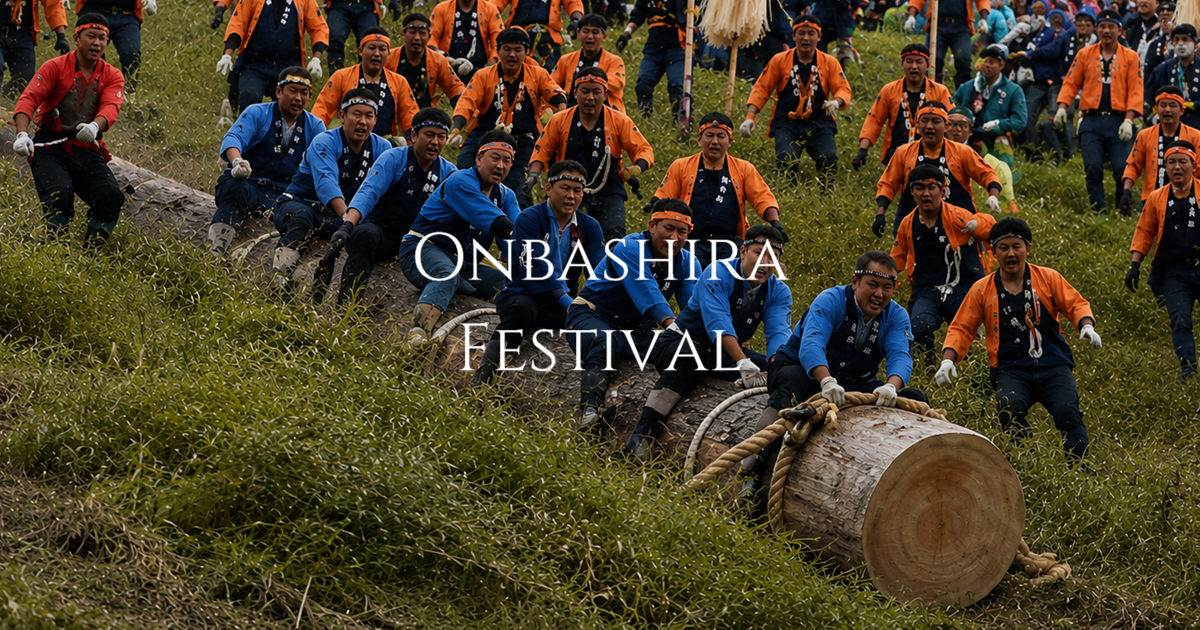
In the Suwa region of Nagano Prefecture, communities draw massive fir logs from mountain forests, move them across difficult terrain, and raise them beside shrine buildings through labor that no single household could complete alone. The Onbashira Festival is often reduced to its most visibly dangerous moment, but that moment does not explain why the ritual exists. Its structure lies elsewhere — in the repeated remaking of sacred boundaries, and in the obligations that tie participants to one another, to the land the logs pass through, and to the generations who once did the same work.
Continuity here is not assumed. It is rebuilt, cycle after cycle, through effort that no individual can supply on their own.
For more stories like this, explore our Strange Festivals & Rituals collection.
Danger, Discipline, and the Logic of Onbashira
The Onbashira Festival is the recurring ritual cycle of Suwa Taisha, centered on the selection, transport, and raising of massive wooden pillars at the shrine’s principal sites. It is not a single dangerous event but a sustained regional undertaking, and this distinction matters: the festival persists not because it produces striking footage, but because it periodically renews the boundaries and relationships that define the shrine’s sacred territory.
The cycle is held in years designated by the traditional zodiac calendar, commonly described as once every six years. The name joins the honorific prefix on with hashira, meaning pillar. These pillars stand at the corners of the shrine complexes, marking sacred space rather than serving as ordinary architectural supports.
Long before the descending logs reach public attention, suitable trees are chosen in the mountains, felled, and prepared for the journey from forest into settled and sacred ground. Moving them calls for ropes, coordinated pulling, signals passed down through practice, and the organization of groups drawn from separate local districts.
Two broad stages structure the public cycle. Yamadashi brings the logs down from the mountains, and includes Kiotoshi, in which the trunks descend steep slopes while participants attempt to stay on or near them. Satobiki follows, drawing the pillars through settled areas toward the shrine precincts before they are raised.
Kiotoshi dominates public perception because its danger requires no explanation — a trunk gathering speed on a slope reads as spectacle on its own terms. The rest of the ritual depends on slower, less photographed work: hauling, waiting, adjusting ropes, and filling roles shaped by earlier cycles of participation.
The physical logic is not one of uncontrolled chaos. Instability is present, but it operates inside a system of preparation, hierarchy, and inherited knowledge. The possibility of losing control is what gives the labor of maintaining it its weight.
From Mountain Forest to Sacred Boundary
The logs are not neutral material waiting to be used. They come from a mountain landscape long tied to the religious life of the Suwa region, and their movement joins forest, road, village, and shrine precinct into a single ritual passage.
This matters because sacred space here is not separated from its surrounding environment. The shrine depends on a wider territory from which its pillars must repeatedly be drawn — the forest is not simply a timber source, and the route between forest and shrine becomes part of the ritual itself rather than a means of reaching it.
The trees change status as they move. In the mountains they belong to a landscape shaped by both practical use and sacred association. Once cut and set in motion, they become the focus of concentrated communal effort, and their size keeps them from becoming easy objects of control even after they leave the ground.
A smaller object could be moved efficiently, but efficiency would remove the need for collective dependence. The weight of the trunks forces participants to rely on ropes, timing, terrain, and each other’s responses — material difficulty makes social coordination visible in a way that ease would not.
When the pillars are finally raised, they mark the corners of the shrine sites. A corner is not the center of worship, but it sets the limits within which a space can be recognized. The pillars establish sacred territory without enclosing it.
Their vertical position also reverses the horizontal journey that preceded it. A tree grows upright, is felled, crosses the land, and is raised again in altered form — renewal here does not restore the original state but depends on transformation. The pillar carries the mountain into the shrine, and even at its most still, its presence already contains the knowledge that another tree will one day follow the same route.
Risk as a Form of Collective Commitment
Danger in the Onbashira Festival cannot be separated from the conditions under which it is performed. The logs are heavy, the slopes are steep, and the movement of a crowd around a shifting trunk resists full prediction. Injuries and deaths have occurred in past cycles, so the risk involved cannot be treated as purely symbolic.
To describe the event only as reckless, though, misses the structure surrounding that danger. Participants do not meet risk as isolated individuals. They enter an inherited system of roles, local affiliations, and practical knowledge, and it is this structure — prepared for, witnessed, remembered — that gives the risk its communal meaning.
Contemporary life generally works to reduce physical uncertainty through engineering, regulation, and distance from hazardous processes. Onbashira does not reject those values outright, but it preserves a setting where bodily exposure still carries social weight. Pulling, balancing, restraining, and responding to sudden shifts produce forms of knowledge that resist being fully explained in words.
No one masters the log alone. Its weight makes individual control impossible, and its motion can exceed even coordinated intention — personal courage is placed inside collective dependence rather than standing apart from it. A rider may become the visible center of a photograph, but the event proceeds through the labor of far less dramatic participants.
This distinction is easy to lose in short video clips. The person on the trunk appears to embody the festival, while the pulling teams, route preparation, and accumulated experience surrounding the descent recede from view. The image favors individual daring; the ritual itself depends on collective structure.
Risk also makes commitment concrete. Belonging cannot remain an abstract claim when it demands time, bodily effort, and responsibility toward others — exhaustion and uncertainty are not interruptions to the ritual’s meaning but part of how that meaning is experienced.
None of this makes danger sacred on its own terms, and the possibility of harm does not justify every inherited practice by default. Its ritual role is more specific: physical difficulty gives visible form to obligations that might otherwise stay unspoken, and participants must trust established methods while responding to circumstances no tradition can fully predict.
Danger becomes part of communal identity not as a celebration of injury but as a condition felt directly in the body — in strained arms, shifting footing, the sudden need to trust a stranger’s grip. The log moves only when many people act together, and its instability makes the limits of individual autonomy impossible to overlook.
Inherited Labor and the Making of Community
The Onbashira Festival reorganizes the Suwa region well before the pillars enter public view. Local districts assemble teams, assign responsibilities, preserve chants and signals, and coordinate participation across institutions and generations. The ritual is not layered onto ordinary community life from outside — for a time, it becomes one of the structures through which that life is organized.
This gives the festival a social function beyond ceremony. Residence alone does not hold a community together; it requires occasions in which membership is enacted, recognized, and passed on. Onbashira supplies such an occasion at unusual scale.
The interval between cycles strengthens this process. Participants return older, while others take part for the first time. Children who once watched may later pull ropes or take on organizational roles, and those who carried authority in one cycle may step back in the next, handing practical knowledge to people who previously stood at the margins.
Continuity, then, does not mean the same individuals repeating the same actions indefinitely. The ritual survives because responsibility moves between generations — what is inherited is not only belief, but a practical arrangement of bodies, roles, routes, and remembered decisions.
Shared labor also produces a kind of memory distinct from official commemoration. A participant may recall where a rope tightened, how a group responded when the log shifted, or whose voice carried above the crowd. These memories attach to physical locations and relationships rather than settling into a single authorized account.
Local identity, through this process, is experienced as action rather than declared as an abstract attachment to place. Mountain route, roadside settlements, and shrine grounds connect through the movement of the pillars, and residents encounter the region less as a map than as a sequence of difficult passages made legible through cooperation.
Participation is not necessarily equal, and inherited rituals can preserve hierarchy as readily as solidarity. Questions of authority, visibility, and access do not disappear simply because the labor is shared. Yet the task still requires coordination across difference — the log does not erase distinction, but it creates a problem no household, district, or individual can solve alone.
Community takes shape here through obligation: people become part of the same ritual body because they are responsible for moving something larger than any one of them.
Renewal Without Permanence
Many forms of preservation try to protect an object from alteration. The Onbashira Festival follows a different logic — its pillars matter not because they remain unchanged, but because they belong to a cycle of removal and replacement.
Continuity is maintained through change rather than against it. A sacred boundary can endure precisely because its material markers do not; each replacement acknowledges deterioration while keeping deterioration from becoming abandonment.
Repetition does not simply reproduce an earlier act — it restores a relationship by making it present again. The mountain must once more provide the trees, communities must once more organize their labor, the route must once more be crossed, and the pillars must once more be raised.
Each cycle resembles those before it without duplicating them exactly. The landscape changes, safety practices develop, local populations age, and forms of participation shift. Continuity depends on preserving the ritual’s structure while allowing its performance to respond to altered conditions.
That balance has grown harder as regional communities face depopulation, changing work patterns, and weaker expectations of inherited participation. A festival that requires large numbers of people cannot remain untouched by demographic change or by younger generations moving toward urban areas — and because the cycle returns only once every six years, the transmission of practical skill and organizational role is never continuous but must be recovered, district by district, at each interval.
Contemporary safety standards add another pressure. The visible risks of Kiotoshi and the raising of the pillars draw scrutiny that earlier cycles did not face in the same way, and organizers must preserve a ritual whose meaning depends partly on physical difficulty while accepting responsibility for reducing preventable harm.
These negotiations are not external threats to an otherwise untouched tradition. They have become part of the work through which the tradition continues — rituals endure not by refusing all change, but by deciding which changes can be absorbed without dissolving the relationships that give the ritual its meaning.
Onbashira does not renew a fixed past. It renews the community’s responsibility to carry something forward under present conditions.
The Festival Beyond the Image of Danger
Television footage and online video have given the Onbashira Festival a public life well beyond the Suwa region. Short sequences of riders descending on a massive trunk communicate speed and physical intensity almost instantly, and this visibility has made the festival widely recognizable while narrowing the range of meanings through which outsiders understand it.
The dramatic footage is not false. Kiotoshi is a real part of the ritual, and its danger should not be softened into abstraction. But one highly visible phase can easily come to stand in for a much longer cycle.
Spectacle organizes itself around what can be seen from outside. Ritual organizes itself around obligations that may stay invisible to an observer — preparation meetings, district affiliations, the transfer of practical knowledge, and the slow movement of logs through familiar territory resist condensing into a single image, even though they explain why the festival continues.
Tourism and media attention also reshape the conditions under which the ritual is performed. Outside interest can strengthen regional pride and support preservation, but it can also pull attention toward whatever is most photographable. Onbashira exists simultaneously as local religious practice, regional heritage, and nationally circulated image, and these roles do not necessarily cancel one another out.
The tension surfaces when external visibility becomes the primary measure of value, reducing inherited obligation to a performance staged for spectators. That reduction remains incomplete, because much of the festival’s meaning depends on relationships that cannot be entered through observation alone — watching a log descend reveals the force involved, but not the years of memory gathered around a route, or the expectations carried by those holding the ropes.
Its persistence depends on returning danger to the wider structure of renewal, labor, and collective memory that makes it more than an isolated act of daring.
Conclusion
The pillars of Suwa Taisha appear to stand as fixed markers, yet everything that gives them meaning moves in a cycle. Trees are selected and felled, trunks travel through mountain and settlement, and communities assemble around work that must eventually be performed again.
Risk enters this cycle because renewal is never carried out at a distance. It passes through bodies exposed to weight, motion, fatigue, and the imperfect control of collective action — the festival makes communal identity tangible by placing each participant inside a force larger than individual intention.
When the pillars rise, the achievement is temporary by design. Their eventual replacement is not the failure of preservation but the return of obligation: sacred space, regional memory, and communal responsibility must once again be made present through shared effort.
Related Articles
- Hadaka Matsuri — Bodily exposure and crowd density place purification within a temporary ritual community, where vulnerability itself becomes the shared condition.
- Naki Sumo — Ritualized infant crying reframes vulnerability as a protective, vitalizing force rather than something to be shielded from view.
- Kanamara Matsuri — Fertility symbolism moves into public procession through humor, converting an intimate concern into open collective expression.
Sources and Further Reading
The following works examine Shinto ritual practice, shrine life, and the structure of Japanese festivals from historical and anthropological perspectives.
- Ashkenazi, Michael. Matsuri: Festivals of a Japanese Town. University of Hawai’i Press, 1993.
- Nelson, John K. A Year in the Life of a Shinto Shrine. University of Washington Press, 1996.
- Earhart, H. Byron. Japanese Religions: Unity and Diversity. Wadsworth Publishing, 2004.
- Kasulis, Thomas P. Shinto: The Way Home. University of Hawai’i Press, 2004.
Author’s Note
What I remember most is the sensation of the rope stiffening — many hands, sometimes hundreds, turning hemp fiber into something as unyielding as an iron bar. I first felt that weight in elementary school tug-of-war, and years later, a misplaced rhythm at my son’s sports day left a bruise on my chest that lasted for days. Onbashira is perilous on a different scale, but it shares the same core logic: the moment many bodies create a force that no single person can control alone — a force I first felt, in miniature, with a rope in my own hands.