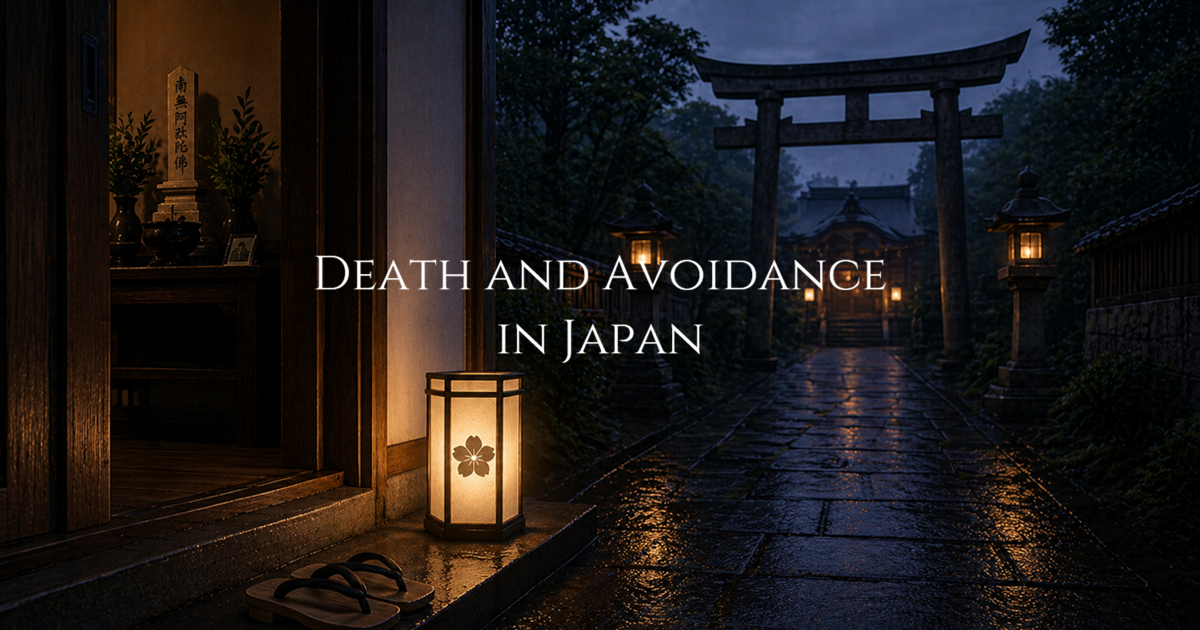
Death in Japan is rarely kept outside the rhythm of daily life. Household altars hold photographs and small offerings, graves receive visitors at fixed points in the year, and memorial services continue long after a funeral has closed. What is treated differently is death as an immediate subject — the moment it must be named, the word chosen to carry it, the setting allowed to receive it.
This indirectness is not a refusal to acknowledge mortality. It regulates how death enters a relationship: when it may be raised, how plainly it should be spoken, and which spaces are permitted to hold its disruption. Distance gives death a recognized position without letting it pass unmarked into every room occupied by the living.
For more stories like this, explore our Sacred & Taboo collection.
The Boundary Around Death in Japan
Death avoidance in Japan is not a broad discomfort with speech. It is a set of practices that govern how mortality is named, approached, and kept apart from ordinary social life — a narrower operation than chinmoku, the wider cultural use of silence to preserve ambiguity across many kinds of interaction. Where chinmoku manages what is left unsaid in general, this avoidance is organized around a single object: death itself, and the specific risk of introducing it into a setting unprepared to receive it.
The distinction carries weight because death is not simply pushed out of view. Memorial practice keeps the deceased present through household altars, incense, posthumous names, and annual observance. What is restricted is not remembrance but uncontrolled proximity — the risk that mortality arrives in a setting unequipped to receive it.
A recent death leaves a household in an unsettled interval. Plans shift, invitations go unanswered, and ordinary greetings can feel misplaced. The deceased has not yet settled into a stable memorial position, and the bereaved have not yet returned fully to daily time. Language, conduct, and ritual timing organize that interval: words grow more careful, funeral space is separated from domestic space, and mourning is given a recognizable duration rather than left as private feeling without social form.
Avoidance, in this sense, builds a boundary around death without erasing it — acknowledging mortality while limiting how far its disruption is allowed to spread through the ordinary relations of the living.
Softening the Verb: Naming Mortality Without Force
Japanese is not short of direct words for death, but directness is not equally welcome in every setting. The plain verb shinu can land abruptly when applied to a specific person, particularly where grief or social distance calls for restraint. Softer expressions do not change the fact being conveyed — they change how heavily that fact is set down in front of another person.
A person may be described as having nakunatta — a conventional equivalent of “passed away” — rather than simply as having died. Formal announcements may reach for seikyo suru; Buddhist framing may speak of departure, passage, or entry into another state. Each phrase places death at a slightly different emotional distance from the listener.
Nobody in this exchange is being kept from the truth. What shifts is the force with which the sentence lands. A direct statement puts finality at the center of attention; an indirect one lets the same meaning arrive without that pressure. This is why softened language does more than perform politeness — announcing a death is never a pure transfer of fact. The speaker weighs the listener’s relationship to the deceased, the timing of the news, and the room in which it will be heard.
The same caution can appear before death occurs. Physicians and families have at times hesitated to state a prognosis in blunt terms, wary of a directness that might read as removing hope. Contemporary medicine leans more toward explanation and informed decision-making, yet the pull between clinical clarity and relational care has not gone away.
Death enters language through sound as well as meaning. The number four, shi, shares a pronunciation with a reading of the character for death, and some hospitals, hotels, and apartment buildings skip room number four; certain numeric pairings are avoided in gifts or in institutional numbering. The habit is inconsistent and often shrugged off, but its persistence shows how an ordinary syllable can pull mortality into a setting meant to stay neutral. The concern is rarely that a number causes harm — its association alone is enough to feel unwelcome beside illness, residence, or celebration, and removing it becomes a small courtesy toward anyone who might notice.
Indirect language does not make death less real. It sets the distance from which reality is allowed to be spoken.
Funeral Timing and the Social Work of Distance
A death changes a household’s condition before it settles into memory, and funeral practice gives that change a sequence — one that both family and community can recognize. The wake, the funeral, cremation, the gathering of bones, memorial services, and later grave visits vary by region, family, Buddhist school, and personal choice, but their underlying function stays consistent: death is not treated as complete the moment life ends.
The sequence performs real work. Relatives must be told, the body cared for, ritual roles assigned, visitors received. It also lowers the ordinary social expectations placed on the bereaved, reorganizing time so the household is not required to behave as though nothing has changed. Later memorial observances continue this movement rather than repeating the funeral outright — each interval sets the deceased and the survivors into a slightly altered relation, letting immediate disruption harden gradually into established remembrance.
The mourning period known as mochū makes this altered condition visible from outside the household. A family in mourning may decline festive invitations, skip celebrations, or withhold New Year’s greetings, sometimes sending advance notice that seasonal messages will not be exchanged that year. What looks like an absence of communication is, in practice, carefully communicated: the household is spared from explaining its grief repeatedly, and others are spared from guessing how to approach without imposing the language of celebration.
This distance protects both sides. The mourner is released from certain obligations; the community is relieved of guesswork about which forms of contact are appropriate. Avoidance functions here as shared social structure, not unexplained personal withdrawal.
The same logic separates mourning from celebration more broadly. Weddings, shrine visits, and festive occasions belong to a different symbolic register than recent death, and keeping the two apart does not require believing that sorrow physically contaminates joy. It recognizes only that each condition depends on its own emotional order, and that ritual time exists partly to keep incompatible conditions from being forced into the same moment.
Kegare: Purification as Response to Disruption
Death-related avoidance is often discussed through kegare, usually translated as impurity or pollution — a translation that risks implying moral blame it does not carry. Death-related kegare does not mean the deceased was sinful, shameful, or unclean. The issue is disruption, not judgment.
Death unsettles the ordinary categories that hold bodies, spaces, households, and relationships in place. A person who was socially present becomes physically absent while remaining an object of active remembrance. A home stays the same physical place while its internal order has shifted. Practices of separation and purification do not resolve death or dissolve grief; they give the disturbance a recognizable form, marking that a transition has taken place and that ordinary life cannot simply resume without some acknowledgment of it.
This structure shows up in the religious division around death as well. Funerary practice in modern Japan is overwhelmingly Buddhist, while Shinto shrines generally do not serve as sites for handling the dead — a boundary not absolute across every period or community, but durable enough to express a lasting allocation of ritual roles. Buddhist institutions built extensive practices around funerals, posthumous names, and ancestral continuity, while Shinto ritual leaned toward purification, renewal, and relationships with kami. Death was not excluded from religious life; it was routed toward the institutions considered equipped to manage its passage.
Small domestic customs preserve the same logic at a much smaller scale. Salt is sometimes used after returning from a funeral, though the practice is neither universal nor uniformly accepted across Buddhist traditions, and it is generally understood as a gesture of purification before reentering the home. The act is brief, but its placement is exact — at a threshold, between funeral space and the resumed space of daily life. The salt matters less as a substance than as a marker of passage. Purification does not erase attachment to the deceased; it separates the condition created by death from the household’s return to its ordinary rhythm, and in that separation, avoidance appears not as denial but as a way of restoring a boundary that has been disturbed.
Relocating Dying: Hospitals and Funeral Halls
Modernization changed where death is actually encountered in Japan. Dying, bodily care, and mourning were once embedded more directly in domestic and neighborhood life, where family members were likelier to witness the physical process of death and take part in preparing the body for the funeral.
The growth of hospitals moved dying into medical institutions. Later, professional funeral companies and purpose-built funeral halls carried much of the wake and funeral away from the home altogether, a shift driven as much by urban housing and smaller households as by the rise of specialized services. These institutions did not invent death avoidance — they gave it a modern spatial form.
A hospital room separates dying from the domestic environment; medical routines govern access to the patient, communication with relatives, and the moment death is formally confirmed, so the passage from living patient to deceased person unfolds within an administrative structure as much as an emotional one. Funeral halls create a second controlled setting, bringing the body, altar, visitors, food, and professional assistance together in a space built specifically for temporary mourning. Once the rites end, the building resets for the next family rather than carrying visible traces of one death into the surrounding neighborhood.
The arrangement offers practical relief — families no longer need to transform limited living space or manage every ritual detail themselves — but the same convenience widens the distance from death’s material presence. Many people reach adulthood without ever sitting for long beside someone dying or helping prepare a body; death is handled carefully, but much of its physical weight passes to people whose profession is to manage it.
This is not concealment so much as a redistribution of labor: hospitals and funeral halls make death manageable under the conditions of modern urban life, offering procedures where extended family and neighborhood networks may no longer be positioned to do so. In exchange, they protect the continuity of ordinary space — the apartment, the office, the train platform proceed with little visible sign that death has occurred nearby, even as mortality remains present, its passage simply directed through specialized places.
When Death Avoidance Enters Ordinary Life
Managing death does not end with the funeral. It surfaces in decisions that look minor until placed side by side — how a room is numbered, whether a property’s history must be disclosed, which greetings go unsent, which gifts feel wrong beside illness or celebration.
Real estate offers one of the clearest examples. A property where a death occurred under circumstances considered psychologically significant may be treated as jiko bukken, a stigmatized property; disclosure obligations vary by circumstance and transaction type, and attitudes differ among buyers, tenants, and agents. The concern cannot be reduced to belief in ghosts. Knowledge of a death changes how a room is imagined — a future resident may know nothing about the deceased, yet the space no longer feels entirely neutral once attached to an event that cannot be seen but is not easily forgotten. Disclosure lets that distance be established before someone enters the property, and the market absorbs the rest through price, delay, or an intervening tenancy: an economic procedure standing in for a way of managing symbolic difference.
Gift-giving follows a related logic. Certain numbers, objects, or expressions are avoided when they carry associations with death, severance, or suffering — an item harmless in an ordinary exchange can feel wrong at a wedding or hospital visit. What is being regulated is not the object but the risk that death-related meaning enters a setting where it has no place.
Seasonal custom sharpens the picture further. A household in mourning may withhold New Year’s greetings while continuing to honor the deceased through incense, grave visits, and household offerings — restricting death in one channel while sustaining it in another. This selectivity sits at the center of the whole structure: the dead are welcomed during Obon, photographs stay visible in the home, anniversaries are observed for years. What is avoided is not continued relationship but the uncontrolled overlap of death with occasions governed by a different social meaning. Funerals, inheritance, caregiving, and solitary death are all discussed openly where practical or ritual responsibility calls for it — indirectness is strongest only where mortality would otherwise arrive unprepared, in a relationship, place, or occasion not arranged to receive it.
Why Indirectness Survives
Death resists ordinary conversation because it cannot be made socially neutral. A statement can be factually accurate and still land too abruptly, too publicly, or too close to someone whose relationship to the event has not been weighed.
Indirectness persists because it lets knowledge move without pretending that information is the only thing being exchanged. A softened phrase acknowledges the listener; a mourning notice protects a household from festive expectation; a funeral hall lends death a temporary space; a threshold gesture marks the movement back toward daily life. Each practice creates distance, but that distance is shaped by responsibility — asking not only what has happened, but who must hear it, when, and in what form the news can be carried.
The forms around death keep changing. Smaller households lean more on professional services, funerals grow shorter and more private, and memorial arrangements now stretch to communal graves, tree burials, and compact ossuaries; digital accounts and online memorial spaces extend remembrance into forms earlier ritual systems never anticipated. These shifts loosen some older obligations, but they do not remove the underlying need to position death somewhere — who should be told, where remembrance belongs, how long responsibility continues, what may return to ordinary life.
Avoidance endures because death alters relationships while leaving the living responsible for how that alteration is recognized. Direct speech cannot settle that responsibility on its own, and sometimes the most accurate sentence is not the most careful one — a distinction that continues to matter.
Conclusion
Death in Japan is neither hidden away nor folded indiscriminately into everyday life. It is given particular words, spaces, intervals, and forms of conduct — boundaries that let remembrance continue while the disruption surrounding death is contained by degrees, and that protect the living from confronting mortality without regard for timing, relationship, or setting.
Distance can look like a way of pushing death aside. More often it is what allows death to keep its weight. By declining to make mortality ordinary in every context, this structure gives it a position from which separation and continued presence can both be sustained.
Related Articles
- Kegare — Treats impurity as a condition of disruption rather than moral failing, showing why death-related boundaries are handled through purification instead of judgment.
- Sacred and Forbidden — Maps restrictions on spaces, acts, and conditions, defining where ordinary access is required to stop.
- Mount Osore — Locates contact with the dead within a specific sacred landscape, where geography and pilgrimage give separation a physical, walkable form.
Sources and Further Reading
These works ground the discussion of Japanese funerary practice, ancestral continuity, religious boundary-keeping, and the social organization of death.
- Suzuki, Hikaru. The Price of Death: The Funeral Industry in Contemporary Japan. Stanford University Press, 2000.
- Smith, Robert J. Ancestor Worship in Contemporary Japan. Stanford University Press, 1974.
- Stone, Jacqueline I. Right Thoughts at the Last Moment: Buddhism and Deathbed Practices in Early Medieval Japan. University of Hawai’i Press, 2016.
- Douglas, Mary. Purity and Danger: An Analysis of Concepts of Pollution and Taboo. Routledge, 1966.
- Reader, Ian, and George J. Tanabe Jr. Practically Religious: Worldly Benefits and the Common Religion of Japan. University of Hawai’i Press, 1998.
Author’s Note
I was eight when my grandfather died, and somewhere in that blur of a first encounter with death, I remember being taught — probably by one of my parents — to say nakunaru instead of shinu. No one explained why the softer word mattered; it was simply handed to me as the correct way to speak, and I used it without question well into adulthood.