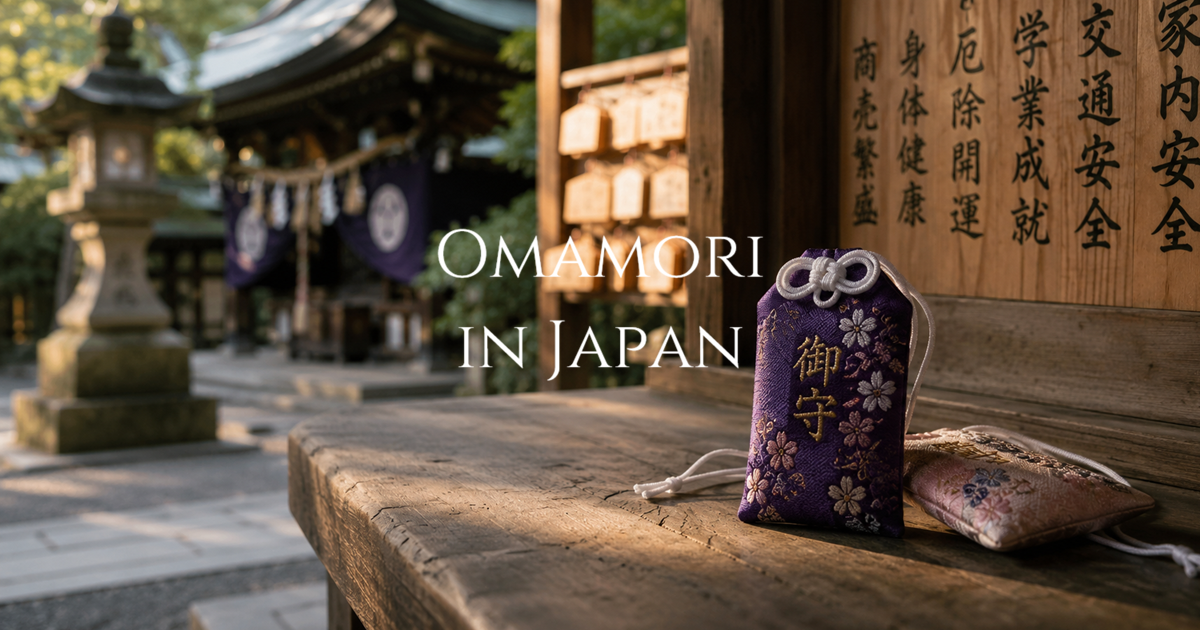
Small fabric charms appear throughout everyday Japan — attached to bags, placed inside cars, tucked into wallets, or hanging beside office desks. Known as omamori, these objects are commonly associated with protection, safety, and good fortune. Their presence is so familiar that they often fade into the background of ordinary life.
Yet omamori are not simply lucky charms in the casual sense. They belong to a wider cultural structure shaped by ideas of ritual care, purity, uncertainty, and appropriate distance from misfortune. Rather than removing instability from life, they create a symbolic framework through which vulnerability can be acknowledged and carried.
Unlike large public rituals, omamori operate quietly. They move with the individual through daily routines while maintaining a subtle connection to shrines, temples, and sacred space. Their significance lies less in dramatic belief than in repetition, proximity, and inherited custom.
For more stories like this, explore our Sacred & Taboo collection.
What Is Omamori?
Omamori are small protective amulets distributed at Japanese shrines and Buddhist temples. The term derives from the verb mamoru, meaning “to protect,” and the objects are generally associated with safety, purification, success, or stability in specific areas of life.
Most omamori take the form of fabric pouches containing prayers, inscriptions, or sacred materials sealed inside. The contents are traditionally concealed from view, and opening the pouch is often discouraged. Their authority comes not from visibility, but from the ritual relationship established through consecration.
Different types of omamori correspond to different forms of concern or transition. Some are connected to examinations, traffic safety, health, childbirth, business success, or travel. Others are associated with more specific conditions, such as protection during illness or support during periods of instability.
Although frequently translated as “good luck charms,” omamori function differently from ordinary talismans or decorative objects. They are tied to particular sacred institutions and are usually obtained through direct visits to shrines or temples. In this sense, they operate less as magical objects than as portable extensions of ritual space.
Their importance within Japanese society comes partly from their ordinariness. Omamori are woven into seasonal routines, family customs, and everyday movement through public life. They are carried quietly rather than displayed dramatically, existing at the edge of habit, belief, and cultural continuity.
Cultural and Historical Context
The cultural background of omamori emerged through the long interaction between Shinto ritual practice and Japanese Buddhism. Both traditions developed systems for managing impurity, illness, instability, and misfortune through material objects, prayers, and acts of ritual protection. Omamori became one visible expression of this broader structure.
In Shinto thought, the world is shaped by shifting conditions of purity and disruption. Human life regularly encounters forms of imbalance associated with sickness, death, exhaustion, conflict, or social disorder. Ritual practices do not necessarily erase these conditions completely, but they help restore balance and maintain appropriate relationships between people, communities, and sacred space.
Protective objects existed in various forms long before contemporary omamori became standardized. Court rituals, pilgrimage traditions, and local shrine practices all included portable forms of protection linked to divine authority or sacred presence. Buddhist temples also distributed inscribed objects, sutras, and blessings associated with healing, safe travel, or spiritual reassurance.
Over time, these traditions became integrated into everyday Japanese life rather than remaining limited to formal religious settings. During the Edo period, pilgrimage culture expanded significantly, increasing the circulation of protective items connected to famous temples and shrines. In the modern era, rail travel, urbanization, and seasonal tourism further normalized the practice of purchasing omamori during visits to religious sites.
Today, omamori continue to exist within a society often described as secular in formal terms. Yet their persistence suggests that ritual participation in Japan does not always depend on explicit declarations of faith. Many people carry omamori without framing the act as religious commitment. Instead, the practice often operates through inherited custom, seasonal repetition, and a cultural preference for maintaining symbolic forms of care around uncertain situations.
This continuity reflects a broader tendency within Japanese ritual culture: sacred practices frequently remain embedded within ordinary behavior long after their doctrinal boundaries become less clearly defined.
Structure and Meaning
Omamori derive much of their meaning from containment. The fabric pouch conceals what lies inside, and this concealment is not accidental. The unseen interior preserves a boundary between sacred presence and ordinary handling. Rather than revealing power openly, the object maintains distance through restraint.
This structure reflects a recurring pattern within Japanese ritual culture, where sacredness is often managed indirectly. Many ritual objects, spaces, and practices depend upon controlled access rather than full visibility. Meaning is strengthened through careful handling, formal limitation, and respect for boundaries that are not entirely explained.
The prohibition against opening omamori illustrates this logic clearly. Breaking the seal is sometimes understood as disrupting the protective relationship established through consecration. More broadly, opening the object collapses the separation between ritual authority and ordinary curiosity. The value of the omamori lies partly in what remains inaccessible.
Omamori also organize vulnerability into recognizable forms. Different charms correspond to different moments of exposure: examinations, illness, childbirth, travel, financial instability, or traffic safety. These situations share a common characteristic — they involve outcomes that cannot be completely controlled through effort alone.
The object therefore does not eliminate instability so much as give it structure. Carrying an omamori creates a small ritual framework around periods of transition or exposure. In this sense, the charm functions less as a supernatural guarantee than as a symbolic acknowledgment that human life contains conditions beyond direct control.
Their modest appearance is also significant. Omamori are intentionally small, portable, and quiet. They rarely dominate attention. Instead, they remain close to the body while blending into daily routines. This subtlety allows them to exist comfortably within modern life without requiring overt displays of religious identity.
The cultural role of omamori may therefore depend precisely on their ambiguity. They occupy a space between belief and habit, between ritual object and everyday accessory. Their meaning remains stable not because it is constantly defined, but because it is continuously practiced.
How It Appears in Practice
Omamori appear throughout Japan in ways that are both highly visible and easily overlooked. Students attach examination charms to school bags during entrance exam season. Drivers place traffic safety omamori inside cars. Travelers carry protective charms purchased before long journeys, while families may give health-related omamori to relatives recovering from illness.
The objects often circulate through relationships rather than individual purchase alone. Parents buy omamori for children, friends exchange them before important events, and coworkers sometimes distribute them after visiting well-known shrines or temples. In these cases, the object carries not only ritual protection but also social care expressed through material form.
Their use is especially noticeable during periods of transition. New Year shrine visits commonly include the purchase of fresh omamori for the coming year. University entrance examinations create seasonal demand for academic success charms, while pregnancy and childbirth are frequently accompanied by shrine visits associated with safe delivery and maternal protection.
The handling of old omamori also reflects ritual structure. Many people return them to shrines or temples after roughly one year so they can be ritually burned or disposed of properly. Even individuals who do not consider themselves religious may hesitate to throw omamori away casually with ordinary household waste. The object retains a degree of symbolic status after use because it remains connected to sacred space.
In contemporary Japan, omamori have also adapted to changing social environments. Some are designed around highly specific concerns, including digital security, workplace success, or protection during air travel. Regional shrines sometimes produce localized designs connected to historical figures, animals, or cultural symbols associated with the area.
Despite these modern variations, the underlying practice remains remarkably consistent. Omamori continue to function as portable forms of ritual reassurance carried through everyday movement — small objects positioned between instability and routine life.
Modern Interpretation
In contemporary Japan, omamori exist simultaneously as religious objects, cultural customs, personal habits, and tourist items. Their meanings shift depending on context, yet the basic structure surrounding them remains recognizable. A student carrying an examination charm, a tourist purchasing one as a souvenir, and a commuter keeping a traffic safety omamori inside a car may all engage with the object differently while still participating in the same cultural framework.
Modern interpretations often reduce omamori to symbols of luck. However, their continued presence suggests a more complex role connected to ritual maintenance and symbolic reassurance. They persist not because everyone interprets them literally, but because they provide a socially familiar way to acknowledge instability without requiring explicit theological commitment.
This flexibility allows omamori to function comfortably within highly modern environments. They appear in train stations, airports, department-store districts, and online marketplaces while still retaining connections to shrines and temples. Their survival does not depend on separation from modern life. Instead, they adapt to it.
Media and popular culture have also contributed to the visibility of omamori. Anime, films, tourism campaigns, and regional branding projects frequently incorporate them as recognizable symbols of Japanese spiritual culture. Some shrines now produce collaborative or highly stylized omamori connected to contemporary aesthetics and consumer culture.
Yet even these commercialized forms tend to preserve certain ritual boundaries. Omamori are still generally purchased through religious institutions, handled respectfully, and replaced periodically. The object may change visually, but the surrounding behaviors remain relatively stable.
This continuity reflects a broader characteristic of Japanese ritual culture, where practices often endure through repetition and atmosphere rather than doctrinal certainty. Omamori do not require public declarations of belief in order to remain culturally meaningful. Their significance survives through quiet integration into everyday routines, seasonal habits, and shared social expectations.
Why It Persists
Omamori persist because they offer a practical way to live alongside uncertainty without demanding complete certainty in return. They do not promise absolute protection, nor do they require strict doctrinal belief. Instead, they create a symbolic framework through which vulnerability can be acknowledged, carried, and socially managed.
This structure aligns closely with broader patterns within Japanese ritual culture. Many practices surrounding purity, avoidance, and seasonal renewal focus less on permanent resolution than on continuous maintenance. Omamori function similarly. Their protection is not understood as final or absolute, but as part of an ongoing relationship between individuals, sacred institutions, and everyday life.
Their physical presence also matters. Unlike abstract prayers or internal beliefs, omamori remain tangible and portable. They can be touched, carried, hung near the body, or placed within familiar spaces such as cars, desks, or bags. This material closeness allows ritual reassurance to move directly through ordinary routines.
At the same time, omamori persist because they accommodate ambiguity. A person may carry one out of faith, family custom, social habit, emotional comfort, or simple hesitation about ignoring tradition entirely. Japanese ritual practices often allow these motivations to coexist without requiring clear separation between belief and non-belief.
Their modest scale contributes to this durability as well. Omamori rarely interrupt daily life or demand public attention. They exist quietly at the edges of routine behavior, reinforcing symbolic order through repetition rather than dramatic display.
In this sense, omamori endure not because they resist modernity, but because they integrate easily into modern conditions of instability. Examinations, illness, travel, financial pressure, and social uncertainty remain part of contemporary life. Small ritual objects that acknowledge those conditions continue to retain cultural usefulness, even in highly secular environments.
Conclusion
Omamori reveal how protection within Japanese culture is often expressed through restraint, repetition, and quiet proximity rather than dramatic displays of belief. Their significance lies not only in what they are believed to do, but in how they organize relationships between vulnerability, ritual care, and everyday behavior.
Carried through ordinary routines, these small objects create a subtle continuity between sacred institutions and modern daily life. They allow invisible concerns to be acknowledged without requiring constant explanation or overt religious declaration.
Their enduring presence suggests that ritual in Japan frequently survives through habit, atmosphere, and symbolic maintenance rather than rigid systems of doctrine. Omamori remain meaningful precisely because they occupy an ambiguous space — neither fully ordinary nor entirely separate from ordinary life.
Related Articles
- Shimenawa — Sacred ropes that establish ritual boundaries and distinguish purified space from the ordinary world.
- Kegare — The cultural logic of impurity and avoidance that shapes purification practices throughout Japanese society.
- Death Avoidance in Japan — Everyday expressions of distance from death and misfortune embedded within language, behavior, and social etiquette.
Sources and Further Reading
The following works provide historical and cultural context for Japanese ritual practice, purity concepts, and the social role of protective objects such as omamori.
- Reader, Ian, and George J. Tanabe Jr. Practically Religious: Worldly Benefits and the Common Religion of Japan. University of Hawai‘i Press, 1998.
- Nelson, John K. A Year in the Life of a Shinto Shrine. University of Washington Press, 1996.
- Hardacre, Helen. Shinto: A History. Oxford University Press, 2017.
- Smyers, Karen Ann. The Fox and the Jewel: Shared and Private Meanings in Contemporary Japanese Inari Worship. University of Hawai‘i Press, 1999.
Author’s Note
Omamori are often treated as ordinary objects within Japan precisely because they move so quietly through everyday life. Their presence suggests a cultural preference for carrying uncertainty carefully rather than trying to erase it completely.