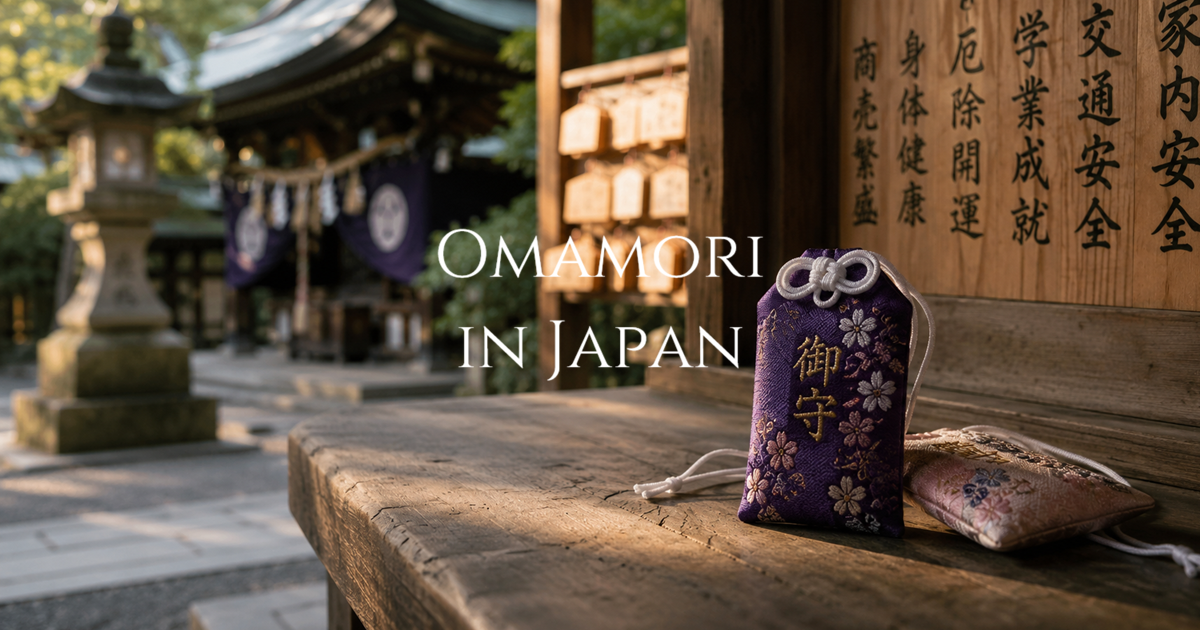
Small fabric pouches hang from school bags, rest on car dashboards, and disappear into the folds of a wallet across Japan. Known as omamori, they are received at shrines and temples for concerns as different as safe travel, childbirth, examinations, illness, and traffic accidents. Their size is modest, but their placement is not incidental: they stay close to the body of the person whose exposure they are meant to accompany.
Omamori do not remove uncertainty, and they do not promise a particular outcome. What distinguishes them from other sacred objects in Japanese religious life is that protection is not displayed but carried — kept in motion with the body rather than fixed in a shrine precinct or a household alcove. Where engimono give visible form to a hoped-for future through purchase, display, and exchange, omamori are defined by proximity: protection here is not represented, it is carried.
For more stories like this, explore our Sacred & Taboo collection.
Omamori as a Tradition of Portable Protection
Omamori are small protective objects distributed by shrines and Buddhist temples, but their cultural function is completed away from those grounds. The word derives from mamoru, “to protect,” and the object’s task is to carry a sacred relationship into the settings where vulnerability is actually met — the road, the classroom, the hospital corridor.
Most take the form of a small brocade pouch closed with cord, containing a ritually prepared object, inscription, or sacred material tied to the issuing institution. The contents stay concealed, and opening the pouch is discouraged. An omamori’s protective status depends not on what can be inspected inside it, but on its origin, its enclosure, and the continued care with which it is handled — which separates it from an engimono, whose cultural function more often depends on visible form and placement.
Different omamori answer to different forms of exposure — traffic safety, health, childbirth, examinations, business, travel, general misfortune. What unites them is structural rather than thematic: each concerns an outcome that effort alone cannot secure. Each is also tied to a specific shrine, temple, deity, or bodhisattva, and it is this attribution — not decorative appeal — that lets the relationship continue once the person has left the sacred grounds.
The object crosses a boundary without dissolving it. The shrine remains the source; the omamori enters the commute, the exam hall, the car. Ritual does not need repeating at every moment because the relationship has already been given a form small enough to travel. That smallness is not a design accident. It is protection scaled to the body — a material acknowledgment that ordinary life contains conditions no one fully controls.
From Sacred Grounds to Everyday Movement
Portable forms of religious protection have a long history in Japan, developed by both Shinto and Buddhist traditions as ways to carry prayer, sacred names, and ritual authority beyond formal ceremony. Contemporary omamori descend from this broader pattern rather than from a single point of invention.
Pilgrimage shaped much of their early circulation. A visit created a direct relationship with one place, but a protective object let that relationship travel home, or pass to a family member who never made the journey themselves. During the Edo period, as pilgrimage routes expanded, movement itself became a recognized source of exposure — illness, accident, unfamiliar roads, shifting weather — and the omamori linked that uncertainty to the authority of the place it came from.
Modern transportation extended the same logic without replacing it. Railways made distant shrines reachable; automobiles introduced new, everyday forms of risk, and traffic-safety omamori became a fixture inside cars, accompanying driver and vehicle through conditions no one can fully predict. Air travel and long commutes have since opened further settings for the same practice — the structure has not changed, only its terrain.
This mobility explains, in part, why omamori fit so easily into a religious culture organized around practice rather than declared belief. Carrying one requires no public statement. It can be sustained by family custom, personal trust, or simple reluctance to leave a known risk completely unattended — moving, in each case, from sacred space into personal routine without needing to be verbally defined.
This is also where omamori diverge most clearly from objects that protect by staying still. A shimenawa marks a boundary that must remain visible in one place. An omamori addresses exposure differently: rather than securing a location, it moves with the person who has to pass through many.
Protection Kept Close to the Body
The placement of an omamori is rarely accidental. Tied to a school bag, kept in a wallet, kept near the driver’s seat of a car — even without touching skin, it stays inside the person’s immediate radius of movement. This proximity gives the object a bodily register that a displayed engimono does not share: protection here is not confined to an annual visit or a prayer offered at a distant sacred site, but travels with the specific risk it was chosen to answer.
A charm for academic success rides into the exam hall inside the same bag carried every morning. A traffic-safety omamori sits in the car each time the driver joins traffic. One for childbirth may stay close through a pregnancy; a health-related charm may accompany someone through illness and recovery. In every case, the object occupies the point where the body meets an uncertain environment — not preventing the transition, but entering it alongside the person.
Visibility is secondary to closeness. Some omamori are brightly patterned, associated with local symbols, seasonal motifs, or contemporary collaborations, and a few are collected for their design. But their function does not depend on being seen; an omamori buried in a pocket loses nothing by staying hidden. That quietness is not the absence of practice. Choosing where to place the charm, avoiding damage to it, noticing that it is still there, hesitating to discard it carelessly — these are the small, largely wordless acts through which the relationship is kept up.
Bodily proximity carries a social layer as well. Many omamori are received from a parent, partner, or colleague before an examination, journey, or illness — carried not only as a connection to a shrine, but as evidence that someone else registered the vulnerability and answered it with something that could travel. Protection, in this form, is both sacred and interpersonal at once.
Enclosure, Restraint, and the Unseen Interior
The fabric pouch gives omamori their recognizable shape, but the more consequential feature is what stays hidden. Opening one is widely discouraged, and the practical rule is understood without needing to be explained: the pouch is not opened to satisfy curiosity. Its meaning depends less on what could be revealed inside than on the boundary staying intact.
This produces a layered object. The exterior belongs to ordinary handling — touched, carried, exposed to daily movement — while the interior remains withheld. The carrier stays physically close to the sacred content without gaining unrestricted access to it, which is precisely the discipline that keeps an omamori from becoming fully ordinary even as it rides in the same bag as a train pass or a set of keys.
The restraint resists a modern instinct to confirm meaning through inspection. An omamori does not establish its status by displaying an unusual object or a visible mechanism; its authority rests on where it came from and how the relationship since has been maintained. Trust is given material form — the carrier accepts that the interior matters without needing it exposed.
This matters more, not less, in an environment where omamori are also appreciated for design. A person may describe one casually, treat it lightly in conversation, and still avoid opening it or throwing it away without ceremony. That hesitation reveals that the object has not become fully interchangeable with the rest of what sits in the same bag.
Giving Protection When Outcomes Cannot Be Controlled
Omamori pass frequently from one person to another. Parents obtain them for children before entrance examinations; friends give them before a journey; relatives bring them to someone facing surgery, pregnancy, or a new stage of work. These transfers cluster around a specific limit: a parent can encourage study but cannot sit the exam; a friend can wish someone a safe trip but cannot supervise the road; a relative can support a patient without determining how treatment unfolds.
An omamori occupies exactly the space left by that limit. It converts concern into something portable without pretending the concern can guarantee an outcome — which is also why its meaning does not depend on literal belief in supernatural protection. The gesture already carries weight on its own: to give one is to acknowledge that planning and skill do not account for everything, that chance and circumstance remain beyond anyone’s command.
A traffic-safety omamori can register the danger of the road without describing an accident; one for childbirth can acknowledge risk without letting risk define the pregnancy. The gesture stays protective and restrained at once. Receiving one adds a further layer of proximity — the person carries not only a link to the shrine or temple, but the specific concern of whoever noticed the exposure and responded.
This circulation follows a different orientation than engimono typically take. Engimono are exchanged or displayed as visible wishes reaching outward, toward what might still be gained. Omamori turn more often toward vulnerability already present, following the person or situation judged to need protection rather than announcing a desired future. Both traditions give human wishes material form; they simply organize those wishes around a different relationship to uncertainty.
Renewal, Return, and the Limits of Protection
Omamori are not usually kept indefinitely. Many are replaced after about a year, often around the New Year, when the old charm is returned to a shrine or temple for ritual disposal — ideally the one it came from, though local practice varies. Some are instead kept until a specific event has passed — an exam, a birth, a recovery — and released once that period closes rather than on any fixed schedule.
The return matters as much as the receiving. It preserves the omamori’s distinction from an ordinary possession right up to the end of its use, and it completes the arc built into the object from the start: sacred ground, everyday movement, then a deliberate release rather than casual disposal. This is also why many people hesitate to drop an old omamori into household rubbish — not necessarily from a firmly stated belief about consequence, but because ordinary disposal would collapse the very distinction that gave the object its meaning in the first place.
Renewal reflects a fact about vulnerability itself: it changes. The exam ends, the journey concludes, a different concern takes priority the following year. A new omamori does not mark the failure of the old one; it marks a new period in which protection is being sought again. Protection, understood this way, is maintenance rather than permanent security — a practice renewed because the conditions of a life keep shifting under it.
Conclusion
Omamori make protection portable without making it absolute. Their force lies in accompanying vulnerability rather than denying it — a small enclosed object entering the exam hall, the road, a pregnancy, an illness, where outcomes remain only partly within reach. Because it travels this close, sacred care can enter ordinary routine without turning every day into ceremony.
What continues is not the promise that misfortune can be eliminated, but the practice of refusing to meet uncertainty with empty hands.
For more stories like this, explore our Sacred & Taboo collection.
Related Articles
- Engimono — Examines wishes made visible through display and exchange, in contrast to omamori’s protection carried close to the body rather than shown to others.
- Shimenawa — Focuses on sacred boundaries that must remain fixed and visible in one place, unlike omamori, which protect by accompanying a person through many.
- Sacred and Forbidden — Explores how sacredness is maintained through restricted access, while omamori allow a controlled form of sacred presence to move into daily life.
Sources and Further Reading
The following works provide context for worldly-benefit religion, Shinto institutional practice, and the material forms through which sacred relationships travel into everyday life.
- Reader, Ian, and George J. Tanabe Jr. Practically Religious: Worldly Benefits and the Common Religion of Japan. University of Hawai’i Press, 1998.
- Nelson, John K. A Year in the Life of a Shinto Shrine. University of Washington Press, 1996.
- Hardacre, Helen. Shinto: A History. Oxford University Press, 2017.
- Breen, John, and Mark Teeuwen. A New History of Shinto. Wiley-Blackwell, 2010.
Author’s Note
No one in my family wore an omamori or carried one in a bag; ours was not a household that placed much weight on them, and I never once put one in a pocket myself. The ones I received from others went straight into a drawer, where they gradually stopped registering as objects at all. I could not tell you now when any particular one disappeared. The single rule that survived that neglect was never to open the pouch — something I only now recognize as the one instruction my parents had quietly passed down.