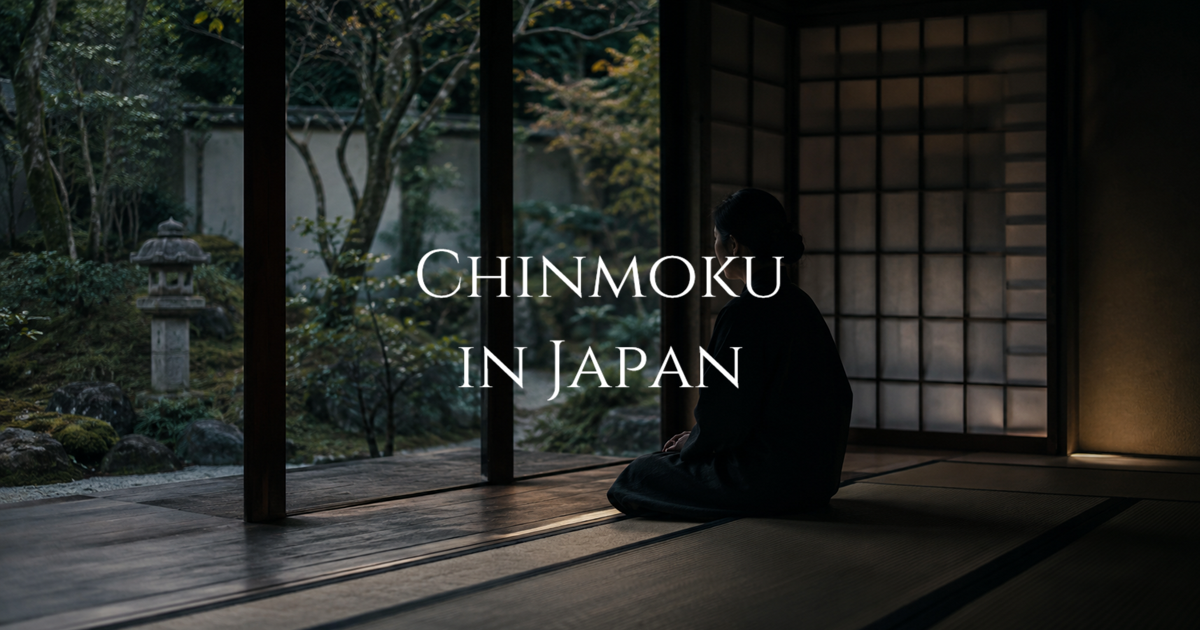
Silence in Japan is rarely a simple absence. A pause can carry hesitation, deference, disagreement, or care, and its meaning shifts with who is present and what has already passed between them. What matters is not that speech has stopped, but what the people around that pause are expected to notice in its place.
For more stories like this, explore our Sacred & Taboo collection.
Silence as a Social Boundary
Chinmoku (沈黙) names silence in Japanese, but as a social practice it does more than mark the absence of words. It governs how far disagreement, emotion, or hesitation is permitted to enter a shared space before it must be addressed directly. Where other forms of Japanese communication soften meaning by choosing gentler words, chinmoku operates on a different axis entirely: it withholds speech itself, letting a pause, an omission, or an unfinished sentence carry what a phrase never gets the chance to say. This is what separates it from the vocabulary substitution found in death-related language, where discomfort is managed by replacing one term with another rather than by declining to speak at all.
Because nothing has been stated, the feeling underneath a silence is not erased. It is only kept from taking public form. Anger can remain unresolved without becoming confrontation; doubt can persist without being voiced as objection. What changes is not the emotion but its permitted shape.
That shape depends entirely on relationship and setting. Silence between close friends can read as ease. In a meeting, the same stillness may signal reluctance or a need for further consultation. Within a family it might spare someone embarrassment, or it might quietly widen a distance no one names. At a funeral, shared quiet becomes a form of collective respect. The behavior looks identical from the outside; its meaning is assembled from status, timing, expression, and what happened just before.
When speech recedes, attention has to do more work. A lowered gaze, a delayed answer, the choice not to respond at once — these become part of the exchange itself. Communication has not ended. Its burden has simply moved from statement to interpretation.
Restraint, Hierarchy, and the Control of Speech
Silence becomes especially useful in relationships that continue past a single conversation. Families, schools, and workplaces bring the same people back into contact repeatedly, which makes an open confrontation harder to contain once it has actually been spoken.
Chinmoku delays that moment. A person can withhold agreement without issuing a refusal, or let discomfort register without directly challenging anyone. The tension does not disappear — it simply avoids being fixed into language, where it would demand a response.
This is not the same as harmony. More precisely, it preserves room to adjust. Once a disagreement has been stated in unambiguous terms, everyone involved is more or less obligated to respond to it. Silence keeps the situation unsettled, and therefore reversible.
Hierarchy determines who relies on this restraint most. A junior employee hesitates to contradict a senior colleague mid-meeting. A student lets a teacher’s error pass uncorrected. A younger relative swallows an objection that would look disrespectful if spoken aloud to an elder. In each case, responsibility for indirect communication falls unevenly: the person with less standing is expected to speak through implication, while the person with more standing decides whether that implication will be acknowledged at all.
This is where chinmoku turns morally ambiguous. It can express tact and consideration for a relationship, but it can equally preserve an unequal arrangement by making disagreement difficult to voice in the first place. Absence of objection is not proof of consent — it may only mean that objection had no safe outlet.
The interval between honne and tatemae — private feeling and its socially acceptable presentation — helps explain the structure. Silence sits in that interval, letting a private response stay perceptible without forcing it into a direct statement. That interval is not inherently deceptive. Every social interaction requires some judgment about what should be spoken, what can be implied, and what is better left alone. Chinmoku makes that judgment visible as restraint, even while leaving the judgment itself unexplained.
Reading the Atmosphere
Silence only functions as regulation where people are expected to notice the atmosphere it sits inside. The expression kūki o yomu — reading the air — describes exactly this: recognizing what a moment requires without needing every expectation spelled out.
That “air” is made of accumulated social information — who holds authority, what has already been implied, how comfortable the group appears, which response might unsettle the current balance. Chinmoku carries meaning because it appears inside this field of shared observation, not outside it.
A pause following a proposal rarely amounts to outright refusal. More often it signals limited enthusiasm, an unresolved concern, or a hope that the speaker will reconsider without needing to be contradicted directly. Silence lets the message register while still leaving space for revision.
To someone accustomed to treating direct speech as the clearest form of honesty, this indirection can look evasive. But within communication built around contextual awareness, excessive directness can itself feel inconsiderate. A blunt refusal forces the other person to absorb rejection in the open; silence offers a path to the same understanding without the public exposure.
The system only works when interpretation is genuinely mutual. One person may believe their reluctance has been communicated clearly; another may read the same silence as acceptance. What was meant as restraint can collapse into misunderstanding at exactly that gap.
Chinmoku does not remove conflict from an exchange — it relocates it, from the words spoken to the act of interpreting them. The operative question stops being “What was said?” and becomes “What should have been understood?” That uncertainty is part of what gives silence its regulatory force: it slows reaction and delays finality, while leaving unresolved who is responsible when the atmosphere gets misread.
Quietness in Shared Public Space
The social function of silence becomes especially visible where strangers are pressed into the same limited space. Commuter trains run quiet not because passengers are indifferent to one another, but because sound itself is treated as a form of presence that others cannot easily escape.
A phone call, a loud conversation, an argument — on a packed carriage, no one nearby can simply step away from it. Restraining sound limits how far one person’s private life gets imposed on people who never agreed to receive it.
That quiet creates a kind of boundary inside physical closeness. Passengers read, doze, or listen through earphones, each holding a narrow zone of privacy despite having no real distance from anyone else. Silence is what lets those zones exist side by side.
The same logic runs through apartment buildings, waiting rooms, offices, and school corridors, adjusted by setting but organized around the same underlying question: how much of one person’s presence should others be required to absorb? Public restraint extends to emotion as well. Loud anger or complaint is judged not only by its content but by how widely it spreads — a private dispute becomes a public burden the moment everyone nearby is made to witness it.
This is not a fixed cultural preference for quiet. Festivals, stadiums, and entertainment districts permit — or actively require — collective noise. Japanese public life is not silent everywhere; what shifts is whether sound fits the purpose of the place it occupies. Chinmoku in shared space, then, is less a taste for silence than a method of non-intrusion: sharing a location does not automatically grant access to someone else’s attention.
The Pause Inside Institutional Life
Schools and workplaces complicate silence further, since participation there is judged through both speech and restraint at once. Speaking can signal engagement, but speaking too fast or too forcefully can just as easily read as inattentive to the group.
In a classroom, a student may hesitate before answering even when the material is well understood. Answering exposes a single voice to correction and separates it from a quieter room, risking the appearance of overreach. Waiting, in that context, can express caution rather than uncertainty. Teachers themselves disagree on how to read it: some treat attentive quiet as participation, others as disengagement, and contemporary classrooms often hold both expectations — encouraging discussion while still discouraging students from dominating the room.
Workplace meetings produce a parallel ambiguity. A pause might mean reflection, reluctance, deference to seniority, or simply the sense that consultation is not yet finished. Formal meetings are frequently not where a decision actually forms — that happens earlier, through informal exchanges and gradual private adjustment, so that silence in the room can mean consensus has already been settled elsewhere, or that disagreement has not yet found anywhere safe to surface.
For this reason, a fast verbal response is not automatically read as the clearest sign of engagement; it can just as easily suggest that the speaker has not weighed the decision’s wider effects. Delay, in this frame, can communicate care toward people who are not in the room.
Institutional silence has a cost, though. When no one objects out loud, an organization may later record that quiet as agreement — leaving those who felt unable to speak with no record that their restraint was ever anything but consent. The line between respectful silence and enforced passivity cannot be drawn from the quiet room alone. It depends on who is permitted to speak, whose hesitation actually gets noticed, and whether disagreement has any other channel that does not carry a penalty.
Sacred Quiet and Emotional Discipline
Silence takes on a different register in funerals, memorial rites, temples, and shrines — spaces where behavior is deliberately restrained. Here quietness is not just about preventing disturbance; it helps construct the emotional form the setting calls for.
At a funeral, grief does not need continuous verbal explanation to be recognized. Bowing, offering incense, waiting in line, staying quiet — these let people participate together without requiring anyone to narrate private sorrow aloud. The restraint protects mourners from having to perform grief through speech; emotion receives a public structure while its personal content stays undisclosed.
Religious spaces work on a related principle. Lowered voices and slower movement mark the space as distinct from ordinary life, often with no explicit rule ever announced — the boundary is absorbed by watching how others behave and adjusting accordingly. Each person’s restraint becomes, in effect, instruction for the next.
Traditional arts extend the same logic outward. In Noh, tea practice, and musical performance, pauses and empty intervals shape how gesture and sound are received; the gap is not simply space between meaningful elements but what allows those elements to retain their force. The concept of ma is often used to describe this structured interval — not identical to silence, but overlapping with it wherever a pause organizes attention and keeps one action from being immediately erased by the next.
Chinmoku works on a similar principle within social exchange. Silence does not always conceal a second, hidden message. Sometimes it simply preserves the effect of what has already been said or done, refusing to let the moment be crowded out. Sacred quiet and interpersonal silence are not the same practice, but both discipline attention in a similar way — resisting the urge to fill every gap, and letting meaning stay incomplete without treating it as absent.
When Silence Becomes Pressure
Because chinmoku so often reads as tact, it is easy to describe it too generously. The same practice can isolate, confuse, or hand the entire burden of interpretation to whoever receives no clear answer.
Someone who senses disapproval without ever hearing its cause may start reading every pause, gesture, and shift in tone for an explanation that never arrives. Silence then regulates behavior sideways — not by naming what is wrong, but by making the other person responsible for discovering it alone.
That burden grows heavier inside unequal relationships. An employee may understand a proposal is unwelcome without receiving any stated reason. A family member may sense anger through a prolonged quiet with no opening to address it directly. Outward order holds, while uncertainty keeps accumulating underneath it.
Silence can turn punitive, too. Withholding ordinary acknowledgment, avoiding conversation, or sustaining an atmosphere of disapproval exerts pressure without ever producing a statement that can be questioned. Because nothing has technically been said, the person affected may struggle even to prove that anything is happening to them. At that point chinmoku stops softening confrontation and starts making it impossible to locate — control has moved out of language and into atmosphere itself.
The same pattern scales up institutionally. When silence surrounds misconduct or a preventable failure, restraint tends to protect authority rather than relationship. A communication style built to spare embarrassment in ordinary exchange becomes something else entirely when responsibility needs to be named clearly and isn’t.
Contemporary schools and workplaces have responded by building other channels for speech — private consultation, anonymous reporting, procedures that don’t require public confrontation. Their purpose is not to eliminate silence but to keep it from being the only option available. Digital communication has reshaped this ambiguity without resolving it: a message can go unread, be read without reply, or receive a delayed response whose meaning stays genuinely unclear. Platforms now make the duration of silence visible, even though they reveal nothing about the intention behind it. Chinmoku becomes pressure the moment its ambiguity stops protecting both sides and starts binding only one — the real question is not whether words are absent, but who benefits from that absence, and who is left holding what it might mean.
Why Chinmoku Endures
Chinmoku persists because social life cannot run on explicit statement alone. Relationships depend not just on honesty but on timing, proportion, and some working sense of what another person is prepared to receive in a given moment.
Silence leaves room for revision. A suggestion can be reconsidered without a formal rejection ever being issued. Disagreement can register without splitting a group into fixed opposing sides. Grief can be shared without being translated into explanation. These functions remain genuinely useful in contemporary Japan, particularly wherever people share close quarters or maintain relationships that outlast any single disagreement.
Part of its endurance comes from how it is learned — through repetition rather than instruction. Children notice adults lowering their voices, leaving a sentence unfinished, or choosing not to press someone for an answer, and over time silence becomes one more thing a social situation can be read for.
Its persistence does not depend on the practice always working well. Chinmoku survives partly because its ambiguity is useful on its own terms: the same pause can protect dignity, delay conflict, conceal resistance, or apply pressure, and that flexibility lets people act without having to define the act completely. But that flexibility marks the limit of silence as much as its strength. When shared interpretation breaks down, what one person intends as consideration can be received by another as indifference; what looks like agreement may be carrying an objection that was never given anywhere safe to go. Chinmoku’s force finally rests on the possibility that silence can later be reconsidered or answered through some other form of communication — it lives in the unstable space between expression and withdrawal, where feeling stays present without ever quite becoming public.
Conclusion
Silence in Japan carries no fixed translation. It regulates when meaning becomes explicit, how far emotion is allowed to travel, and whether disagreement has to take the shape of confrontation at all.
Through chinmoku, people protect one another from embarrassment, preserve flexibility inside a relationship, or establish the restraint a shared or sacred space calls for. The same silence can just as easily conceal unequal pressure, postpone responsibility, or leave someone else carrying the weight of figuring out what was never said.
The absence of words does not end communication — it moves communication into timing and atmosphere, into the expectation that someone else will notice what was withheld. A relationship built on silence can look calm from outside. What actually matters is whether that silence leaves room for understanding, or only makes understanding impossible to ask for.
Related Articles
- Death and Avoidance — Traces how death is managed through softened vocabulary and word substitution, a linguistic strategy distinct from chinmoku’s regulation of meaning through the suspension of speech itself.
- Sacred and Forbidden — Examines conduct shaped by implicit boundaries and unstated restrictions, where limits are recognized before they are ever spoken aloud.
- Kegare — Interprets impurity as a condition managed through separation and purification, a structural logic distinct from the interpersonal restraint of voice and emotion.
Sources and Further Reading
These works offer anthropological frameworks for understanding restraint, hierarchy, contextual communication, and the social interpretation of silence in Japan.
- Doi, Takeo. The Anatomy of Dependence. Kodansha International, 1973.
- Hall, Edward T. Beyond Culture. Anchor Books, 1976.
- Lebra, Takie Sugiyama. Japanese Patterns of Behavior. University of Hawai’i Press, 1976.
- Nakane, Chie. Japanese Society. University of California Press, 1970.
Author’s Note
The library where I first understood chinmoku wasn’t the elementary school reading room, where quiet was simply enforced. It was the local library I started visiting around age eight or nine, sitting among adults who had come for the same reason I had—and the tension I felt there wasn’t fear of being scolded, but the quieter awareness that I had joined something no one had formally invited me into.