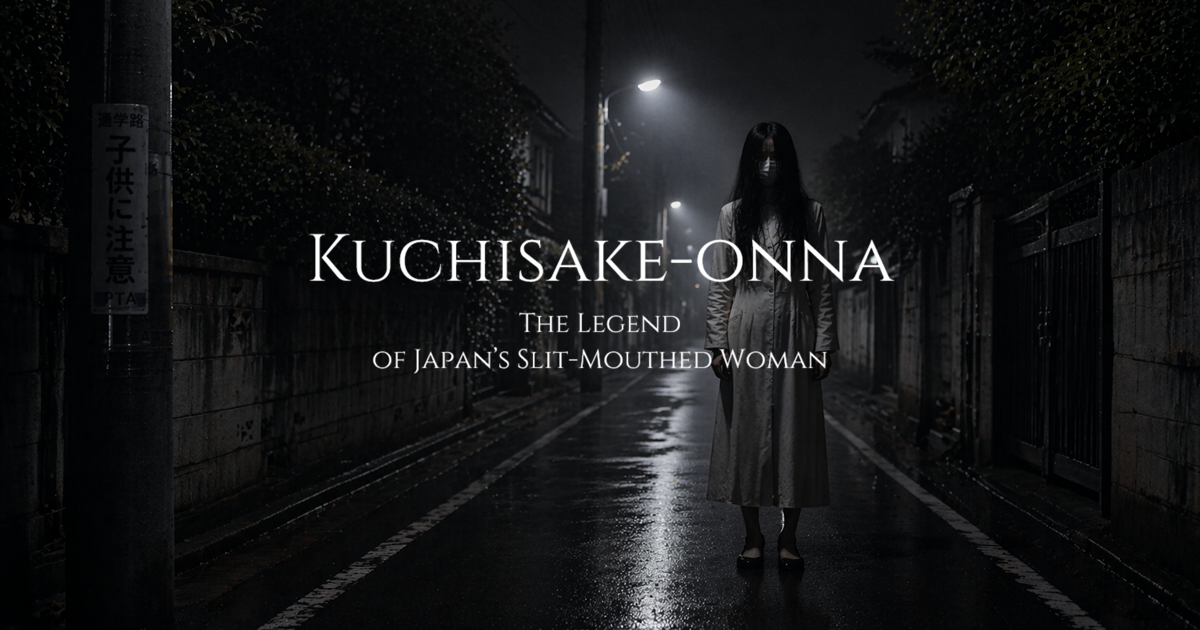
A woman wearing a surgical mask stops someone on a quiet residential road and asks whether she is beautiful. The encounter begins as a recognizable social interaction — brief, polite, ordinary. What the Kuchisake-onna legend introduces is not a monster, but a disturbance within the structure of that interaction itself.
Unlike older supernatural figures tied to mountains or historical trauma, Kuchisake-onna belongs to the interchangeable spaces of modern urban life: school routes, residential intersections, anonymous streets where strangers pass briefly without context. The legend requires no mythology to function. Its cultural weight comes from how little needs to change before familiar social behavior stops working.
For more stories like this, explore our Urban Legends in Japan collection.
A Masked Encounter on an Ordinary Street
In most versions, Kuchisake-onna appears as a woman with long dark hair and a surgical mask. She approaches pedestrians — most often children — in quiet public spaces and asks a direct question: “Am I beautiful?”
If the answer is yes, she removes the mask. The mouth beneath it has been cut wide across the face. She asks again.
The structure of the legend is spare. There is no elaborate origin required, no supernatural setting, no ritual to trigger the encounter. The interaction carries everything.
Most urban legends operate through uncertainty about what was actually seen. Kuchisake-onna works differently. The unsettling element arrives through recognition — the listener understands immediately that something about the face has become socially unreadable, even before any physical threat is made explicit. The legend does not present an alien being crossing into the human world. It takes something culturally central — a face, a question, a polite exchange — and makes it impossible to interpret correctly.
The rumor spread widely across Japan during the late 1970s, moving through school networks and local communities. Reports of sightings near school routes prompted some parents and local organizations to escort children. Newspapers and television addressed the phenomenon not as confirmed fact but as a pattern of collective rumor — a distinction that only made its spread more durable. Unlike folklore attached to specific historical sites or regions, Kuchisake-onna could appear anywhere. That portability was part of what made it travel.
The Social Face and the Fear of Disruption
Kuchisake-onna is structured around the social meaning of the face — not its appearance alone, but its function as a tool for reading the world.
In ordinary urban interaction, faces allow people to interpret emotion, intention, and familiarity almost instantly. Communication depends on the assumption that this process works, that a face is legible before anything is said. The legend targets that assumption with precision.
The surgical mask is central to how it does this. In Japan, masks are commonplace — worn for illness prevention, seasonal allergies, and general courtesy. Because the mask appears completely normal, the encounter opens within familiar expectations. Nothing signals in advance that this belongs to the register of legend.
That ordinary quality is what the legend requires. It does not introduce something visually alien. It alters something already recognizable, then holds it there.
The repeated question compounds this instability. Beauty in the legend functions less as attractiveness than as social acceptability — a request for the listener to confirm that the person before them falls within readable norms. The question is unanswerable in the terms it offers. Saying yes leads to the revelation. Saying no leads somewhere worse. Silence or deflection offers no clear exit.
The tension is not located in the face itself. It comes from the collapse of the conversational rules surrounding it. Social interaction normally depends on predictable exchanges — questions invite acceptable answers, politeness reduces uncertainty, and appearance supports the basic mechanics of recognition. The encounter with Kuchisake-onna dismantles all three at once.
This is part of why the legend spread so effectively through school environments. Children in Japanese schools are taught highly structured forms of social behavior, particularly around courtesy toward adults and the management of appearance. The legend transforms that training into a trap. The better a child has learned to respond politely, the less equipped they are for an interaction that punishes politeness.
School Routes, Rumor Networks, and Childhood Transmission
The legend’s spread through school networks was not accidental. Schools function through dense oral communication, shared routines, and limited adult verification. Stories circulate quickly between classrooms and along routes home, especially when the claims involved cannot be easily dismissed or confirmed. Urban legends thrive in exactly this kind of environment.
Kuchisake-onna attached itself to the specific geography of the school day: the walk home, the quiet side street, the intersection where children waited briefly without supervision. These were spaces that children navigated regularly, governed by social rules but outside direct adult oversight.
The legend made those familiar spaces feel structurally different without changing them physically.
Part of what sustained the rumor was the instability of its proposed solutions. Some versions claimed that answering with an ambiguous phrase could confuse the figure. Others suggested candy as a distraction, or responding with a counter-question that disrupted the exchange’s logic. These countermeasures were never stable — they varied by region, by school, by generation, and changed with each retelling.
That variation is culturally meaningful. Traditional folktales tend to stabilize over time, converging on recognizable moral structures and fixed outcomes. Urban legends survive differently — through adaptation, through the refusal to settle. Each version preserves the central encounter while adjusting the peripheral details, keeping the rumor in circulation precisely because no authoritative version exists to close it.
School culture amplified this process. Repetition, variation, and collective transmission were already part of how children communicated. A story did not need to be believed literally in order to circulate. Participating in the rumor — passing it on, adding a detail, proposing a new defense — was itself a form of social behavior.
For many people who grew up in Japan during that period, Kuchisake-onna was less a fixed figure than a quality of atmosphere: a feeling that briefly attached itself to ordinary afternoon streets, that made the walk home feel slightly less predictable than it had been the week before.
Appearance, Proximity, and the Logic of the Encounter
Kuchisake-onna is often read as a female supernatural figure, but the legend does not depend on supernatural identity. Its tension comes from the convergence of two pressures that operate simultaneously within a single ordinary encounter: the demand to evaluate appearance, and the impossibility of maintaining safe distance from the one making that demand.
Gender is structural here, not incidental. In Japanese urban culture, women have historically been associated with visible self-presentation and controlled public behavior in ways that are closely regulated. Kuchisake-onna inverts this: rather than being the object of evaluation, she becomes its enforcer — transforming the face into something unreadable while compelling others to render judgment on it anyway. The question “Am I beautiful?” is not ritual. It conscripts the listener into a system of appearance-based assessment that normally operates below the surface of interaction, and it does so without offering any position from which that assessment can be safely made.
This is where proximity becomes the mechanism of the legend’s particular dread. Unlike figures that operate through remoteness — the ghost glimpsed at the end of a corridor, the shape seen across a field — Kuchisake-onna closes the distance entirely. She speaks directly, waits for an answer, and remains inside the interaction. There is no position of observation available, no moment at which the encounter can be processed from a remove. The conversation continues to follow its outward form while the social foundation beneath it gives way, and the listener has no option but to remain present while that happens.
The legend also emerged during a period when this kind of encounter could travel through two channels simultaneously. Television and weekly print media allowed the figure to circulate nationally, giving Kuchisake-onna a recognizable visual and narrative form across regions that might otherwise have developed entirely separate local variants. At the same time, oral transmission continued independently in schools, neighborhoods, and households — producing the regional variations in countermeasures, in the figure’s appearance, in the rules of the encounter, that kept the rumor from hardening into fixed folklore. What resulted was something relatively new in Japanese supernatural culture: a figure with national legibility and local instability at the same time. Later adaptations in manga, film, and internet culture inherited this structure. The encounter changed its settings across each new medium; the logic beneath it did not.
This dual circulation also explains the legend’s durability beyond its original moment. The anxieties it touches — visibility, self-presentation, the reliability of public social exchange, the gap between surface behavior and underlying intention — are not fixed to the late 1970s. They shift in form with each generation but do not disappear. Kuchisake-onna does not need to update itself to remain legible. The structure of the encounter is generic enough to reattach wherever those pressures are felt.
Conclusion
The legend of Kuchisake-onna does not require distance from ordinary life to function. A quiet street, a familiar kind of stranger, and a simple social question are enough to make the encounter feel possible.
What gives the legend its durability is not the image of a cut mouth. It is the possibility that the systems of recognition underlying ordinary interaction might fail without warning — that a face could become unreadable, that politeness could stop providing safety, that public space could briefly lose the predictability it normally carries.
That possibility remains culturally legible in modern Japan, where masks are part of everyday life, where public self-presentation is carefully managed, and where the gap between surface behavior and underlying feeling is a recognized feature of social life. Kuchisake-onna does not need to be believed literally in order to continue circulating. The anxiety it names is structural, and it does not resolve.
Related Articles
- Hanako-san — A school-based legend structured around ritual repetition and the transformation of shared institutional space into a site of collective testing.
- Teke Teke — An urban legend organized around bodily fragmentation and railway movement, where visual shock spreads through the specific geography of modern transportation.
- Aka Manto — A bathroom-centered rumor built on forced choice and constrained response, in which the ordinary logic of safe conversation is made to fail by design.
Sources and Further Reading
These works provide cultural and scholarly context for understanding Japanese urban legends, rumor circulation, and the social dimensions of modern folklore.
- Foster, Michael Dylan. Pandemonium and Parade: Japanese Monsters and the Culture of Yōkai. University of California Press, 2009.
- Foster, Michael Dylan. The Book of Yōkai: Mysterious Creatures of Japanese Folklore. University of California Press, 2015.
- Komatsu, Kazuhiko. An Introduction to Yōkai Culture: Monsters, Ghosts, and Outsiders in Japanese History. Japan Publishing Industry Foundation for Culture, 2017.
Author’s Note
The story came through a classroom, handled with the casual disbelief that most middle school rumors receive. Nobody committed to it. The premise felt slightly broken from the start — a woman in a mask asking whether she was beautiful seemed to undermine itself before it arrived at anything frightening.
What I associated with that kind of fear was older and less specific. Walking home from cram school in elementary school, the route passed through an area that still had farms and open lots, not many houses, not many streetlights. My parents gave me a flashlight. What I was afraid of was not a figure from folklore but the ordinary category of dangerous adults — kidnappers, strangers who might stop and ask something. The fear was structural: a child alone on a dark road, no one nearby, an encounter that couldn’t be navigated by the usual rules.
Kuchisake-onna names something close to that feeling — not quite, but close enough that the distance between them is worth thinking about. What I carried on that road was a flashlight and a specific fear of real adults, not folklore. What the legend carries is a face that cannot be read and a question that cannot be answered. The geography is the same: a child alone in the dark, no one nearby, the ordinary rules suspended. The figure at the end of the road is different. The road is not.