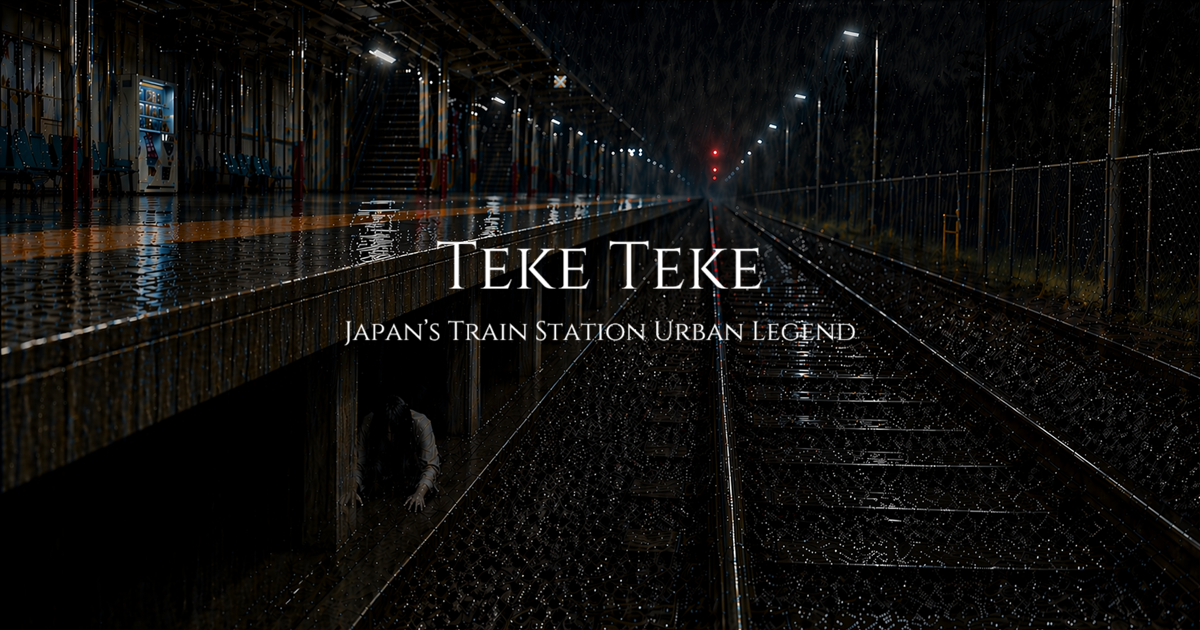
Railway platforms operate on the assumption that the body passing through them is whole, upright, and moving at a predictable pace. The infrastructure — tracks, barriers, timetables, platform markings — is designed around this assumption. It does not ask what happens when that assumption fails.
Teke Teke belongs to the space where that failure becomes imaginable. The legend describes a figure severed by a train, moving through stations and commuter routes with only the upper half of the body remaining. Its name is drawn from the sound said to accompany its approach: a repeated scraping across the ground — teke… teke… teke… The image is stark, but the legend’s cultural weight lies less in the figure than in the environment it inhabits. Teke Teke turns the railway system into a structure of bodily exposure, one that most commuters pass through every day without registering as such.
For more stories like this, explore our Urban Legends in Japan collection.
Severance and the Commuter Landscape
Teke Teke is a product of modern urban space rather than older supernatural tradition. Its setting is not the mountain path, the village boundary, or the ancestral shrine. It is the railway environment: platforms, crossings, underpasses, school routes, and the quiet streets that connect residential neighborhoods to transit lines. This positioning matters because the legend does not ask its audience to step outside the rhythms of daily life — it places unease inside the infrastructure they already depend on.
What distinguishes Teke Teke from older ghost narratives is the nature of its origin. The figure is not the product of ritual transgression, ancestral neglect, or spiritual imbalance. She is produced by the city itself — by the mechanics of transit, the geometry of tracks and platform edges, and the ordinary exposure that comes with moving through infrastructure that does not accommodate the body’s fragility. The severance that defines her is not metaphorical. It is mechanical.
The basic outline of the legend is spare. A young woman is killed after contact with a moving train. She continues to exist afterward, moving with the upper half of her body through the same spaces where the accident occurred or through routes nearby. The sound of that movement — the repeated scraping rhythm — gives the legend its name and its primary sensory register. A listener does not need a detailed account. Platform, darkness, sound, incomplete body: the structure transmits quickly and holds.
Railway Infrastructure and the Logic of Bodily Exposure
The railway system in Japan carries associations that go well beyond transportation. Trains organize workdays and school schedules; stations mark the edges of neighborhoods; commuter lines define the geography of daily movement for millions of people. The system is understood as reliable, coordinated, and predictable. These qualities are part of its social function — the train does not merely carry bodies from place to place, it gives routine its shape.
Teke Teke works by inhabiting this familiarity. The legend does not require an unfamiliar landscape. It draws its force from the same infrastructure that structures ordinary life, and it asks what that infrastructure reveals about the body when the organizing logic of crowd and schedule is stripped away.
A platform during the morning rush is a managed space. Movement follows marked paths; bodies are regulated by turnstiles, doors, and announcement patterns. The same platform at midnight is structurally identical but experientially different. Nothing has changed in the physical environment, yet the absence of other people makes the space’s indifference to individual bodies briefly visible. The barriers that exist to manage movement are also, from another angle, the edges that mark where the body’s safety ends. The platform’s edge, the gap between train and platform, the open track beside a crossing — these are designed with safety in mind, but they make legible a permanent relationship between human fragility and mechanical force.
Teke Teke gives that relationship a figure. The severed body is not introduced as an accident to be mourned but as a presence that continues to move — through the same stations and routes, across the same surfaces, along the same paths commuters take each day. The legend does not resolve the discomfort it names. It installs the discomfort inside the commuter environment and leaves it there.
Sound, Rhythm, and the Structure of Approach
The legend is built around anticipation more than appearance. What the listener first encounters is not the figure but the sound — a rhythm arriving from an uncertain distance, crossing the ground in a direction that has not yet resolved itself into a visible presence. The name of the legend is also the texture of its central event. Teke teke: the syllables reproduce what they describe, giving the story an oral shape that survives transmission even when other details are altered or forgotten.
Urban spaces are full of repeated sounds. Trains produce them constantly: wheels on rails, warning bells at crossings, the pneumatic hiss of platform doors, the measured cadence of announcement loops. These rhythms function as structural reassurance — they mean that the system is operating, that schedules are being kept, that the environment is coordinated. The crossing bell means a train is approaching and barriers are lowering. The platform chime means boarding is complete.
Teke Teke takes the same rhythmic logic and redirects it. The sound that announces the figure is not part of the system’s reassurance. It arrives from a different direction — from beneath the sightline, from the ground — and it does not resolve into a familiar mechanical event. Repetition, which normally signals order, becomes something the listener cannot place within the known structure of the environment. The station or crossing does not change physically. The sound changes what it means to be in it.
This is part of how urban legends alter ordinary perception without requiring that perception to remain permanently altered. A listener who has heard the legend does not necessarily believe in the figure’s literal existence. But the sound of an empty crossing at night, or footsteps in a station underpass, can briefly activate the legend’s frame. The environment and the story exist in the same sensory register, which is why the story can attach to places without those places needing to verify it.
School Rumor and the Social Life of the Legend
Teke Teke circulates most actively through school-age networks. Students navigate commuter environments without adult supervision — walking to train stations, waiting on platforms, taking underpasses, returning home after dark. The legend maps onto routes they already use, making it a form of social knowledge about vulnerability in transit spaces rather than a story about a distant or unfamiliar place.
In that form, the legend functions as a cautionary structure, though one that operates laterally rather than through explicit instruction. It does not tell students what to avoid or why. It associates certain situations — waiting alone near tracks, lingering in an empty station, walking an unlit route after the crowd has gone — with a presence that moves through those situations. The warning is embedded in the atmosphere the legend creates, not stated as a rule.
Rumor transmission keeps the legend alive and variable. Teke Teke does not have a fixed canonical text. It travels through classrooms, after-school conversations, and now through digital platforms and image boards, accumulating variations without losing its core structure. One version emphasizes accident; another adds an element of social harm — bullying, abandonment — before the death. Some place the figure near railway lines; others move her into residential streets or school grounds. A few versions include a survival condition, a phrase or action the listener can use to protect themselves. These variations do not fragment the legend. They allow it to attach to different local environments while preserving the pattern that gives it meaning: a young woman’s body broken by urban infrastructure, continuing to move through the space that broke it.
Digital circulation has given the figure a more consistent visual identity than oral transmission alone would have produced. Online versions often include illustrations, film stills, or described visual details that standardize the figure’s appearance across retellings. This makes the legend more recognizable and more shareable. But the core remains what it always was: a transit environment, a damaged body, and a rhythmic sound that arrives before understanding does.
The Gendered Body and Urban Order
The figure described in Teke Teke is almost always a young woman. That specificity connects the legend to a wider pattern in Japanese urban legends, where female bodies appear at the intersection of injury, altered appearance, and transgression of ordinary spatial boundaries. Kuchisake-onna centers her threat on facial appearance and the social encounter; Kashima Reiko structures the encounter around forced questioning and missing limbs. Teke Teke places the broken body in direct relation to infrastructure. The mechanism of severance is not ambiguous. It is the train itself, the platform edge, the crossing — the elements of the modern city’s movement system.
What the legend does with that damaged body is more complex than victimhood. The figure does not remain at the site of injury. She pursues. A body that should, by any physical logic, be immobile after such an injury moves quickly — crossing distance, closing gaps, reaching the listener before they can escape. The expectation that bodily damage equals incapacity is reversed. The incomplete body becomes the active presence in a space designed for whole, upright, efficiently moving bodies.
This reversal operates on the logic of the transit system itself. The modern commuter environment depends on bodies that comply: they stand behind the yellow line, board when the doors open, move through turnstiles in the correct direction. The environment is not designed for any other kind of body. Teke Teke imagines what appears when a body that cannot comply with these demands — that cannot stand, queue, or move at normal pace — enters the system anyway. The figure’s movement is a refusal of the system’s spatial discipline, not through agency, but through the irreversible fact of what the system already did to her.
Why the Tracks Still Carry the Legend
Teke Teke continues to circulate because the conditions it names have not changed. Railway infrastructure still organizes daily life. Commuter environments still empty at night. Students still move through transit spaces without adult accompaniment. The experience of a platform after the last train, an underpass without other footsteps, a road beside the tracks at the edge of an hour — these remain available to anyone who uses the network.
The legend’s durability also comes from its structural economy. It does not require belief in a supernatural entity, a specific origin story, or an elaborate cosmology. The minimum elements — severed body, transit space, approaching sound — are sufficient to activate its atmosphere. Because so little is fixed, the legend adapts across decades, media forms, and transmission contexts without losing coherence.
What the legend names is not ultimately supernatural. It is the momentary visibility of something the railway system normally keeps abstract: the relationship between mechanical force and the human body that moves through its infrastructure. That relationship is present in the design of every platform edge and every level crossing. The transit system does not conceal it. It simply organizes daily movement efficiently enough that the relationship never needs to be consciously registered. Teke Teke gives it a sound, a figure, and a route. The legend persists because the infrastructure it describes is not going anywhere.
Conclusion
The legend does not require that the listener abandon the modern city. It asks something smaller: that they notice, briefly, what the modern city is built on. The platform edge exists. The gap between train and track exists. The moment when a crowd of bodies becomes a single body, exposed on an empty platform at the wrong hour, exists. Teke Teke gives form to that moment without resolving it.
What lingers after the legend is not only the thought of an approaching sound. It is the altered quality of the infrastructure itself — the platform that functions as designed during the day and reveals something else at night, the crossing bell that measures time between trains, the underpass that connects two streets efficiently and without acknowledgment of what it might mean to cross it alone. These spaces return to ordinary use by morning. The legend persists because ordinary use never fully closes the gap it names.
Related Articles
- Kuchisake-onna — A public-space rumor where the threat is organized around facial appearance and social encounter rather than mechanical injury, mapping bodily anxiety onto the unstable judgment of strangers.
- Kashima Reiko — A legend structured around bodily fragmentation and ritualized questioning, where the encounter is governed by forced exchange rather than spatial pursuit.
- Kisaragi Station — A transit legend in which the railway system becomes the site of spatial disappearance and narrative disorientation, transmitting through anonymous digital testimony rather than school rumor.
Sources and Further Reading
The following sources provide academic context for urban legend transmission, the folklore of fear, and the cultural dynamics of modern ghost narratives in Japan.
- Bennett, Gillian, and Paul Smith, editors. Contemporary Legend: A Reader. Garland, 1996.
- Brunvand, Jan Harold. The Vanishing Hitchhiker: American Urban Legends and Their Meanings. W. W. Norton, 1981.
- Goldstein, Diane E., Sylvia Ann Grider, and Jeannie Banks Thomas. Haunting Experiences: Ghosts in Contemporary Folklore. Utah State University Press, 2007.
Author’s Note
The crossing bell I remember most clearly was not frightening to me — but it was to the dog I walked. On longer routes that took us past a level crossing, she would stay calm until the bell started, then pull hard toward home, wanting no part of what was coming.
Years later, after she died, I was riding with her in the cremation vehicle when the barrier came down just as we reached a crossing. The bell sounded loud and close inside the car. I said sorry to her, though I was not sure whether I meant the sound, the journey, or the fact that she had always understood something about that bell that I had not taken seriously.