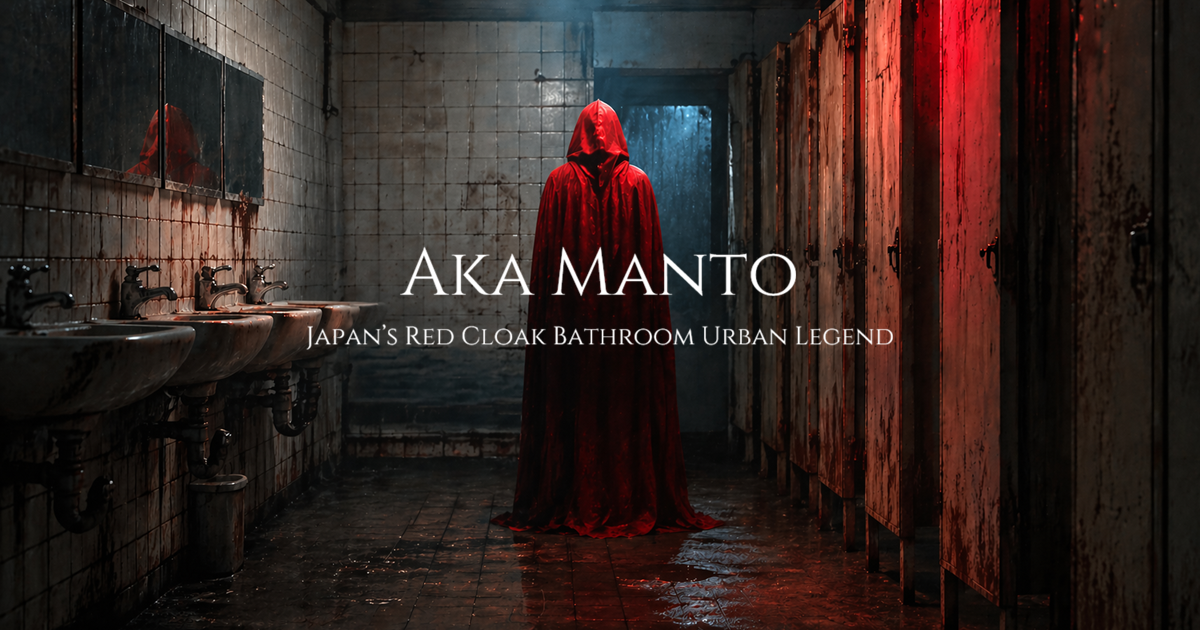
In Japanese urban legend, Aka Manto is remembered less for a fixed appearance than for the structure of the encounter. A person enters a school or public bathroom alone, closes the stall door, and hears a voice offering a choice: red paper or blue paper. The question is simple enough to sound almost ordinary, yet the story’s unease begins when the listener realizes that neither answer leads to safety.
The legend belongs to the social world of rumor: repeated warnings, half-serious rules, and ordinary spaces that become charged through collective memory. Aka Manto endures because it turns choice itself into pressure — a situation where answering feels required, but every available response has already been determined by something else.
For more stories like this, explore our Urban Legends in Japan collection.
A Bathroom Legend Built Around an Unsafe Choice
Aka Manto is a modern Japanese urban legend built around a bathroom encounter, not a traditional yōkai tale with stable mythology or fixed regional origin. In its familiar form, someone enters a school or public restroom alone — often the final stall — and hears a voice ask whether they want red paper or blue paper. The figure behind the voice may be described as a man in a red cloak, a masked presence, or nothing visible at all, but the visual details are secondary to the demand to answer.
Aka Manto survives not because of what it describes, but because of what it requires. The legend reduces an encounter to its minimal elements: an enclosed space, an unseen authority, and a question whose available answers have already been made unsafe. That reduction is what gives the story its longevity — it carries no unnecessary weight, only the structure of a trap.
The bathroom setting reinforces this economy. A restroom stall is both private and institutional — separated from ordinary supervision yet still located inside the shared world of school, station, or public building. It creates a small boundary where the body is temporarily hidden and ordinary social visibility is suspended. Aka Manto uses that boundary with unusual precision. A closed door and a voice are enough to turn a familiar place into a scene where the normal rules of response no longer apply.
The Structure of an Impossible Choice
The central question in Aka Manto appears to offer agency. Red or blue. One answer or another. On the surface, the listener is being invited to choose, but the invitation is false. The system behind the question has already determined that neither answer can protect the person being asked.
This is where the legend’s pressure begins. In ordinary life, choice usually implies some degree of preference, control, or participation. Aka Manto removes those meanings without announcing it. The act of answering does not resolve the situation — it completes it. Whatever is chosen, the choice itself is what the encounter was waiting for.
That structure gives the story a sharper social meaning than a simple threat would. The person in the stall is not attacked without warning, nor offered a clear path of escape. They are placed under a demand that sounds formal and almost polite, while the consequences remain hidden. The danger lies in being made responsible for a decision whose rules were never explained.
This pattern is recognizable outside the supernatural frame. Schools and other institutional environments often require people to respond before they fully understand what is expected of them. A student may be asked a question whose correct answer depends less on knowledge than on reading the room. A child may be tested by older students through a scenario that appears to have options but carries only one acceptable outcome. A person in a group may feel pressure to answer quickly, even when silence would be safer.
Aka Manto compresses that ordinary anxiety into a ritualized form. The voice speaks as if the rules are already known. The listener is forced into the position of someone who must act without enough information to act safely. The repeated advice associated with the legend — do not answer — is therefore more than a practical escape rule. It reframes silence as protection, and refusal as the only way to avoid entering a system designed to make every response unsafe.
The Bathroom Stall as Ritual Space
Aka Manto depends on the bathroom not merely as a setting, but as a spatial condition. A restroom stall is a small enclosure inside a larger institution. It belongs to the school, station, or public building, yet it also creates a brief withdrawal from ordinary visibility. The person inside is alone, but not outside the social world — and that combination is precisely what the legend requires.
The stall is private enough to make interruption feel invasive, but public enough for the encounter to remain connected to everyday life. Aka Manto does not transport the listener into a distant supernatural realm. It alters the meaning of a space already present in ordinary routines, using what is already there rather than introducing something foreign.
The final stall intensifies this effect. It gives the bathroom a narrative endpoint — the place farthest from the entrance, closest to silence, and easiest to mark through rumor. Once students begin to associate that location with a story, the place can carry tension even without any claimed experience. Avoidance itself becomes part of the legend’s circulation, adding weight to a spot that nothing visible has changed.
The encounter also takes on a ritual quality through repetition of form. The closed door establishes a boundary. The unseen voice delivers a formula. The listener is expected to respond according to rules that are only partially known. These elements do not constitute formal ritual in any religious sense, but they give the story a repeated structure of entry, question, response, and consequence — the shape of a test that has no passing answer.
School Rumor and the Authority of Warning
Aka Manto belongs to the social world of school rumor, where repetition matters more than proof. Many people encounter the story through classmates, older students, or siblings rather than through books or media. The authority of the legend comes from proximity: someone heard it at school, someone knows which stall to avoid, someone says the warning has been passed down for years.
This mode of transmission allows the story to change without losing its identity. One version may emphasize red and blue paper. Another may introduce additional colors with different consequences. Some describe Aka Manto as a visible figure in a cloak; others leave only a voice. The details shift, but the encounter stays recognizable because its structure is stable. The legend does not depend on consistency of content — only consistency of form.
School culture provides a natural environment for this kind of circulation. Students share the same buildings, repeat the same routes, and move through spaces where informal rules often carry as much weight as official ones. A rumor attached to a bathroom stall can become part of that daily geography without ever requiring confirmation. The warning shapes behavior even when no one claims to have experienced what it describes.
The story is often performed half-seriously — repeated as a joke, then acted on anyway. A student may say the words as a test of others, then hesitate before entering the last stall alone. This suspended belief is not a failure of the legend. It is one of the mechanisms by which urban legends regulate behavior without requiring full conviction. The question remains available whenever the space becomes quiet enough to receive it.
Modern Media and the Stabilization of the Red Cloak
As Aka Manto moved from spoken rumor into manga, illustrated collections, television, internet forums, and short-form video, the figure acquired a more consistent visual identity. The name itself points toward appearance — a red cloak or red cape — and modern versions often present Aka Manto as a masked man dressed in red. This gives the legend an image that can be reproduced and recognized across platforms.
That visual stability changes the story’s balance. In older rumor forms, the most important element was often the voice rather than any visible presence. The figure could remain entirely undefined, located somewhere beyond a closed door. Modern media tends to resolve what rumor leaves open, converting an unnamed pressure into a character with recognizable form. The encounter becomes easier to illustrate, easier to search for, and easier to share.
Even so, the red cloak does not replace the structure of the encounter. Aka Manto retains its effect only because the figure asks the question. Without the forced choice, the cloak is visual decoration. With the question, it becomes part of a system that cannot be safely entered from either direction.
Digital circulation suits the legend’s compact form. A bathroom stall, an unseen voice, two colors, and a trap with no exit can be communicated quickly. The story does not require backstory, which allows it to travel easily through online summaries, video retellings, and brief written accounts. Yet even in these formats, Aka Manto is often presented in the tone of informal warning rather than distant fiction — something passed along from one person to another, with the instructions still attached.
Conclusion
Aka Manto is often remembered through its colors, but the legend’s structure lies in the moment before the answer. Red and blue appear to divide the situation into options. The unease begins when those options reveal themselves as different expressions of the same outcome.
The bathroom setting gives that trap a precise shape: private but not free, enclosed but not separate from the institution around it. Within that space, the question functions as a small system of authority — one that demands participation while withholding the conditions that would make participation safe.
That is why the legend continues to feel recognizable across its many versions. The figure may change, the rules may shift, and the image of the red cloak may become more standardized over time, but the structure stays intact. Aka Manto persists because it understands something quiet about social life: the moment when being asked to choose no longer feels like freedom.
Related Articles
- Hanako-san — A school bathroom legend shaped by naming, summons, and the way institutional spaces accumulate childhood rumor over time.
- Kashima Reiko — A bathroom-based urban legend structured around verbal response and bodily fragmentation, where the correct answer must be delivered under pressure.
- Kuchisake-onna — A street encounter where disrupted appearance and forced politeness turn ordinary public interaction into an exchange with no safe exit.
Sources and Further Reading
The following sources provide academic context for contemporary legend theory, rumor transmission, and the structural patterns through which modern urban legends circulate and persist.
- Bennett, Gillian, and Paul Smith, editors. Contemporary Legend: A Reader. Garland, 1996.
- Dégh, Linda. Legend and Belief: Dialectics of a Folklore Genre. Indiana University Press, 2001.
Author’s Note
Aka Manto was never explained to me by anyone. It arrived the way school rumors do — already known, already circulating, with no clear moment of transmission. What I retained was less a story than a warning: that there was a question, and that answering it was the wrong move. No one seemed to know where the rule came from. We only knew enough to repeat it.