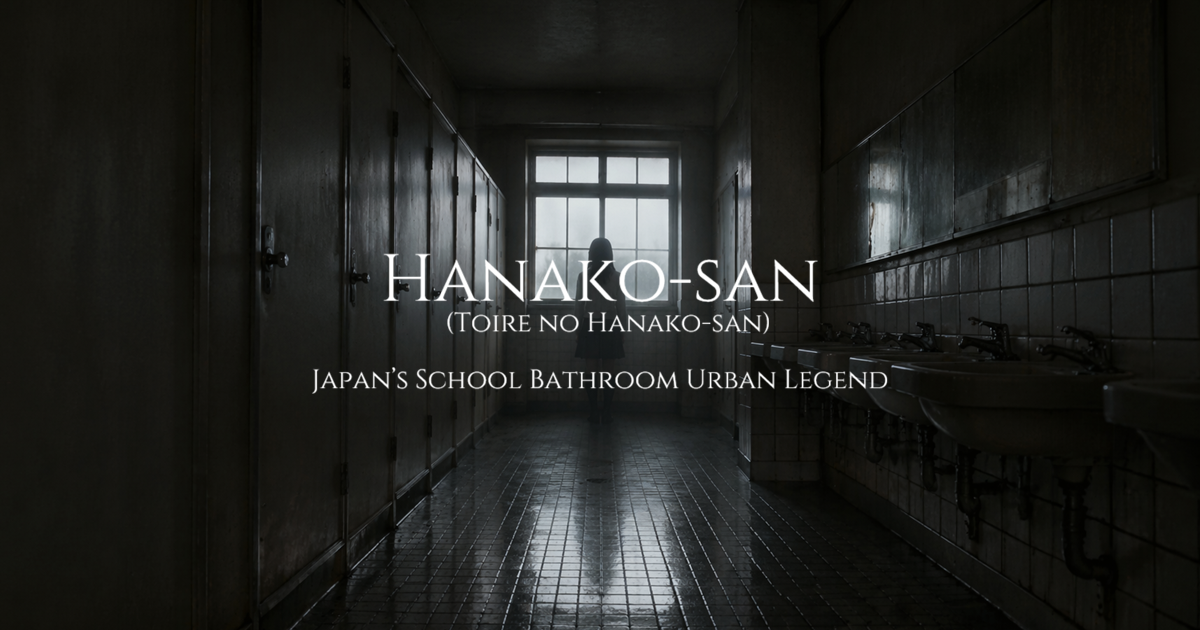
Among Japanese urban legends, Hanako-san occupies a space that is both ordinary and precisely located. The story does not require an abandoned building, a remote road, or a figure glimpsed from a distance. It belongs to the school bathroom — a room students know from daily experience, yet one that briefly separates them from the collective routines of classrooms, corridors, and supervision.
What makes the legend functional is not the figure herself, but the procedure. A child approaches a specific stall, knocks a set number of times, and asks whether Hanako-san is present. The question is not rhetorical. It expects the possibility of an answer.
For more stories like this, explore our Urban Legends in Japan collection.
A School Bathroom, a Closed Stall, and a Question
Toire no Hanako-san — Hanako-san of the toilet — is a modern Japanese urban legend centered on a girl said to inhabit a school bathroom stall and respond when children call her name through a repeated ritual. What distinguishes her from older ghost traditions tied to temples, historical grievances, or named tragedies is precisely the setting: she belongs to the shared architecture of school life, not to the sacred or the remote.
In most versions, a student approaches a bathroom on a specific floor, stands before a specific stall, knocks three times, and asks, “Hanako-san, are you there?” A reply may or may not come. Some versions describe a girl in red clothing. Others extend the encounter into disappearance or injury. But these variations do not define the legend. What children inherit most reliably is not a biography or a backstory — it is a method.
Origin stories attached to the figure vary widely. Some describe a girl who died during wartime; others offer no explanation at all. None of these accounts controls how the legend circulates. The figure survives because the procedure is simple enough to be transmitted in a few sentences, demonstrated in a hallway, and immediately tested in the nearest available bathroom. The story is durable because it is, above all, procedural.
Hanako-san also belongs to a specifically institutional kind of folklore. Schools across Japan differ in detail, but children move through broadly similar arrangements of stairs, corridors, and bathrooms. A rumor attached to that shared architecture travels easily because the spaces it requires already exist everywhere the legend might need to go.
Why Schools Produce Ghost Narratives
Schools are organized around visibility. Students move according to bells and timetables. Classrooms arrange bodies in rows. Corridors direct movement. Teachers and classmates keep behavior legible at almost every moment.
Bathrooms occupy a different position within this system.
They are necessary parts of the building, but they are not social spaces in the way classrooms are. A student enters alone or in small groups. Doors close. The body, ordinarily disciplined by collective activity and posture, becomes briefly private. In a place built around shared visibility, the bathroom introduces a pocket of partial concealment.
This is why rumors attach themselves to bathrooms rather than to classrooms or gymnasiums. Hanako-san does not appear where the school’s social frame is fully intact. She appears at the point where that frame weakens slightly — not enough to constitute real isolation, but enough to allow a different kind of attention.
The stall door is the central object in this logic. It divides space without removing it from reach. Children can stand close to it, knock on its surface, and imagine something just beyond it. Nothing needs to be shown. The structure of the door is sufficient. It is close enough to feel accessible and closed enough to remain unknown.
Schools generate ghost narratives not because children are particularly credulous, but because the institution itself produces spaces that fall just outside its own order. The rumor does not require a gap in the building’s physical structure — only a gap in its social one.
The Ritual as a Structure of Participation
The ritual surrounding Hanako-san is brief, but its brevity is part of how it works. A location is named. A stall is selected. A number of knocks is counted. A question is spoken. Then comes a pause.
That pause is where the legend lives.
The child performing the ritual is not simply listening to a story. They are entering a sequence with expected steps — controlled enough to be repeated accurately, but open enough to remain unstable. If nothing happens, the legend is not disproved. Perhaps the wrong stall was chosen, or the question phrased incorrectly. The ritual protects itself from failure. Its effect lies not in what happens afterward, but in the moment before the door is opened, when children know exactly what they are supposed to be imagining and cannot quite prevent themselves from imagining it.
This pattern recurs in school-based folklore. A rumor becomes more transmissible when it can be enacted. The child is not only a recipient of narrative — they are a participant in its reproduction. To perform the ritual is to keep the conditions of the legend alive.
The sequence also functions as a collective test. Children typically approach together, with one pushed forward or volunteering while others watch from behind. The act may be framed as a game or a joke, but the group still treats the procedure as genuine. Laughter and hesitation coexist. The ritual works precisely because no one is required to declare belief openly.
This half-belief is characteristic of childhood folklore. A child may claim not to believe in Hanako-san while still knowing the correct floor, the correct stall, the correct number of knocks. Knowledge of the procedure persists independently of any commitment to its truth. The legend survives less as doctrine than as practice — and that practice gives children temporary purchase on uncertainty. Instead of being surprised by the unknown, they invite it under conditions they control.
Transmission, Variation, and the Closed Circuit of School Rumor
Hanako-san passes between children through everyday school relationships rather than through adults or official channels. It arrives during recess, is whispered after class, recalled during cleaning rotations, or repeated while a group walks past the relevant bathroom. Because the story circulates among peers, it carries a particular kind of authority — not institutional, but socially real. A teacher does not need to confirm Hanako-san for the legend to shape behavior.
The school provides a closed circulation system. Children spend long hours in the same building, moving through the same corridors, returning to the same bathrooms day after day. A rumor attached to one part of that environment is reinforced with each encounter. Every glance at the stall becomes a small reminder.
Variation strengthens rather than weakens this circulation. One school may place Hanako-san on the third floor; another may specify a different bathroom, a different number of knocks, a particular way of asking the question. These differences allow the legend to be localized. A child hearing the story adapts it to the nearest available architecture. The rumor does not need a single canonical form because its function is spatial — it teaches children how to identify a place within their own school where the story might apply.
The name Hanako contributes to this flexibility. Ordinary enough to feel culturally familiar, it is generic enough to avoid full historical specificity. The honorific “san” gives the figure a recognizable social form even as the encounter it frames remains uneasy. Children do not summon a nameless presence. They address someone. That address matters: the question “Are you there?” assumes the possibility of presence while leaving the answer deliberately unresolved.
Media, Nostalgia, and the Persistence of the Stall
From the late twentieth century onward, Hanako-san became increasingly visible in film, television, manga, anime, and children’s ghost-story collections. These adaptations gave the figure a more stable visual form — particularly the image of a young girl associated with red clothing and school bathrooms — while oral transmission continued to keep the legend locally variable.
Media and rumor did not replace each other. They entered a cycle.
A child might first encounter Hanako-san through classmates, then see a version in a manga or on television, and later pass on a form shaped by both sources. Popular culture stabilizes certain images while school rumor keeps the legend flexible and spatially specific. The result belongs to neither category entirely. The stall remains. The knock remains. The question remains.
For many adults in Japan, Hanako-san is not primarily remembered as a frightening story. She is remembered as part of the texture of school life: the bathroom no one wanted to enter alone, the rumor everyone claimed not to believe, the friend who knocked and ran away, the moment after the question when the group went quiet. This memory gives the legend a second layer. Hanako-san becomes a marker of the period when belief and disbelief were not yet fully separated — when a procedure could feel serious and laughable at once.
The continued visibility of the figure in media preserves not only a ghost but a recognizable structure of childhood experience. The school building, the closed stall, the collective dare, and the unanswered question remain culturally legible across generations. Each retelling renews not only the story but the social conditions that made it feel possible.
Conclusion
Hanako-san persists not because the story is frightening, but because the conditions that produce it keep renewing themselves. Each generation of children enters school, learns its routines, and discovers the rooms that fall just outside those routines. The institution changes in detail; the experience of moving through it as a child does not.
The legend works in the gap between the school’s promise of order and the small spaces where that order becomes incomplete. The bathroom is still tiled, still fluorescent, still part of the building. But the closed stall introduces a different kind of attention — one that the school does not officially organize and cannot entirely prevent.
Hanako-san is, in the end, a way of naming that gap. Not a ghost in the usual sense, but a figure conjured by the architecture of institutions and the social life of children who know how to find the places where walls are slightly thinner.
Related Articles
- Aka Manto — A bathroom-centered urban legend structured around forced choice, where the ritual encounter becomes irreversible through the act of answering.
- Kashima Reiko — A school-linked legend organized through compulsive questioning and bodily fragmentation, in which the mechanism of transmission itself becomes the source of dread.
- Kuchisake-onna — An urban legend in which danger is produced through direct address and the pressure of answering incorrectly, linking social anxiety to the act of speech.
Sources and Further Reading
The following sources provide academic context for contemporary legend, the social function of rumor, ghost narrative in modern Japan, and the transmission of folklore within institutional settings.
- Bennett, Gillian, and Paul Smith, editors. Contemporary Legend: A Reader. Taylor & Francis, 1996.
- Brunvand, Jan Harold. The Vanishing Hitchhiker: American Urban Legends and Their Meanings. W. W. Norton, 1981.
- Goldstein, Diane E., Sylvia Ann Grider, and Jeannie Banks Thomas. Haunting Experiences: Ghosts in Contemporary Folklore. Utah State University Press, 2007.
- Komatsu, Kazuhiko. An Introduction to Yōkai Culture: Monsters, Ghosts, and Outsiders in Japanese History. Japan Publishing Industry Foundation for Culture, 2017.
Author’s Note
My first encounter was probably through a horror manga my younger brother owned. What stayed was a simple, specific unease: a girl appearing in an empty school bathroom felt wrong in a way that did not need explaining. The school toilets I knew were bright and midday-ordinary, and the story left them visually unchanged. But both sets of grandparents lived in old farmhouses where the toilet was outside, reached at night across an unlit yard. That was a different architecture entirely. Hanako-san belonged to institutions. The dark I remembered was older than any school.