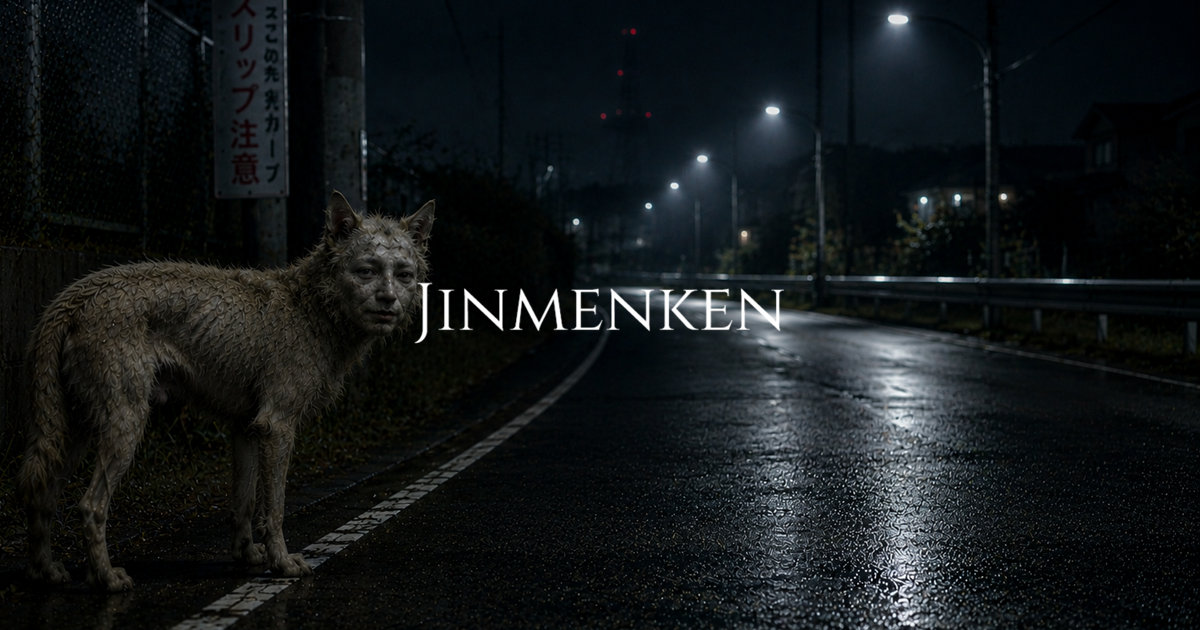
In Japanese urban legends, unease rarely announces itself. It emerges from a familiar category that begins to behave unexpectedly — a street that feels wrong at a certain hour, a figure glimpsed too briefly to confirm, a recognizable shape that will not resolve into something manageable. Jinmenken belongs to this register of unstable perception.
Described as a dog with a human face, Jinmenken does not operate through violence or elaborate supernatural machinery. Its disturbance is structural. The body is animal; the face appears human. That combination makes recognition itself the problem — the boundary between person and creature becomes, for a moment, genuinely impossible to hold.
For more stories like this, explore our Urban Legends in Japan collection.
When the Face Appears on the Wrong Body
Jinmenken is a Japanese urban legend about a dog with a human face, most commonly encountered at night along roads, near tunnels, at suburban edges, or beside industrial margins. Some versions place it near graveyards, though the dominant setting is modern and mobile: headlights, asphalt, the brief window of a passing car. In its most widely circulated form, it is not a curse, a messenger from the dead, or a figure from older religious cosmology — though variants do exist in which the creature is explained as a spirit of resentment possessing an animal body. These accounts belong to the looser field of rumor rather than established tradition, and they have not displaced the more prevalent image of Jinmenken as a disturbance of recognition rather than a supernatural agent.
This setting is not incidental. Jinmenken is distinguished from older supernatural figures precisely by its environment and its mechanics. Where yokai tend to carry established names, visual forms, regional roots, and symbolic roles embedded in tradition, Jinmenken belongs to the looser, faster world of urban rumor. It circulates through reported sightings, television segments, magazine features, internet posts, childhood memory, and parody. No single authoritative version exists. The story spreads because the central image is compact enough to travel without a mythology attached to it.
Most versions are brief. A driver sees a dog by the road. The animal turns. The face is human — aged, expressionless, or faintly irritated. Sometimes it speaks, in a low voice or a complaining tone. More often it only looks back, and the car passes before any interpretation is possible. The encounter ends without explanation. That lack of resolution is part of the structure: Jinmenken rarely offers a stable origin story, and the explanations that do circulate — an experiment, a mutation, a misidentified shadow, or in some versions a possessing spirit — belong to rumor rather than tradition.
Why Does the Human Face Produce Misrecognition?
The force of Jinmenken lies not in the animal body but in the face attached to it. Human beings read faces before almost anything else. A face communicates identity, emotional state, social position, and intention. It carries a demand for recognition — before language, a face already asks to be read as someone.
When a face appears where it should not, the observer is forced into an unstable position. To register the face as human is to extend the creature a kind of personhood. To dismiss it as animal is to deny what perception seems to be reporting. The body says one thing; the face says another; and the two cannot be resolved into a single stable category.
This is where Jinmenken’s social force lies. Everyday movement depends on fast, reliable classification — person, animal, stranger, pet, threat, harmless object. These categories are processed quickly because ordinary life requires them. Jinmenken slows that process for a moment. It turns a roadside glance into a question the observer cannot finish answering. The disturbance has already occurred at the level of perception, before any action becomes possible.
The discomfort also depends on partial resemblance. Jinmenken is rarely described as a perfect human head placed cleanly on an animal body. The face is usually human enough to be recognized, but not human enough to be accepted — aged, blank, or faintly misaligned. The result is not a legible hybrid identity but a failure of classification, a figure that sits between available categories without belonging to either.
Dogs, Intimacy, and the Wrong Form of Closeness
Jinmenken depends on the specific cultural position dogs occupy in relation to human society. An insect or fish with a human face would produce a different response — one of straightforward grotesquerie. Dogs are different. They are familiar, named, trained, and photographed. They wait at doors, learn household routines, and occupy emotional space inside families. A dog is not human, but it is rarely treated as merely an animal in social life. It already exists on the near side of the human-animal boundary.
Jinmenken takes that existing closeness and pushes it past comfort. The creature does not simply become intelligent or responsive. It becomes visibly recognizable as something that might answer back. The human face transforms the dog from companion into a possible social subject — while the animal body prevents that subject from ever becoming fully human. The result is a figure that cannot be cared for, categorized, or dismissed through the ordinary channels of domestic affection.
This is one reason Jinmenken often carries an unexpectedly mundane tone. In many versions, the voice does not speak in mysteries. It complains. It tells the observer to stop staring, in a tone closer to fatigue than menace. That flatness is part of the discomfort. The animal sounds like a tired person caught in the wrong form — and the implication of that is harder to dismiss than a conventional monster.
The legend also touches a wider anxiety about emotional projection. People routinely imagine what animals would say if they could speak. Children’s stories, cartoons, and pet culture all make use of this fantasy. Jinmenken gives that fantasy a colder form. The animal speaks, but not to confirm human affection. It interrupts it.
Roads, Headlights, and the Conditions of Partial Sight
Jinmenken belongs to the road because roads are structurally designed for fleeting perception. A driver moving through a night landscape encounters a moving sequence of fragments — shadows, guardrails, vegetation, figures at the margin — none held long enough to examine. Urban legends often attach to such environments because uncertainty is already built into the conditions of movement.
The typical encounter is brief. A dog appears near the road or runs alongside the car. For a moment the scene is ordinary. Then the headlights catch the face, or the animal turns, and the ordinary image breaks. The road gives the observer no time to verify. By the time doubt begins, distance has already settled the matter in the wrong direction.
This rhythm — perception, disturbance, disappearance — is central to how the legend works. Jinmenken is a figure one passes, not one one approaches. The story does not require a chase or confrontation because the speed of the encounter produces its own uncertainty. The witness is left with memory rather than evidence, and that memory is structurally inconclusive.
Roadside settings also place Jinmenken outside stable social supervision. Homes, schools, and shrines are organized by rules of belonging. Roads connect places without fully belonging to any of them. At night, especially near tunnels or industrial edges, they become spaces of temporary detachment — transited but not inhabited, lit by movement rather than presence. A dog at the roadside might be a pet, a stray, a shadow, or a momentary perceptual error. The human face enters that already uncertain field and gives it a focus the observer cannot process in the available time.
The road also prevents accountability. A driver who sees something strange may be unable or unwilling to stop. The encounter continues moving, and the figure is left behind. No investigation becomes necessary, no decision about what was real. The legend survives in the gap between seeing and confirming.
Rumor, Media, and the Circulation of a Visual Contradiction
Jinmenken is not maintained by a single authoritative text. It survives through repetition across different media: oral rumor, television reenactments, magazine features, internet posts, altered images, parody, and retrospective lists of famous Japanese urban legends. Each form is brief, and versions can contradict one another, but the central image remains recognizable across all of them.
This compactness is structural. Some urban legends require a precise sequence of actions, a specific location, or a ritual frame. Jinmenken needs only a visual contradiction. A dog has a human face. That image travels easily from speech to illustration, from television to online post, from childhood memory to casual joke. The boundary violation survives each retelling because it does not depend on narrative detail to function.
The legend also circulates across a wide tonal range. It can be treated as genuinely unsettling, as absurd, as nostalgic, or as a shared cultural reference with no particular weight. This tonal flexibility is one of its strengths. In contemporary rumor culture, many urban legends do not require complete belief to remain active. People may repeat Jinmenken skeptically, laugh at it, or invoke it as shorthand, while still preserving the small structural discomfort that keeps it worth repeating. Disbelief does not prevent circulation.
Digital media adds a further layer. Online, images can be detached from origin, compressed, reposted, and treated as evidence, joke, or nostalgic artifact depending on context. A human-faced animal is already a question of authenticity. In digital space, that question becomes harder to settle. The legend that began as a roadside rumor continues in an environment where the reliability of images is itself a running uncertainty — and where Jinmenken’s original question, whether a face can appear where it should not, maps onto a newer anxiety about whether any visual can be trusted to remain within its proper category.
A Boundary Error That Refuses to Close
The human-animal boundary that Jinmenken exploits is both obvious and fragile. Modern pet culture, biological science, and emotional projection all soften the line. Dogs are family members, companions, symbols of loyalty. They are not human, but they are rarely treated as merely animals in social life. The boundary is held, but it requires continuous, unacknowledged maintenance.
Jinmenken exaggerates that maintenance until it fails. The face does not complete the animal’s entry into human society. It produces a figure that cannot be integrated through any of the ordinary channels — affection, classification, rejection, or humor. The discomfort is not resolved because the category error cannot be corrected. If it is only a dog, why does it have a human face? If it is somehow human, why does it move and behave as an animal? The contradiction is simple, but it is not closed.
Conclusion
Jinmenken is a small legend with a precise disturbance. A dog appears in an ordinary modern environment, but the face refuses to let the body’s category stand. The encounter requires no violence, no curse, no complete explanation. Its force comes from the brief collapse of recognition — the moment when available categories stop fitting the image in front of the observer.
The human face is normally the most reliable sign of personhood. In Jinmenken, that same sign appears on a body that cannot be integrated into human society. The observer recognizes too much and not enough at the same time.
There is also a larger modern anxiety beneath the legend. Contemporary life is filled with things that look almost right — altered images, synthetic voices, modified bodies, expressions of personhood detached from stable identity. Jinmenken belongs to an older form of rumor, but its structure maps onto this newer uncertainty. A face appears where it should not, and the viewer is left to decide what kind of recognition it deserves.
What remains is not the fear of an animal. It is the discomfort of a face asking to be recognized from the wrong side of the boundary — and the unease of not knowing how to answer.
Related Articles
- Cow Head — A forbidden-story legend structured around dangerous transmission rather than visual misrecognition; the threat lies in the act of narration itself.
- Kuchisake-onna — A street encounter legend centered on the human face, public questioning, and the social anxiety of disrupted appearance.
- Red Room — A digital urban legend shaped by repetition, forced exposure, and the loss of control in online space.
Sources and Further Reading
These sources provide folkloric, anthropological, and theoretical perspectives on contemporary legend, rumor transmission, and the instability of cultural categories.
- Bennett, Gillian, and Paul Smith, editors. Contemporary Legend: A Reader. Garland, 1996.
- Brunvand, Jan Harold. The Vanishing Hitchhiker: American Urban Legends and Their Meanings. W. W. Norton, 1981.
- Dégh, Linda. Legend and Belief: Dialectics of a Folklore Genre. Indiana University Press, 2001.
- Goldstein, Diane E., Sylvia Ann Grider, and Jeannie Banks Thomas. Haunting Experiences: Ghosts in Contemporary Folklore. Utah State University Press, 2007.
Author’s Note
Jinmenken came to me less as something frightening than as something uncertain — a rumor that never quite landed. Human-faced fish had been in the news at some point, photographed in ponds and passed around on television with a kind of laughing disbelief. They were strange but manageable: markings that happened to suggest eyes and a mouth, something you could look at and smile about.
Jinmenken felt different, though I am not sure I understood that difference at the time. It was not a pattern resembling a face, but a human face placed on an animal body — and not just any animal. Dogs are close in a way fish are not: named, spoken to, treated as having feelings that matter. The dog was what made the legend feel as if it were touching something real, even if I could not say exactly what.