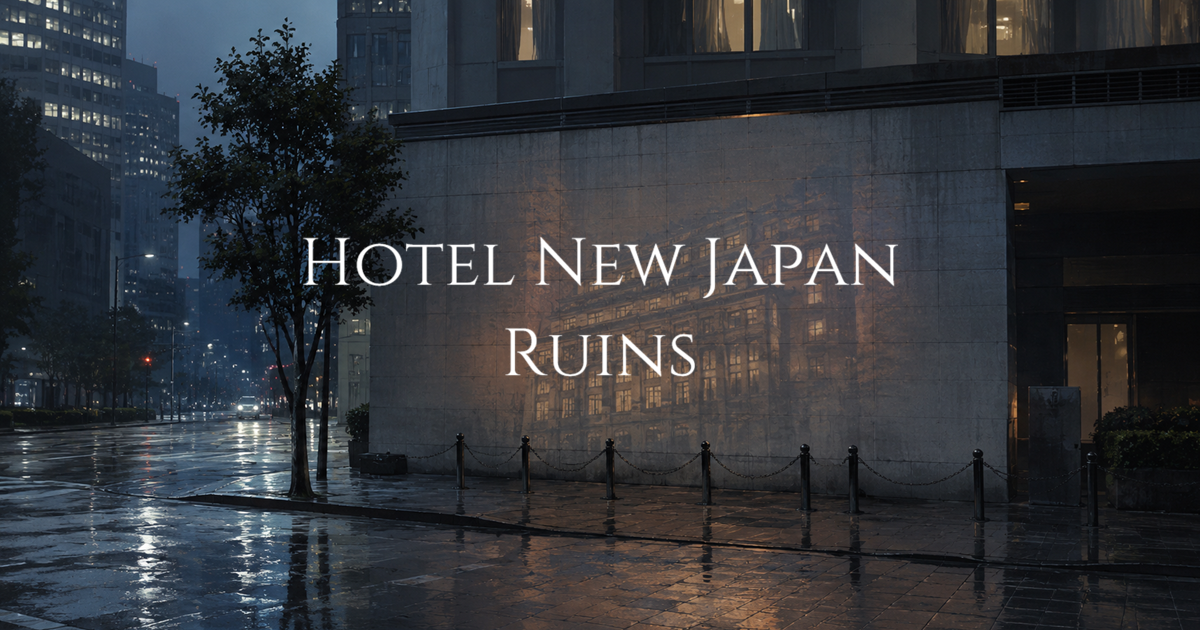
Hotel New Japan no longer stands in Tokyo. The building was damaged by fire, left standing in the city for years, and eventually removed through redevelopment. What remained was not a ruin but a question — about the gap between a building’s public image and its actual condition, about who held responsibility, and about how a city absorbs disasters without fully resolving them.
Its afterlife belongs to a different kind of haunted geography. This is not an old legend attached to a mountain pass or forest path, but a documented urban disaster that has been absorbed into the texture of a changing city — present not through decay or monument, but through the persistence of what the fire exposed.
For more stories like this, explore our Haunted Places in Japan collection.
Hotel New Japan and the Memory of a Vanished Disaster Site
Hotel New Japan was a luxury hotel in central Tokyo, located in a district associated with politics, administration, and postwar metropolitan prestige. On February 8, 1982, a fire broke out in the building. Thirty-three people died. Many others were injured. The hotel’s name has not been separable from that event since.
What makes the former site culturally distinct from other haunted places in Japan is not the presence of folklore or supernatural association, but the precision of documented failure. The fire was investigated, reported, and attributed — to management decisions, to neglected safety measures, to the distance between a building’s public presentation and its operational reality. That specificity gives the site a different kind of weight. Memory here attaches not to legend but to institutional accountability that was never fully settled.
For a time, the damaged building remained physically present in the city. It did not function as a preserved memorial. It stood as an unresolved structure: a visible remainder of a disaster that had occurred inside a space designed to project safety, efficiency, and modern control. Its continued presence made the fire difficult to separate from the urban systems that had allowed it.
After demolition and redevelopment, the site became harder to read directly. A person passing through the area now would not encounter anything that announces what happened there. Memory survives through language — through reports, retrospectives, online discussions, and the phrase “the former Hotel New Japan site” — rather than through visible form.
Luxury Hotels and the Fragility of Urban Trust
Hotel New Japan belonged to a particular image of postwar Tokyo. Large hotels in the decades after the war were more than commercial buildings. They materialized recovery, internationalization, and metropolitan confidence — spaces where Tokyo could receive guests, conduct business, and organize modern life through comfort, order, and the appearance of control.
Hotels operate on a form of ordinary trust. Guests sleep in unfamiliar rooms because they assume the building is managed, regulated, and prepared for emergency. The more prestigious the hotel, the stronger that assumption becomes. Luxury does not only mean service or decoration. It implies that the invisible systems behind the surface are functioning — that fire doors close, that sprinklers work, that staff have been trained.
The 1982 fire damaged that assumption. Public attention did not settle on the fact of the fire alone. It turned toward the conditions that made the disaster so severe: what had been ignored, what had been deferred, what had existed behind a surface that gave no sign of it. A fire in a visibly deteriorating building might be read through ordinary neglect. A deadly fire in a central luxury hotel produces a different kind of unease — one that locates danger not at the margins of urban order but inside it.
This is what gives the former site its place within haunted geography. The atmosphere does not derive from isolation, wilderness, or folklore. It derives from the failure of a modern urban promise. The location became charged because it exposed how fragile the infrastructure of trust can be when the systems behind it are not maintained. The disaster also occurred in a city already defined by rapid renewal. Tokyo’s modern identity often depends on the capacity to replace and continue. Hotel New Japan interrupted that forward motion by making visible a form of risk that was not ancient or supernatural, but bureaucratic and managerial.
The Ruin Before Erasure
Before the building was removed, the damaged hotel occupied an uneasy position in the city. It was not a ruin in the romantic or picturesque sense. It was not overgrown, not remote, not slowly consumed by nature. For nearly fourteen years it stood inside central Tokyo, surrounded by ordinary urban movement, carrying a history that redevelopment had not yet absorbed.
This intermediate period has its own significance. A disaster site that remains physically present holds memory in place. The structure becomes a kind of unwanted witness — not an official memorial, not a preserved monument, but something that prevents the event from becoming abstract. People may not enter such a building, and the city may continue to move around it, but its presence resists the smoothness of the surrounding environment.
The damaged hotel made the past visually inconvenient. It placed institutional failure inside a district associated with authority and urban order. A ruin of this kind carries an uncomfortable pressure: too recent to become legend easily, too public to be treated as private grief, too implicated in specific systems of responsibility to be reduced to atmosphere. Its presence forced attention back toward practical questions — what was permitted, what was delayed, what was known.
That is also what separated it from older haunted places whose reputations accumulate through distance and repetition. In tunnels, forests, or abandoned industrial sites, the surrounding environment often contributes to a sense of separation from ordinary life. Hotel New Japan was unsettling precisely because it was not separate. It belonged to the same modern city that was expected to explain and contain what had happened inside it.
Disaster Memory After Redevelopment
Redevelopment changes the moral texture of a place. A new building makes a site appear complete, productive, oriented toward the present. It can also make older histories harder to approach directly. In Tokyo, where rebuilding is frequent and urban surfaces shift quickly, this tension is especially legible.
The former Hotel New Japan site shows how disaster memory can survive after architectural evidence disappears. Physical removal creates a cleaner cityscape, but it does not produce cultural closure. The more complete the surface transformation appears, the more memory depends on forms that exist outside the landscape — language, archives, media, recollection.
This is why certain phrases carry weight. “The former Hotel New Japan site” is not simply a way of indicating location. It preserves a layered relationship between past and present, allowing an address to hold two histories at once: what exists there now, and what once happened there. The present tense of the city does not cancel the past tense of the event. It holds it underneath, accessible to those who know to look.
Media also sustains this kind of memory. Anniversary reporting, fire safety retrospectives, and online discussion periodically return the site to public awareness. Each return reactivates the place as more than an ordinary urban location. The memory is not continuous in daily experience, but it is recoverable — attached not to a visible structure but to a known address, a documented event, a name that has not been allowed to separate itself from what it refers to.
Hotel New Japan therefore belongs to a broader pattern in Tokyo’s cultural geography. The city often appears to move forward by replacing its own evidence. Yet certain places resist being fully absorbed into ordinary continuity. Their histories remain legible not through preservation, but through the failure of redevelopment to neutralize meaning.
The Former Hotel Site in Haunted-Place Discourse
The former Hotel New Japan occasionally appears in haunted-place discourse, but its reputation requires careful handling. The cultural significance of such references does not rest on any claim about the supernatural. It rests on what those references reveal about how sites of sudden death and unresolved responsibility acquire a residual atmosphere — even after the physical traces have been removed.
In many haunted-place narratives, the language of haunting provides a frame for what ordinary history cannot comfortably close. A location becomes charged when the past feels active, when the present cannot fully separate itself from what occurred there. For Hotel New Japan, that activity comes less from legend than from documented failure — from the knowledge that the disaster was not simply natural or unavoidable, and that the systems meant to prevent it did not function as presented.
This separates the site from places where inherited folklore provides the primary interpretive frame. There is no need to read the former hotel through ghost motifs in order to understand why it carries cultural weight. The unease comes from documentation, from public memory, from the precise record of what was neglected and who bore responsibility. “Haunted” in this context functions as a cultural metaphor — a way of describing a site where responsibility continues to press against the surface of redevelopment.
That kind of haunting is distinctly urban. It does not require darkness, abandonment, or remoteness. It can exist beneath office buildings, along familiar streets, in districts that appear fully integrated into the contemporary city. The surface may be orderly. The meaning has become layered.
Why Urban Disappearance Does Not End Cultural Presence
The former Hotel New Japan site persists because disappearance and resolution are not the same thing. A building can be demolished, a site redeveloped, a district returned to ordinary function — and cultural memory can continue to attach itself to the ground.
The fire remains present because it implicated systems that were supposed to protect people. Regulations, inspections, management decisions, staff training, emergency procedures — these belong to the unseen infrastructure of urban trust. When that infrastructure fails visibly and fatally, the memory of the failure does not stay confined to the event. It becomes a way of thinking about the vulnerability of the city itself, about what the surfaces of modern urban life are built over.
This is why the site’s meaning does not diminish simply with the passage of time. Some disasters become historically distant because their causes are settled or their locations are formally memorialized. Hotel New Japan occupies a more ambiguous position. The memory is public, but the site is not encountered as a preserved disaster landscape. There is no marker, no obvious frame, no decay demanding attention.
The absence is itself part of the site’s force. The past must be supplied by memory. The location becomes meaningful only when the viewer knows what has been removed — and that condition mirrors Tokyo’s broader relationship with its own history. The city often makes the past difficult to see, not because history is absent, but because replacement is part of its ordinary rhythm. Some histories do not disappear with their architecture. They attach themselves to what was there, and they stay.
Conclusion
Hotel New Japan shows how a disaster site can remain culturally present after its physical removal. Its meaning does not depend on surviving ruins, visible decay, or inherited folklore. It depends on the unresolved relationship between documented failure, institutional responsibility, and a city that rebuilt over what it could not fully close.
The former site belongs to a quieter form of haunted geography — one defined not by darkness or legend, but by the afterlife of a known event within a landscape that has moved on materially while leaving the questions intact. The building is gone. The address remains. What the fire exposed — about trust, safety, and the gap between appearance and reality in modern urban life — still gathers around the ground where the hotel once stood.
Related Articles
- Kiyotaki Tunnel — A road tunnel in Kyoto where modern infrastructure becomes the medium for haunted reputation, shaped by rumor and the discomfort of enclosed transit rather than disaster record.
- The Ruins of Gunkanjima — An abandoned industrial island where it is the building’s survival, not its disappearance, that exposes the instability beneath Japan’s postwar modernization.
- Aokigahara Forest — A forest whose cultural weight accumulates through silence, public memory, and the difficulty of separating a landscape from the social grief that has become attached to it.
Sources and Further Reading
The following sources provide cultural and historical context for understanding urban memory, disaster interpretation, redevelopment, and the relationship between place and public remembrance in Japan.
- Sand, Jordan. Tokyo Vernacular: Common Spaces, Local Histories, Found Objects. University of California Press, 2013.
- Sorensen, André. The Making of Urban Japan: Cities and Planning from Edo to the Twenty-First Century. Routledge, 2002.
- Morris-Suzuki, Tessa. The Past Within Us: Media, Memory, History. Verso, 2005.
- Low, Setha M., and Denise Lawrence-Zúñiga, eds. The Anthropology of Space and Place: Locating Culture. Blackwell Publishing, 2003.
Author’s Note
The fire at Hotel New Japan was widely shown on television, and the images entered public memory. I have no clear memory of sitting in front of the screen, but I remember a professor years later using the footage as an example — of how people observe disaster from a remove, curious in ways that are not quite cold and not quite caring. What I recognized in that description was something harder to name: not detachment, but the particular unreality of watching something genuinely terrible happen in real time, in a building that looked like every other modern building, in a city that was supposed to have made such things preventable.