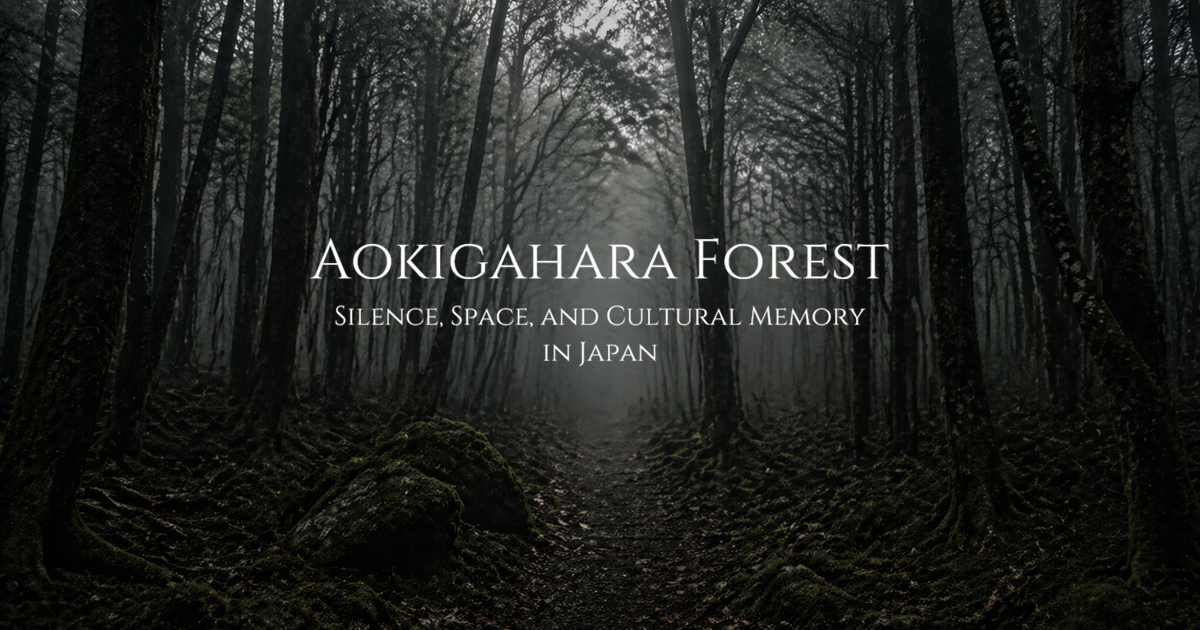
Aokigahara Forest is often described through silence, but that silence is not merely the absence of sound. Beneath the trees at the northwestern base of Mount Fuji, ordinary signals of distance, direction, and movement become softened. Sightlines shorten, footsteps lose their scale, and the forest begins to alter how space is felt before it is consciously understood.
Its reputation does not rest only on stories attached to it, but on the physical experience of entering a dense volcanic landscape where orientation becomes less certain. The forest does not announce meaning directly. It creates conditions in which isolation, memory, and spatial uncertainty gather quietly around perception itself.
For more stories like this, explore our Haunted Places in Japan collection.
A Landscape Where Silence Becomes Structure
Aokigahara lies along the northwestern base of Mount Fuji in Yamanashi Prefecture, where trees grow across hardened lava formed by volcanic activity over centuries. The physical structure of the place is central to its cultural meaning: uneven ground, exposed roots, dense vegetation, and shortened sightlines create an environment where ordinary spatial confidence weakens before the visitor becomes aware of it weakening.
Unlike many haunted places in Japan, Aokigahara is not organized around a named figure, apparition, or repeated narrative. There is no single presence that accounts for the forest. Its cultural force comes from atmosphere — from the body’s response to enclosure, and from the subtle uncertainty that develops when sound and distance no longer behave as expected. This distinguishes Aokigahara from tunnels, ruins, or sites attached to specific incidents: its meaning does not come primarily from passage, abandonment, or testimony, but from the gradual adjustment of perception.
The forest therefore functions less as a setting for a story than as a structure of experience. It asks how a landscape can alter perception before interpretation has fully formed.
Volcanic Terrain and the Unstable Sense of Distance
The physical ground of Aokigahara matters because the forest does not only grow densely. It grows across volcanic terrain, and that terrain changes how the body moves through it. Roots spread across uneven surfaces. The forest floor breaks into irregular textures. Even where marked paths exist, the surrounding environment creates a persistent compression.
This compression develops without announcement. Trees limit long views. Repeated trunks and undergrowth reduce the number of distinctive markers available to the eye. Without open sightlines, distance becomes harder to judge. A section of forest nearby can feel farther than it is, while a different section may feel familiar without offering reliable orientation.
In ordinary landscapes, depth is often confirmed by contrast: a road, a building, a horizon, the sound of activity beyond the immediate field of vision. Aokigahara reduces many of those cues. The visitor remains surrounded by detail, but that detail does not easily become a map.
This is one reason the forest has become so strongly associated with isolation. The isolation is not only emotional or social — it is spatial. The body continues moving through a real environment, but the environment gives fewer assurances about where one stands within it. A place does not need to be remote in absolute terms to produce that effect. Aokigahara is accessible, mapped, and visited. Yet beneath the canopy, that accessibility can quietly recede.
How Does Silence Reorder Perception?
In everyday environments, sound helps organize space. Voices suggest distance. Traffic gives direction. Footsteps, wind, and the ambient movement of people confirm that the world extends beyond what can be seen directly. When these signals are muted, perception shifts.
A quieter landscape does not merely reduce information. It turns attention toward smaller details: breathing, the rhythm of walking, the texture of nearby ground, the narrow movement of light through trees. The body begins to fill the silence with its own awareness.
This is where Aokigahara becomes culturally charged. Silence does not function as stillness. It creates conditions in which the visitor becomes more aware of being present, separated, and uncertain. The forest is not empty, but it gives less back. That reduction makes the boundary between external landscape and internal perception harder to maintain.
Japanese cultural geography has long treated mountains and forested terrain as spaces where ordinary social order becomes less stable. Remote or wooded places have suggested retreat, purification, danger, discipline, or contact with forms of presence not easily accommodated by daily life. Aokigahara belongs to this wider geography, but its meaning is not primarily religious or mythological. It is sensory before it is symbolic.
The forest’s silence invites interpretation precisely because it refuses explanation. A visually dramatic place imposes a kind of attention. Aokigahara works differently. Its atmosphere is made through subtraction: fewer landmarks, fewer auditory references, fewer signs of ordinary social movement. That absence becomes active because it changes the terms by which the world is measured. This also explains why the forest can carry several associations at once — natural landscape, tourist destination, cultural image, site of loss, space of withdrawal — without any of those meanings displacing the others.
Death, Memory, and the Accumulation of Meaning
Aokigahara’s modern reputation cannot be separated from public associations with death, but that association requires care. The forest has often been approached through simplified labels that flatten both the place and the people connected to it, turning a complex landscape into a single idea more convenient to repeat than to examine.
Within Japanese cultural life, death is not always imagined as an absolute severing of presence. Memorial practices, grave visits, household altars, and seasonal observances allow the dead to remain socially present in structured ways. Places connected to death may therefore become sites where memory accumulates gradually, rather than spaces defined only by rupture.
Aokigahara’s enclosure, quietness, and reduced visibility have allowed this accumulation to become especially dense. The landscape makes it possible for emotional distance and physical distance to overlap. Stories, reports, warnings, private memories, and media images collect around the forest, each adding a layer to a cultural identity that no single layer fully accounts for.
A more careful interpretation is quieter than the familiar labels suggest. The forest has become a place where social unease about isolation — withdrawal, grief, emotional exhaustion, the feeling of separation while remaining physically near — can be displaced into landscape. It gives spatial form to experiences that are difficult to name directly. That is part of why public discussion of Aokigahara often carries a certain indirection. Here, silence is not only environmental. It becomes part of the cultural handling of the place itself.
Media Images and the Narrowing of the Forest
Many people encounter Aokigahara first as an image rather than as a place. Television, documentary, film, photography, and international reporting have all shaped how the forest is understood before it is visited. This circulation has made Aokigahara widely recognizable, but it has also narrowed the range of meanings attached to it.
A real landscape becomes easier to repeat when it is reduced to a clear symbolic identity. For Aokigahara, that identity often emphasizes isolation and death in ways more direct than the physical experience of the forest itself tends to be. The result is a tension between the slow, sensory quality of the place and the more fixed image that travels through media.
This tension matters because the forest’s cultural meaning depends on ambiguity. Aokigahara is not visually dramatic in the way many representations suggest. Its atmosphere emerges from limited cues, repetition, quietness, and the gradual weakening of orientation — qualities difficult to convey through a single photograph, title, or brief description. When media images define the forest too strongly, they risk replacing perception with expectation. Visitors may arrive already knowing what the place is supposed to mean. Yet the forest itself does not always confirm that expectation. Its experience is slower and less declarative.
Aokigahara therefore exists in two forms simultaneously. One is the physical forest: dense, quiet, uneven, and spatially disorienting. The other is the mediated forest: a cultural image shaped by repetition, simplification, and international circulation. The distance between those two forms is now part of the place’s meaning.
Why the Forest Persists Without a Single Legend
Aokigahara persists because it converts ordinary environmental conditions into a structure of uncertainty. The forest does not need a single legend to organize its reputation. Its physical qualities already prepare the ground through which legend, memory, and speculation can gather.
Silence provides the forest’s central mechanism. Without ordinary auditory confirmation, space becomes less stable. Without long sightlines, distance becomes less reliable. Without clear variation in the landscape, direction becomes harder to hold. These are practical features of moving through dense volcanic forest, but cultural imagination can transform them into something more enduring.
The forest also persists because it allows indirect thought about isolation. Experiences that are difficult to discuss plainly — social withdrawal, grief, emotional exhaustion, the feeling of being separated from ordinary life while remaining physically near it — can be imagined through this landscape without being fully named. Aokigahara offers that spatial displacement. Its ambiguity is not a deficiency. It is what makes the forest available to each generation as a site for a different form of distance.
Conclusion
Aokigahara Forest is most often approached through what seems absent: sound, orientation, visual distinction, ordinary social presence. Yet these absences do not simply remove meaning. They change the conditions under which meaning begins to form.
The forest’s significance lies in that change. Its silence alters perception. Its density weakens distance. Its repetition unsettles the confidence with which people usually move through space. From these physical conditions, a larger cultural image has grown — one shaped by isolation, memory, and the difficulty of giving clear form to certain kinds of experience.
Rather than functioning as a haunted place organized around a single story, Aokigahara remains a landscape where perception itself becomes uncertain. Its atmosphere does not resolve into explanation. The forest continues to accumulate meaning because it leaves so much partially unconfirmed.
Related Articles
- Inunaki Tunnel — A tunnel landscape where the social construction of haunted space through rumor and collective exclusion defines how inaccessible infrastructure acquires meaning.
- Mount Osore — A volcanic sacred landscape where death is approached through ritual continuity, pilgrimage, and structured communication with the unseen.
- Kiyotaki Tunnel — A roadside passage where modern infrastructure, darkness, and the limits of visibility transform ordinary transit into a space of rumor and lingering uncertainty.
Sources and Further Reading
The following sources provide cultural, historical, and theoretical context for interpreting Aokigahara through landscape, spatial perception, memory, and the anthropology of place.
- Iwasaka, Michiko, and Barre Toelken. Ghosts and the Japanese: Cultural Experience in Japanese Death Legends. Utah State University Press, 1994.
- Reader, Ian. Religion in Contemporary Japan. University of Hawai’i Press, 1991.
- Blacker, Carmen. The Catalpa Bow: A Study of Shamanistic Practices in Japan. Routledge, 1999.
- Tuan, Yi-Fu. Space and Place: The Perspective of Experience. University of Minnesota Press, 1977.
- Augé, Marc. Non-Places: Introduction to an Anthropology of Supermodernity. Verso, 1995.
Author’s Note
The forest arrived early, through a television programme that presented it as a place where ordinary rules seemed to fail. The compass fails, the paths loop back, something remains among the trees — these were delivered as facts, and received as such. What stayed, after the certainties softened with age, was not quite knowledge and not quite fear: something the body still holds that the mind has largely revised.