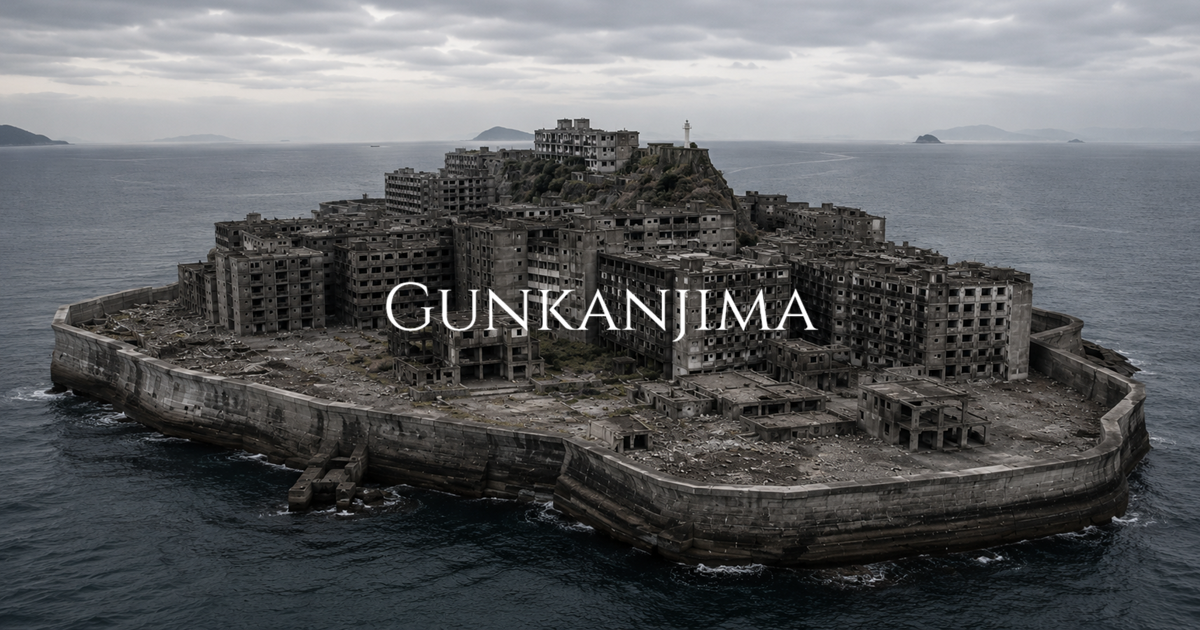
Gunkanjima — formally known as Hashima Island — is most often encountered as an image: concrete apartment blocks rising from a seawall, windows exposed to salt air, corridors open to the sky. What the image does not immediately convey is the completeness of what was left behind. This was not a factory, a warehouse, or a single structure. It was an entire urban settlement, built to sustain a workforce beneath the seabed, and abandoned within living memory.
The island’s cultural force does not depend on the scale of its ruin. It comes from the coherence of what remains. Housing, labor, education, and infrastructure were once compressed into an offshore site where land was too scarce and too costly to waste. When coal extraction ceased in 1974, that compression became a kind of preservation. The outline of modern collective life stayed visible while the life itself disappeared.
For more stories like this, explore our Haunted Places in Japan collection.
The Ruins of Gunkanjima as a Haunted Place
Gunkanjima is the common name for Hashima Island, a former coal-mining settlement off the coast of Nagasaki Prefecture. Its popular nickname — often translated as “Battleship Island” — derives from the silhouette formed by its seawalls and multi-story buildings: a dense, angular mass rising from open water, resembling a warship at anchor.
What makes the island culturally unsettling is not the presence of a ghost story but the absence of one. Gunkanjima does not require a legend. Its atmosphere is organized by structure rather than narrative — by the persistence of forms after the functions that generated them have ended.
The island’s development was never incidental to mining. It was total. Apartment blocks, schools, shops, a hospital, communal bathing facilities, roof gardens, and mining infrastructure were arranged within an extremely limited offshore area, stacked upward because horizontal expansion was impossible. The settlement was built to support continuous extraction, which meant it had to support continuous life. Domestic space and industrial space were not separated by distance. They were separated only by floor level and function.
When the mine closed and the population departed quickly, the architecture remained without transition. Rooms that had held families became empty frames. Corridors that had connected people to work, to school, to meals became passages leading to nothing. The buildings did not stop being legible. They stopped being inhabited. That gap between legibility and habitation is what defines the island’s particular kind of unease — not the uncanny of something strange, but the uncanny of something recognizable and wrong.
Coal, Concrete, and the Promise of Industrial Control
Hashima’s development belongs to a specific phase of Japanese industrial history in which coal was not simply a fuel but a foundation. It powered railways, factories, and urban expansion throughout the Meiji and early Showa periods. The island, brought under Mitsubishi ownership in the late nineteenth century, became one of the most concentrated expressions of what industrial logic could produce when applied without geographic compromise.
The offshore location imposed severe constraints: limited land, exposure to typhoons and salt corrosion, and total dependence on mainland supply chains. The response to those constraints was not withdrawal but intensification. Seawalls held back the ocean. Reinforced concrete — relatively new and expensive — was used to build structures that could withstand both the sea and continuous heavy occupation. Labor and domestic life were stacked into the same vertical footprint, organized around the demands of extraction beneath the seabed.
This arrangement expressed a particular confidence in the capacity of modern engineering to overcome geography. The environment could be enclosed. Space could be multiplied vertically. Labor could be coordinated. Permanence could be made concrete, literally. The island seemed to demonstrate that technology and planning could sustain a complete human settlement where none would otherwise be possible.
That confidence is now part of what makes the site unstable. The buildings were designed to last. They were not designed for a world in which coal would lose its economic position within a single generation. When the mine closed, the durability of the structures outlasted the system that had justified building them. What had appeared to be permanent infrastructure became obsolete almost overnight.
The island’s history also prevents any clean reading of its industrial achievement. During the wartime period, Korean and Chinese workers were brought to Hashima under conditions of coercion, working in confined underground shafts with limited safety provisions and restricted movement. This history is inseparable from the physical record. The concrete that preserved modern life also preserved a labor system whose costs were borne unevenly and are still contested. The island cannot be understood as a simple monument to industrial ambition without confronting what that ambition required.
Offshore Density and the Architecture of Isolation
The island’s cultural meaning is shaped in part by its geography. Hashima stands entirely surrounded by open water, with no gradual transition to the mainland and no neighboring settlements. Abandonment on the mainland can be approached gradually — an empty building beside occupied ones, a decaying block adjacent to a functioning street. Here, abandonment is total and bounded. Everything within the seawall belongs to the same condition.
From a distance, the island appears almost sealed. The seawall presents a continuous perimeter. Concrete rises directly from the waterline, with buildings packed close behind the barrier as if compressed inward by the surrounding sea. There is no soft edge, no transitional space between the structure and the ocean.
That compression was always part of the settlement’s logic. Because land was scarce, every available surface was used. Apartment blocks rose to accommodate thousands of residents within an area of less than seven hectares. The population density at the island’s peak was among the highest recorded anywhere in the world. Domestic life, communal facilities, educational space, and industrial infrastructure occupied the same bounded footprint, separated by vertical distance and designated function rather than physical separation.
After the population left, this density became a different kind of meaning. Apartment blocks carry associations of domestic life: cooking, sleep, childhood, routine. Schools carry associations of childhood and daily repetition. A site containing both, together with hospital space, bathing facilities, and mining infrastructure, does not simply evoke a single lost function. It evokes a lost world in its entirety.
The result is a place where absence is organized. Empty windows repeat across facades at the scale of entire residential blocks. Stairways connect levels with no one moving through them. Balconies still mark where households once divided the exterior. The settlement’s architecture continues to present the grammar of collective life, even though no sentences have been spoken for half a century.
Abandonment as Interrupted Modern Time
Ruins are often understood through distance. Ancient walls, medieval towers, and early industrial machinery invite a sense of time that has already become remote. The gap between the observer and what they are looking at is long enough to feel historical in the conventional sense. Gunkanjima does not offer that distance.
The island was emptied in 1974. The buildings that remain belong not to a historical period that has become abstract but to an era that is still within living memory — photographable, documentable, and continuous with the modern Japan that followed it. The unease this produces is different from the melancholy of ancient ruins. It is closer to the unease of encountering a recent past that has not been absorbed.
The difference is legibility. Even significantly damaged, the apartment blocks can still be understood as apartment blocks. The school building can still be understood as a school. The corridors, the balconies, the communal areas — each still presents a recognizable use, now suspended. Where an older ruin might require imagination to reconstruct its original purpose, here the purpose remains evident and the absence of activity is direct.
Abandonment on Hashima does not obscure meaning. It holds meaning in place while removing everything that gave that meaning a point.
This produces a particular temporal effect. The structures exist in a state between active use and complete dissolution — not restored enough to function, not decayed enough to become abstract. The promise of permanence that motivated their construction can still be seen in their form, but it can no longer be fully believed. Modernity built this settlement with the expectation that it would continue. The settlement continued; modernity moved elsewhere.
Industrial ruins carry this quality in a way that ruins from other periods do not. They were built through systematic confidence — in energy markets, in labor organization, in technological planning, in the presumed continuity of economic growth. When they are abandoned, the failure is not primarily architectural. It is a failure of the assumptions that organized the construction. The ruin reveals that the system itself had a lifespan, and that lifespan ended sooner than the materials used to express it.
Heritage, Memory, and the Limits of Ruin Tourism
Gunkanjima now circulates through multiple registers simultaneously: UNESCO World Heritage site, tourist destination, film location, photographic subject, and contested historical record. Its visual identity is unusually stable — the dense concrete silhouette, the seawall, the rows of empty windows — and this identity has allowed the island to be recognized far beyond the local or national contexts that shaped it.
Tourism has not resolved the island’s complexity. Visitors reach Hashima by boat and are guided along designated routes, with access restricted to a limited area near the landing point. Much of the island remains visible but unreachable: the residential blocks, the upper levels, the school, the interior of most structures. The island is observed, not entered.
This partial visibility is not incidental. It shapes the experience into one of observation across a distance that cannot be closed. The visitor confronts modern architecture — domestic, institutional, industrial — without the possibility of passing through it. The effect is different from being inside a ruin. It places the viewer in a position of looking at a world that cannot be joined, which intensifies rather than resolves the sense of separation.
Memory at Hashima is also layered in ways that resist simplification. The island can be presented as a record of Meiji and Showa industrial achievement, as a landmark of early modern concrete construction, as an unusually dense example of mid-century urban planning, and as evidence of a close-knit community organized around shared labor and limited space. At the same time, the wartime labor history introduces a record that does not harmonize easily with those framings. The same buildings that housed mining families also housed workers whose presence was not voluntary. Heritage does not dissolve that tension; it makes it structurally visible.
The island’s haunted reputation operates within this layering. It does not require claims about paranormal presence. The cultural unease attached to Gunkanjima comes from the unresolved relationship between modernity and its costs — between what was built, why it was built, and what it required of people who had no say in the matter. That unresolved quality does not disappear when the site is designated, curated, or photographed. It becomes part of what the designation is trying to contain.
Why Industrial Ruins Continue to Disturb Modern Imagination
Industrial ruins persist in cultural imagination because they make visible what modern systems prefer to leave implicit: that progress has a material form, that the material form outlasts the progress, and that the gap between them is uncomfortable to inhabit.
Gunkanjima makes this unusually concentrated. The island is not a scattered industrial district, not a factory on the edge of a functioning town, not a single building absorbed into a changing streetscape. It is a bounded settlement whose entire existence was organized around one technological and economic logic. When that logic ended, everything premised on it became structureless at the same moment. The settlement did not gradually adapt. It was vacated.
The abruptness matters. Slow decline allows communities to adjust their relationship to place over time — to convert, repurpose, memorialize, or simply move on incrementally. Rapid abandonment leaves the built form intact while removing the social processes that would normally mediate between a place and its past. At Hashima, structure and absence confront each other without that mediation.
The island also unsettles because modernity characteristically understands itself as transitional — always moving toward a more functional, more efficient, more developed state. New infrastructure replaces old infrastructure. Technologies improve and displace their predecessors. Cities absorb, expand, and redevelop. Gunkanjima interrupts this self-image by showing a modern environment that did not transition. It was not absorbed into a newer use. It was left offshore, exposed to weather and salt and the gradual dissolution of its own materials.
What remains is not nostalgia and not simply loss. It is the residue of a future that was built and then vacated — apartment blocks and seawalls and stairways designed for a continuation that did not come. The island asks not only what was abandoned but what kind of certainty once seemed sufficient to build like this.
Conclusion
Gunkanjima holds cultural force because it makes visible a form of ending that modernity does not have a clear language for. The island’s buildings are not ancient, not mythologized, not transformed into something decorative or commemorative. They are the material remains of a system — industrial, residential, social — that ended within living memory and left its physical form standing.
As a haunted place, the island does not require apparitions. What haunts Hashima is the structure itself: the apartment blocks that still imply households, the school that still implies children, the corridors that still imply movement. The implication persists without the substance. The architecture remembers a purpose that no longer exists.
The island continues to face open water as a ruin of modern confidence. It does not simply show that buildings decay. It shows that the futures built into them can become unrecognizable before the buildings themselves fall.
Related Articles
- Kiyotaki Tunnel — A mountain passage where modern infrastructure generates unease through enclosed space, restricted visibility, and the compression of movement into a single unavoidable corridor.
- Aokigahara Forest — A forested landscape shaped by silence and spatial disorientation, where collective memory has become inseparable from the physical environment itself.
- Inunaki Tunnel — An abandoned road tunnel where exclusion from access sustains persistent rumor, and the boundary of entry becomes the site’s defining cultural feature.
Sources and Further Reading
The following works provide historical, anthropological, and spatial-theoretical context for interpreting industrial abandonment, modernity, and place memory in Japan.
- Gluck, Carol. Japan’s Modern Myths: Ideology in the Late Meiji Period. Princeton University Press, 1985.
- Gordon, Andrew. A Modern History of Japan: From Tokugawa Times to the Present. Oxford University Press, 2003.
- Ivy, Marilyn. Discourses of the Vanishing: Modernity, Phantasm, Japan. University of Chicago Press, 1995.
- Augé, Marc. Non-Places: Introduction to an Anthropology of Supermodernity. Verso, 1995.
- Tuan, Yi-Fu. Space and Place: The Perspective of Experience. University of Minnesota Press, 1977.
Author’s Note
The concrete school buildings I grew up around never felt old. They were simply there — three stories of reinforced structure that belonged to daily life without requiring any particular attention. What made them briefly uncomfortable was a rumor, heard in elementary school, that something appeared near the large clock on the middle school building after dark. The clock was ordinary by day. After hearing that, it seemed to mark time differently at night.