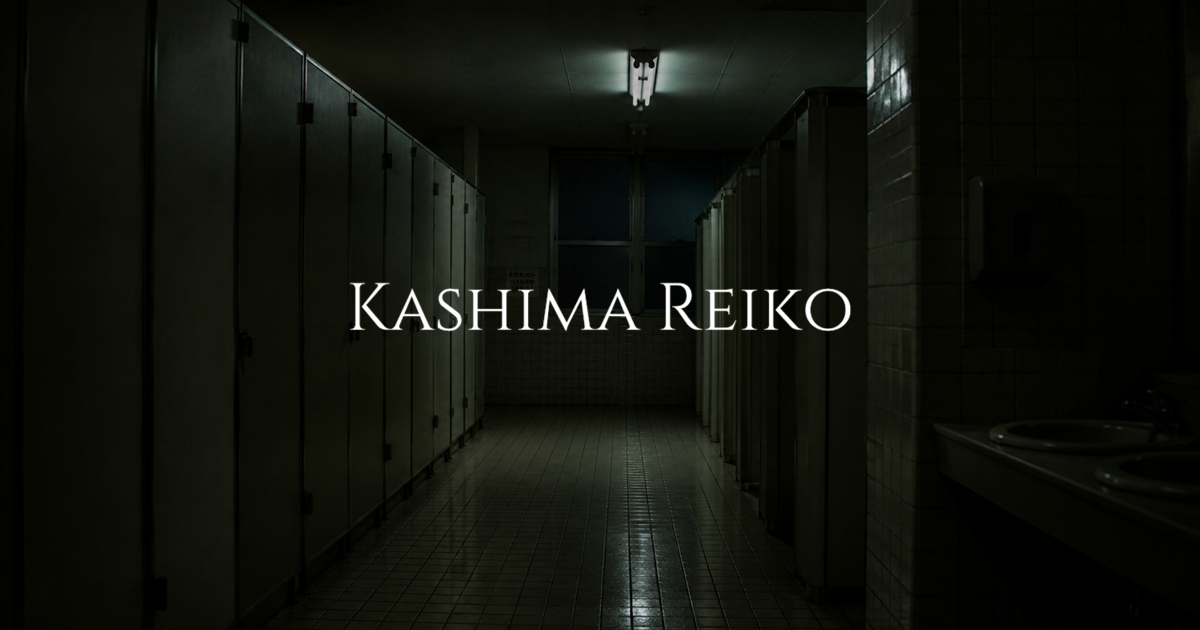
In Japanese urban legends, fear tends not to begin in distant or unfamiliar places. It begins in spaces already known — a corridor, an institutional bathroom, a room that ordinary behavior has made legible. These spaces are already governed by small social rhythms: enter, wait, respond, leave. When something interrupts those rhythms, the disruption carries weight precisely because the routine was so unambiguous.
Kashima Reiko belongs to this tradition of structured encounter. The legend takes place inside familiar environments — school bathrooms, institutional spaces — and its force comes not from the appearance of something strange, but from the demand that an ordinary person say the right thing at the wrong moment. What gives the story its persistence across decades of retelling is not the figure herself, but the verbal structure that surrounds her.
For more stories like this, explore our Urban Legends in Japan collection.
Speech, Memory, and a Question That Must Be Answered
Kashima Reiko is not best understood as a fixed narrative with a stable cast and setting. She is a repeatable rumor pattern — a legend whose structural core is more durable than any particular version of her story. Details vary from telling to telling: the wording of the question changes, her appearance shifts, the framing of the encounter differs across school years and online posts. What does not change is the form. Someone is in an ordinary space. A voice or presence addresses them. An answer is required.
That quality of repeatability is what defines Kashima Reiko as a legend type rather than a single story. She is a figure assembled from circulation rather than from a documented source, and her force comes precisely from the fact that no authoritative version exists to anchor or limit her. Different tellings do not cancel one another. They generate a field of uncertainty around the correct form of the story, and that uncertainty is where the anxiety lives.
The school bathroom setting contributes to this by providing a space that already has slightly unusual social rules. Public yet intermittently private, institutional yet loosened from classroom supervision, it is a place where sound carries in unexpected ways and where normal social visibility is briefly compromised. A voice heard from a closed stall cannot easily be verified. Kashima Reiko uses this ambiguity not for visual shock but for verbal pressure. The listener is addressed before they have a chance to look.
What makes the legend structurally distinct within the broader category of school bathroom folklore is its emphasis on language. Hanako-san centers on summoning and the crossing of stall boundaries. Aka Manto builds around forced choice with no safe exit. Kashima Reiko is organized around memory and verbal precision. The encounter demands not that you choose well but that you remember correctly — and that you have already prepared before you arrive.
Why Does the Encounter Begin with a Question?
The question is the center of the Kashima Reiko legend, and removing it would change the nature of the encounter entirely. Without it, the legend collapses into a simple apparition story: a figure appears, something disturbing occurs, and the encounter ends. The question transforms the structure. It makes the person being addressed responsible for what follows.
This responsibility is the mechanism that separates Kashima Reiko from legends organized around visual surprise or involuntary contact. The encounter is not passive. The person who hears the question cannot remain an observer — they must produce language, and the language must conform to a rule they may not yet fully understand. Tension is generated not through action but through the pressure of speech.
That pressure is recognizable outside the supernatural register. Many social situations require a correct response before the full context is clear: a formal exchange, a test, an encounter with someone in authority. The legend gives this familiar experience a figure and a place. Being addressed by Kashima Reiko is structurally similar to being called on before you are ready, except the stakes are made explicit and irreversible.
The question also gives the legend a mnemonic form. A rule embedded in a story is easier to carry than atmosphere alone. A listener might forget peripheral details — her appearance, her precise location, the specific setting — but the required answer tends to remain. This makes the legend unusually well suited to peer transmission, where oral retelling compresses naturally and stories survive by becoming portable. The core of Kashima Reiko can be passed between students in a few sentences without losing its structural force.
There is also a small social drama in the exchange between teller and listener. When someone tells the story, the listener may immediately ask what the correct answer is. The teller holds this knowledge and controls access to it. For a moment, the story functions as both a warning and a test, and the social form of instruction replicates the legend’s own internal logic. The teller becomes the figure who knows the answer. The listener becomes the person who has just heard a question they may someday be expected to answer.
Repetition, Memory, and the Pressure to Respond
Legends built around complex plots are vulnerable to distortion as details are lost across retellings. Legends built around rules tend to survive even when almost everything surrounding the rule has changed. Kashima Reiko belongs to the second type. The specific wording may drift, the setting may vary, the figure’s description may shift — but the exchange remains, and the demand that the listener remember something specific survives every compression.
This durability through repetition is not incidental to the legend. Repetition is its primary transmission mechanism. Each time the story is told, the name is repeated, the situation is repeated, and the rule is repeated. The listener is not asked to believe in Kashima Reiko in any formal or lasting sense. They are asked to retain a piece of information. The legend frames that retention as practical rather than devotional — something that might, in the right circumstances, matter.
That framing is common among urban legends that circulate among children and adolescents. Such stories are carried rather than simply remembered. The listener leaves the exchange with a rule lodged in the mind, and later, in a bathroom or hallway or institutional corridor, the memory may return without invitation. The legend has become attached to an environment through repetition, not through sustained belief.
The figure of Kashima Reiko is also kept present by this mechanism. She does not require documented origins or a stable founding narrative to remain culturally active. Each retelling of the name, the question, and the required answer constitutes a kind of presence. She persists in ordinary conversation — not in the sense that people discuss her seriously, but in the sense that the structure of the encounter is reproduced every time someone passes the story forward.
There is a discipline implied in this form that goes beyond the supernatural. To hold the correct response in reserve, to maintain the rule in memory against the possibility that it might someday be needed — this resembles ordinary social preparation. The anxiety is not limited to belief in a ghost. It resembles the anxiety of being expected to perform correctly in a situation where the full rules have not yet been explained, and where forgetting carries consequences.
The Bathroom as a Chamber of Uncertain Speech
The bathroom is not simply a setting that Kashima Reiko happens to use. It provides the specific social conditions that make the encounter structurally plausible. The rules governing bathroom use in institutional contexts are already slightly unusual. It is a shared space that nonetheless requires temporary individual separation. It sits inside the controlled environment of the school, but it occupies the edges of classroom order, where teachers are generally absent and supervision is minimal.
In a school bathroom, sound behaves differently. Tile and partition amplify and muffle in unpredictable combinations. A voice heard from an adjacent stall may be ordinary and casual — or it may be something that requires interpretation. The closed door permits conversation while deferring visual confirmation. A person may be addressed without knowing who is speaking, and without the immediate ability to resolve that uncertainty.
This partial concealment is where the question gets its charge. In most social situations, language arrives with a visible speaker whose identity, expression, and body provide context for what is being asked. In the bathroom encounter, the voice arrives without that frame. The question is heard before the questioner can be assessed. The listener is already committed to the exchange before they have had a chance to decide whether to engage.
The bathroom also contributes a specific kind of vulnerability. A person who enters the space expects solitude or functional silence — the ordinary privacy of a routine task. Kashima Reiko turns that expectation into exposure. The encounter begins precisely at the moment when the usual terms of private behavior are overridden by an address that assumes familiarity and demands response. The ordinary withdrawal of privacy is reversed.
The setting also connects Kashima Reiko to a network of school bathroom legends while preserving her particular emphasis. What distinguishes her is not the location — Hanako-san and Aka Manto share the same space — but the degree to which the encounter depends on language rather than appearance or choice. The bathroom becomes, in the logic of the legend, a small ritual chamber: not sacred, not hidden, but partially separated from the normal flow of institutional life. Inside that separation, the rules of speech briefly change.
Oral Transmission, Digital Retelling, and the Memory of a Rule
Kashima Reiko belongs to a form of folklore that survives not by maintaining a single authoritative version but by generating enough structural recognizability that each new version is identified as the same story. The legend circulates in spoken exchange, in written posts, in video summaries, in curated lists of Japanese urban legends — and across all these forms, the underlying structure remains legible even when the specific details have changed.
Earlier forms of transmission depended on student conversation in shared institutional spaces. The school is especially well suited to this kind of circulation because students move through shared routines and regularly experience moments of unsupervised exchange. A story that can be compressed into a name, a rule, and a required answer travels efficiently in these conditions. It does not require a long telling to carry its force.
Digital media extends the speed and reach of circulation without altering the essential structure. Online versions tend to shorten the legend to its most portable elements — the setting, the question, the answer. This compression occasionally flattens regional variation, but it also reinforces the ritual form: a brief post can preserve the rule more efficiently than an elaborate narrative. The legend survives compression because its structural core is already minimal.
The internet also allows the story to circulate with partial irony. Readers encountering Kashima Reiko in an online list or short summary may not approach the material with literal belief. They may read it as cultural nostalgia, as entertainment, or as a reference point within a larger catalogue of Japanese folklore. But the structure of the legend still functions, because it asks the reader to imagine a future moment of recall — a future bathroom, a future question, a remembered answer that may or may not arrive in time.
That future orientation is what gives the legend its particular durability across different modes and registers of transmission. Kashima Reiko is not only a story about what happened to someone else. It is framed, however ironically, as something that might matter if the listener enters the wrong space without having remembered correctly. The legend extends beyond the moment of telling and waits inside the memory of whoever carries it forward.
Conclusion
Kashima Reiko endures because she gives ritual form to something that does not require supernatural belief to be recognizable. The pressure of being addressed before you are ready, of being required to answer correctly under conditions you do not fully control — this is a structure that belongs to ordinary life as much as it belongs to folklore. The legend takes that structure, places it inside a familiar space, and assigns it a name.
The bathroom functions in the legend not primarily as a location for horror but as a place where the social rules that usually make speech predictable are briefly loosened. The closed door, the uncertain acoustics, the temporary withdrawal from supervision — these are real features of real spaces, and Kashima Reiko makes use of them without requiring the listener to accept anything overtly supernatural. The setting is already slightly unusual. The legend only needs to alter the terms of what speech means inside it.
What persists across every version of the story is not the figure but the exchange. Someone is addressed, placed under the requirement to respond, and left dependent on a piece of knowledge they may or may not have retained. The legend encodes that situation and passes it forward. Whoever hears the question knows that they have already been given the answer — and that the only thing standing between preparation and failure is memory itself.
Related Articles
- Hanako-san — A school bathroom legend organized around summoning and the crossing of stall boundaries, where children’s ritual transforms institutional space into a site of controlled encounter.
- Aka Manto — A bathroom urban legend built around forced choice between options that offer no safe exit, where language provides apparent escape but forecloses it in every direction.
- Kuchisake-onna — A question-based street encounter shaped by social anxiety around appearance, where the demand for a response is embedded in the logic of judgment and concealment.
Sources and Further Reading
The following sources provide academic context for contemporary legend, rumor transmission, and the cultural structure of modern folklore.
- Bennett, Gillian, and Paul Smith, editors. Contemporary Legend: A Reader. Garland, 1996.
- Brunvand, Jan Harold. The Vanishing Hitchhiker: American Urban Legends and Their Meanings. W. W. Norton, 1981.
- Goldstein, Diane E., Sylvia Ann Grider, and Jeannie Banks Thomas. Haunting Experiences: Ghosts in Contemporary Folklore. Utah State University Press, 2007.
Author’s Note
What unsettled me about Kashima Reiko was not the figure but the structure: a question directed at someone who may not have the answer, by something that already knows. The imbalance is familiar. A parent in the middle of a lecture, a teacher waiting for a student who cannot yet find the words — the same demand for a response, made from the side that already holds authority. I am not sure I have always been on the right side of that exchange.