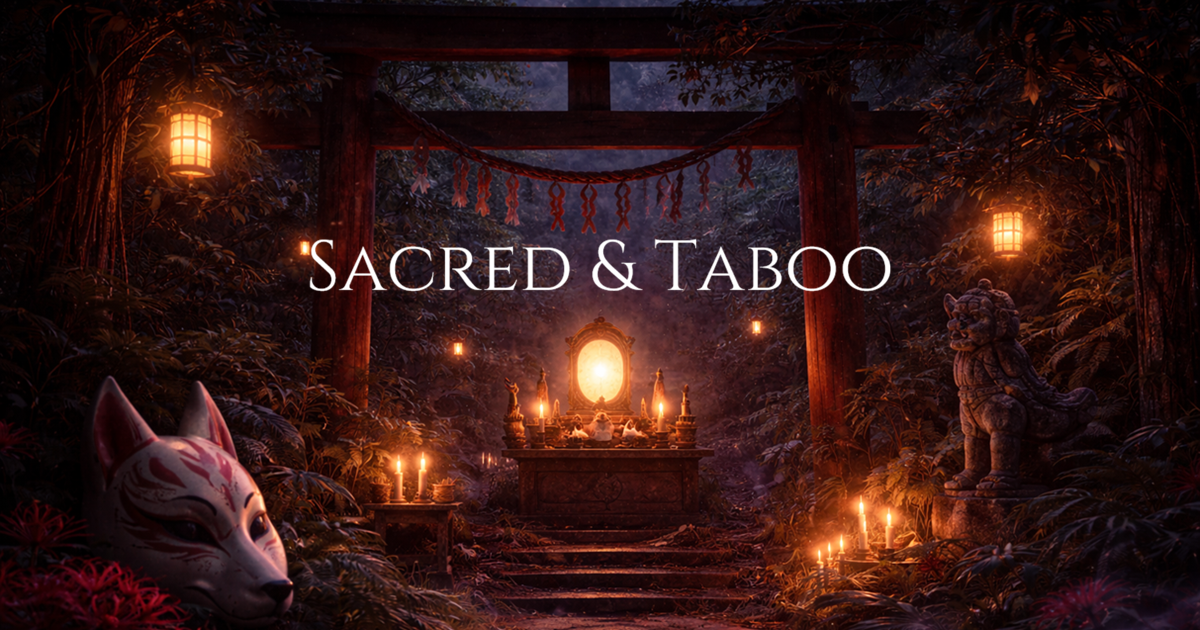
In Japan, the sacred and the forbidden are not opposites. They emerge from the same source — a persistent cultural logic that distinguishes the pure from the impure, the permitted from the prohibited. To cross that line is not simply to break a rule. It is to disturb something older and less visible than law, something that has organized Japanese life from the architecture of its shrines to the protocols surrounding its dead.
This logic is not uniform, and it is not static. It shifts with context, with season, with the specific space one enters or the category of work one performs. What it shares across all of these registers is a coherent grammar: certain things require care, certain encounters require preparation, and certain violations — whether of space, of ritual timing, or of inherited social boundaries — produce consequences that ritual must then work to address. The articles in this section follow that grammar into its particulars, including how boundaries define social order and restriction.
What Does “Taboo” Mean in Japanese Culture?
The English word “taboo” arrives in Japanese contexts with excess baggage. It implies something arbitrary, irrational, a prohibition whose origins have been forgotten or whose logic was never sound. Japanese prohibitions are rarely any of these things. They belong to a coherent system of thought that links purity, order, and spiritual integrity in ways that have shaped social practice for well over a millennium.
The most foundational concept is kegare — ritual impurity or defilement. Kegare is not moral wrongdoing in the Western sense; it is a condition that arises from contact with certain categories of experience: death, blood, illness, decay. A person who has been near death is not considered evil but temporarily contaminated, in a state that requires ritual correction before they can re-enter spaces where that correction matters. The distinction between moral and ritual status is essential, and it is one that the word “taboo” tends to obscure.
The counterpart to kegare is harae, purification. Shinto practice is organized around the movement between these two states — incurring defilement and performing the rites that restore purity. Misogi, the ritual washing associated with Shinto, is one expression of this; others include the use of salt at funeral entrances, the avoidance of certain foods before ceremonies, and the specific protocols that govern shrine priests. These are structural responses to a world in which purity must be actively maintained, because the forces that disturb it are a normal part of living — not attempts to ward off bad luck, but acknowledgments that the work of restoration is ongoing.
What distinguishes Japanese taboo from its Western analogues is its relationship to time. Kegare is not permanent. The same death in the family that temporarily bars someone from shrine participation does not bar them permanently; the period of defilement ends, the appropriate rites are performed, and the restriction lifts. The system is less about punishment than about management — acknowledging when something is out of order and knowing how to restore it.
Context shapes everything here. What is prohibited at a Shinto shrine may carry no restriction at a Buddhist temple; what is forbidden during one ritual period may be entirely permissible afterward. Outsiders sometimes read this flexibility as inconsistency, but the system is responsive to a different set of organizing principles — ones in which the meaning of an act cannot be separated from the conditions under which it is performed.
Purity, Impurity, and Shinto Cosmology
Shinto does not have a canonical text in the way that the Abrahamic faiths do. Its theology is embedded in practice — in ritual, in spatial arrangement, in the gestures performed before a shrine. The concept of kegare is among the most ancient of these embedded ideas, and it reaches into nearly every corner of Shinto-inflected life.
The origin narrative that underlies much of this is found in the Kojiki, Japan’s oldest chronicle. When the god Izanagi descends to the underworld to retrieve his dead wife Izanami, he finds her body in a state of putrefaction and flees in horror. Upon returning to the living world, he undergoes rigorous purification — washing his body in a river, generating new deities with each act of cleansing. The logic embedded in this story has never really left: death contaminates, and contamination must be addressed before the sacred can be approached.
That logic extends into the material world in ways that are still visible. Shrines are spaces of concentrated ke — vitality, spiritual presence — and they must be maintained in a corresponding state of purity. Rinsing the hands at the temizuya before approaching a shrine building is not merely ceremonial; it marks the transition from the ordinary world into a space that operates under different conditions. Animals, particularly horses and doves, have long been associated with shrines precisely because they stand outside the categories of defilement that humans must continuously navigate.
The spatial logic of purity extends outward from the shrine itself. Certain directions are considered inauspicious at certain times of year — a practice called katatagae, or directional taboo. The calendar carries its own ritual restrictions: certain months and days govern when specific activities should and should not be performed. This temporal dimension of purity has been largely obscured by modern secular life, but it remains visible in how Japanese households observe the new year, how deaths are managed in relation to ceremonial calendars, and how certain professions involving pollution — butchery, funerary work — were historically positioned at the margins of community space.
What this cosmology describes, ultimately, is a world in which the boundary between the sacred and the contaminated is not fixed but constantly in motion. Purity is not a permanent state that some people have and others lack; it is something that must be tended, lost, and recovered — a practice rather than a condition, repeated across every generation that has lived within this framework.
Death, Mourning, and Avoidance Practices
Death is perhaps the most universal source of ritual anxiety across human cultures, but the specific shape of that anxiety in Japan is distinctive, shaped by practices of distance and avoidance. It is organized not around fear of the dead per se, but around the contaminating properties of death itself — the category of kegare that death produces, and the ritual work required to manage it.
When someone dies in a Japanese household, the defilement is understood to extend outward from the event. The family enters a period of mourning — mofuku — during which they withdraw from participation in certain public and religious activities. Visiting shrines is prohibited during this period, as is sending out New Year’s cards (nengajō). These restrictions mark a changed ritual status that affects the entire household, not simply the individuals who grieve.
The practices surrounding the body itself reflect this concern with containment. The body is washed and dressed, typically in a white kimono — the color associated not with purity in the Western sense but with liminality, the state of transition between the living world and whatever lies beyond. Salt is placed at doorways to prevent the defilement from spreading further. These gestures persist in modern Japanese funerary practice, even among families with no strong religious affiliation, because they have become embedded in cultural habit rather than conscious belief.
Buddhist practice intersects with Shinto logic here in ways that are historically complex. Buddhism, arriving in Japan in the sixth century, brought with it a different relationship to death — one in which monks and priests actively engaged with funerary rites that Shinto priests were expected to avoid. This division of labor has shaped Japanese religious life for centuries: Shinto for birth and life, Buddhism for death and the afterlife. The butsudan, or household Buddhist altar, is maintained as a space for communicating with ancestors; the local shrine is visited for blessings and festivals. The two systems have long operated side by side, addressing different dimensions of a life without much need to resolve their differences.
What persists in contemporary Japan is a set of avoidance behaviors that most people observe without interrogating — the reluctance to speak ill of the recently dead, the care taken with funerary objects, the resistance to occupying a space where someone has recently died. These habits are evidence of how deeply a particular logic of contamination and care has been absorbed into everyday life, well past the point where anyone needs to articulate the reasoning behind it.
Sacred Spaces and Restricted Access
Japanese sacred spaces are not equally accessible to everyone, and this has been true for as long as the spaces themselves have existed. The restrictions are not arbitrary exercises of institutional power; they arise from the same logic of purity and defilement that governs other areas of Japanese ritual life, though they also carry historical weight that has been contested and, in some cases, substantially revised.
The most well-documented form of restricted access involves women and certain mountain or island spaces. Ōyama, the sacred mountain associated with rain and agriculture in Kanagawa, restricted women from its summit paths for centuries. Okinoshima, the remote island in Fukuoka Prefecture inscribed as a UNESCO World Heritage Site in 2017, maintains a strict prohibition on women entering at all. The justification is ritual purity — the island’s sacred character is understood to require the absence of certain kinds of contamination. The specific logic draws on the concept of kegare as applied to menstrual blood, a category of defilement in Shinto cosmology that has organized the treatment of women in ritual contexts for much of Japanese history.
That logic has a long history, and it has also been contested. The term nyonin kinzei — the prohibition of women — describes a practice that was widespread on sacred mountains during the medieval period and has been progressively dismantled in the modern era. Mount Ōmine in Nara remains the most prominent current example; it has maintained its prohibition even under considerable public and international pressure, including debates around its World Heritage designation. The priests who maintain the restriction argue that it is an inseparable part of the mountain’s sacred character. Critics argue that it is a discriminatory practice that religious designation should not protect. The argument has not been resolved.
Inner sanctuaries present a different kind of restriction. The innermost precincts of major shrines — particularly at Ise, where the imperial family maintains its strongest ritual connection — are accessible only to priests of specific rank, and in some cases only to the high priest or priestess. The logic here is not about gender but about ritual qualification: the space is considered so concentrated in sacred presence that entry by someone unprepared would itself constitute a violation, regardless of who that person was.
What these varied restrictions share is a common grammar — the idea that certain spaces carry a concentration of sacred power requiring careful management of who approaches them and under what conditions. Whether that grammar continues to justify specific exclusions in the contemporary world is a question Japanese society has not yet finished answering, and the debate around it illuminates something about how tradition and accountability coexist within living religious institutions.
Social Taboos and Historical Stigma
Not all Japanese taboos are rooted in Shinto cosmology. Some belong to the social world — to the organization of communities, the distribution of labor, and the historical machinery of caste. The burakumin, descendants of communities that performed work considered ritually impure under premodern Japanese social organization, represent the longest-lived and most consequential social taboo in Japanese history.
The work in question was primarily funerary and butchery-related — categories of activity that Shinto cosmology places in direct contact with kegare. Those who performed this work were spatially and socially segregated: they lived in designated settlements, were prohibited from intermarrying with other classes, and were barred from certain occupations and civic activities. The Meiji government formally abolished this system in 1871, but the stigma attached to buraku ancestry did not dissolve with legal abolition, persisting as a social reality enforced through discrimination in employment, marriage, and housing well into the modern period.
What makes this history philosophically significant is the mechanism by which the stigma operated. The impurity attributed to burakumin was not based on individual behavior but on category — on the work one’s ancestors had performed, on the neighborhood where one’s family had lived. Contamination, in this framework, was heritable, and no amount of personal conduct could remove it. This represents a profound distortion of the original kegare logic, which held that defilement was temporary and correctable through ritual. The social application of that logic transformed it into something fixed and structural, with consequences the original framework had no mechanism to address.
Contemporary Japan has addressed this history through legislation — the Dōwa Measures, enacted in the 1960s and continuing through subsequent legal frameworks — but discrimination has not been eliminated. Studies conducted through the 2010s documented continued disparities in marriage and employment, and the gap between official disavowal and social reality has proven difficult to close.
The burakumin case is not the only instance of socially embedded stigma in Japanese history. Attitudes toward certain illnesses — particularly leprosy, for which Japan maintained forced institutionalization well into the postwar period — also drew on the logic of ritual contamination, rendering the ill person both medically and socially untouchable. These histories illuminate how a cosmological framework can migrate from the ritual to the social sphere and acquire a momentum of its own, far exceeding anything the original framework intended or could contain.
Secrecy in Religious Practice
Japanese religious institutions maintain a category of knowledge and practice that is not intended for general access. This is not unique to Japan — esoteric traditions exist across world religions — but the specific form it takes in Japanese Buddhism and Shinto has its own logic and its own history, one that connects the withholding of knowledge to the preservation of its integrity.
The most formal expression of this is mikkyō, the esoteric Buddhism transmitted through the Shingon and Tendai schools. Mikkyō holds that certain teachings — particularly those involving mantras, mandalas, and specific ritual procedures — can only be transmitted directly from teacher to student, and only after the student has completed appropriate ritual preparation. To transmit these teachings in written form, or to a person who has not been properly initiated, would be to misuse them. The knowledge is not hidden because it threatens outsiders; it is hidden because it is too precise, too concentrated, to be correctly received without the preparation that gives it meaning.
At Shinto shrines, a parallel logic governs the treatment of goshintai — the sacred objects that serve as the physical dwelling of a kami. These objects are typically housed in the innermost sanctuary and never displayed publicly, and many have not been seen by human eyes in centuries. The priests who serve the shrine do not necessarily know what their own goshintai looks like, and this invisibility is not negligence or indifference. To expose the goshintai to the ordinary gaze would be to subject it to a form of contamination — the same logic that governs restricted access in other parts of Japanese sacred life, applied here to the act of looking itself.
This principle — that the sacred is protected by restriction rather than display — runs counter to the logic of modern religious tourism, in which visibility and accessibility are markers of significance. Japanese sacred institutions have long navigated this tension by creating zones of graduated access that allow broad participation without exposing the innermost core. The outer precincts of a shrine may be crowded with visitors during a festival while the inner sanctuary remains closed. The spatial arrangement is not a contradiction; it is a carefully constructed architecture that permits contact with the sacred while preserving what makes that contact meaningful.
The secrecy of religious practice in Japan also has a historical dimension shaped by the Meiji period’s forced separation of Shinto and Buddhism (shinbutsu bunri), and by the subsequent state control of Shinto that lasted until 1945. Religious institutions that survived this period carried with them practices of discretion developed under pressure. Some of what appears as secrecy today is, in part, a residue of institutional memory about what happens when the interior of religious life is exposed to political scrutiny.
Modern Transformations of Taboo
Taboos do not disappear when the social conditions that produced them change. They transform — sometimes into secular habits, sometimes into aesthetic sensibilities, sometimes into commodified forms of the very anxiety they once managed. Japanese taboo has undergone all three of these transformations in the modern period, with results that are sometimes surprising and rarely simple.
The association between certain numbers and misfortune is perhaps the most visible secular residue of older cosmological thinking. The number four (shi) shares its pronunciation with the word for death; the number nine (ku) shares its with suffering. Many Japanese hospitals and hotels omit these floor numbers; gift sets avoid groupings of four. This is not theological belief — few people who avoid the number four are making a conscious statement about Shinto cosmology. But the avoidance persists as cultural reflex, demonstrating how taboo logic can detach from its origins and survive as habit long after the framework that produced it has faded from conscious view.
The kowai aesthetic in Japanese popular culture — the horror films, the kaidan literature, the yokai imagery — represents a different kind of transformation. What was once a system for managing genuine cultural anxiety about contamination, death, and the sacred has become, in part, a genre. Onryō — the vengeful spirits produced by intense suffering — are now cinematic figures as much as cosmological ones. This transformation does not mean the original anxiety has disappeared; it means that the cultural imagination has found a new container for it, one that allows proximity to what the older system required to be carefully managed.
More ambivalent is the transformation of sacred spaces into tourist destinations. Aokigahara, the forest at the base of Mount Fuji with its long association with death and disappearance, now attracts visitors specifically because of that association — the taboo converted into an attraction. This is not simply commercialization; it reflects a broader cultural tendency to seek proximity to the prohibited, to approach the boundary without crossing it. The taboo functions here not as a prohibition but as a marker of significance, signaling that something important, however uncomfortable, is located in this place.
What these transformations share is continuity of function even as the form changes. The cultural work once done by explicit ritual prohibition — acknowledging that certain things are not ordinary, that certain encounters require care — continues in these secular and aesthetic registers. Japan’s relationship with the sacred and the forbidden has not been archived but renegotiated, repeatedly, by each generation that has inherited the anxiety without always inheriting the framework for addressing it.
FAQ — Japanese Taboos Explained
Are Japanese taboos based on superstition?
The word “superstition” implies belief without rational foundation, which does not accurately describe how Japanese taboos function. They emerge from a coherent cosmological system — particularly the Shinto concepts of kegare and harae — that has its own internal logic. Whether one finds that logic persuasive is a separate question from whether it constitutes a system. Many of the practices that appear superstitious from outside, such as the use of salt after funerals or the avoidance of the number four, are better understood as cultural habits carrying the residue of a long-standing framework for organizing the relationship between purity and defilement.
Why is death considered impure in Japan?
In Shinto cosmology, death generates kegare — a form of ritual contamination — not because the dead person is morally deficient, but because death represents a fundamental disruption of the vital order. The narrative precedent is ancient: even in the Kojiki, the primordial god Izanagi flees the underworld in a state of defilement that requires ritual cleansing. Family members of the deceased temporarily enter a state of changed ritual status as a result, requiring avoidance of certain sacred spaces and activities until the appropriate period of mourning has passed. The logic is about maintaining the integrity of those spaces, not condemning the bereaved.
Are women still banned from certain sacred places?
Some restrictions remain in place. Mount Ōmine in Nara is the most prominent current example of nyonin kinzei — the prohibition of women — and it has maintained this policy despite significant public debate. The sacred island of Okinoshima in Fukuoka also prohibits women from entering. These restrictions draw on the association between menstrual blood and kegare in Shinto cosmology, and they remain deeply contested. Many other historically restricted spaces have opened over the course of the twentieth century, and the continued maintenance of these prohibitions is a point of active social and legal discussion in Japan.
Do Japanese people avoid the number four?
Avoidance of the numbers four (shi) and nine (ku) — which share pronunciation with words for death and suffering respectively — is widespread enough to be considered a cultural norm rather than an individual quirk. It appears in architectural numbering, product packaging, and the composition of gifts. This is primarily a secular habit rather than a religious observance; most people who follow it do not articulate a theological reason for doing so. It represents the kind of transformation that older taboo logic undergoes over time — detaching from its cosmological origins while persisting as cultural reflex.
Are religious rituals in Japan secret?
Some are. Esoteric Buddhist traditions, particularly Shingon and Tendai, maintain teachings and practices that are transmitted only through direct teacher-to-student initiation and are not publicly documented or displayed. In Shinto practice, the goshintai — the sacred object housed in the innermost sanctuary of a shrine — is typically never displayed and in some cases has not been seen for centuries. These forms of secrecy reflect a considered view that certain kinds of sacred knowledge and presence require protection from ordinary exposure to retain their integrity — a principle of restriction as preservation rather than restriction as exclusion.
Is discrimination today based on religious impurity beliefs?
The connection is indirect but traceable. Historical discrimination against burakumin communities drew on the Shinto association between certain forms of labor — particularly funerary work and butchery — and ritual impurity. Legal abolition of the caste system in 1871 did not eliminate the social stigma, which persisted through the twentieth century in employment, marriage, and housing discrimination. Contemporary discrimination, where it persists, is rarely articulated in explicitly religious terms; it is more likely to operate through social habit, family resistance to marriage, and residential patterns. The religious logic has largely been forgotten while its social effects continue.
Are Japanese taboos disappearing?
Some have weakened substantially, particularly those tied to formal religious observance. Others have transformed rather than disappeared — surviving as secular habits, aesthetic sensibilities, or tourism phenomena. The number avoidances persist; funerary customs retain their basic structure; certain sacred spaces maintain their restrictions. What has changed is the frame: these practices are less often understood as ritual necessities and more often experienced as cultural convention. Whether that shift represents the dissolution of taboo or simply its adaptation to new conditions is a question that scholars of Japanese religion continue to debate.
Conclusion — Taboo as Social Architecture
The practices described across this pillar are not relics. They belong to a living culture that has developed, over many centuries, a highly specific way of thinking about what it means for the world to be in order — and what kinds of disruption require a response.
Kegare and harae, the contamination and purification that form the axis of Shinto cosmology, are not primitive superstitions awaiting replacement by modern rationalism. They are one answer to a question every culture must answer: how do we mark the things that matter, the boundaries that must be respected, the transitions that require attention? The Japanese answer has been to build this marking into architecture, into calendar, into the spatial layout of sacred places, into the protocols surrounding death. That marking has outlasted many of the explicit beliefs that produced it, which is itself worth noting.
What makes this worth understanding rather than merely cataloguing is the way it illuminates the connection between cosmology and social structure. Ritual purity systems do not remain contained in the religious sphere; they migrate into social life, shaping who is excluded and on what grounds, how stigma is distributed and inherited, which bodies are permitted in which spaces and under what conditions. Japan’s taboo system carries this double history — as a framework for organizing the sacred, and as a set of ideas that moved beyond that framework with consequences its originators could not have anticipated.
The questions this history raises — about restriction and access, about inherited stigma, about the rights of sacred institutions to maintain prohibitions that conflict with contemporary values — remain open. The tradition is long, and the world that has grown up around it has changed in ways the tradition was not designed to accommodate. That tension is not a failure of either side. It is where the work of understanding has to be done.
Author’s Note
Writing about taboo from outside any tradition requires a particular kind of care. The practices described here are not curiosities; they are, or were, living frameworks for organizing experience — some of which have caused real harm, and some of which continue to do so. I have tried to present them with the attention they deserve, describing their internal logic without obscuring the questions that logic raises.
Japan’s relationship with the sacred and the forbidden has produced some of the most refined ritual architecture in human history, and has also been used to justify exclusions that damaged lives. Holding both at once, without collapsing the tension into easy judgment, seems like the only honest way to approach the subject. The articles in this section follow specific practices and places into their details, where these patterns become particular, historical, and human.