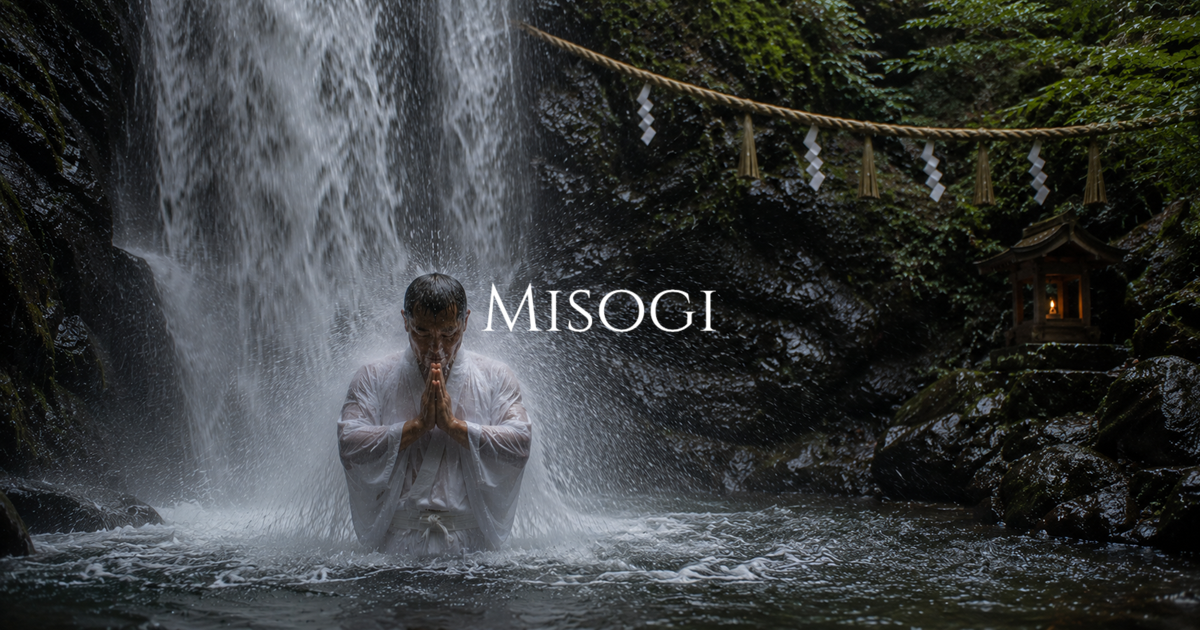
Misogi is usually pictured as a single image: a figure in white beneath a waterfall, the body nearly lost inside the force of falling water. The picture looks severe, but severity is not the point of it. Misogi is a practice of purification in which water, breath, posture, and controlled movement separate a person from ordinary conditions and prepare the body for a different kind of attention.
For more stories like this, explore our Sacred & Taboo collection.
Misogi as a Tradition of Bodily Purification
Misogi is a Shinto-associated practice in which contact with water restores ritual readiness; it is not a punishment for wrongdoing, and it is not primarily a test of physical endurance, even though it can look like one from outside. Its forms include immersion in rivers and the sea, standing beneath waterfalls, and other disciplined encounters with flowing or gathered water, distinguished from ordinary bathing by the sequence surrounding them.
The most recognizable form places a practitioner beneath cold, moving water. Participants may wear white garments, recite prayers, regulate their breathing, follow set movements, or enter as part of a group. These elements keep the act from turning into an improvised contest with the cold. The body moves through a sequence in which order carries as much weight as the water itself.
Misogi sits within the wider practice of harae, Shinto purification in general, though the two terms are not simply interchangeable. Harae can be carried out through prayer, ritual objects, offerings, or the actions of a priest on someone’s behalf. Misogi gives particular weight to physical contact with water: purification is not only requested or received, it is performed by the body itself, through breath, posture, exposure, and motion.
This physical weight also separates misogi from the brief rinsing done at a shrine basin. Before approaching a sanctuary, visitors commonly wash their hands and mouth at a temizuya. The gesture is small and folded into ordinary shrine etiquette, but it follows a related pattern: pause, set aside everyday conduct, undergo a cleansing act, proceed in a more prepared state.
Water here is not a sacred substance acting on its own. Its meaning comes from the relationship between environment and discipline. Current, temperature, sound, breath, and physical restraint combine to mark a passage from one condition into another. Purification becomes something the body carries out, not an idea simply pronounced over it.
From Izanagi’s Washing to Shinto Practice
The ritual importance of water reaches back into one of the founding narratives of Japanese mythology. After entering Yomi, the land of the dead, Izanagi returns carrying the contamination of contact with death. He removes his clothing and washes in water, separating the condition of Yomi from the world of the living and restoring order to his own state.
The story sets a lasting pattern among death, impurity, separation, and renewal. Izanagi is not treated as morally at fault for entering Yomi. The problem is contact itself: he has crossed into a condition that cannot simply be carried back unaltered.
Purification therefore responds to a situational disturbance rather than a lasting flaw. Someone touched by death, illness, grief, exhaustion, conflict, or ritual disorder is not thereby made corrupt. The condition still needs attention, but it is something that can be removed, redirected, or allowed to pass.
This logic connects closely to kegare, a term often rendered as impurity or pollution, though neither word maps cleanly onto it. Kegare does not correspond to dirt, sin, or personal guilt. It names a state in which vitality, order, or proper separation has weakened. Death is its clearest expression, since it marks both the end of a life and a disturbance in ordinary social relations, but other destabilizing conditions can prompt the same response.
Misogi gives that structure a physical channel. Water carries away what should not remain attached to a person. Flowing water suits the task particularly well, since it holds no fixed shape of its own: it arrives, makes contact, and moves on past the body.
Water purification took different shapes across religious history in Japan. Shinto practice placed cleansing before approach to kami, while mountain ascetic traditions folded rivers and waterfalls into disciplined cycles of prayer, breath, and bodily restraint. Local customs, individual shrine lineages, and later religious movements each produced their own version of misogi, so no single performance stands for the practice as a whole.
What holds constant across these variations is the emphasis on preparation. Water appears before prayer, training, entry, renewal, or return. Misogi belongs less to a language of final transformation than to the repeated work of crossing a boundary in the right condition.
Why Cold Water Changes the Ritual Body
Cold water matters in misogi not because discomfort carries spiritual value on its own, but because cold interrupts ordinary bodily control. Breathing shortens, muscles tighten, thought narrows, and attention is pulled toward the immediate physical moment. Habits that normally pass unnoticed become impossible to ignore.
Ritual discipline reorganizes that reaction. Participants may prepare through stretching, rowing-like arm movements, chanting, prayer, or patterned breathing before entering the water. These actions warm the body, coordinate a group, and set a rhythm that can hold under pressure. The cold is met, then, not as raw shock but as one stage in a prepared sequence.
Under a waterfall, sound narrows awareness further. Conversation becomes difficult, the surrounding landscape recedes, and the body has to answer the water striking the head and shoulders. A practitioner cannot easily hold onto the posture, pace, or drifting attention of daily life. Water breaks that continuity.
This interruption is part of why cold water, rather than warm, is tied to purification. Warm water soothes the body and invites gradual relaxation. Cold water draws a sharper line between before and during, shelter and exposure, ordinary movement and ritual attention — a line felt in the body, not only understood by the mind.
Physical strain by itself, though, does not produce purification. Without preparation, form, and interpretation, cold water is simply cold water. Misogi turns exposure into practice by regulating when the encounter begins, how the body enters, what words are spoken, how breath is held, and when the participant withdraws.
The white garments common in formal practice add to this reduction of ordinary identity. White carries several ritual associations in Japan, among them purity, sacred attendance, and death. Under falling water, personal style and social distinction fade from view. The body reads less as a private self and more as a participant occupying a set ritual position.
None of this erases individual experience. Cold may bring fear, sharpened focus, discomfort, exhilaration, or stillness, depending on the person. What the ritual does is hold these responses inside a shared movement and an inherited form, rather than leaving them to run their own course.
Misogi therefore makes the body both the object and the instrument of purification. It receives the water, follows the sequence, and gives the transition a visible shape. Spiritual preparation is not set apart from physical condition; it is organized through it.
Flowing Water and the Release of Kegare
Water suits purification because it moves across surfaces, changes shape, and carries material away from where it started. Misogi draws on these visible properties without reducing the ritual to hygiene. The water cleans, but its cultural weight lies in what movement lets a practitioner imagine and act out.
Flow matters because it gives direction to removal. What reaches the body does not stay there. It passes over the skin, joins the current, and continues past the ritual site. Purification is expressed less as the destruction of impurity than as its separation and departure.
This distinction matters because kegare is not treated as something foreign to ordinary life. Many of its causes are unavoidable. People grow exhausted, families encounter death, bodies pass through illness and childbirth, and communities move through conflict, grief, and the turn of seasons. Impurity accumulates simply because ordinary life keeps bringing different conditions into contact with one another.
A practice built around flowing water accepts that recurrence. Misogi does not promise a permanent state of purity. A practitioner returns to daily life, where disturbance can gather again. Repetition is not a sign that purification has failed; it belongs to the underlying premise that purity has to be restored, not owned outright.
Purity, in this frame, reads closer to readiness than to moral perfection. A purified person is prepared to approach a kami, enter ritual space, begin training, or rejoin collective activity. The aim is not to stay untouched by the world, but to recover a workable relationship with it.
The natural setting reinforces this logic. Waterfalls often sit in mountain valleys where settlement gives way to forest, rock, and steep ground. Rivers and shorelines mark similarly unstable edges between land and water. These places are already physically transitional, before ritual interpretation adds a further layer of meaning.
Japanese religious tradition has long treated mountains as spaces of withdrawal, training, and encounter. Water descending through them links an upper landscape to the human world below. To stand inside that flow is to place the body within a movement that is already underway.
The practitioner does not control the waterfall. Its force cannot be negotiated through intention alone. Ritual discipline is aimed instead at posture, breath, voice, and endurance. The environment stays larger than the person undergoing purification, and that imbalance keeps the act from turning into a display of personal mastery.
Discipline Before Entry
The moment beneath the waterfall is only one part of misogi. Its meaning also depends on what happens before and after it: bowing, prayer, warming movements, instruction, entry in a set order, and withdrawal at an agreed signal. Preparation and return give the exposure its ritual frame.
This surrounding structure keeps the practice from becoming a simple contest of endurance. A participant does not just arrive, withstand the cold, and leave with a personal story of toughness. The body is placed in relation to a site, a religious lineage, a group, and a sequence of actions that existed before the individual entered it.
Group practice makes this especially visible. Shared chanting and synchronized movement help regulate breathing and fear, but they also bind participants together socially. Each person takes in the water through an individual body while remaining inside a collective rhythm. Purification prepares not only isolated individuals, but a temporary ritual community.
This social alignment sets misogi apart from modern practices built around self-optimization. A participant may come away with clarity or sharpened concentration, but the traditional structure does not start from an autonomous individual chasing a private breakthrough. The act is aimed at readiness, proper approach, and participation inside an inherited form.
A related pattern shows up in less demanding forms of purification. At a shrine, visitors wash before prayer, not after. The gesture does not reward completed devotion; it sets the condition under which devotion can begin.
Everyday custom often follows a comparable logic. Shoes come off before stepping onto a raised interior floor. Bodies are washed before entering a shared bath. Rooms are cleaned before guests arrive or seasonal observances start. These practices are not forms of misogi, and their histories should not be folded into it, but they share an attention to the condition in which entry occurs.
A threshold, in this light, is more than a line between two spaces. It places a demand on whoever crosses it. Bodily and social conditions do not carry over unchanged into every setting. Footwear, posture, language, clothing, or cleanliness may all need adjustment before participation becomes appropriate.
Misogi enlarges that demand until it is impossible to overlook. What ordinary etiquette handles through small gestures, the ritual carries out through force, exposure, and cold. Preparation stops being a quiet preliminary step and becomes something felt through the whole body.
Misogi in Contemporary Japan
Misogi continues within shrine communities, religious organizations, mountain traditions, martial disciplines, and local groups, though its form varies considerably from one setting to the next. Some practices take place beneath waterfalls, others in rivers, seawater, buckets of cold water, or designated purification areas. Participation may be regular, seasonal, preparatory, or tied to a specific ceremony.
Winter performances draw disproportionate public attention because they make for striking images: participants in white garments standing in icy water while onlookers stay bundled in coats along the bank. Media coverage often frames the scene as an unusual feat of endurance, an emphasis that can flatten the ritual down to temperature and spectacle.
For practitioners, cold may matter precisely because it rules out casual participation. The body has to be prepared, movement controlled, attention held. Suffering, though, is not necessarily the point. When hardship becomes the main story, personal tolerance starts to crowd out the ritual structure that gives the act its meaning.
The word misogi also carries a metaphorical life in contemporary Japanese speech. A difficult stretch, a public setback, or a demanding experience can be described as a kind of misogi when it seems to clear away past failure and open the way back. No water is involved, but the older pattern still shows through: exposure, purification, renewed standing.
Wellness and self-discipline culture have produced a further reading. Cold-water exposure is sometimes presented as a mental reset, a way to sharpen focus, or a test of resilience. These ideas overlap with parts of the traditional practice, since breath, bodily control, and interruption genuinely belong to both. The difference sits in what the experience is meant to prepare a person to enter next.
Once separated from shrine practice, prayer, inherited sequence, and the framework of ritual purity, misogi can turn into a technique aimed at individual improvement. The body is still tested, but the destination changes. Instead of readiness for sacred or collective participation, the goal may shift toward productivity, confidence, or private transformation.
Tourism produces a comparable shift. Some religious sites now let visitors experience waterfall purification under supervision. Such programs can introduce outsiders to the practice, but they also compress an inherited discipline into something that has to be explained, scheduled, and finished within a single visit. The waterfall becomes both ritual site and destination at once.
None of this necessarily empties misogi of meaning. Rituals rarely stay untouched by social change, and their significance depends on who performs them, where, under what teaching, and what participants believe they are preparing themselves to do. Across these varied contemporary forms, one intuition holds steady: a change of condition sometimes needs more than thought. The body has to stop, enter, endure, and emerge. Water marks the boundary across which that change becomes something a person can actually feel.
Conclusion
Misogi places purification somewhere it cannot stay abstract. Cold reaches the skin, moving water interrupts the breath, and disciplined movement gives the encounter a definite shape. The ritual makes separation visible by making it bodily.
Its logic does not rest on the idea that a person can remain permanently pure. Ordinary life brings exhaustion, grief, illness, death, and disorder, so purification has to be repeated. Water does not erase these conditions or lift the practitioner above them. It creates a temporary distance from which a proper relation to the world can be restored.
The waterfall makes this pattern unmistakable, but the quieter version runs through daily life as well: before certain thresholds, a person changes their condition first. Misogi turns that expectation into a full bodily act, so renewal reads not as an escape from the world, but as preparation to enter it again.
Related Articles
- Kegare — Treats impurity as a temporary disruption of vitality and order, the condition misogi answers through water and bodily discipline rather than moral judgment.
- Sacred and Forbidden — Examines how boundaries regulate access to spaces, objects, and actions, while misogi prepares the body itself to cross such boundaries.
- Death and Avoidance — Traces the linguistic and behavioral distance built around death, the condition most closely tied to ritual impurity in Japanese culture.
Sources and Further Reading
The following works offer historical, anthropological, and comparative context for Shinto purification, the concept of kegare, and the ritual use of water and bodily discipline in Japan.
- Reader, Ian, and George J. Tanabe Jr. Practically Religious: Worldly Benefits and the Common Religion of Japan. University of Hawai’i Press, 1998.
- Douglas, Mary. Purity and Danger: An Analysis of Concepts of Pollution and Taboo. Routledge, 1966.
- Blacker, Carmen. The Catalpa Bow: A Study of Shamanistic Practices in Japan. Routledge, 1999.
- Ono, Sokyō. Shinto: The Kami Way. Tuttle Publishing, 1962.
- Turner, Victor. The Ritual Process: Structure and Anti-Structure. Aldine Publishing, 1969.
Author’s Note
Misogi rarely crossed my mind growing up—until I began hearing the word used in a very different way. When a politician caught in scandal wins re-election, commentators sometimes declare that their “misogi is complete,” as if a single vote could stand in for the water. I had always understood purification as something that could never be completed once and for all, so each time I hear the phrase, I am struck by how conveniently an unfinished practice has been turned into a finished event.