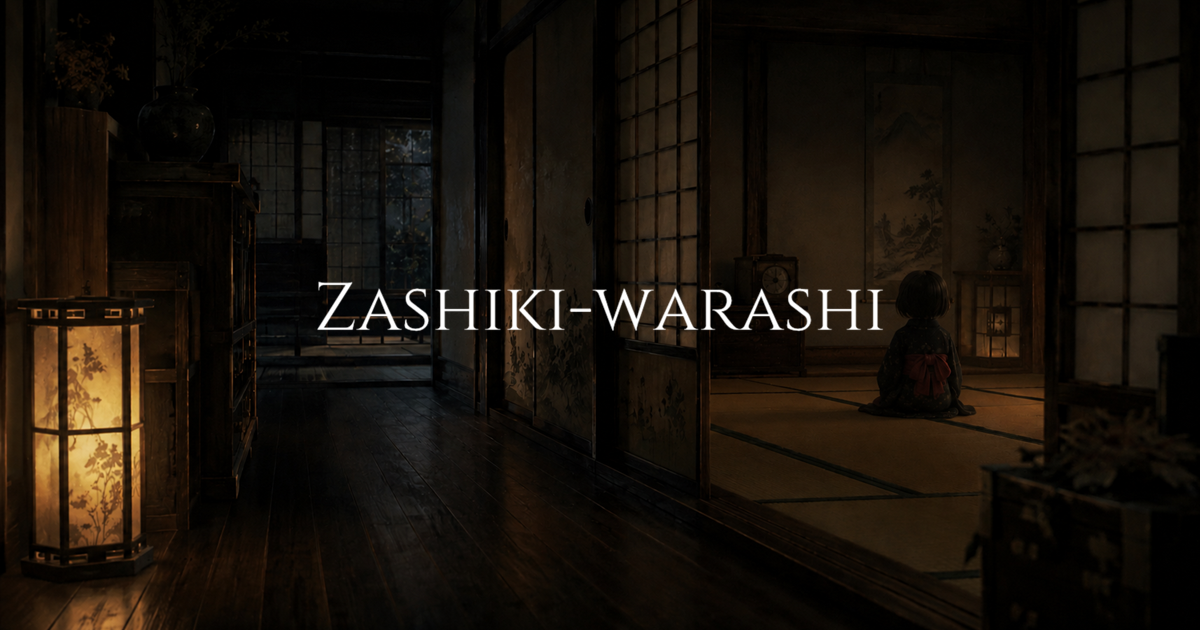
Zashiki-warashi occupy a quiet corner of Japanese folklore precisely because their danger, if it can be called that, never leaves the house. Rather than marking a road, a river, or a mountain pass, this yōkai marks a threshold inside the home itself — the line between a household that feels occupied by more than its residents and one that does not.
Traditionally associated with the Tōhoku region, especially Iwate, zashiki-warashi are known less through direct sighting than through residue: a set of footsteps crossing an empty tatami room, a sliding door that seems to move on its own, the sense that someone has just passed through a corridor a moment before. A household said to house one is expected to flourish. A household it has left behind is expected to fall into decline.
What the folklore preserves is an older logic of the home — not as a fixed structure but as something that accumulates condition over time, shaped by ancestry, obligation, and the slow buildup of daily use. The unseen child figure gives that logic a form: prosperity, in this reading, is not simply held. It is hosted, and it can leave.
For more stories like this, explore our Yokai & Supernatural Folklore collection.
What Is a Zashiki-warashi?
A zashiki-warashi is a child-shaped household spirit in Japanese folklore, most closely tied to the Tōhoku region, whose presence has traditionally functioned less as a threat than as a domestic barometer — evidence that a home remains in good standing with whatever sustains it. The name itself locates the figure precisely: zashiki names the tatami-floored reception room at the heart of a traditional house, and warashi is a regional word for child.
That naming already separates zashiki-warashi from most other yōkai. Where figures tied to bridges, wells, mountain paths, or field boundaries mark the edges of settled space, this spirit belongs to the interior. Its geography is made of corridors, alcoves, storehouses, and the particular hush of a room believed to be empty.
Descriptions of its appearance vary — a small child, sometimes with a bobbed haircut or a flushed face, dressed in the manner of an earlier era — but many accounts never resolve into a clear image at all. What gets reported instead is the impression of small feet crossing a floor, a futon that shifts without cause, the faint sense that someone has just left the room. Visibility, here, is partial by design.
That partiality is the point. A zashiki-warashi rarely confronts; it is inferred from the texture of a house rather than encountered directly, as though the building itself had absorbed something childlike into its rooms. And this is what separates the figure most clearly from yōkai built around disruption: where those spirits announce misfortune, the zashiki-warashi’s disappearance is what announces it — its presence is read instead as continuity, its departure as the first sign that a household’s fortunes are turning.
Rather than a single narrative figure, then, zashiki-warashi functions as a way of reading domestic space itself — a recurring answer to a question every household eventually asks in one form or another: what does it mean for a house to feel inhabited by more than the people who live in it?
The Domestic Room as a Site of Folklore
The zashiki was never a neutral backdrop. In a traditional Japanese house, this tatami room carried social and ritual weight — the place where guests were received, ancestors acknowledged, and the household’s public face assembled. A spirit rooted in that specific room is rooted, by extension, in the inner order of the family itself.
Much of Japanese folklore locates the uncanny at the edge of settled life — crossroads, shorelines, forest boundaries, the places where one kind of order gives way to another. Zashiki-warashi folklore turns that logic inward. Its boundary is not between village and wilderness but between the household as visible arrangement and whatever keeps that arrangement functioning.
This inward focus matters because a house is never only its architecture. It holds repeated gestures, inherited objects, half-remembered voices — accumulations that resist being counted as property. A room can feel occupied by decades of use even when no one currently stands in it, and zashiki-warashi folklore gives that feeling a shape small enough to imagine: a child, present but never fully accounted for.
The smallness carries its own logic. A child in a house signals incompletion — a household still oriented toward what comes next rather than a story already finished. Encoded into the figure, then, is something closer to lineage than haunting: a presence that can be sensed without ever being settled into fact.
Fortune, in this framing, becomes something closer to atmosphere than accounting. A household that is thriving simply feels different to move through — warmer, more continuous — and the zashiki-warashi belongs to that feeling rather than to any single visible cause.
Household Prosperity and Invisible Balance
The prosperity attached to zashiki-warashi was never purely economic. It described a wider condition: whether a family line continued, whether a home stayed occupied, whether relationships within it held together. Fortune here is closer to balance than accumulation.
That framing fits a broader pattern in Japanese religious life, where worldly benefit has often been understood relationally — dependent on proper standing among people, places, ancestors, and local powers rather than achieved by an individual acting alone. A household’s good fortune was never treated as something it simply possessed outright.
Zashiki-warashi gives that relational idea a domestic shape. Its presence signals that a house is in order, but the stories rarely isolate a single cause — hospitality, memory, and inherited care all blur together into something the folklore declines to fully explain.
Departure, correspondingly, carries more narrative weight than arrival. When the spirit leaves, decline follows: the family’s standing weakens, the home grows quieter or emptier. Loss of prosperity is narrated, almost without exception, as loss of presence — which implies something specific about how fortune was understood: as fragile precisely because it depended on conditions no household could command outright.
There is also a structural inversion worth naming. A child requires protection, yet in these stories the child figure protects the household instead. Care runs in both directions at once — the house shelters the unseen child, and the child, in turn, becomes proof that the house itself remains sheltered.
Signs, Sounds, and the Unseen Child
Most zashiki-warashi accounts skip the dramatic encounter entirely. What accumulates instead are signs — footsteps, faint laughter, a sensation of nearby movement, a glimpse of a child who cannot be placed among the family present.
These details stay modest because domestic life already produces plenty of ordinary sound. Floors settle, doors shift, bedding holds the shape of whoever last used it. Folklore does not add new sounds to a house; it changes how existing ones get interpreted, turning ordinary creaks into something that might mean.
Ambiguity keeps the figure from settling into a fixed image — heard but not seen, glimpsed but never confirmed. That unresolved quality keeps attention on the household itself rather than on the spirit as a discrete character; the real question each account is asking is not what the child looks like, but what its traces say about the condition of the place.
The unease it produces is domestic rather than foreign. A child’s footsteps are among the most familiar sounds a house can hold. When those footsteps appear without a visible child attached to them, nothing foreign has entered — the familiar has simply been displaced, and the house seems to contain more domestic life than the family currently living there can account for.
That distinguishes this folklore from hauntings built around rupture. A strange sound in a zashiki-warashi story rarely signals invasion. More often it signals surplus — a household carrying more presence than its visible occupants alone would explain, and asking to be left partly unresolved rather than confirmed.
Regional Memory and the Tōhoku Household
Zashiki-warashi are strongly rooted in northeastern Japan, particularly Iwate and the wider Tōhoku region, and that regional grounding gives the folklore a specific texture — tied to older farmhouses, family lineages, rural inns, and communities where domestic continuity across generations was assumed rather than remarkable.
Tōhoku has often stood in modern Japan as shorthand for rural endurance and older custom, an association that can flatten into cliché when viewed from outside. Within zashiki-warashi folklore, though, the regional setting still does real work: the figure belongs to houses where time accumulates rather than resets with each new occupant.
Rural households in this tradition were never purely private residences. They functioned as units of labor, inheritance, and local identity — carrying a family’s past and future alongside its present. A spirit living inside such a structure could plausibly read as part of the household’s ongoing life rather than as an intrusion into it.
This is also where zashiki-warashi folklore attaches most visibly to specific buildings. Certain historic inns have become known for rooms where guests report footsteps, brief impressions, or an atmosphere the building itself seems to hold. These places matter less as destinations than as evidence of how thoroughly the folklore depends on architecture — on wooden corridors, worn tatami, and old staircases doing as much narrative work as any plot.
That grounding keeps zashiki-warashi from flattening into a generic household charm. Its meaning stays tied to a specific relationship between house, lineage, and place — one that depends on domestic space being embedded in a real history of settlement.
Modern Homes and the Longing for Presence
Contemporary Japan has largely dismantled the conditions that once made this folklore feel like common sense. Many households now live in apartments or rented spaces without long generational continuity — homes that may be carefully arranged but remain, in a structural sense, temporary.
Against that backdrop, zashiki-warashi has taken on a slightly different charge. It still signals prosperity, but it now also carries something closer to longing: a wish for a house shaped slowly, over years, by objects and habits that outlast any single occupant’s stay.
Popular media tends to render the figure gently — nostalgic, protective, approachable enough for children’s stories or regional mascots. That softened surface has not erased the underlying structure, though; the spirit still marks the possibility that a home might hold an interior life beyond what its residents can see.
Tourism has reshaped the folklore in its own way. Visitors to inns associated with zashiki-warashi are not necessarily seeking confirmation of anything supernatural. Many are drawn instead to an atmosphere — tatami, low light, old wood — where an older idea of domestic depth still feels architecturally available, even briefly.
In cities, the figure can also register an absence. A well-designed apartment can be efficient and clean without ever becoming rooted, and zashiki-warashi stories preserve the image of a home that has accumulated enough life to be, in some sense, accompanied. That is what allows the figure to move so easily between folklore collections, tourism, and children’s media without losing its core question: what turns a dwelling into a household, and what kind of presence lets prosperity feel like more than a number.
Conclusion
Zashiki-warashi are usually filed under household spirits, but their real work is interpretive: they turn a house from a private structure into something read as a living environment, shaped by memory and inherited care as much as by architecture.
Their tie to prosperity was never really about wealth. The fortune the figure represents is quieter than that — a household flourishes because something inside it stays present, because its rooms feel occupied by continuity as well as people, because its condition resists being fully measured.
That the figure still circulates suggests the idea of a genuinely inhabited house has not lost its pull, even as fewer homes carry visible traces of generations passing through them. The unseen child stays just short of confirmation, and that unresolved quality is doing real work — a house is not most alive when everything in it can be accounted for, but when something in it can still be felt.
Related Articles
- Tsukumogami — Objects animated through decades of use, showing how domestic time itself can accumulate into presence rather than merely wear.
- Tanuki — A shape-shifting figure whose association with abundance is unstable and playful rather than quietly structural, marking a different relationship between yōkai and household fortune.
- Kitsune — Fox spirits operate at the boundary of protection and deception, holding an ambiguity that zashiki-warashi’s unambiguous domestic benevolence does not share.
Sources and Further Reading
These sources ground the household, folkloric, and religious context behind zashiki-warashi and the broader logic of worldly benefit in Japanese tradition.
- Foster, Michael Dylan. The Book of Yōkai: Mysterious Creatures of Japanese Folklore. University of California Press, 2015.
- Foster, Michael Dylan. Pandemonium and Parade: Japanese Monsters and the Culture of Yōkai. University of California Press, 2009.
- Komatsu, Kazuhiko. An Introduction to Yōkai Culture: Monsters, Ghosts, and Outsiders in Japanese History. Japan Publishing Industry Foundation for Culture, 2017.
- Reader, Ian, and George J. Tanabe Jr. Practically Religious: Worldly Benefits and the Common Religion of Japan. University of Hawai’i Press, 1998.
Author’s Note
No one in my family ever spoke about anything living in the house. What I remember instead is the feeling arriving on its own — the quiet question of whether someone was there, though it never resolved into a room, a sound, or a moment I can point to. It did not feel frightening. It was closer to a question the house seemed to ask, one I never expected to be answered.