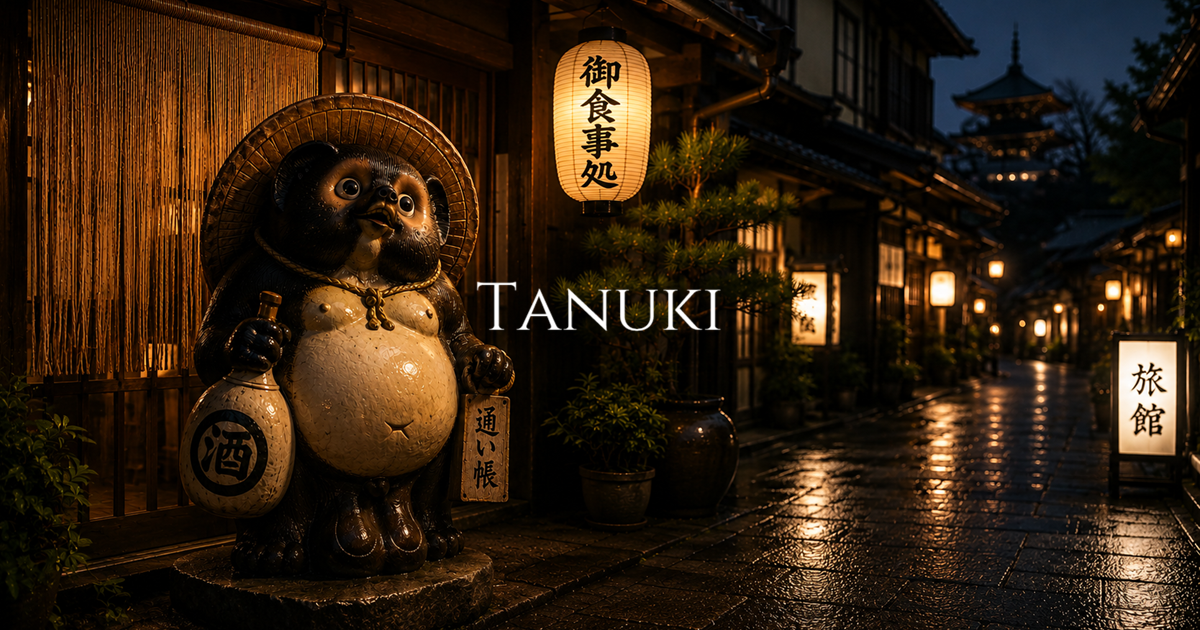
Tanuki occupy a distinctive place in Japanese folklore because their transformations stay close to the surfaces of ordinary life. They appear around roadsides, shops, inns, and places of social exchange, where disguise functions less as a source of danger than as a way of loosening fixed roles. Their humor matters because it allows uncertainty to remain visible without becoming hostile.
As yōkai, tanuki are associated with illusion, prosperity, and adaptability, but their cultural meaning depends entirely on the tone of that transformation. Unlike shapeshifters whose ambiguity points toward sacred distance or bodily unease, tanuki turn unstable appearances into something social, comic, and widely tolerated.
For more stories like this, explore our Yokai & Supernatural Folklore collection.
Shapeshifting at Street Level
A tanuki is a Japanese raccoon dog, but in folklore the name also refers to a shapeshifting yōkai associated with disguise, illusion, humor, and good fortune. Tanuki are said to change form, imitate human beings, alter the appearance of objects, and produce temporary scenes convincing enough to mislead those who encounter them.
Their transformations place them within a wider world of animal yōkai, especially alongside kitsune. Yet the cultural register of the tanuki is different. The fox tends to carry sharper associations — sacred authority, possession, seduction, or hidden intelligence operating at a remove from human comprehension. The tanuki’s ambiguity sits closer to the ground. It belongs to the roadside, the shopfront, the tavern, the village path, and the unremarkable transactions of daily life.
This difference can be read in the tanuki’s familiar appearance. A round belly, straw hat, sake bottle, and promissory note are not random comic props. They position the tanuki within a recognizable world of travel, hospitality, credit, drinking, and improvised exchange — a world where appearances are regularly performed and occasionally misleading.
The tanuki is therefore not simply a trickster who deceives. It is a figure through which Japanese folklore imagines unstable appearances in a form that society can laugh at, absorb, and return to use.
How Does Transformation Become Comedy?
Transformation in tanuki folklore tends toward humor because it exposes how easily social appearances can be arranged. A tanuki might appear as a monk, a traveling merchant, a respectable elder, or an object that seems valuable. The deception itself matters less than what it reveals: that a robe can suggest devotion, a posture can imply authority, a surface can produce trust.
This is where tanuki diverge from more threatening forms of shapeshifting. Their disguises disturb perception without dismantling the social world around them. The mistake may be embarrassing or absurd, but it is almost always survivable. A tanuki trick becomes a comic lesson about how much ordinary interaction depends on performance — and how fragile that performance is when examined.
The key is that tanuki transformation operates at the level of social ambiguity rather than supernatural terror. The tanuki does not only cross the boundary between animal and human. It crosses smaller, more familiar thresholds: guest and host, buyer and seller, poverty and prosperity, sincerity and pretense. These are not distant metaphysical divisions. They are the flexible categories through which daily life is organized and continuously renegotiated.
Humor makes this tolerable. If every unstable appearance provoked fear, social exchange would become paralyzed. Tanuki stories allow people to acknowledge uncertainty while keeping it within a shared comic frame. The world is unreliable, but not always hostile. Someone may be fooled, but the story can be told again, laughed at, and folded back into communal life without permanent damage.
Prosperity as Social Exchange
Modern tanuki statues appear outside restaurants, izakaya, inns, and small shops throughout Japan. They are commonly read as symbols of welcome and good fortune, but the kind of prosperity they embody is not purely material. Tanuki prosperity is social prosperity — the circulation of food, drink, trust, hospitality, and mutual tolerance that keeps commercial life moving.
The placement of these figures matters. A shop entrance is a threshold where strangers become customers, where money becomes a shared meal, and where public space briefly turns into something hosted and intimate. The tanuki belongs at this point of transition because it represents precisely the flexible social exchange that makes such places work.
Its objects reinforce this role. The straw hat signals readiness for changing conditions and the uncertainties of travel. The sake bottle connects the figure to conviviality and shared appetite. The belly suggests ease and abundance. The promissory note points toward credit, trust, and the willingness to extend a relationship beyond a single transaction. Taken together, these details make the tanuki less a distant supernatural presence than a symbolic participant in everyday commercial exchange.
This is not simply a modern or decorative association. The tanuki adapts because adaptation is already its defining quality. A shapeshifting yōkai can become a roadside statue, a shop guardian, a mascot, or an illustration without losing its internal logic. Its form changes; the cultural pattern remains.
Three Registers of Transformation
Tanuki, kitsune, and rokurokubi all unsettle the boundary between appearance and identity. The cultural difference lies in what kind of instability each one embodies and where that instability is felt.
Kitsune tend to carry the heavier weight. Their transformation connects to sacred authority, divine service, possession, and a form of intelligence that operates slightly beyond human reach. Even when fox stories are playful, the fox retains a quality of distance — it may know something humans do not, and its presence draws the human world toward forces that resist easy resolution.
Rokurokubi place instability inside the body. The elongated neck or the head that detaches and wanders suggests that the human form itself contains a hidden abnormality. The disturbance is not only that someone appears different from what they are. It is that what they are contains something that cannot be normalized.
Tanuki occupy a third position. Their transformations are social rather than sacred, comic rather than bodily. They do not reveal the danger of possession or the horror of inner distortion. They reveal the looseness of social surfaces — the degree to which a role can be worn, a reputation staged, an object made persuasive because people are already disposed to trust the signs around it.
This gives the tanuki its particular cultural function. Human society requires stable categories to operate, but it also requires the flexibility to bend them. People misread one another, perform status, exaggerate capability, and recover from embarrassment. Tanuki folklore gives these small, recurring instabilities a visible shape — and then, by framing them as comedy, gives them a place where they can be acknowledged without causing alarm.
Folklore as Part of the Street
Tanuki remain highly visible in contemporary Japan because they entered public space in a form that feels ambient rather than remote. Ceramic figures appear outside restaurants and shops in towns and cities across the country. Regional mascots borrow their roundness and comic warmth. Children’s stories and popular images often soften the figure into something approachable and domestic.
This familiarity does not erase the older folklore. It changes the conditions under which that folklore is encountered. A tanuki statue outside a restaurant may not require anyone to believe in transformation. Yet it still places a shapeshifting figure at the threshold of social exchange. It still connects welcome, appetite, commerce, luck, and performance in a single image.
The tanuki’s continued visibility also depends on its tolerance for tonal range. It can be decorative without becoming empty. It can be comic without losing symbolic coherence. It can serve as a commercial emblem while retaining older associations with disguise, abundance, and the unreliability of surfaces.
This makes the tanuki unusually mobile among yōkai. Some supernatural figures grow distant as belief fades. Others survive mainly as narrative references or seasonal imagery. Tanuki persist as part of daily visual culture because their meaning does not require solemnity — and in fact works better without it. Their symbolism functions precisely because it can be casual, because the threshold of a shop is exactly the right place for a figure who has always been at home in the ambiguities of exchange.
Conclusion
Tanuki are best understood not simply as shapeshifting animals but as yōkai of social flexibility. Their transformations do not only disguise identity. They make visible how much ordinary life already depends on appearance, timing, trust, and performance.
This is why tanuki transformation is so consistently linked with humor rather than dread. Laughter allows uncertainty to remain present without becoming unbearable. A tanuki trick may disturb perception, but it also returns that disturbance to the social world, where it can be remembered, retold, and absorbed without threatening the fabric of exchange that produced it.
Through tanuki, Japanese folklore gives ambiguity a hospitable form. The figure stands at thresholds not as a warning against deception but as an acknowledgment that social life has always required some tolerance for shifting surfaces — and that this tolerance, kept lightly and laughed at when needed, is not a weakness but part of how the world holds together.
Related Articles
- Kitsune — A shapeshifting fox whose ambiguity is tied to sacred power and possession, operating at a greater remove from human social life than the tanuki’s comic register allows.
- Rokurokubi — A yōkai of bodily distortion, where transformation reveals hidden instability within the human form itself rather than in the surfaces of social performance.
- Kappa — A river yōkai whose relationship with humans is structured through rules and fragile reciprocal exchange, placing negotiation at the center of the encounter.
Sources and Further Reading
The following sources provide cultural and historical context for understanding tanuki within Japanese folklore, yōkai studies, animal belief, and popular visual culture.
- Foster, Michael Dylan. The Book of Yōkai: Mysterious Creatures of Japanese Folklore. University of California Press, 2015.
- Foster, Michael Dylan. Pandemonium and Parade: Japanese Monsters and the Culture of Yōkai. University of California Press, 2009.
- Reader, Ian, and George J. Tanabe Jr. Practically Religious: Worldly Benefits and the Common Religion of Japan. University of Hawai’i Press, 1998.
Author’s Note
I had a small Bunbuku Chagama figurine on my desk through primary school — a tanuki crouched inside a tea kettle, bought from a souvenir shop on a family trip to Tatebayashi. I chose it because I thought it was cute. It sat among pencils and erasers, and I used to look at it often, the way you look at something small that you like without quite knowing why. I knew it was a tanuki, but I never thought of it as folklore. It was just there: present, a little round, and easy to be fond of — which may be exactly how tanuki have always preferred it.