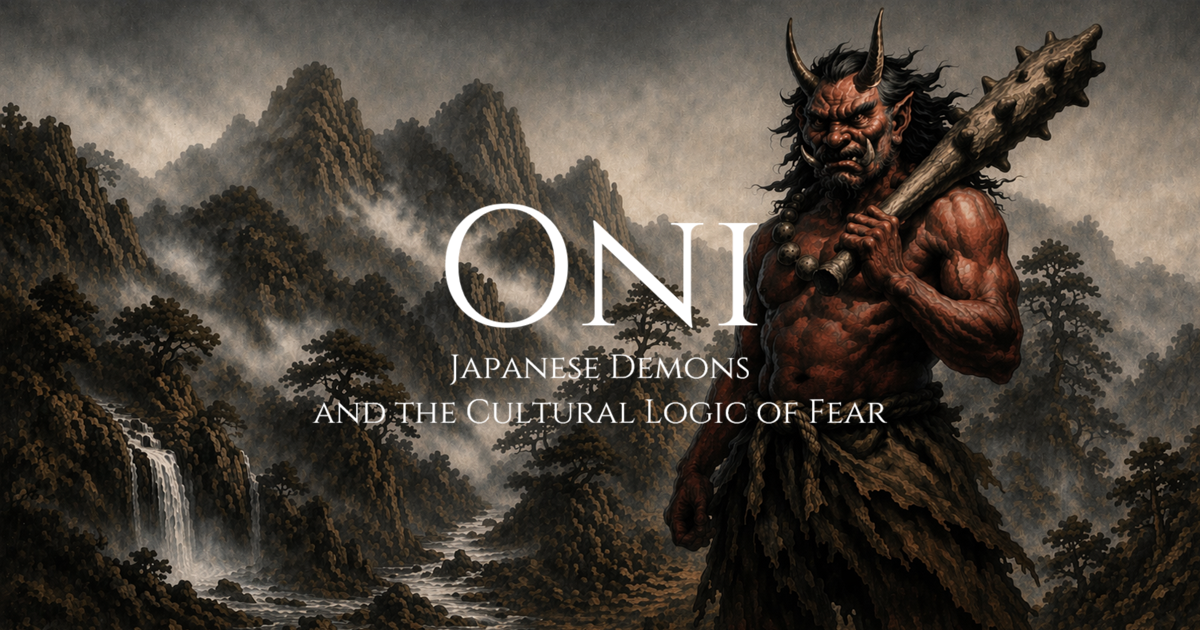
The word “demon” appears often as the English equivalent of oni, yet the translation carries assumptions that do not hold. Where “demon” implies a force defined by opposition to human society — something that exists to threaten it from outside — oni operate according to a different internal logic. They are not simply enemies. Across centuries of folklore, ritual practice, and religious imagery, oni appear where social order becomes strained, where emotional restraint begins to collapse, where the distinctions that organize daily life require reaffirmation. Their presence marks a condition rather than a threat.
What the oni makes visible is imbalance. Not evil in any fixed theological sense, but the particular instability that arises when the systems holding communal life together begin to loosen. This is why the figure persists across such different contexts — seasonal ritual, theatrical tragedy, Buddhist hell imagery, contemporary media — without losing its recognizability. The symbolic structure remains consistent even as its surface meanings shift.
For more stories like this, explore our Yokai & Supernatural Folklore collection.
Beyond “Demon”: What Oni Actually Names
Among all figures in the Japanese yōkai tradition, the oni carries perhaps the most immediately legible visual identity. Horns, oversized bodies, tiger-skin garments, iron clubs, and skin in shades of red, blue, or green appear with remarkable consistency across painted scrolls, temple architecture, theatrical performance, and contemporary illustration. These elements have remained recognizable across centuries because they are not incidental — each communicates something about the cultural function the oni is designed to serve.
The enlarged body signals excess rather than power. The iron club implies force unconstrained by social refinement. Animal-like features and distorted expressions mark the figure as something that has moved beyond the boundaries of ordinary human appearance and behavior. Every visual element pushes the oni away from moderation — away from the qualities that make communal existence possible.
Yet the oni is never entirely separate from the human.
This is what distinguishes the figure from many comparable supernatural beings in other traditions. Within Japanese folklore and religious imagery, the oni frequently emerges from human experience itself. Rage, jealousy, obsession, and humiliation are not merely characteristics the oni possesses — they are the conditions through which human beings become oni. The transformation narrative, in which a person crosses over into oni-like existence through accumulated emotional excess, appears across folktales, theatrical traditions, and religious storytelling with enough consistency to suggest something structural.
The oni stands outside society. But it is produced from within it.
Cartography of Disorder at the Edge of Society
The figure did not emerge from a single tradition. Its development reflects the gradual accumulation of Buddhist cosmology, Chinese iconographic influence, indigenous folk belief, and earlier frameworks for understanding pollution, disease, and social danger. These layers did not displace one another — they accumulated, giving the oni an unusual range of symbolic applications across different historical periods and social contexts.
Buddhist visual culture provided one important layer. In hell-realm imagery, oni administer punishment to the dead under the governance of the judge Enma. Their violence is structured rather than arbitrary — what they enact is the consequence of karmic imbalance, made physically visible. The oni in this context does not simply represent evil. It gives form to the logic of moral consequence.
Older folk beliefs located oni at the margins of settled space. Mountains, caves, borderlands, isolated roads, and the edges of village territories were understood as places where ordinary social protections weakened. Distance from the centers of communal life corresponded to distance from the systems that made everyday existence stable. Oni were spatially appropriate to these locations precisely because they represented the instability that gathered where ordinary order was already thin.
Historical thinking extended this cartography into human social categories as well. Groups positioned outside or beneath recognized social structures — including foreigners, outcasts, and those marked by criminal or marginal status — were at times associated with oni-like qualities. The figure absorbed anxieties surrounding social exclusion and disorder, gathering into itself whatever a given society chose to place beyond its accepted limits.
The boundary between human and oni therefore never became fixed. The oni stood at the outer edge of social life, but the path toward it ran through conditions already present in human emotional and moral experience. This instability — the suggestion that transformation remained possible — is what gave the figure its particular cultural weight.
When Emotional Excess Becomes Transformation
The most psychologically precise aspect of oni symbolism appears in the transformation narrative.
Across theatrical and folkloric traditions, the passage from human to oni-like existence follows a consistent pattern. A person does not simply become monstrous — they are worn into monstrousness through accumulation. Jealousy returns. Resentment deepens. Obsession forecloses all other forms of attention. The transformation unfolds gradually, through repetition and fixation, as the emotional structures that sustain ordinary social engagement erode.
Noh theater made this pattern central to some of its most enduring dramatic forms. Characters consumed by jealousy or vengeance do not abandon their humanity so much as distort it past recognition. The oni-like form the transformed figure assumes is not alien — it is the outer expression of an internal condition that can no longer be contained within normal human appearance. The monstrous body externalizes what has become impossible to hold inward.
Kabuki engaged similar territory through different theatrical means, giving the transformation more physical immediacy and spectacle, but preserving its core logic. What matters across both traditions is not the violence itself but its origin: the excess that makes visible what emotional restraint normally keeps hidden.
This is why oni appear so frequently at thresholds.
Temple gates, mountain passes, village borders, and the transitional moments of the seasonal calendar are all spaces where categories must be continually maintained — where inside and outside, purified and polluted, ordered and disordered require active separation rather than passive coexistence. The oni marks the point where that maintenance becomes uncertain. It appears not to create instability, but to make already-present instability recognizable and therefore manageable.
Setsubun and the Structure of Expulsion
The oni’s persistence in Japanese culture depends not only on its presence in folklore or religious imagery, but on its repeated enactment through ritual.
Setsubun — the seasonal observance marking the threshold of spring — provides the most widely shared example. Families throw roasted soybeans outward while reciting oni wa soto, fuku wa uchi: oni out, fortune in. Children take on the role of the figure to be expelled; adults throw beans at them; the atmosphere often carries a deliberately playful and domestic tone. The familiarity of the practice can make it easy to underestimate what it is doing.
Setsubun is fundamentally about boundary maintenance. The ritual enacts the separation of inside from outside, fortune from disorder, purity from pollution, at a moment when the transition between seasons renders those categories temporarily unstable. The beans do not destroy the oni. They send it back beyond the threshold — a gesture that acknowledges the boundary’s fragility while performing its reaffirmation.
The annual repetition is the point. Setsubun does not imply that disorder has been eliminated. It assumes the opposite: that disorder returns, that the boundary requires periodic reinforcement, and that the community must participate in that reinforcement together. Purification in Japanese ritual culture is rarely understood as permanent. It is renewed, seasonally, through repeated collective action.
The broader ritual landscape confirms this pattern. Regional festivals throughout Japan incorporate oni in different roles — as presences requiring expulsion, as protective figures associated with agricultural cycles, as ambiguous forces that demand encounter rather than avoidance. The specific meaning varies by context, but the association with transition and boundary management persists across them.
Even contemporary usage retains traces of this structure. Strict supervisors, relentless workers, or emotionally overwhelming personalities are described through oni imagery in everyday Japanese speech. The figure functions as a shorthand for forms of excess that exceed ordinary social comfort — even in settings where any literal supernatural content has long since faded.
Contemporary Forms Without a Fixed Meaning
The oni’s appearance across modern Japanese media — manga, anime, games, regional tourism, children’s educational materials — has multiplied the figure’s surface meanings considerably without dissolving the underlying structure.
What has shifted most visibly is emotional register. Many contemporary oni are rendered as sympathetic outsiders, comic figures, or complex characters whose threatening aspects coexist with loneliness or misunderstanding. The visual markers persist — horns, unusual coloring, physical scale — but the interpretation attached to them has become considerably more flexible. An oni in a children’s story may be fearsome in appearance while requiring the human characters’ understanding rather than their fear.
This adaptability reflects something consistent in how the figure has always operated. The oni was never tied to a single fixed meaning. Different contexts have always activated different aspects of the symbolic structure without erasing earlier associations. What gives the figure its longevity is precisely its capacity to absorb new interpretive frames while preserving its recognizable visual and structural core.
Regional tourism makes this especially visible. Areas with historical connections to oni legends frequently incorporate the figure into local identity and promotional culture. In these contexts, the oni operates less as a supernatural presence than as an emblem linking landscape, local history, and communal memory. The figure has moved into cultural heritage territory without losing its symbolic function.
Beneath softened or commercialized surface appearances, the logic of excess and boundary remains operative. Even a friendly oni is recognizably excessive — in scale, in emotion, in the traits that mark it as something that has moved past ordinary social proportion. The cultural grammar of the figure persists even when its tone changes.
Conclusion
Translation narrows the oni by fitting it into an existing category. What the figure actually does within Japanese cultural imagination is harder to name but more precise: it makes social instability visible, gives emotional excess a body, and provides a shared symbolic vocabulary for recognizing and managing conditions that are always present within communal life.
This is why the oni persists where so many comparable figures have faded. Seasonal ritual renews it. Theater and storytelling draw on it. Contemporary media reinvents it. The figure endures not because the supernatural threats it represents remain literally believed, but because the structural conditions it names — emotional excess, the fragility of social order, the difficulty of maintaining boundaries between restraint and collapse — are never resolved.
What the oni holds, across all its changing contexts, is the recognition that disorder does not come only from outside. It is something that order continually produces, and must continually, carefully, contain.
Related Articles
- Tengu — A mountain-associated yōkai whose cultural role is organized around the unstable boundary between ascetic isolation, territorial authority, and human social life.
- Kappa — A water-dwelling figure structured around the logic of exchange and etiquette, where danger arises specifically through the breakdown of ordinary social behavior rather than through supernatural force.
- Nurikabe — A yōkai of spatial obstruction whose presence transforms the experience of disorientation and blocked movement into a recognizable folkloric form encountered along otherwise familiar paths.
Sources and Further Reading
The following works provide cultural and academic grounding for understanding oni, yōkai traditions, and the ritual and folkloric structures of Japanese supernatural belief.
- Foster, Michael Dylan. The Book of Yōkai. University of California Press, 2015.
- Foster, Michael Dylan. Pandemonium and Parade: Japanese Monsters and the Culture of Yōkai. University of California Press, 2009.
- Reider, Noriko T. Japanese Demon Lore: Oni from Ancient Times to the Present. Utah State University Press, 2010.
- Komatsu, Kazuhiko. An Introduction to Yōkai Culture: Monsters, Ghosts, and Outsiders in Japanese History. Japan Publishing Industry Foundation for Culture, 2017.
- Reader, Ian, and George J. Tanabe Jr. Practically Religious: Worldly Benefits and the Common Religion of Japan. University of Hawai’i Press, 1998.
Author’s Note
The clearest memory I have of oni comes from first grade. We made masks from construction paper — red faces, horns, the familiar image — and tied them on with rubber bands. Mine snapped before the bean-throwing began. I stood in the schoolyard holding a paper face I couldn’t wear, watching the others chase the oni out.
I’ve thought about that small failure more than it deserves. The ritual requires you to be on one side or the other. What stays with me is the moment of being neither.