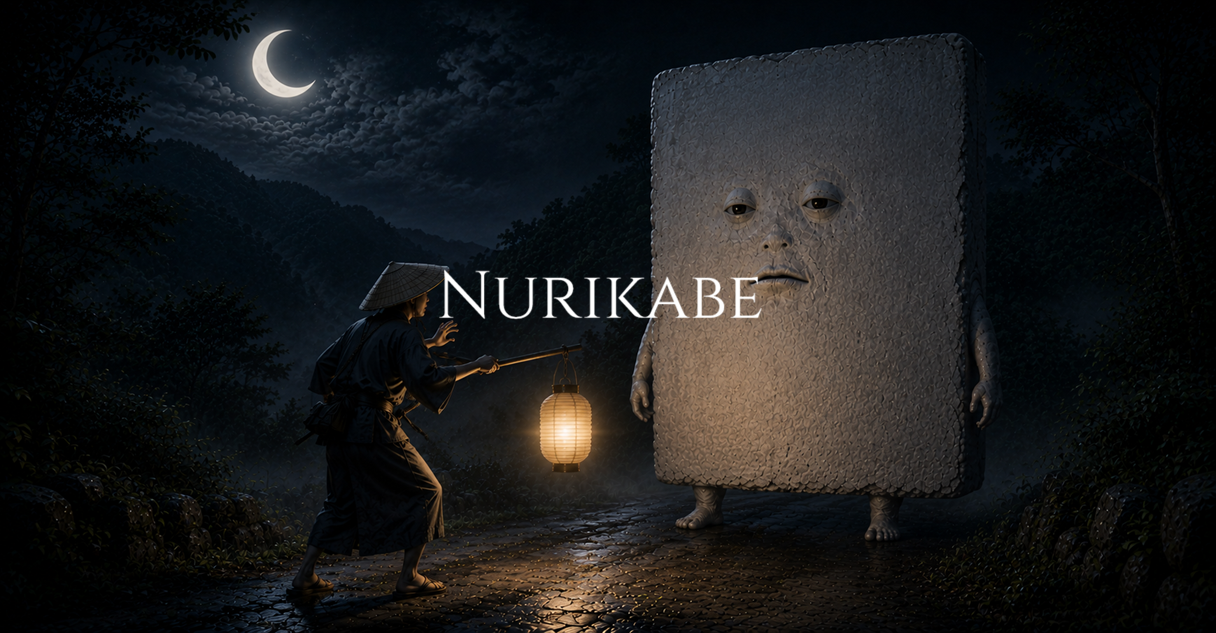
Not every yōkai announces itself through appearance. Nurikabe belongs to a category of encounter defined instead by absence: a traveler moving along a familiar path finds, without warning, that the path no longer permits passage, and nothing in the surrounding scene has visibly changed to explain why.
Movement ordinarily depends on an unspoken agreement between the body and the space it occupies. A road opens, the legs carry the traveler forward, and the destination stays within reach of intention. Nurikabe describes what happens when that agreement fails without any accompanying transformation of the world around it — no altered scenery, no announced threat, only a passage that has stopped functioning as a passage.
The yōkai does not require a monstrous body to register as strange. What marks the encounter is the sudden unreliability of forward motion itself: direction still exists, intention still exists, but the connection between the two no longer holds. Nurikabe gives that failure a cultural form, turning a private confusion into something that can be named, recognized, and told.
For more stories like this, explore our Yokai & Supernatural Folklore collection.
What Is Nurikabe?
Nurikabe is a yōkai defined by an invisible wall that halts a traveler’s forward movement, without presenting a visible body, a voice, or any direct confrontation — a structural distinction that separates it from yōkai whose meaning depends on appearance or pursuit. The name joins nuri, plastering or coating, with kabe, wall, pointing toward a barrier composed of resistance rather than material. Contemporary illustration typically gives Nurikabe a broad, wall-shaped body and a simple face, but that visual identity is a later layer added to a concept originally rooted in the experience of obstruction rather than in physical form.
This distinction shapes everything else about the figure. Nurikabe does not pursue, threaten, or speak. It is closer to a condition that settles over a location than to an actor within it. A person walking at night may discover that the road ahead refuses to open, even though no barrier can be seen, touched preemptively, or measured by eye. The traveler may step aside, retreat, or press forward, and still find that the road does not resume its ordinary behavior.
Because the yōkai begins as a failure of perception rather than an arrival, nothing needs to appear for the encounter to register. The environment itself becomes difficult to read. A road that should lead somewhere becomes, instead, a surface of resistance, and the traveler’s confidence in direction is suspended along with it.
Modern imagery has given Nurikabe a body that can be drawn, merchandised, and placed alongside other named yōkai. This has made the figure easier to teach and circulate, but it has also shifted the center of gravity in the story. Once a wall can be seen, part of the uncertainty that defined the original encounter is already resolved. The older version depends on not knowing where the obstruction begins, what produces it, or why a familiar road has stopped cooperating.
As a cultural figure, Nurikabe belongs to a wider yōkai tradition in which disorientation is not dismissed as a private lapse in attention. It becomes an event with a name and a place in shared memory — something that happened to someone, and could happen again, rather than a mistake that ends the moment it is corrected.
Blocked Roads and the Logic of Spatial Refusal
Roads are ordinarily instruments of certainty. They organize movement, link settlements, and let a person hold two places in relation to each other before ever leaving home. A path implies continuity: each step follows logically from the last, and movement in a known direction should, eventually, produce arrival. Nurikabe interrupts that implication without dismantling the road that carries it.
The yōkai’s significance lies partly in what it does not do. It does not erase the landscape or substitute another realm in its place. The scene remains visibly intact while the road’s most basic function — allowing passage — simply stops working. The traveler can still see, stand, and attempt to move, but the working relationship between intention and progress has been severed.
This is a restrained form of supernatural encounter compared with figures who rely on visible strangeness: an unusual body, an impossible face, a voice with no speaker. Nurikabe operates instead through spatial refusal, locating its difference not in what appears but in what can no longer be accomplished. The world becomes strange through resistance rather than through display.
That resistance carries a social dimension as well. Roads connect more than physical points; they connect a traveler to the patterned life of a community — a shrine, a well, a market, a household waiting at the end of the route. When passage is blocked, the traveler is momentarily cut off from that web of orientation, so the obstruction functions as both a practical setback and a symbolic one.
Read this way, Nurikabe becomes a figure of interrupted relation. The traveler remains physically present within the landscape but is no longer fully joined to it: the path is there without being usable, and the body’s desire to continue finds no confirmation from the space around it.
That gap is where the figure draws its quiet force. Violence is unnecessary, because the disruption is already total. Being stopped by something invisible reveals how much familiar space depends on unspoken trust — and how easily that trust can give way.
The Invisible Wall and the Failure of Direction
The wall’s invisibility is central to what Nurikabe means, not incidental to it. A visible obstacle can be measured, walked around, or accepted as a material fact. An invisible one disturbs the basic relationship between perceiving and acting: the traveler feels resistance without being able to locate where it starts.
Folklore frequently gives shape to experiences that resist plain description. Darkness, exhaustion, fog, uneven ground, and unfamiliar terrain can each unsettle a person’s sense of movement on their own. Nurikabe’s cultural weight, however, does not depend on tracing the story back to any single practical cause. Its importance lies in how these separate conditions are drawn together into one recognizable pattern with a name attached.
The invisible wall functions as more than an explanation for a bad night’s walk. It is a way of describing a specific kind of uncertainty: the sense that the world has stopped cooperating while offering no visible reason. This differs from simply being lost. A lost traveler does not know which direction is correct. A traveler obstructed by Nurikabe may know exactly where the road should lead and still find that knowledge insufficient for continuing.
That difference gives the yōkai its conceptual precision. The story is not about ignorance; it is about interruption. Knowledge survives the encounter intact, but knowledge alone no longer moves the body forward. The traveler’s sense of place stays coherent even as passage through that place fails.
This is part of why the image of a wall carries such force. A wall is among the simplest spatial boundaries available — it separates here from there, access from refusal, permitted movement from blocked movement. Making that wall invisible converts a clear architectural object into an unverifiable experience. The boundary is present, but not in any form the traveler can confirm by sight or touch.
In this sense, the yōkai gives physical vocabulary to obstruction that has no material cause: an unstated social expectation, a hesitation that resists naming, a system that looks open yet resists entry. Nurikabe belongs to folklore, but the structure it describes reaches well beyond old roads.
Where Communal Order Thins: Night Roads and the Village Edge
Nurikabe is most closely tied to travel after dark along rural roads, mountain paths, and isolated routes — settings that were never abstract. Before electric lighting, paved surfaces, and dependable transportation, movement after nightfall could transform the character of even a well-known place. A route familiar by daylight might become nearly illegible once landmarks disappeared into shadow.
Under those conditions, the line separating confidence from confusion could be thin. A bend in the road, a slope, a stand of trees, or the edge of a field might guide the body reliably in daylight and turn unreliable after dark. The traveler’s feet might still know the road even as the eyes stopped confirming it — and Nurikabe takes shape precisely in that gap between habit and uncertain vision.
The yōkai also occupies the border zones of communal life. A village organizes itself around centers — homes, wells, fields, shrines, shops — used and reused in daylight. Between and beyond these centers lie transitional spaces where the usual social order thins out. Mountain roads, forest paths, and night routes sit within that uncertain zone: not entirely outside community life, but not fully protected by it either.
Yōkai tend to gather in transitional settings because such places already carry interpretive pressure before anything unusual happens. A strange sound inside a crowded home means one thing; the same sound on an empty mountain road at night means something else, because the environment has already weakened the ordinary supports of certainty.
Some accounts describe practical responses to Nurikabe — striking the lower part of the invisible wall with a stick, or shifting attention downward rather than searching the upper surface for an opening. These details matter. They frame the encounter not as combat against a hostile presence, but as a technique for restoring passage: a way of locating the specific point where the obstruction can be loosened.
That practical dimension keeps the folklore tethered to lived experience. The story is not only about being stopped by something impossible. It is about learning how to move again once movement has failed — and the traveler does not defeat the yōkai so much as recover a workable relationship with the road. That is one reason the tale feels restrained beside more dramatic supernatural narratives: no curse, no moral lesson, no violent consequence, only the road closing and, eventually, opening again.
From Unseen Obstruction to Visual Yōkai
As yōkai traditions passed through printed collections, illustrated encyclopedias, manga, anime, and games, Nurikabe grew steadily more visible. This pattern is not unique to Nurikabe — many yōkai that likely began as local experiences or ambiguous regional presences later acquired standardized bodies through visual culture.
For Nurikabe, the shift stands out because the older idea depends on invisibility. A story built around an unseen obstruction becomes, in modern depictions, a large wall-shaped figure with a face. The change makes the yōkai easier to recognize and circulate, but it also converts an unstable event into something closer to a character.
None of this makes the modern image false. Visual standardization is one of the mechanisms by which folklore continues to circulate: a form that can be drawn can also be taught, displayed, and adapted. Children meet yōkai through picture books and animation; museum visitors meet them through panels and figures; regional festivals use them as symbols of local identity. A recognizable Nurikabe can carry the older idea into settings where firsthand accounts of night travel no longer carry the same everyday weight.
At the same time, something is lost when the wall receives a face. The source of obstruction becomes easier to locate, and the uncertainty that once belonged to the entire environment concentrates into a single figure. The road itself grows less unstable once the problem has a body to attach to.
This tension runs through the broader modern life of yōkai. Contemporary culture tends to preserve supernatural figures by making them legible — turning ambiguous phenomena into mascots, icons, and educational images. That process can soften the original force of a story, though it can also expose what made the figure durable enough to survive in the first place.
Nurikabe adapts well to this transformation because its underlying structure stays simple and memorable even after illustration: something blocks the way, and it cannot be seen. The wall-creature version alters the texture of the experience without erasing that central theme of obstructed movement. In this sense, Nurikabe occupies a position between two modes of folklore — the experiential and the iconic — beginning as a disturbance in space before becoming a figure that represents that disturbance. Each version preserves something the other cannot: one keeps the uncertainty of the encounter, the other keeps the name.
Invisible Barriers in Modern Life
Contemporary Japan no longer depends on the conditions of night travel that shaped many older yōkai accounts. Roads are lit, mapped, and folded into transportation networks; navigation devices reduce uncertainty about direction; urban infrastructure promises movement that can be planned with increasing precision. Even so, the sensation behind Nurikabe has not disappeared.
The modern version of the invisible wall tends to appear through systems rather than landscapes. A person can follow every stated procedure and still find forward movement impossible. A social expectation can block action without ever being spoken aloud. A workplace, school, bureaucratic process, family structure, or digital interface can each generate resistance with no single visible source — the path looks open, yet passage stays difficult.
This does not reduce Nurikabe to a loose metaphor for frustration. Its folkloric value is more precise than that. The yōkai describes a world in which obstruction is spatialized: difficulty is not purely emotional or administrative but registers as a blockage in the relationship between body and environment. A person stands before a limit that cannot be seen and discovers that intention alone does not guarantee movement.
That structure stays legible because people continue to experience space through expectation. A station corridor should lead to the platform. A street should lead home. A form should lead to approval. A conversation should lead to understanding. When one of these expected passages fails, the result is not simple inconvenience — it can produce a quiet disorientation, a sense that the surrounding order has stopped responding to the traveler at all.
Nurikabe gives cultural shape to that experience without resolving it too neatly. The yōkai does not explain every cause of obstruction, identify a villain, or offer a universal fix. It names the interruption, which is enough to make the experience shareable and recognizable to someone else who has felt it.
This may explain why the figure continues to function in a contemporary setting even after its rural, nocturnal origins have faded. Movement today may be faster, but it is not necessarily more transparent. People still meet limits they cannot see directly, and they still need a shared vocabulary for describing them. Nurikabe survives because it was never only a story about a dark road — it is a pattern of experience: the moment when the world looks open and still refuses passage.
Conclusion
Nurikabe shows how a yōkai can take shape from a failure in space rather than from a visible body. Its meaning centers on the interruption of movement — the sudden instant when a path stops behaving like a path. Nothing needs to appear for the encounter to carry cultural weight; the absence of a visible cause is itself part of the figure’s structure.
As folklore, the invisible wall converts disorientation into a shareable form. It acknowledges that space is not automatically neutral, stable, or available to human intention — that roads and passages depend on a kind of trust, and that trust can fail without warning. The encounter with Nurikabe marks the point where that failure becomes more than private confusion.
The figure also demonstrates how yōkai traditions hold uncertainty without forcing it into full explanation. Nurikabe does not resolve the problem of obstruction; it gives the interruption a name, a shape, and eventually an image, allowing people to describe the moment when progress halts and the reason stays out of view.
That is why the yōkai continues to carry meaning well beyond the conditions that first produced it. The road may no longer be dark in the old way, and the wall may now be drawn with a face, but the underlying structure persists: a way forward, a body ready to move, and an invisible limit appearing exactly where passage should have been.
Related Articles
- Tsukumogami — Ordinary household objects gain presence through repeated use, unsettling the line between tool and living attention rather than blocking physical movement.
- Rokurokubi — Domestic space turns uncertain when a familiar body stops behaving predictably, locating disruption within recognition rather than within the road itself.
- Tanuki — Deliberate misdirection destabilizes social perception, contrasting Nurikabe’s wordless spatial refusal with a yōkai whose disruption is built on trickery and appearance.
Sources and Further Reading
The following sources offer cultural and historical grounding for understanding yōkai traditions, spatial folklore, and the visual standardization of supernatural figures in Japan.
- Foster, Michael Dylan. Pandemonium and Parade: Japanese Monsters and the Culture of Yōkai. University of California Press, 2009.
- Foster, Michael Dylan. The Book of Yōkai: Mysterious Creatures of Japanese Folklore. University of California Press, 2015.
- Komatsu, Kazuhiko. An Introduction to Yōkai Culture: Monsters, Ghosts, and Outsiders in Japanese History. Japan Publishing Industry Foundation for Culture, 2017.
Author’s Note
The clearest memory I have of this feeling is not from a road I knew, but from one I did not. I once took a wrong turn only a short distance from home and found myself on a forest road at night, waiting for it to open into something recognizable. It eventually did, of course, but what stayed with me was that stretch of not-yet-recognizing — the sense that the road itself had stopped agreeing to lead anywhere.