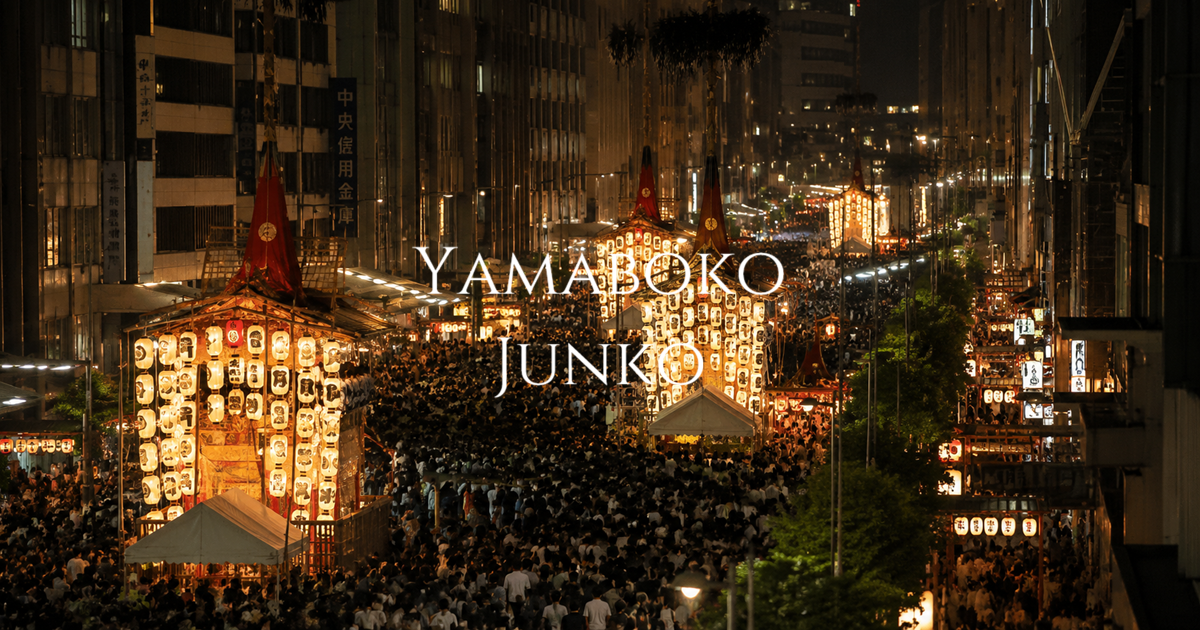
Kyoto’s grid does not disappear during Yamaboko Junko, but its logic does. The same intersections, the same shopfronts, the same paved corridors remain physically unchanged, yet for a set span of July they stop answering to traffic signals and start answering to rope, timing, and inherited sequence. What moves through the city is not simply a parade layered on top of ordinary streets. It is a working demonstration of how a community organizes itself when it decides, once a year, to reorder its own space.
The floats draw attention first through height and ornament, but the procession’s real subject is the coordination that gets them moving at all. Nothing about a hoko’s advance is automatic. Its motion is assembled, negotiated, and renewed by people who have agreed, in advance, to occupy different roles inside one shared task.
For more stories like this, explore our Strange Festivals & Rituals collection.
Yamaboko Junko and the Temporary Reordering of Kyoto’s Streets
Yamaboko Junko is the procession of yama and hoko floats through central Kyoto during the Gion Festival, and what separates it from an ordinary parade is not scale but function: for a defined interval, the procession reassigns who controls the street, what pace governs it, and which forms of coordination take precedence over ordinary circulation. That reassignment is temporary by design, which is precisely what keeps the ritual legible as ritual rather than as permanent urban change.
The processions occur during the Saki Matsuri and Ato Matsuri phases in July, each float maintained year-round by a yamahoko-chō, a neighborhood organization whose obligations extend well past the day the float appears in public. Components are stored, inspected, reassembled, and later dismantled. Musicians rehearse fixed phrases. Positions on and around the float are assigned according to accumulated local knowledge rather than open selection.
Hoko are typically large wheeled structures topped by tall poles; yama vary more widely, often bearing sacred objects, figures, or scenes drawn from religious and literary sources. The distinction matters visually, but both types answer to the same underlying system of neighborhood custody and scheduled movement.
The largest hoko rise well above the crowd and cannot move under their own power. Their advance depends on rope, coordinated pulling, called signals, and musical rhythm — an agreed sequence rather than a mechanism. A float that appears to dominate the street is, at every moment, dependent on dozens of people accepting a narrow, specific role inside a larger structure. The procession makes that dependency visible. Preparation that would otherwise stay confined to meetings, storage sheds, and rehearsal halls becomes, for a few hours, a public sequence of coordinated motion. What passes through Kyoto is a neighborhood system, given temporary physical form.
From Epidemic Rite to Merchant Neighborhood Festival
The festival’s earliest memory reaches back to the epidemic rites of the Heian capital. In 869, amid disease and political instability, a goryō-e ceremony at Shinsen’en sought to pacify spirits held responsible for the city’s disorder; ritual spears were raised as part of that effort to restore balance.
The present-day procession is not a static continuation of that single rite. Its current form accumulated gradually, as religious practice, urban administration, merchant wealth, and neighborhood organization became entangled with one another over centuries. What survived was not a fixed ceremony but a working assumption: that disorder affecting the city could be answered through coordinated ritual action, repeated and adjusted across generations.
That assumption pushed the festival past the boundary of a single shrine. Yasaka Shrine remains its religious anchor, but the procession’s continuity has long depended on Kyoto’s commercial districts, which supplied the resources, technical skill, and institutional memory needed to sustain and expand the floats over time.
The floats themselves carry the residue of those commercial networks. Textiles and ceremonial objects acquired across different eras and regions were folded into their decoration, so that each yamahoko now functions as an uneven record of local wealth, taste, and exchange rather than a uniform artifact. No two floats share an identical history of acquisition and repair.
That ownership, though local, is not private in any isolating sense. A float belongs to one district, but its appearance in the procession places it inside a civic order larger than any single neighborhood. Identity is confirmed through participation alongside others, not through separation from them — each district maintaining its own responsibilities while submitting to the timing of a shared sequence. Shrine authority, merchant capital, craft knowledge, and neighborhood obligation do not sit in separate layers here; during Yamaboko Junko they converge in the single, repeated act of building and moving a float through the city.
Streets Recast as Ceremonial Space
A street’s physical form is fixed, but its function depends on rules about who may occupy it, at what pace, and for what purpose — and during Yamaboko Junko, those rules are temporarily rewritten. Traffic barriers make the shift immediately legible: vehicles are cleared, spectators gather along the route, and intersections turn from points of passage into points of waiting.
The change runs deeper than logistics, though. A commercial avenue does not become permanently sacred the way a shrine precinct is; its ceremonial character is produced through use, not inherited through consecration. Rope lines, music, clothing, and the sustained attention of a crowd distinguish the route from the same street on an ordinary Tuesday. Ceremonial space here is an effect of coordinated behavior, not a zone marked off by permanent boundary.
Pace changes the experience of the street as much as barriers do. Modern roads are usually evaluated by throughput — how fast people and vehicles clear an intersection. The yamahoko move against that standard. Progress depends on human timing rather than mechanical flexibility, and pauses are built into the route rather than treated as failure.
This becomes most visible at corners. The wheels of a large hoko do not pivot, so a change of direction requires tsujimawashi: bamboo strips laid and wetted beneath the wheels to reduce friction, while teams pull the float through a sequence of small, forced rotations. The procedure is often treated as a photogenic highlight, but its significance lies elsewhere — in how openly it displays difficulty. The float’s weight and the street’s resistance cannot be concealed inside a machine; an intersection built for effortless turning becomes a place where movement must be negotiated step by step, in view of everyone watching.
The float does not overpower the city; it submits its weight to the street’s actual limits and depends on people trained to manage that encounter. Turning, at that moment, is less a mechanical operation than a visible act of collective control. Music extends the same logic outward — the repeated phrases of Gion bayashi carry the float’s presence beyond its immediate footprint, announcing it before it arrives and marking its passage after it has gone. For the length of the procession, the city is measured differently: in approach, wait, turn, and disappearance, rather than in ordinary transit time.
Building the Procession Before It Moves
The familiar image of Yamaboko Junko — completed floats moving through packed streets — can make the festival look like a single-day event. For the neighborhoods responsible for it, the ritual begins earlier, when stored components and half-forgotten routines are brought back into active use.
Wooden sections are pulled from storage and rebuilt using inherited assembly methods. Major joints are bound with rope rather than fixed permanently with metal, which means each float must be reconstructed annually rather than simply uncovered. Assembly, in this sense, is not preparation for the ritual — it already is the ritual, structured as a repeated act of construction rather than as a single moment of unveiling.
This annual rebuilding preserves a kind of knowledge that resists being written down. Participants need to know the order components are joined in, how tightly ropes must be drawn, where stress concentrates as the structure rises, and how the float behaves as its weight increases. That knowledge is transmitted through observation and correction rather than instruction manuals; a permanently assembled float might preserve its outward shape, but it would erode the very process that keeps the knowledge and the social roles around it alive.
The float’s supporting infrastructure extends into the neighborhood itself. Decorative textiles and sacred objects are sometimes displayed in spaces normally used for residence or business, opening part of the district’s stored memory to public view while keeping it rooted in the household or organization responsible for its care. Textiles need protection from humidity and light; wooden joints require inspection; instruments, ropes, and clothing all demand ongoing maintenance that has nothing to do with spectacle.
Participation, correspondingly, extends well past the people visible on the street. Some residents manage schedules, others handle finances or keep records, others teach the musical phrases to younger participants. By the time a float begins to move, the neighborhood has already reorganized itself around it for weeks; the public procession compresses that labor into a single visible passage, but the order behind it was built long before any wheel touched the pavement.
Collective Order Without Uniformity
Yamaboko Junko gets described as an expression of community, but that word risks flattening what the procession actually shows: not harmony so much as a system of differentiated roles, inherited obligations, and separate local authorities brought into temporary alignment. Participants are not performing the same task in parallel. Some direct movement, some pull, some manage the wheels, some hold ritual positions on the float itself — and the procession functions because these differences are coordinated, not because they are erased.
The float embodies that same logic structurally. It reads as a single object from the street, but it is assembled from separate beams, bindings, textiles, and ornaments, no one of which stands for the whole; its apparent unity is a product of assembly and is tested, each time, by movement.
Neighborhood identity works the same way. Each district keeps its own float, its own customs, its own accumulated technical knowledge — participation confirms local distinctiveness rather than dissolving it. But no single district can produce Yamaboko Junko alone; the procession exists only at the point where separate local traditions enter one shared sequence. That produces an urban order that is neither centralized nor purely individual: decisions form inside neighborhood structures, yet their consequences become public the moment the floats reach common streets.
Individual prominence is limited by the same structure. A hoko’s movement cannot be attributed to any single person — force is distributed across ropes and bodies, music depends on group repetition, and a successful turn is a matter of timing rather than display. None of this removes uncertainty; weather, crowd behavior, and material wear remain live risks throughout. What the procession demonstrates is not the absence of difficulty but a structure through which difficulty gets managed collectively. That is also why the event resists being read as spectacle alone: spectacle rewards what is visible, while ritual order includes everything that had to be learned, repeated, and entrusted to someone else long before the float appeared on the street.
Heritage Within a Working City
Contemporary Kyoto presents Yamaboko Junko through tourism schedules, broadcast coverage, and civic promotion, and many visitors encounter it as a seasonal event framed by viewing routes and photographs. But that visibility does not explain how the festival actually continues from year to year. The floats are not built for an audience; their assembly and maintenance depend on neighborhood organizations whose obligations begin long before spectators arrive and continue after the crowds disperse.
Two overlapping experiences of the same event follow from this. A visitor understands the procession through a route map and a good vantage point at an intersection. A participating district experiences it through meetings, storage logistics, financial decisions, and relationships carried across generations. The two are connected but not identical, and tension surfaces whenever the procession gets treated as a finished historical image rather than as an unfinished practice that has to be rebuilt, administratively and physically, every year.
The city around the route makes this coexistence visible. The yamahoko pass office buildings, transit lines, and modern storefronts; the procession does not recreate an untouched historical Kyoto so much as move through a contemporary one shaped by tourism, commerce, and infrastructure. That coexistence is the point rather than a compromise. Tradition survives here not by withdrawing from the working city but by temporarily redirecting it — roads close, businesses adjust, safety requirements get folded into an inherited structure without displacing it. The ritual city is produced inside the working city, through negotiation, not apart from it, and for a limited span each July, contemporary Kyoto makes room for an older pattern of movement without ceasing to be contemporary.
Conclusion
Strip away the height and ornament of the floats and what remains is a demonstration of how a city can be temporarily reassembled around inherited obligation. Stored knowledge becomes public sequence; streets built for circulation take on another logic entirely; and for the length of the procession, timing outranks speed, and shared sequence outranks individual passage.
None of this erases the ordinary city sitting just beneath it. Shops stay open nearby, offices keep functioning, and the traffic grid waits, unchanged, for the barriers to come down. What Yamaboko Junko demonstrates is not that Kyoto can become something else, but that it can be reordered on schedule, by agreement, and returned afterward — a capacity that has less to do with any single year’s procession than with the fact that it can be done again.
Related Articles
- Onbashira Festival — Massive logs are drawn through the landscape by coordinated human force, making bodily risk and regional participation central to sacred renewal.
- Oniyo Fire Festival — Controlled fire reorganizes shrine space through disciplined handling, turning destructive potential into a communal act of purification.
- Owara Kaze no Bon — Restrained dance and music reshape narrow town streets through seasonal movement, local atmosphere, and a slower form of collective passage.
Sources and Further Reading
The following works inform this article’s treatment of Japanese festival organization, urban ritual space, and the historical relationship between religious practice and city administration.
- Ashkenazi, Michael. Matsuri: Festivals of a Japanese Town. University of Hawai’i Press, 1993.
- Nelson, John K. A Year in the Life of a Shinto Shrine. University of Washington Press, 1996.
- Reader, Ian, and George J. Tanabe Jr. Practically Religious: Worldly Benefits and the Common Religion of Japan. University of Hawai’i Press, 1998.
- Sorensen, André. The Making of Urban Japan: Cities and Planning from Edo to the Twenty-First Century. Routledge, 2002.
Author’s Note
My first sense of the Gion Festival came secondhand, through a boyhood television drama about the Shinsengumi — an episode built around the Ikedaya incident, with festival activity filling the Kyoto streets around it. I have never stood on the procession route myself; what I know of it gathered slowly from television, newspapers, and magazines, until those separate impressions began to form something coherent. The drama arrived before the festival did, and understanding was assembled afterward.