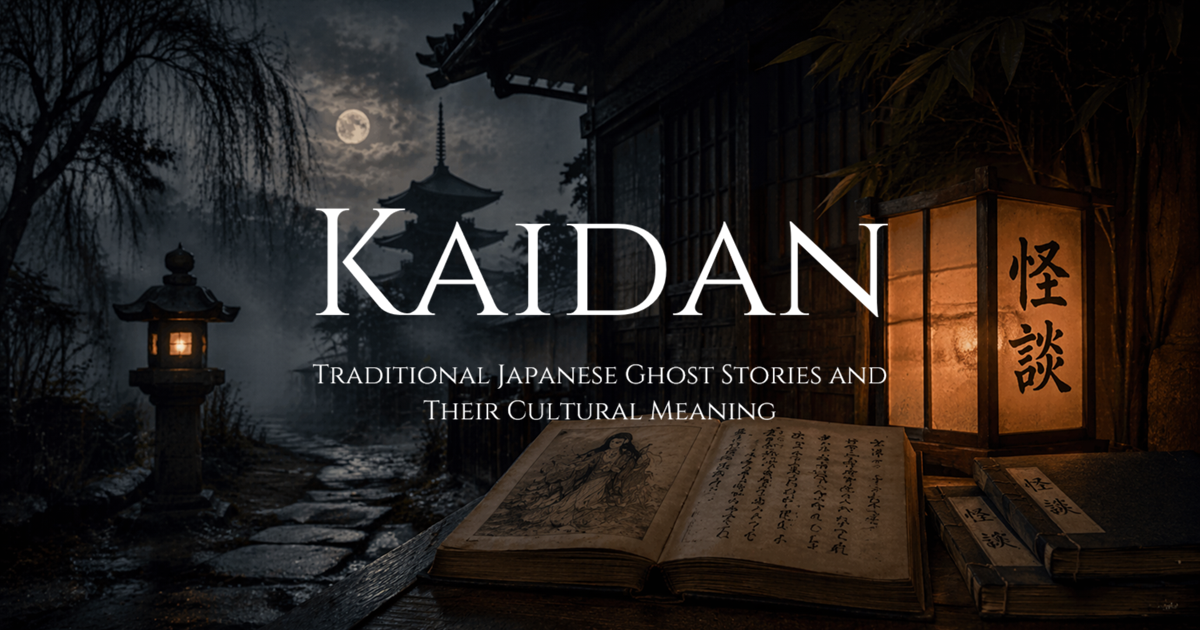
Ghost stories in Japan rarely function as simple accounts of the dead. They give shape to experiences that resist tidy explanation: a grief that does not end when ritual says it should, a resentment that survives the person who once felt it, a memory that resurfaces without ever settling into a fixed account of what happened.
Kaidan sits inside this broader field of strange narrative, and it approaches the unseen differently than a single spirit type does. Rather than separating the supernatural from ordinary life, kaidan lets it surface through repetition, silence, seasonal atmosphere, and small disturbances in familiar rooms. A ghost may appear, but the real subject is usually the narrative architecture that allows an unresolved feeling to become visible at all.
This is part of why kaidan has stayed recognizable across oral storytelling, Edo-period print, kabuki and nō, cinema, and now online forums and video. It converts private unease into a shared narrative form, one that lets uncertainty be repeated, interpreted, and remembered without ever being fully closed.
For more stories like this, explore our Folklore & Ghost Culture collection.
The Form and Meaning of Kaidan
Kaidan is best understood as a narrative genre rather than a fixed category of ghost, and this distinction separates it from horror as commonly marketed today. The word joins kai, meaning strange or mysterious, with dan, meaning tale or narrative account, and its cultural weight comes less from what appears in a given story than from how the appearance is framed and withheld.
A kaidan may involve ghosts, uncanny sounds, unexplained objects, or events that will not yield to ordinary explanation, but the story’s real interest lies elsewhere. It is less concerned with confirming that something supernatural occurred than with asking why a presence has returned, what memory it is carrying, and what unfinished relationship allowed it to remain near the living. That question, more than any inventory of spirits, is what distinguishes kaidan from adjacent genres and accounts for its long survival across changing media.
This framing gives kaidan a wider role than any single spirit figure such as Yūrei or Onryō could occupy on its own. Those figures may appear inside a kaidan, but the genre itself is a structure for arranging uncertainty, a way of letting grief, resentment, obligation, or longing surface without being reduced to a lesson or a diagnosis.
Restraint does much of the work here. Kaidan tends to favor suggestion over confrontation: a sound repeated once too often, a figure glimpsed at a threshold, a room that feels different after a story has been told in it. The listener is not steered toward certainty; the form keeps uncertainty intact and lets it sit.
Because of this, kaidan has outlasted its status as mere entertainment. It offers a durable cultural method for holding experience that refuses to resolve cleanly, particularly experience bound up with death, memory, and emotional continuation. The ghost story becomes less a record of what appeared and more a container for what could not be made to disappear.
Strange Tales and the Shape of Cultural Memory
Ghost narratives in Japan persist partly because they can preserve feelings that will not hold as plain fact. Details of a death fade, a family conflict stops being discussed directly, a local incident becomes hard to separate from decades of retelling. What survives is not the record but the emotional shape of the disturbance itself.
This is one of kaidan’s central functions as cultural memory. It rarely transmits history as an accurate account of events. Instead it carries patterns forward: the wronged woman who returns, the promise that still exerts force after death, the voice heard where no one should be standing, the object or room or road that seems to remember more than any living witness does.
These patterns give individual unease a shared grammar. A listener does not need the original details to follow the structure. Something was left unfinished. Someone went unmourned, unacknowledged, unforgiven, or unreleased. The strange event becomes the visible marker of an emotional condition that never settled, and that visibility is what lets the story travel between people who never lived through the original event.
The structure also ties kaidan to broader Japanese frameworks around death and continuity. Buddhist ideas about attachment and consequence, layered onto older assumptions that unseen presences move near the human world, created conditions in which the dead could plausibly be felt as still active. Kaidan rarely states this doctrine outright; it carries the assumption through atmosphere, repetition, and the behavior of memory itself.
This is also why kaidan tends to resist full closure. A story may leave a spirit’s intention unclear, an event’s truth unconfirmed, an ending only partly resolved. That incompleteness is not a flaw in the form. It is one of the mechanisms by which the story keeps memory active, letting the past stay present without hardening into fixed explanation.
Edo Storytelling and the Shared Management of Unease
Kaidan became a widely recognizable storytelling tradition during the Edo period, when urban growth, print circulation, theatrical performance, and social gathering gave strange tales new routes of travel. Earlier collections had already preserved ghost stories, karmic disturbances, and uncanny encounters, but Edo culture made the strange tale repeatable on a much larger scale.
One of the clearest examples is Hyakumonogatari Kaidankai, a gathering in which participants told one hundred strange stories while extinguishing a light after each one. The sequence mattered as much as any individual tale. With every story, the room grew darker, and the audience grew more conscious of its own listening.
That format shows how ghost storytelling could operate as a controlled social experience rather than something each person had to face alone. Unease was arranged through sequence, atmosphere, shared attention, and a ritualized pacing that everyone in the room understood in advance, even without knowing what the final story would leave behind.
This structure helped kaidan move across generations, because a story told inside a recognizable form is easier to remember and retell. The pauses, the dimming light, the expectation that something would go unresolved, and the deliberate pacing all instructed the audience in how to receive the tale. The experience trained people not only in narrative but in how to sit with ambiguity without needing it settled.
Printed collections extended this further, carrying strange tales beyond local gatherings so that motifs, scenes, and emotional conflicts could circulate to wider audiences while still keeping a sense of intimate transmission. Kaidan grew inside that balance: personal enough to feel close, structured enough to survive being told again and again by strangers.
Ghost Figures, Restraint, and Emotional Residue
The spirits that populate kaidan tend to function less as independent supernatural beings than as markers of emotional residue, evidence that something was never absorbed into ordinary life. A person dies, but the relationship stays active. A wrong occurs, but its consequences keep pressing on the living. A promise is broken, yet the narrative behaves as if the promise still carries weight.
This is especially visible in the figures of Yūrei and Onryō. A Yūrei tends to be shaped by attachment, grief, or a connection left unfinished, while an Onryō gives form to resentment and injury that return with mounting pressure. Inside kaidan, these are not simply characters; they are narrative forms through which unresolved emotion becomes visible without needing translation into ordinary language.
Visual convention reinforces this logic. White burial clothing, unbound hair, a pale face, a lowered posture, and slow, deliberate movement all signal a body no longer fully situated within ordinary social order. These details, built up through literature, theater, illustration, and later film, formed a shared visual grammar for the returning dead, one legible even to audiences unfamiliar with a story’s specific origin.
Restraint governs the effect throughout. A kaidan spirit rarely receives full explanation or direct display. It may surface briefly, through a sound, a reflection, a shadow, or an action repeated past the point where it should have stopped. What remains with the audience is a presence that has been felt but never fully clarified.
That indirectness is part of why the form endures. A fully explained ghost tends to release the emotional pressure that gave it force. By leaving certain elements unresolved, kaidan keeps intact the sense that the past has not been converted into ordinary knowledge. Silence, darkness, and repetition become carriers of meaning rather than decoration, letting emotional residue register without reducing it to a moral.
From Theater to Screens: Changing Media for the Strange Tale
Kaidan has never been bound to a single medium. It has moved through oral storytelling, printed collections, kabuki, nō, prose fiction, cinema, television, and now digital circulation. The outward form changes with each shift, but the underlying structure tends to survive: something unresolved returns through atmosphere, repetition, and partial disclosure.
Theater gave the ghost story a powerful visual vocabulary. Kabuki works such as Yotsuya Kaidan shaped the returning spirit through gesture, costume, timing, and stage mechanics, tying betrayal and social failure to a figure of the dead who cannot be contained within ordinary boundaries. Nō contributed its own grammar of haunting, particularly through spirits bound to memory, place, and longing left incomplete.
Literature developed a different register. Strange tales collected in Ugetsu Monogatari use the supernatural to probe desire, illusion, and unstable perception without always separating the ghostly from the human. On the surface these stories can read as controlled and elegant, even while their emotional architecture quietly destabilizes what the characters believe they know about themselves.
Film and television inherited many of these rhythms. Slow pacing, off-screen presence, deliberately unresolved endings, and ordinary spaces altered by repeated disturbance all carry older kaidan patterns forward. The setting may shift to an apartment, a school, a hospital, or a train platform, but the underlying structure stays close to the traditional tale: a familiar world changed by what it has not managed to resolve.
Digital culture has reshaped the form again. Anonymous posts, forum threads, video retellings, and internet ghost stories often circulate without stable authorship or a fixed ending, which puts them closer to oral transmission than to formal literature. Details shift between versions, the truth of any single account stays uncertain, and each retelling becomes part of how the story keeps moving. Candlelight becomes a screen; the shared room becomes a thread or a comment section. What survives the transition is not only the ghost but the structure that lets an unresolved presence keep traveling.
Why Structured Ghost Stories Continue to Travel
Structured ghost stories persist because they give uncertainty a shape without forcing it toward explanation. Kaidan does not require every mystery to be solved; it asks its audience to recognize a pattern, that something unfinished has taken form and that the living are being asked to acknowledge its nearness.
This is what makes the genre so portable. A story tied to one specific setting can lose force once that setting disappears, but a story organized around unresolved emotion travels across periods and media without much friction. Betrayal, grief, obligation, longing, and memory stay recognizable whether the setting is an old household, a kabuki stage, a modern apartment, or an anonymous post online.
Kaidan also survives because it trains a particular kind of attention. A small disturbance can matter. A sound heard twice can signal a return. A quiet, unresolved ending can carry more weight than a full account would. The genre teaches listeners and readers to notice traces rather than to demand an immediate answer.
None of this repeatability makes the stories fixed. It lets them change while staying legible: a storyteller can shift the location, the relationship at the center, the medium, or the degree of ambiguity while keeping the deeper architecture of the tale intact. Cultural memory survives through exactly this kind of variation, stable enough to be recognized on contact, flexible enough to be told again in an unfamiliar register.
The endurance of kaidan, then, is not simply a matter of ghost stories staying popular. The genre offers a disciplined method for keeping unresolved experience inside shared memory, allowing the living to return, again and again, to what has never been fully put away.
Conclusion
Kaidan lasts because it gives form to what does not easily disappear. Its ghosts are not only figures returning from beyond death but signs of relationships, promises, injuries, and memories that continue past the point where ordinary closure was supposed to end them.
Across oral gatherings, printed collections, theater, literature, film, and digital storytelling, the outward shape of kaidan has changed repeatedly. Its deeper structure has not: a familiar world is altered by something it has not resolved, and the story holds that uncertainty in a form built to be shared rather than closing it down.
That is why kaidan continues to matter within Japanese ghost culture. It preserves not only old tales but a discipline of listening to what lingers, turning the strange story into a vessel for what cannot be proven, dismissed, or fully forgotten.
Related Articles
- Yūrei — A ghost figure shaped by funerary symbolism, attachment, and the difficulty of separating the dead from memory.
- Onryō — A spirit of grievance in which private injury becomes a force that unsettles social order.
- Botan Dōrō — A returning-lover narrative where lantern imagery, desire, and seasonal atmosphere turn haunting into repetition.
Sources and Further Reading
The following works provide literary, folkloric, and cultural context for understanding kaidan as a narrative form and its place within Japanese ghost culture.
- Foster, Michael Dylan. Pandemonium and Parade: Japanese Monsters and the Culture of Yōkai. University of California Press, 2009.
- Iwasaka, Michiko, and Barre Toelken. Ghosts and the Japanese: Cultural Experience in Japanese Death Legends. Utah State University Press, 1994.
- Keene, Donald. Japanese Literature: An Introduction for Western Readers. Grove Press, 1955.
- Reider, Noriko T. Tales of the Supernatural in Early Modern Japan: Kaidan, Akinari, Ugetsu Monogatari. Edwin Mellen Press, 2002.
- Tyler, Royall. Japanese Nō Dramas. Penguin Classics, 1992.
- Ueda, Akinari. Tales of Moonlight and Rain. Columbia University Press, 2007.
Author’s Note
Kaidan first existed for me not in a book, but in my late father’s voice. Sitting beside my younger brother, I asked him again and again for the story of the mountain hag, frightened each time in exactly the same way. He told it well, but that does not fully explain why something so frightening became something we kept asking to hear.