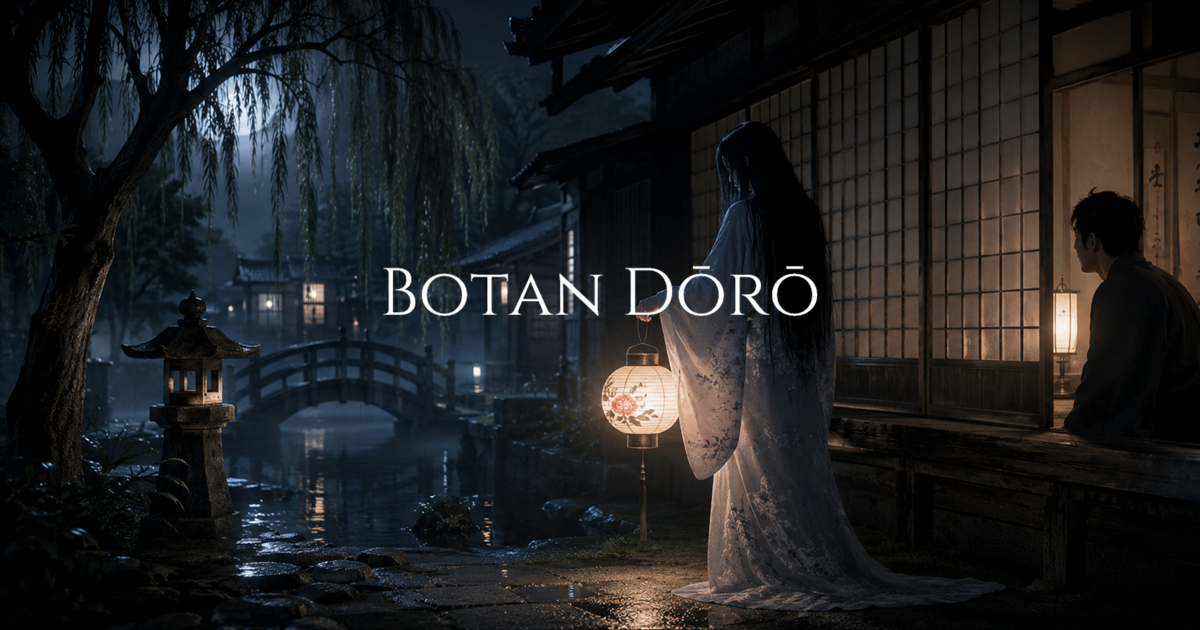
Botan Dōrō, often rendered in English as The Peony Lantern, belongs to a small group of Japanese ghost stories whose power rests less on the fact of haunting than on the willingness of the living to remain inside it. A woman crosses into a man’s life at night, lantern in hand, and returns not once but repeatedly, so that the story’s tension comes from continuation rather than shock. What unsettles is not that a ghost appears, but that her appearance is met with desire rather than refusal.
Within Japanese ghost culture, the dead frequently return through feeling left unresolved — attachment, longing, obligation, or grief that has not been absorbed into ordinary memory. Botan Dōrō narrows that broad pattern into an intimate case. The line separating the living from the dead does not fail through violence here; it loosens gradually, through visits that become expected, recognition that arrives late, and a wish, on the man’s side, that the arrangement might continue rather than end.
The peony lantern itself carries this logic in miniature. It is a passage as much as an object, marking the point where an ordinary night gives way to a condition death has not settled. The story asks why a bond can still feel active once the person behind it is gone, and why the living sometimes follow that feeling even as it draws them away from life.
For more stories like this, explore our Folklore & Ghost Culture collection.
The Peony Lantern as Ghost Story and Cultural Form
Botan Dōrō is a Japanese kaidan built around a relationship between a living man and a woman who belongs to the world of the dead, which is what separates it from ghost stories organized around haunting alone: here, the ghost story is also a story about desire that outlasts death. Its recognizable shape — night visits, lantern light, the slow discovery that an apparently human encounter has crossed into another register of existence — has carried the tale across centuries of retelling, and that durability is part of what distinguishes it from more punitive ghost narratives built on discovery and expulsion rather than continued closeness.
The tale’s route into Japanese storytelling passed through Chinese supernatural fiction before being reshaped inside a cultural environment where impermanence, ancestral memory, and unfinished emotional ties already carried weight. By the Edo period, stories of this kind functioned as more than accounts of the uncanny. They gave shape to relationships that refused to end cleanly, offering audiences a way to think about attachment without requiring it to be named directly.
In the story’s familiar form, a man meets a beautiful woman who begins visiting him after dark. The encounters are private, set apart from the daytime world of obligation and social visibility. She is usually accompanied by a servant and by the glow of a peony lantern, and only gradually does the truth surface: the woman is dead, and the bond has pulled the living man into proximity with a world he was never meant to enter so closely.
This is where Botan Dōrō departs from ghost stories organized around attack or punishment. The ghost does not arrive as an adversary. She arrives through attraction, and the man does not simply endure an intrusion — he takes part in the bond that eventually threatens him. The story’s discomfort comes from that shared involvement. Desire is not a response to the supernatural here; it is what opens the way for it.
The tale’s influence on later Japanese ghost narrative is difficult to overstate. It helped fix a pattern — the quiet female spirit, the night visit, the emotional tie that survives death, the gradual collapse of ordinary boundaries — that would surface again and again in theater, print, and eventually film. But the imagery came later than the meaning. What endures is the underlying premise: that the dead may stay close for as long as feeling toward them remains unabsorbed by memory.
Desire at the Edge of the Living World
Botan Dōrō does not turn on a single moment of discovery. Its structure is a repeated crossing, each visit making the arrangement feel slightly more ordinary than the one before. The man grows used to the woman’s arrival, to the lantern’s glow, to the private hours the two of them have built together. Meaning accumulates through repetition before it announces itself directly.
That repetition matters because boundaries in Japanese ghost culture are rarely treated as strictly physical. The separation between life and death is also sustained by ritual, memory, social recognition, and the emotional work of letting go. When any of that falters, the dead do not necessarily appear as remote or alien; they can surface as presences still entangled with the living, still owed something. Botan Dōrō converts that idea into an intimacy that cannot be separated from risk.
The man’s desire is therefore not incidental to the plot — it is structural. He wants the visits to continue, and that wish is precisely what delays recognition. The ghost’s return depends on an attachment that has not settled; his vulnerability depends on the same thing. Neither side of the relationship has accepted that separation occurred.
This is what gives the story its refusal to resolve simply. The woman is not merely dangerous, yet she cannot be read as harmless either. Her presence carries genuine longing, and that longing draws the living toward death regardless of intention. The man’s continued closeness to her is not straightforward foolishness; it reflects a more common difficulty — the trouble of withdrawing from something that still feels emotionally real, even once its cost becomes visible. Botan Dōrō holds tenderness and wrongness in the same frame without collapsing one into the other.
Night is the condition under which that contradiction can persist. Daylight belongs to recognition, social obligation, and the ordinary claims of communal life; night creates a space partly outside those pressures, where the visits can recur without immediate correction. The dead return not because darkness itself invites them, but because the living man has already entered a rhythm in which the usual distinctions have started to give way.
Attachment in this story therefore occupies a threshold rather than a single category — not purely spiritual, not purely psychological, but situated in the overlap between memory, longing, physical presence, and ritual category. Death has occurred; the haunting continues because desire has not agreed to behave as though death settled anything.
The Lantern and the Shape of Return
The peony lantern endures as an image because it makes return visible without making it forceful. Lantern light does not fill a space with certainty; it creates a narrow field of visibility surrounded by darkness that remains unaccounted for. In Botan Dōrō, that light announces the ghost’s arrival, but it also traces the path by which the living man is drawn toward her — illumination and lure sharing the same source.
Lanterns carry broader associations across Japanese cultural life with transition, memorial presence, and the movement between what is visible and what is not. They belong to ritual settings, seasonal observances, and graveside practice — contexts where the dead are actively remembered rather than treated as simply absent. Botan Dōrō gathers those associations into a single object that does not explain the ghost so much as announce that the ordinary world has become permeable around her.
The peony itself adds a further layer. As a flower long linked with beauty, elegance, and cultivation, it softens the encounter with death rather than opposing it. The woman’s return carries no sign of decay or disorder; it is framed through grace and composed movement, which is precisely what makes it dangerous — beauty allows death to arrive in a form the living man can want rather than fear.
That contrast between beauty and impermanence sits at the emotional center of the tale. The lantern does not erase death; it gives death a surface worth looking at. The man perceives what draws him before he understands what it conceals, and the object becomes a marker of misrecognition — what looks like invitation is also passage, and what feels like intimacy may already be a movement away from life.
The lantern’s light also regulates distance. It allows the ghost to be seen without being fully known, revealing enough to sustain desire while withholding enough to delay certainty — a visual condition that mirrors the man’s own state of knowing and not knowing, recognizing and refusing recognition, close enough to be held but never quite clear enough to withdraw.
Read this way, the lantern compresses the story’s whole structure into one image: beauty arriving out of darkness, memory taking visible form, and a living man following a light that does not lead back to where he started.
Performance, Voice, and Theatrical Memory
Much of Botan Dōrō’s cultural force came from performance rather than the page. In rakugo and related storytelling traditions, the tale depends on timing, repetition, and a voice that lets the listener sense the danger before the man inside the story is ready to recognize it. The performer does not need to overwhelm the room; the more effective movement is quieter, letting the audience arrive at recognition slightly ahead of the protagonist himself.
This suits kaidan as a form more broadly. Traditional Japanese ghost storytelling tends to favor atmosphere, pacing, and accumulated unease over direct explanation, inviting listeners to sit inside uncertainty rather than resolve it quickly. A repeated footstep or a familiar phrase can carry more weight than an overt revelation, and Botan Dōrō relies on exactly that kind of patience.
Kabuki and other stage adaptations further shaped how the story looks. Theatrical convention helped fix the now-familiar image of the female ghost — pale clothing, restrained movement, hair worn loose — a figure legible as both human and displaced from ordinary life. These were not decorative choices alone; they built a visual grammar for showing someone caught between categories that language alone struggles to hold.
Staging also made the haunting communal in a way private storytelling could not. What began as an intensely private visitation became something an audience watched together, often sensing before the man on stage did exactly where the relationship was heading. That shared foresight is part of the story’s design — the audience observes not only the ghost, but the human willingness to keep walking toward her.
Print culture and later adaptations carried this pattern into new media, and details shifted along the way, but the underlying structure held steady: desire opens a passage, night allows the passage to recur, and recognition arrives too late to restore the boundary as though nothing had happened. The story’s ability to be retold without a single fixed version is part of what has kept it in circulation across genres and eras.
Its performance history also clarifies why Japanese ghost stories rarely separate cleanly into belief and entertainment. Audiences have met Botan Dōrō as literature, as theater, as seasonal storytelling, and as shared cultural memory, and in each form the ghost functions as more than a figure to fear — she organizes a set of questions about death, attachment, and what it costs not to let go.
Attachment After Death in Modern Readings
Contemporary audiences no longer necessarily share the religious or social assumptions that shaped earlier tellings of Botan Dōrō, yet the story remains legible because its underlying problem is not confined to an older worldview. People go on experiencing relationships after separation — through memory, regret, longing — and death intensifies that pattern rather than inventing it.
Modern readings often treat the ghost as a figure of emotional persistence, a way of giving form to what the living mind has not fully released even once absence should be settled. The man’s vulnerability can be read through loneliness, grief, or the wish to preserve something ordinary life cannot sustain on its own terms. These readings do not replace the ghost story; they help explain why it still feels relevant.
The tale also speaks to how unstable intimate boundaries can be. A boundary may be established socially, ritually, or physically, but feeling does not reliably respect it. Botan Dōrō dramatizes exactly that mismatch: the woman is dead, yet the relationship continues; the man remains among the living, yet his hold on that status weakens the longer the visits go on. Emotional contradiction becomes visible here through supernatural form rather than direct statement.
This double bind is also why the ghost resists being read as simply monstrous or simply pitiable. A purely predatory reading would flatten the story; a purely sympathetic one would remove its danger. Botan Dōrō keeps both possibilities in play — attachment can be tender and destructive within the same gesture, and memory can preserve a connection even as it prevents the release that would end it.
Later depictions of Japanese female ghosts owe something to this template. Quiet movement, pale clothing, and restrained appearance recur across modern film, manga, and television as shorthand for spirits whose force sits beneath a controlled surface. Botan Dōrō did not invent every element of that visual language on its own, but it belongs to the lineage that made it recognizable.
What has carried furthest, though, is not costume or the shape of a lantern. It is the underlying structure of return — someone absent becoming present again, recognized by the living as impossible and yet emotionally plausible at the same time. The story gives form to something ordinary language rarely resolves cleanly: a relationship that has ended in fact but not in experience.
Conclusion
Botan Dōrō endures by treating haunting as a problem of attachment rather than intrusion. The ghost does not simply arrive from outside; she persists through a bond that desire keeps active, met by a living man unable to refuse the return outright. That shared instability, more than any single frightening image, is what has kept the story in circulation.
As part of a wider tradition within Japanese ghost narrative, Botan Dōrō belongs to a framework where death does not automatically produce clean absence — where the dead can remain near through memory, obligation, or feeling that has not finished its work. The tale gives that framework an intimate shape: a night visit, a lantern, a relationship that continues past the point it was meant to end.
Rather than treating love and death as opposites, the story lets them become entangled, and leaves that entanglement largely unresolved. The peony lantern is beautiful because its approach is gentle, but its light also leads somewhere ordinary life does not go. What it illuminates, in the end, is not only a ghost, but the more familiar difficulty of accepting that some forms of closeness cannot continue without becoming something else entirely.
Related Articles
- Yūrei — A wider category of Japanese ghost figures shaped by unfinished emotion and the incomplete self, rather than the specific bond of a single night-visiting spirit.
- Onryō — A more forceful ghost logic built on resentment as a socially disruptive force, distinct from the quiet, mutual intimacy that defines Botan Dōrō.
- Kaidan — The broader storytelling tradition — atmosphere, repetition, controlled uncertainty — that gave Botan Dōrō the narrative form through which it has survived.
Sources and Further Reading
These sources examine Japanese death legends, kaidan as a literary and performative tradition, and the cultural logic connecting memory, desire, and the supernatural.
- Iwasaka, Michiko, and Barre Toelken. Ghosts and the Japanese: Cultural Experience in Japanese Death Legends. Utah State University Press, 1994.
- Reider, Noriko T. Tales of the Supernatural in Early Modern Japan: Kaidan, Akinari, Ugetsu Monogatari. Edwin Mellen Press, 2002.
- Keene, Donald. Japanese Literature: An Introduction for Western Readers. Grove Press, 1955.
- Hearn, Lafcadio. In Ghostly Japan. Little, Brown, and Company, 1899.
Author’s Note
What stays with me is not the lantern as an object, but the smell of a summer night — the particular density of night air at a festival or a bon-odori, felt from inside the crowd rather than from any single light. Lanterns on water I mostly knew from television, watched at a distance. When that distant image and the night air I knew became one memory, I couldn’t say — only that at some point they already were.