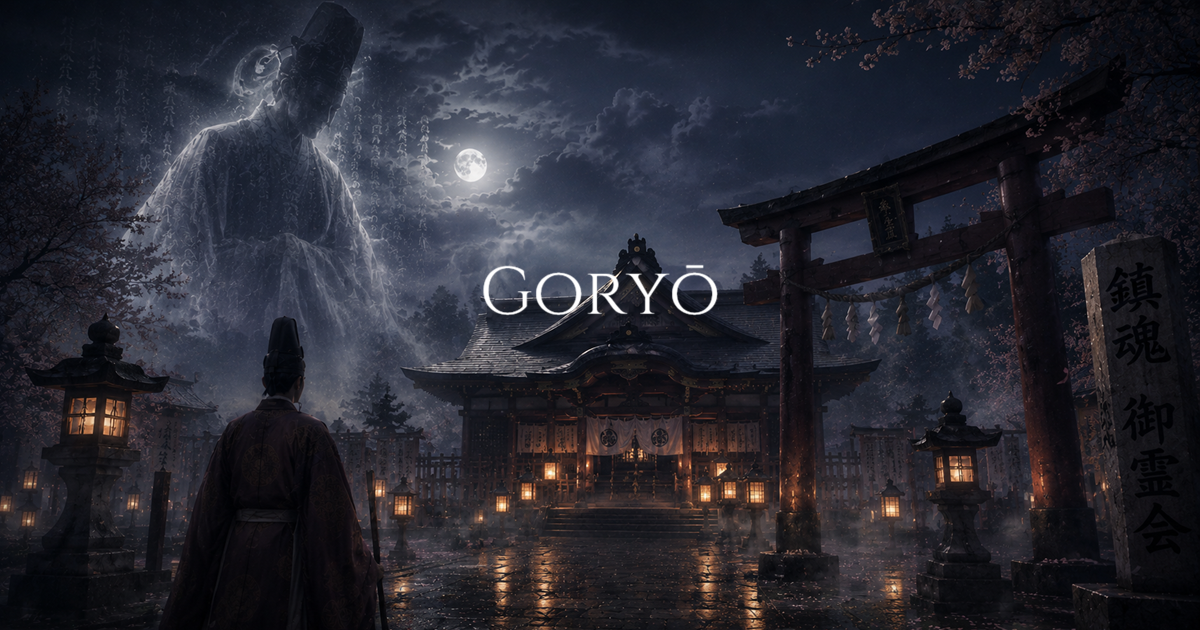
Goryō occupy a distinct place in Japanese ghost culture because their disturbance is never only personal. They belong to a world in which political injury, public catastrophe, ritual duty, and the dead were understood as parts of a single moral order. A death shaped by exile, disgrace, or unresolved injustice could outlast its own moment, returning as illness, fire, storm, or sudden instability within the world of the living.
The figure of the goryō gives this pattern a name. It asks how a society remembers those it has wronged, and what forms of address become necessary when authority cannot simply erase the consequences of its own decisions.
For more stories like this, explore our Folklore & Ghost Culture collection.
Goryō and the Politics of an Unquiet Dead
Goryō are spirits bound to political grievance and public resentment, addressed through formal ritual rather than left as private hauntings. The term applies most precisely to figures whose deaths were felt to be unresolved because the person had been disgraced, exiled, punished, or denied the recognition their rank implied.
This sets goryō apart from later, more familiar shapes of Japanese ghost imagery. A yūrei lingers where personal attachment has not been resolved; an onryō acts through a resentment that seeks recognition or revenge on an individual scale. A goryō belongs instead to the public order of rank, court, and collective welfare — its anger registers not as a private complaint but as a disturbance in the compact between the living, the dead, and the institutions meant to contain both.
Unease about goryō was therefore also unease about power itself. A wrong committed by the court could not always be closed by decree, exile, or death. The social body might continue to carry the injury, and epidemics, fires, droughts, lightning, or unexplained deaths could be read as evidence that something in the moral and spiritual order had come loose.
This gave the goryō a working ritual role rather than a purely narrative one. The response to such a spirit was not simple avoidance or exorcism. It had to be named, honored, and in some cases elevated, so that what politics had failed to settle could be absorbed instead through rite, title, and shrine.
How Court Politics Turned Misfortune Into Spiritual Meaning
Goryō belief reached its fullest expression in the Heian period, when governance, ritual observance, and cosmological order were treated as facets of a single system. The imperial court was not only an administrative center; it was also understood as a point whose stability depended on correct relations among people, deities, ancestors, and the unseen forces that surrounded the state.
Within that framework, catastrophe was rarely read as pure accident. An epidemic moving through the capital, a fire reaching important buildings, a storm out of season, or a sudden death among the elite could each be interpreted as a sign that the visible world had been disturbed by an invisible imbalance. The dead were not separate from politics — they were one of the channels through which political consequence returned.
This logic mattered most in cases where a powerful or accomplished figure died after public disgrace. Exile and demotion were never purely administrative; they severed the relationship between a person, their rank, their place, and their reputation. A death that occurred far from the center of authority, under those conditions, could be felt as spiritually unresolved, because the social order had not yet absorbed the injury it had caused.
The goryō takes shape in that gap. It gives form to the suspicion that political decisions do not end simply because the person harmed disappears from court life. Resentment can outlast the body; reputation can act after official memory has tried to close the matter. In this sense, the dead could become more politically consequential after death than they had been while alive.
None of this reduced every disaster to a single spirit’s will. Goryō belief instead supplied a cultural grammar for connecting events that would otherwise seem disorderly — a sequence of calamities became legible, misfortune found a place within a moral field, and the court could answer through ritual not because ritual replaced politics, but because it offered a way to repair what politics had left unstable.
From Resentment to Ritual Pacification
The defining movement in goryō belief is transformation. A spirit tied to anger or disruption is not held outside the community indefinitely. It is acknowledged, ritually addressed, and in some cases raised into a protective or venerated presence — a process that does not erase the original injury so much as change the dead person’s standing within it.
Pacification rites known as goryō-e developed within this logic. These ceremonies were meant to calm spirits whose unresolved anger was believed to threaten public welfare, and could combine Buddhist observance, courtly ritual, music, and collective offering. Their purpose was not simple banishment. The spirit was treated as a presence whose disorder demanded recognition, not as a threat to be discarded.
This distinction is central to how goryō traditions work: they are less about defeating the dead than restoring a broken relation. The living had to admit that something had gone wrong, and the dead had to be given a place within a reordered structure. Ritual became a form of public memory — one that did not merely recall the past but actively reorganized its meaning.
The movement from danger to protection recurs throughout Japanese religious culture. A spirit once feared for its destructive force can become an object of worship; a figure once linked to calamity can later be approached for blessing. The earlier disturbance is not made irrelevant by this shift — later reverence depends on it, since the spirit’s power is not denied but redirected.
Goryō belief therefore reveals a particular cultural answer to unresolved resentment. Rather than treating anger after death as something to be banished outright, it imagines a process by which that anger can be ritually converted into order — the unsettled dead placed where they can be remembered without continuing to rupture the world of the living.
Sugawara no Michizane and the Shape of Public Memory
The most influential goryō is Sugawara no Michizane. A scholar, poet, and court official, Michizane rose to considerable rank before becoming entangled in political rivalry at court. He was removed from power and sent to Dazaifu, where he died in exile in the early tenth century.
A series of disasters and deaths at court followed, and each came to be associated with his unsettled spirit. Lightning strikes, illness, and political misfortune were interpreted through the possibility that Michizane had returned as a dangerous presence — a case that gave lasting shape to the belief that a wronged political figure could continue to act on the state after death.
The court’s response followed the familiar pattern of pacification and reintegration. Michizane was posthumously restored in rank, honored through ritual, and eventually enshrined as Tenjin. Over time, Tenjin came to be associated less with political danger than with scholarship, calligraphy, and academic success — an association that Tenmangū shrines across Japan continue to make visible in public religious life.
This is not a simple reversal from fear to worship. It shows how goryō traditions function as memory systems. Michizane’s grievance was not forgotten when he became Tenjin; the terms of remembrance changed instead. The dangerous force of political resentment was given a sacred identity, a ritual home, and a continuing role in the lives of later worshippers.
A modern visitor to a Tenmangū shrine may think first of exams and academic wishes rather than court politics. Beneath that familiar practice, though, lies an older structure — the conversion of an unsettled political death into a stabilizing religious presence, carried forward not as a museum label but through repeated acts of offering and seasonal observance.
Michizane’s case also situates goryō within a longer history of how Japan has imagined the relationship between authority and accountability. A court may punish, exile, and rename, but within the cultural logic of goryō belief, power remains answerable to the emotional and spiritual consequences of what it has done.
The Afterlife of Pacified Spirits in Japanese Culture
Goryō belief belongs most strongly to premodern court culture, but its underlying structure did not end with the Heian world. It continued to shape later ghost traditions, religious practice, theater, and literature, and the idea of the unsettled dead more broadly.
One lasting inheritance is the assumption that emotion after death can become socially active. Later yūrei and onryō traditions tend to center on personal grievance, betrayal, or family conflict rather than court politics, but the deeper structure remains recognizable: a feeling unresolved in life continues to demand form after death.
This structure is visible in Noh, where spirits often return not to frighten but to speak from a state of attachment, sorrow, or memory. The stage becomes a place where the dead can be encountered through patterned movement and voice, and a spirit’s unrest functions as a condition to be witnessed and ritually shaped rather than a narrative device alone.
Kaidan storytelling carries part of this same logic forward. Later ghost tales more often center on households, lovers, or wells than on court politics, but they preserve the same underlying concern — a death that has not been properly absorbed into memory can continue to trouble the living, even as the scale of the story changes from the state to the household.
Goryō traditions also help account for why Japanese ghost culture so rarely divides cleanly into fear and reverence. A spirit may threaten disorder and still require care; a danger may point toward a need for acknowledgment rather than elimination. The living maintain relations with the dead through naming, ritual, and repeated cultural forms, rather than simply escaping them.
In this light, goryō belong not only to folklore but to the broader history of Japanese religious imagination. They mark a boundary where memory, authority, and ritual obligation meet, showing that the dead can become part of public order rather than only its negation.
Modern Readings of Political Memory and Spiritual Force
Contemporary audiences are unlikely to read an epidemic or a lightning strike as a direct sign of a wrathful spirit, yet goryō remain culturally legible because the structure behind them still resembles familiar questions — how injustice is remembered, how suppressed resentment returns, and how institutions respond to suffering they had a hand in creating.
Read in contemporary terms, goryō become figures of political memory. They express the idea that wrongs committed by authority do not vanish simply because official records move on; a person removed from power may grow more symbolically forceful after death, particularly if later events expose the instability of the order that punished them.
This reading should not flatten goryō into psychology or metaphor alone. Their historical meaning depended on a worldview in which spiritual presence, ritual action, and public authority were genuinely intertwined, and treating them only as symbols of trauma would erase the religious and political world that produced them. Their continued relevance, though, does rest partly on the fact that the underlying logic still speaks to present concerns.
Heritage culture has reshaped the public face of goryō-linked figures in its own way. Tenjin worship is now tied mainly to education and examination success, and shrines, amulets, and seasonal visits connect Michizane to everyday hope rather than courtly anxiety. That ordinary familiarity is itself the product of a successful ritual transformation — a feared spirit became a trusted presence because generations kept giving him a place.
Goryō matter today less because belief has survived unchanged than because the cultural mechanism behind it remains legible: resentment becomes disturbance, disturbance demands recognition, recognition takes ritual form, and ritual form turns a dangerous memory into a continuing relationship. Goryō are not simply vengeful spirits from an earlier age — they are figures through which Japanese culture worked out the long life of political injury and the difficulty of returning unsettled memory to order.
Conclusion
The cultural meaning of goryō lies in how they connect political wrongdoing to spiritual consequence. They describe a world where resentment is never only private, and where the dead do not become harmless simply because the living have stopped speaking of them — injury can stay active precisely where it has gone unacknowledged.
Through pacification rites, posthumous honors, and shrine enshrinement, goryō traditions built a ritual answer to that problem. The dangerous dead were not pushed away; they were named, addressed, and in some cases transformed into protective presences whose power could be held within a new relationship.
For Japan After Dark, goryō matter because they reveal ghost culture as a form of public memory. Their disturbance begins exactly where authority believes a matter has ended, and what returns is not only a spirit, but the unresolved weight of what a society has to learn to carry.
Related Articles
- Yūrei — A ghost bound by unfinished personal attachment rather than public grievance, lingering at the level of the individual self.
- Onryō — Resentment that erupts as an individual’s active vengeance, without the pacification and enshrinement that redirects a goryō’s anger.
- Kaidan — Storytelling structures that carry unresolved death into households and everyday spaces rather than the machinery of court and state.
Sources and Further Reading
The following sources provide historical, religious, and literary context for goryō belief, court politics, and the ritual pacification of the dead in Japan.
- Borgen, Robert. Sugawara no Michizane and the Early Heian Court. Harvard University Asia Center, 1994.
- Foster, Michael Dylan. Pandemonium and Parade: Japanese Monsters and the Culture of Yōkai. University of California Press, 2009.
- Grapard, Allan G. The Protocol of the Gods: A Study of the Kasuga Cult in Japanese History. University of California Press, 1992.
- Iwasaka, Michiko, and Barre Toelken. Ghosts and the Japanese: Cultural Experience in Japanese Death Legends. Utah State University Press, 1994.
- Komatsu, Kazuhiko. An Introduction to Yōkai Culture: Monsters, Ghosts and Outsiders in Japanese History. Japan Publishing Industry Foundation for Culture, 2017.
- Plutschow, Herbert. Chaos and Cosmos: Ritual in Early and Medieval Japanese Literature. Brill, 1990.
Author’s Note
I first knew Sugawara no Michizane as the god of learning at a small Tenmangū near home, long before I read about the lightning strikes and sudden deaths that followed his exile. Learning that the two stories belonged to the same man never felt like a contradiction; Michizane already read as a wronged figure, and the vengeance made sense on its own terms. When I later encountered the legend of Taira no Masakado, I recognized a similar shape there too — the feeling that political defeat does not always end where history says it does.