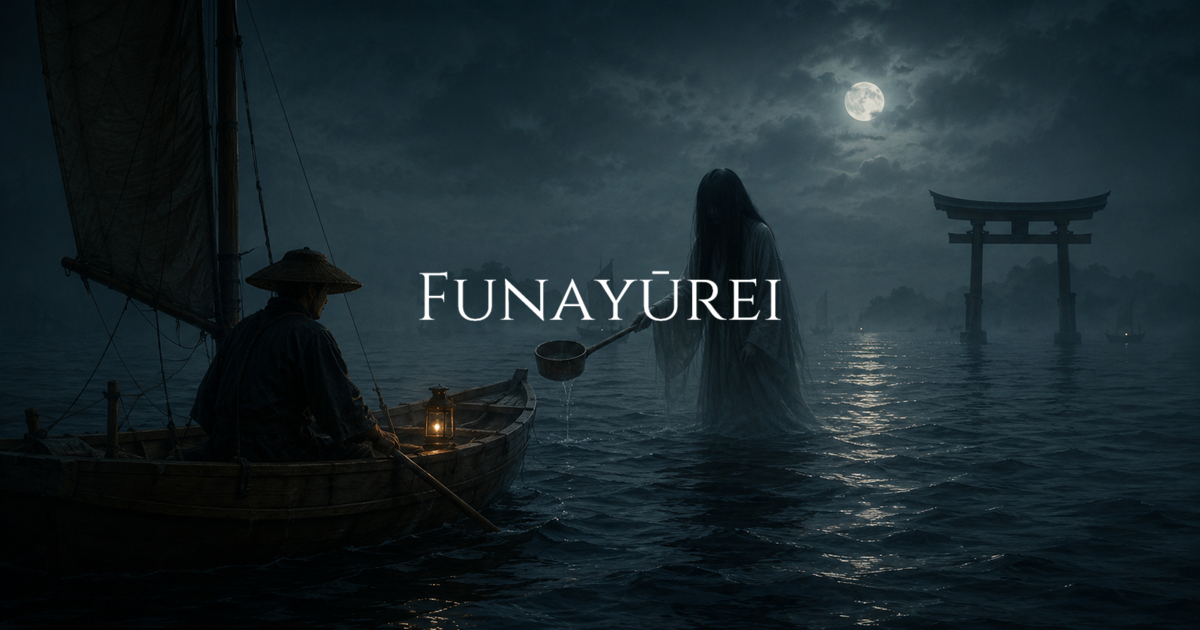
Funayūrei belong to the part of Japanese ghost culture that does not begin on land. They are figures of the drowned and the shipwrecked, spirits whose stories form wherever the sea takes someone without returning a body, a place, or a clear account of what happened. Where many Japanese ghosts are anchored to a house, a well, or a road, funayūrei drift with the water itself, carrying the unfinished business of death into a setting that resists ordinary forms of memory.
For more stories like this, explore our Folklore & Ghost Culture collection.
The Form of Funayūrei in Japanese Ghost Tradition
Funayūrei are spirits associated with the sea, most often those who drowned, vanished in storms, or died in the wreck of a boat. What separates them from other yūrei is not the manner of death alone but the absence of a fixed location for it: a house ghost still has walls to haunt, but a funayūrei belongs to water that moves, closes over, and erases its own traces. The haunting begins from that instability, and it is this spatial condition, rather than any singular legend, that distinguishes funayūrei within the wider family of Japanese ghost stories.
The name joins fune or funa, boat, with yūrei, the general term for the spirits of the dead. Translation only carries the term partway. Funayūrei took shape within a maritime world of fishing routes, weather knowledge, and ritual caution, where the line between safe passage and disappearance could shift with a change in the wind. They are ghosts of the sea, but just as much ghosts of an uncertainty that the sea makes literal.
In many accounts, a funayūrei approaches a boat during fog, at night, or in weather already turning dangerous. It may call out or ask the crew for a hishaku, a ladle used to bail water. The request sounds almost domestic, an ordinary tool passed from one hand to another, yet it carries a hidden mechanism. Give the spirit a working ladle, and it may use it to fill the boat with seawater until the vessel goes under.
The countermeasure recorded across these stories is to hand over a ladle with its bottom removed. This detail gives the legend its particular shape. Nothing here turns on a sudden attack; the encounter is built around an exchange that must be managed with precision. To refuse the dead outright risks its own kind of transgression, but to answer without care is to be pulled into the same fate that took the spirit in the first place.
The bottomless ladle is a small, practical solution to a larger social problem. It lets the crew acknowledge a presence that cannot simply be waved away, while withholding the one motion that would let the sea cross into the boat. In that gesture, funayūrei stories state something central to Japanese ghost culture more broadly: the dead are owed a form of response, but the living must find a way to give it without dissolving the boundary that keeps them alive.
The Sea as a Place Where Mourning Cannot Settle
Japan’s relationship to the sea is built on a kind of double exposure. The water feeds coastal communities, links the islands, carries trade, and structures ritual life along the shore, yet it withholds the fixed markers that make land manageable to grief. A road can be named and a grave visited; the sea covers what it touches and keeps moving.
This distinction matters because mourning is often organized around place. A household altar, a grave marker, or even the known site of an accident gives grief somewhere to go. None of these objects erase a death, but they let the living agree on where remembrance should collect. Someone lost at sea removes that agreement. The death is not in doubt, yet its evidence is. A body may never surface. The precise place where a life ended may stay unknown even to those who search for it.
Funayūrei take shape inside that gap. Their stories imagine the drowned not as having fully departed but as continuing to move through the same waters that took them, still present in a form the living can, on occasion, encounter. The sea keeps them not by preserving their bodies but by declining to offer the confirmation that would let a death close socially. Folklore answers with a shape for that refusal: a voice through fog, a shadow near the hull, a figure that asks for the one object that could let water in.
A ghost tied to a house draws on the intimacy of shared rooms. A ghost tied to a road draws on the logic of passage and boundary. A sea ghost appears precisely where those fixed points give way, in fog and current and distance, where the usual instruments of safety stop being reliable. Funayūrei belong there. Their persistence is not primarily about the return of the dead; it is about what happens to the living when they are left without solid ground from which to say that someone is truly gone.
Ladles, Boats, and the Fragile Boundary of the Living
The ladle is the most recognizable object in funayūrei tradition because it condenses the entire structure of the legend into a single, ordinary item. A hishaku is not a weapon. It belongs to daily labor, to bailing and pouring, to the unremarkable handling of water. When a spirit asks for it at sea, the vocabulary of domestic life is carried into a setting where domestic assumptions no longer hold.
The danger sits in how quickly a familiar gesture changes function. Handing over a ladle answers the dead the way one might answer any request from a stranger. Once given, though, the object’s meaning turns. What was an act of courtesy becomes the instrument by which the sea enters the boat, and a small kindness becomes the beginning of collapse.
The boat itself functions as more than a means of travel in these stories. It is a temporary, human-made boundary set against the water, one that holds only as long as the sea stays outside its boards. Its safety is conditional, dependent on constant exclusion rather than any permanent property. Once a funayūrei begins filling it, the line between vessel and ocean thins, and the space of the living starts to resemble the space of the drowned.
That thinning is why the bottomless ladle carries such weight in the tradition. It neither destroys the spirit nor pretends it is not there. It answers the request while quietly emptying it of consequence. There is no confrontation in this solution, only care, and that restraint is where much of the story’s cultural force sits. Recognition of the dead does not have to become surrender to them.
This exchange also reflects a broader pattern running through Japanese ghost culture: restless spirits tend to appear where something has been left incomplete, whether an unmourned death, an unresolved grievance, or a body never recovered. Funayūrei render that incompletion in maritime terms. The unfinished transition here is not only emotional. It is carried, quite literally, by the sea.
Coastal Memory and the Discipline of Caution
Funayūrei were never purely atmospheric material meant to unsettle a listener. They belonged to communities whose survival depended on practical negotiation with the sea’s risks. Fishermen and sailors worked where weather turned quickly and local currents mattered more than general knowledge, and where an inherited sense of when not to go out could decide whether a boat came home. In that setting, a ghost story could carry caution without becoming a set of instructions.
Stories of spirits on the water gave danger a shape people could recognize and repeat. They marked fog, darkness, particular seasons, and specific stretches of coast as moments that called for heightened attention. Some traditions tied maritime spirits to Bon, when ancestral spirits are said to return briefly to the world of the living. Others attached them to waters already associated with drowning or wreck, so that memory and hazard sat in the same place.
Through these associations, the sea became a landscape that could be remembered even though it left no visible sign. Land can hold a marker, a shrine, or a ruin; water cannot. Story supplied what geography could not, letting communities speak of danger the way they might speak of a known route or a familiar season, rather than treating it only as unpredictable weather.
This kind of storytelling does not need to be read as literal belief, nor dismissed as mere superstition. Its use was more layered than either option allows. A community holding onto a ghost story was also holding onto practical knowledge: which days made poor sailing, how familiar water could turn without warning, and the understanding that those lost to it were not simply erased from the group’s ongoing life.
Caution, not confrontation, is the discipline these legends teach. Funayūrei stories rarely reward curiosity toward the spirit or a wish to prove it false. The expected response is procedural: know the correct gesture, follow the inherited pattern, and treat what the sea presents as something to be managed rather than explained.
Modern Ghost Culture and the Image of the Drowned
In contemporary Japan, funayūrei most often appear through illustrated folklore collections, ghost anthologies, manga, anime, games, and online discussion of traditional spirits. This circulation has kept the figure visible well beyond the fishing and sailing communities that first shaped it. At the same time, that visibility can compress funayūrei into a single image, a pale figure on dark water, detached from the ritual reasoning that gave the story its structure.
The older framework tells more. Funayūrei are not memorable simply because they occur at sea; they persist because they connect disappearance to a form of social feeling that has no other outlet. The drowned person is not only dead but withheld from ordinary confirmation. No body returns. No place can be fixed as the site of the loss. The community is left carrying an absence with no settled outline, even as the water that caused it keeps moving.
This sets funayūrei apart from ghosts bound to houses, wells, temples, or roads. Those settings may carry heavy memory, but they remain places a person can point to. The sea declines that gesture entirely, and haunting becomes drift rather than location. A voice may be heard, a shape may pass near a boat, a request may be made, yet its origin cannot be pinned down.
Contemporary audiences rarely approach the sea with the same working knowledge as earlier coastal communities, but the underlying pattern still registers. Disappearance without closure remains a disruption to ordinary mourning, whatever medium carries the story. Even treated as folklore imagery or ghost-story material, funayūrei keep asking the same question: how a person continues to live with a loss that offers no final image, no last known place, and no answer sufficient to close it.
Why Boat Ghosts Still Speak to Unresolved Absence
Funayūrei endure because they give a recognizable shape to a kind of absence that ordinary language struggles to hold: knowledge without evidence, grief without a location, memory without a fixed object to attach to. The ghost appears in exactly the place where the body does not.
Part of their staying power comes from the sea’s dual role in Japanese life. It is not separate from culture but embedded in work, food, travel, pilgrimage, and ritual practice. It connects communities across islands and, at the same time, takes from them. Funayūrei concentrate that tension into a single recurring figure, one that approaches from the same element on which coastal life depends.
These stories also resist turning the dead into simple adversaries. Some versions carry real danger, and the attempt to sink a boat can read as a pull toward shared death. Even so, the underlying structure keeps a social pattern intact: the spirit asks, and the living answer, however distorted the exchange becomes. That trace of ordinary reciprocity is part of what gives the legend its quiet, lasting force.
Funayūrei present the dead not as wholly separate from the living but as figures whose unfinished passage continues to make a claim on them. Through this figure, unresolved death becomes spatial, practical, and communal all at once. The sea does not merely contain the dead; it changes the terms under which they can be remembered at all.
Conclusion
Funayūrei are not simply ghosts said to appear to sailors. They belong to a broader effort within Japanese ghost culture to account for death that occurs beyond the reach of ordinary mourning practice. The sea removes the body, unsettles the location of loss, and prevents memory from gathering around a single fixed site. Funayūrei give that condition a form that can be encountered, spoken of, and, in a small way, managed.
Their stories show how much of Japanese ghost culture rests on incomplete transition rather than a clean opposition between the living and the dead. A spirit appears where something has not fully crossed over, whether grief, ritual, or the body itself. With funayūrei, that incompleteness cannot be separated from the water that caused it.
The sea stays open, in motion, and resistant to marking. It carries boats forward even as it holds the memory of those who did not return with them. Funayūrei do not simply stand in for a fear of drowning; they preserve the sense that certain deaths keep moving in a place no grave, road, or household altar can fully reach.
Related Articles
- Yūrei — The wider category of the restless dead, shaped by incomplete passage and a bond to household memory rather than an open, shifting expanse like the sea.
- Onryō — A more forceful return of the dead, where unresolved grievance drives active disturbance rather than the drifting, unlocatable presence associated with drowning.
- Kaidan — The storytelling tradition through which unsettled deaths, including those tied to water and disappearance, are preserved as structured ambiguity rather than resolved explanation.
Sources and Further Reading
These sources address maritime religion, the cultural treatment of death without confirmation, and the broader structures of Japanese ghost and yōkai tradition that inform the funayūrei figure.
- Rambelli, Fabio. The Sea and the Sacred in Japan: Aspects of Maritime Religion. Bloomsbury Academic, 2018.
- Iwasaka, Michiko, and Barre Toelken. Ghosts and the Japanese: Cultural Experience in Japanese Death Legends. Utah State University Press, 1994.
- Komatsu, Kazuhiko. An Introduction to Yōkai Culture: Monsters, Ghosts, and Outsiders in Japanese History. Japan Publishing Industry Foundation for Culture, 2017.
- Reader, Ian, and George J. Tanabe Jr. Practically Religious: Worldly Benefits and the Common Religion of Japan. University of Hawai’i Press, 1998.
Author’s Note
The first drowning at sea I ever knew of came from a children’s book my parents had bought me, one about the Genpei War: Emperor Antoku going under the waves at Dan-no-ura. I knew the story long before I understood its weight, and long before Funayūrei or the tale of Hōichi and the vengeful dead of the Heike found their way into the same part of my memory. It took years to notice how naturally they had all grown to sit in the same water.