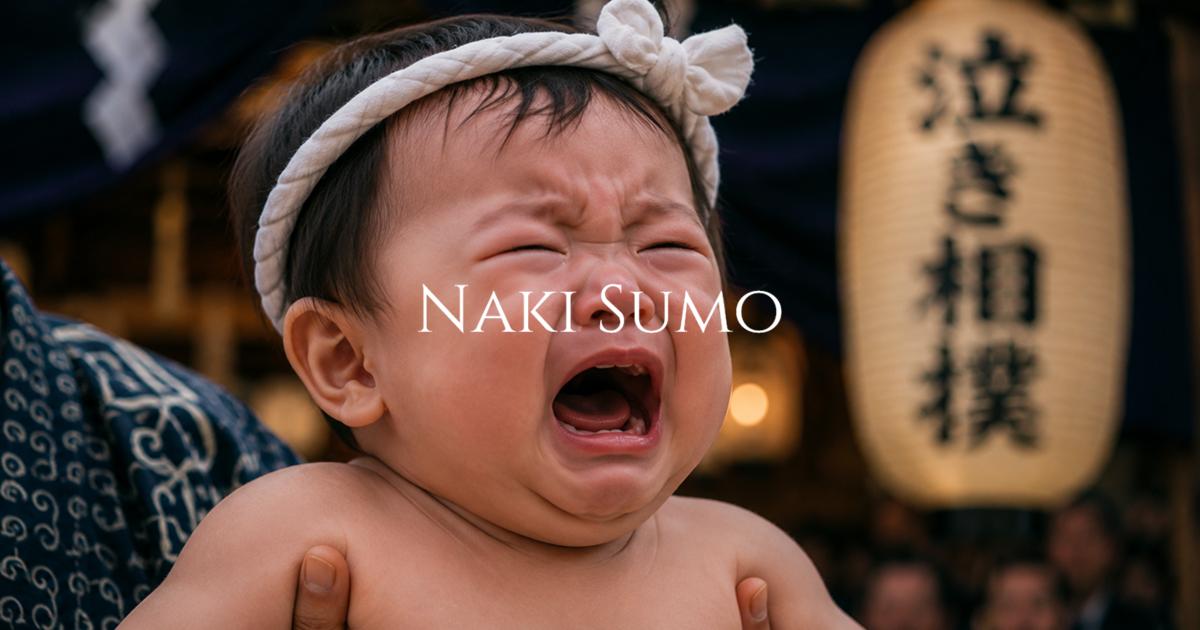
An infant’s cry usually calls for comfort. It signals hunger, fatigue, discomfort, or the need to be held, and the adults nearby move to quiet it before anything else. Naki Sumo takes that same sound and places it inside a different frame entirely — one where crying is not a problem to be solved but a signal to be witnessed. The cry remains a mark of vulnerability. Within the ceremony, it is also read as proof that a child is breathing, responding, and present in the world.
Outside Japan, the ritual is often reduced to a novelty: adults competing to make babies cry. What gives Naki Sumo its cultural weight is not the production of tears but the decision to treat an involuntary response as auspicious — to carry it into a shrine or temple community and attach it to shared wishes for health, growth, and protection.
For more stories like this, explore our Strange Festivals & Rituals collection.
Naki Sumo as a Ritual of Crying and Growth
Naki Sumo describes a family of Japanese ceremonies in which infants are held within a sumo-shaped ritual encounter, and their crying is interpreted as a sign of vitality and future protection — distinct from a competitive event, since the participants neither understand nor pursue the contest built around them. No single national festival governs the practice; instead, local shrines and temples maintain their own versions, each shaped by regional memory rather than a shared founding origin.
At a typical event, two infants are brought forward and supported by sumo wrestlers, parents, or designated attendants while an officiant calls the encounter as though presiding over a bout. Some versions favor whichever child cries first; others favor the louder cry, the quieter child, or treat the outcome as incidental to the larger prayer. What holds across these variations is not a fixed result but a fixed sequence — the infant enters a bounded space, adults create the conditions for a response they cannot dictate, and the sound that follows is received collectively.
This is what separates Naki Sumo from an ordinary contest. The infants do not know the rules, cannot pursue victory, and perform nothing intentionally. Adults handle the staging — the clothing, the positioning, the pairing, the explanation — but the one act at the center of the ceremony cannot be commanded into being.
That absence of intention is the point. Because the cry cannot be rehearsed, it can stand as unforced evidence that the child is alive and capable of asserting presence. The ritual does not turn the infant into a performer. It turns a response no one can control into something a community is willing to protect.
The Cry as Evidence of Life
A baby’s cry is among the first ways a human being reaches into the social world around it. Long before language, the sound draws adults close and asks, without asking, to be understood. No one may know immediately whether it means hunger or fear or exhaustion, but everyone recognizes that it requires a response.
Naki Sumo keeps that ordinary meaning intact. Adults holding the child remain aware that the sound may come from real discomfort. What the ritual adds is a second layer of meaning laid over the first: the force of the cry as evidence that life is active inside the small body producing it. Before a child can speak with intention, breath and sound already announce that something is there.
This is why the cry attaches to growth rather than weakness. The crying child is not read as overwhelmed. The sound demonstrates reach — the capacity to extend beyond the body’s own limits and pull the attention of others toward it. Dependence and vitality, inside the ceremony, are not opposites. They arrive in the same voice.
The everyday phrase naku ko wa sodatsu — a crying child grows — compresses this logic into a familiar saying, absorbed early and rarely explained outright. It does not excuse prolonged distress. It names crying as part of development: the ability to call out, to protest, to seek care, is itself evidence that a life is unfolding as it should.
Inside the ceremony, that private observation becomes public. The cry reaches officiants, relatives, and spectators, not only a parent standing at home. A bodily reaction most families experience alone becomes something a whole gathering can recognize and attach to a shared hope — grow well, stay healthy, pass safely through the fragile early months.
Protection starts there, at the moment of recognition. Before a child holds any social identity built from words or deliberate acts, the community answers a voice that has already arrived.
Sumo Form and the Ordering of Uncertainty
Borrowing the shape of sumo gives Naki Sumo more than visual recognition. It supplies a working vocabulary — boundaries, pairing, officiation, physical presence, a declared outcome — through which an unpredictable event can be followed by everyone present. What a conventional bout depends on, however, is exactly what infants cannot supply: trained bodies, deliberate technique, an understanding of the rules being enacted.
Naki Sumo removes those conditions from the center of the ritual without removing the structure that depends on them. Adults arrange the encounter, call the pairing, and try to prompt a response, but none of them controls when the cry arrives or what shape it takes.
Rigid form meets a life that will not submit to it. The ring is marked. Roles are assigned. The infants are carried forward on schedule. Yet the one moment the entire arrangement exists to produce stays outside anyone’s command.
That tension echoes something true of infancy generally. Sleep, appetite, illness, and mood resist adult planning as a matter of course. Naki Sumo does not claim to master that instability — it surrounds the instability with a form recognizable enough that families can face it without it feeling shapeless.
The competitive framing also changes what the cry is allowed to mean. Outside the ritual, adults typically move to end crying as fast as possible. Inside it, the sound stops being an interruption. It becomes the outcome the entire structure has been organized to receive.
Where a winner is declared, the designation is symbolic rather than comparative — a way for the officiant to mark that the awaited response has arrived, not a claim that one child possesses more strength or worth than the other. Both infants remain inside the same field of blessing and communal attention regardless of which one cries first.
Sumo’s form contains the moment without controlling it, and that containment is itself protective: uncertainty enters a bounded, witnessed space and is returned to the family transformed into a favorable sign.
Protection Through Sound and Exposure
Part of the protective meaning here rests on what sound is allowed to do inside ritual space. A loud cry breaks the stillness of the setting, carries past the body producing it, and makes a small child impossible to overlook. The infant defends nothing through strength. Protection, in this frame, begins with being audibly, undeniably present.
This differs from the more familiar logic of protection through concealment or enclosure. Naki Sumo does the opposite — it places the child in front of others and lets a normally private sound occupy public space. The exposure stays carefully bounded: a wrestler or parent supports the body physically, an officiant regulates the pace of the encounter, and the family stands inside a community gathered around the same hope for the child’s health.
Masks, exaggerated faces, or sudden vocal prompts sometimes enter local versions of the ritual when a child does not cry on cue. Seen without context, these figures can look like the whole point of the ceremony. Inside it, they function as prompts introduced at the edge of an already protected situation — the disturbance approaches while the infant stays physically held and socially surrounded, never left alone with it.
Protection here is not the absence of discomfort. It is the presence of a structure capable of holding discomfort without leaving it uncontained. The cry marks the point where uncertainty enters the ceremony; the adults arranged around the child demonstrate, in the same moment, that the uncertainty does not have to be faced without them.
The sound also travels outward, past the ring or shrine grounds, carrying the child’s presence beyond the limits of the body itself. In that movement the infant appears neither passive nor mute. Still entirely dependent, the child already has the capacity to reach the surrounding world and pull others into relation with it.
The ritual does not ask the child to overcome anything. It lets an immediate bodily response become part of the protection the family came seeking.
Regional Variation and the Limits of a Single Origin
Naki Sumo is often introduced as a centuries-old national festival, a phrase that can suggest a single continuous institution practiced the same way everywhere. What exists instead is a set of local observances that differ in history, calendar, rule, and religious setting — some tied to shrines, others to temples or community associations, with present forms that may have been established, revived, or reorganized at different points in time.
The rules governing the “bout” vary by location. In some places the first child to cry is favored, on the reasoning that the cry signals vigor and protection. Elsewhere the quieter child wins recognition, even while crying itself keeps its auspicious meaning. Some ceremonies foreground the contest; others treat the result as secondary to the act of bringing the child into prayer at all.
These differences do not weaken the ritual’s coherence as a cultural form. They show that Naki Sumo survives as a flexible pattern rather than a standardized national model — communities keep the elements that matter to them (the infant, the cry, the sumo frame, the wish for growth) while arranging those elements through local memory.
Origin stories should be read the same way, locally rather than universally. Local accounts may connect individual ceremonies to an agricultural rite, a story involving wrestlers, or a deity tied to childbirth, depending on the shrine or temple in question. These accounts belong to specific observances and resist being folded into one national history.
The pattern places Naki Sumo inside a broader logic of Japanese festival culture, in which wide recognition does not require central standardization. Continuity here depends less on uniform rules than on repeated acts — families bringing children forward, organizers preparing the space, officiants preserving the ceremonial language, communities agreeing that an infant’s cry still carries a public wish worth witnessing.
What holds across the regional variation is not one fixed outcome but one shared transformation, repeated locally in whatever form a given community has kept: a response no one can plan for is received as favorable.
From Family Prayer to Circulating Image
Contemporary media tends to isolate the single most visually striking part of Naki Sumo — a large wrestler holding a small crying child, sometimes beside a second infant or an approaching masked figure. Lifted out of the surrounding prayer, that image can register as comic, strange, or needlessly harsh.
A photograph holds onto the contrast in scale between bodies, but not the ceremonial sequence around it. It cannot easily show the blessing that precedes the encounter, the reasons parents chose to bring their child, the care with which the infant is supported throughout, or the return to comfort once the sound has stopped. Short video clips do something similar — they foreground the cry while compressing the slower structure that allows the people present to receive it as a good sign rather than a jarring one.
The ritual therefore lives inside two interpretive frames at once. Locally, it belongs to family prayer, to hopes for healthy growth, and to the protection of a child at one of the more fragile stages of life. In wider circulation, it becomes a striking image of cultural difference, detached from most of what surrounds it.
The gap between those two frames explains why outside accounts so often reduce the ceremony to the act of making babies cry. For an observer encountering only the image, the event appears to begin at the moment of visible distress. For the family involved, it began earlier — with the decision to bring the child into a place of blessing — and continues after the sound has faded.
Wider visibility does not simply strip the ritual of meaning. Public attention can also help a local observance stay recognizable, draw participants, and continue across generations. Still, the image that travels rarely carries the full structure with it.
What moves easily between contexts is the cry itself. What stays local is the surrounding network of care, prayer, and interpretation that makes the cry mean protection in the first place.
Conclusion
Naki Sumo gives ceremonial form to something no family can command: whether a child will cry, how strongly, and at what moment. Adults prepare the space, assign the roles, and announce the encounter, but the outcome belongs entirely to the infant’s own body.
The cry becomes protective not because distress is desirable but because the ritual chooses to hear responsiveness as life itself. A sound that would normally send adults rushing to restore quiet is, for a few minutes, allowed to fill a public space instead.
What the ceremony offers is not resolution. Infancy stays as unpredictable after the ritual as before it. What changes is that the unpredictability has, for one occasion, been met in public, by people willing to stand around it together and call the outcome good.
Related Articles
- Kanamara Matsuri — Reproductive vulnerability moves from private wish to public symbol, made visible rather than voiced through sound.
- Hadaka Matsuri — Adult bodies enter risk voluntarily under a shared framework of purification, a deliberate counterpart to the involuntary response at the center of Naki Sumo.
- Onbashira Festival — Chosen physical danger becomes a rite of communal renewal, standing in clear contrast to a ceremony built around a response no participant can choose.
Sources and Further Reading
These works provide broader context for shrine ritual, worldly benefit, bodily participation, and the organization of protection within Japanese religious life.
- Earhart, H. Byron. Japanese Religions: Unity and Diversity. Wadsworth Publishing, 2004.
- Hendry, Joy. Becoming Japanese: The World of the Pre-School Child. University of Hawai’i Press, 1989.
- Kasulis, Thomas P. Shinto: The Way Home. University of Hawai’i Press, 2004.
- Ono, Sokyō. Shinto: The Kami Way. Tuttle Publishing, 1962.
- Reader, Ian, and George J. Tanabe Jr. Practically Religious: Worldly Benefits and the Common Religion of Japan. University of Hawai’i Press, 1998.
Author’s Note
On a train once, my newborn son started crying and nothing I did would settle him. I apologized to the people around us, bracing for the usual tension that comes with a crying baby in a quiet car. Instead, someone nearby said, gently, that crying is a baby’s job. I think about that line often when I think about Naki Sumo — how easily a sound most of us are trained to silence can instead be met as proof that something is simply, correctly, alive.