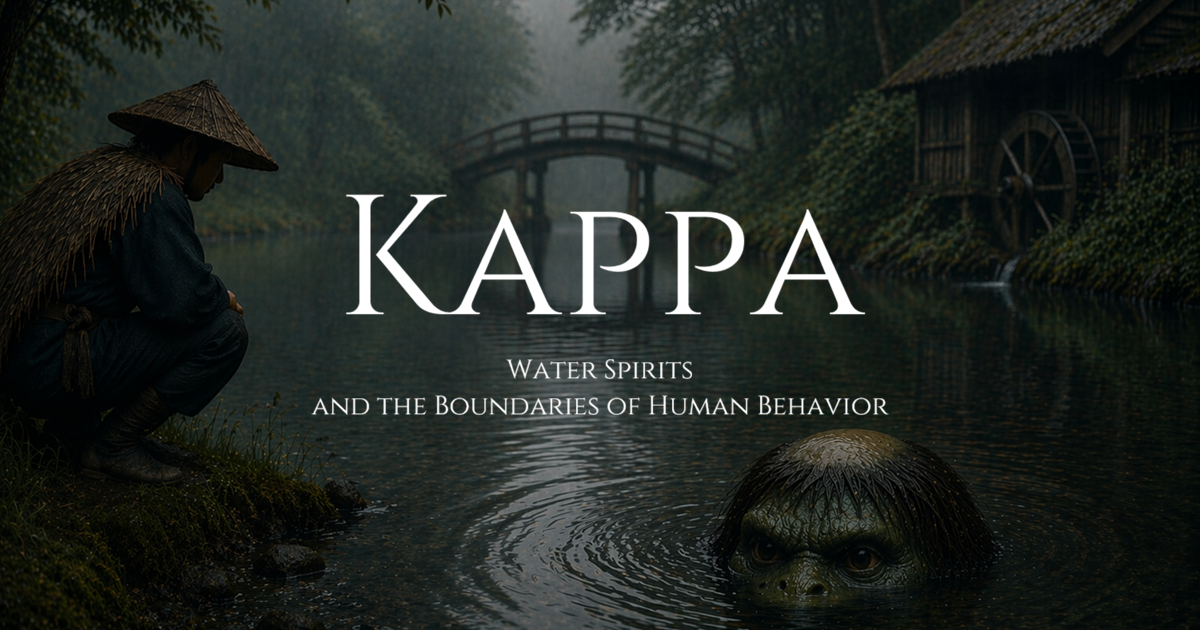
Water moves through Japanese life in ways that are practical and persistent. It irrigates rice fields, fills irrigation channels that cut across lowlands, runs beneath bridges that communities use every day. For most of its length, a river is predictable enough to work beside. But rivers are not entirely predictable, and that gap — between the familiar surface and what cannot be seen or controlled — is where kappa folklore takes hold.
The kappa does not represent water as an abstract force. It gives specific form to the problem of living alongside environments that are used without being mastered. A figure shaped by conduct as much as by danger, the kappa turns the edge of water into a place with conditions.
For more stories like this, explore our Yokai & Supernatural Folklore collection.
The Conditions That Water Imposes
A kappa is a water-associated yōkai found throughout Japanese folklore, attached most consistently to rivers, ponds, irrigation channels, and lowland marshes — wherever water enters the patterns of ordinary life. Its appearance varies across regions, but certain features persist: a small humanoid body, webbed hands and feet, a shell-like back, and a beak or flattened mouth. Most distinctively, a shallow water-filled dish sits at the top of its head.
That dish is the kappa’s structural center. As long as it holds water, the creature retains its strength. If the water spills — through a fall, a well-placed bow, or some other disturbance — the kappa loses its power. This condition shapes everything. The danger is real but not absolute. The creature can be weakened by the terms of the encounter itself.
Kappa stories tend to place the figure precisely at the threshold between ordinary movement and uncontrolled space. A child plays too close to a riverbank. A traveler crosses a bridge without paying attention. A farmer works an irrigation channel at the edge of the planted field. The settings are not remote or exceptional. They are familiar. The danger appears not where people fear to go, but where they have stopped being cautious.
This is what separates the kappa from yōkai whose meaning belongs to mountains, night roads, or abandoned buildings. The kappa occupies places communities depend on. Rivers and channels are infrastructure — for agriculture, transport, washing, fishing, and daily passage. The figure gives shape to a difficulty that is structural rather than incidental: the environments that sustain life are also the environments where life is most exposed.
The kappa’s temperament is equally variable. Some accounts make it predatory or violent. Others describe it as mischievous, oddly bound by courtesy, capable of entering agreements or imparting medical knowledge when bested or shown mercy. This inconsistency is not a flaw in the tradition. It reflects the logic of water itself — useful, dangerous, familiar, and never fully domesticated. The kappa holds that ambivalence without resolving it.
The Hidden Logic of Water Danger
Before modern embankments, warning signs, and safety education, communities living beside rivers had limited means of communicating risk. The danger was real, but much of it was invisible. A current does not always show at the surface. A pond may hold far more depth than its edges suggest. Mud grips the feet. A bank that held firm for years may give way after a week of rain. Children, who tend to treat familiar places as safe by default, were especially exposed.
Kappa stories address this not through instruction but through embodiment. The danger acquires a body that behaves according to rules, can be tricked or appeased, and punishes failures of attention rather than simple misfortune. This transformation matters. A hazard that operates by rules can be navigated. A hazard without form cannot.
The question the stories answer is not only whether water is dangerous, but whether a person knows how to act near it. Many kappa legends position the encounter as a consequence of crossing a threshold carelessly — not reading the place correctly, not maintaining the right kind of attention. The creature appears where ordinary confidence has become insufficient.
This is not folklore as safety manual. The stories preserve their strangeness. Water remains ambiguous, and the kappa itself remains unpredictable. But the underlying structure teaches something precise: natural environments have conditions, and those conditions do not always make themselves visible. A child who grows up with kappa stories does not need a technical explanation of river hydraulics. The figure carries that knowledge in a form that travels — through telling, repetition, and local memory.
Rivers, Irrigation, and the Places Legends Gather
The kappa did not develop in communities where water was scenery. It developed where water was work. Rice cultivation requires the careful management of fields, channels, and seasonal flow. Villages organized themselves around ponds, irrigation systems, and river crossings. Water was infrastructure, but it was infrastructure that resisted complete control. Floods arrived without warning. Channels silted. Lowlands that supported crops could also drown a child.
Kappa legends cluster at the specific points where human order meets environmental instability: bridges, river bends, wells, the edges of irrigation ponds. These are not locations chosen for atmosphere. They are the sites of greatest structural tension — places where communities have built something, but where what lies beneath or downstream still belongs partly to forces that cannot be arranged.
This helps explain why the kappa occupies a position somewhere between threat and neighbor. A purely hostile creature would not fit the social meaning of water, which is neither enemy nor servant. The kappa carries both sides simultaneously. It can harm and it can help. Some traditions record agreements in which a defeated kappa promises to stop harming local people; others describe kappa offering medical knowledge or practical assistance as repayment for mercy. Danger is placed inside a negotiated relationship rather than outside it.
Regional variation strengthens this reading. The kappa is not a single standardized figure. Its form adapts to local water environments, to the particular risks of each place, to the history of flooding or drowning in a given valley. In some areas it functions as warning. In others it becomes a local presence — associated with a specific river, a named pond, a stretch of canal that has its own reputation. What persists across these variations is the link between water and behavioral attention. Familiarity with a river does not replace the need to remain alert to it. A channel crossed for decades may still demand care.
Etiquette at the Edge of Water
What makes the kappa distinctive within yōkai folklore is not its danger but its responsiveness. It is a figure that can be engaged — through courtesy, exchange, promise, or knowledge of its vulnerability. Survival in a kappa encounter does not require strength. It requires recognizing the structure of the situation and responding correctly.
The bowing motif is the clearest example. Because the kappa’s power depends on the water in its head-dish, a person who bows formally to the creature may cause it to return the bow — and in doing so, spill the water. The scene carries an element of dark humor, but its internal logic is precise. Etiquette, correctly applied, has force not because it appeals to the kappa’s goodwill, but because it draws the encounter into a pattern that the creature cannot entirely escape.
This does not soften politeness into sentiment. The story places manners within a wider order that extends beyond human social life. Correct conduct carries weight because it makes the encounter legible — it creates a framework within which the kappa, however strange, operates according to recognizable rules.
Food exchange belongs to the same structure. Cucumbers appear consistently as the kappa’s preferred offering; cucumber sushi rolls carry the name kappamaki in part through this association. In modern use the connection can seem playful or nostalgic. But the underlying logic is older — food acknowledges presence and establishes a relationship of exchange with something that cannot simply be ignored or controlled.
Promises operate similarly. A defeated kappa may pledge not to harm the community again. A human who spares one may receive instruction in bone-setting or herbal medicine. These exchanges do not erase the boundary between human and yōkai. They make that boundary conditional rather than absolute, but only on the basis of obligations that must be remembered and honored.
Bowing, offering, and binding through speech are all forms of the same recognition: that a person at the edge of water has entered a zone where ordinary assumptions do not hold.
The Softened Figure and What Persists Beneath It
In contemporary Japan, the kappa’s visual presence is mostly benign. It appears on river signage, ceramic souvenirs, mascot costumes at local festivals, children’s book illustrations, and public art near bridges. The beak and head-dish remain, but the atmosphere has shifted considerably from the creature that pulled people under water.
This transformation is not a loss of meaning. It is an adaptation. Yōkai are not fixed forms — they respond to changes in the conditions that originally gave them shape. As modern infrastructure reduced the most acute dangers of river living, the kappa did not disappear; it migrated into a different register. The structural link to water remained even as the emotional weight shifted.
Towns along rivers use the kappa to mark local identity. A riverside statue is not a literal warning. It is a statement about place — that this river has a history, that the community has a relationship with the water beside it, that something worth remembering happened here or could have happened. The figure organizes memory more than it transmits danger.
The cautionary function has not entirely vanished. Friendly kappa images near canals and riverbanks sometimes still carry the message not to approach the water carelessly. The tone is approachable, even cheerful, but the underlying structure is the same: water is being made socially legible through a folkloric body.
What the softened kappa shows is the kappa’s unusual flexibility. Some folkloric figures depend on a specific belief context, and when that context weakens, the figure loses its hold. The kappa, because it belongs to ordinary places rather than exceptional ones, has been able to persist in altered form — warning in one register, entertaining in another, marking place in a third, without losing its fundamental attachment to water and to the question of how people should behave near it.
Conclusion
The kappa persists because the condition it addresses has not changed. People still live beside environments they cannot fully control. Rivers are managed, but not predictable. Canals are built and maintained, but water moves through them according to its own logic. The figure that once gave form to drowning and hidden current now carries a lighter atmosphere, but it has not stopped marking the same threshold.
What the kappa encodes is not a belief in supernatural beings. It is a recognition that certain places ask something of human behavior — not strength, not technical knowledge, but attention. A river is not approached the way a road is. An irrigation channel is not the same as an empty field. The kappa belongs to the edge of that understanding, where a familiar landscape quietly requires a different kind of care.
Related Articles
- Tengu — A mountain-associated yōkai whose stories turn on the failures of human arrogance in sacred terrain, where discipline and transgression define the boundary between human and sacred force.
- Nurikabe — A spatial yōkai that manifests as obstruction rather than creature, turning ordinary roads into sites of failed perception without offering any behavioral code for resolution.
- Oni — Figures of externalized disorder and punishment whose encounters are defined by force rather than negotiation, contrasting sharply with the kappa’s rule-bound structure of exchange.
Sources and Further Reading
The following works provide cultural and folkloric context for understanding kappa within Japanese yōkai studies, environmental imagination, and the social logic of behavioral norms in folk tradition.
- Foster, Michael Dylan. The Book of Yōkai: Mysterious Creatures of Japanese Folklore. University of California Press, 2015.
- Foster, Michael Dylan. Pandemonium and Parade: Japanese Monsters and the Culture of Yōkai. University of California Press, 2009.
- Komatsu, Kazuhiko. An Introduction to Yōkai Culture: Monsters, Ghosts, and Outsiders in Japanese History. Japan Publishing Industry Foundation for Culture, 2017.
Author’s Note
As a child, I watched a television programme in which a man had brought what he called a kappa bone — the arm, he explained, of a kappa that had reached up from below to grab an ancestor, who cut it off with a sword. A scholar examined the bone on camera and said it looked like a rabbit’s. The man erupted, offended that anyone would insult his ancestor’s legacy.
I remember finding it funny, but also understanding the anger completely. For him, the bone was not evidence of the supernatural. It was proof of something his ancestor had faced and overcome — a piece of family history made physical. The scholar had not doubted a creature. He had doubted a story that held a family together.