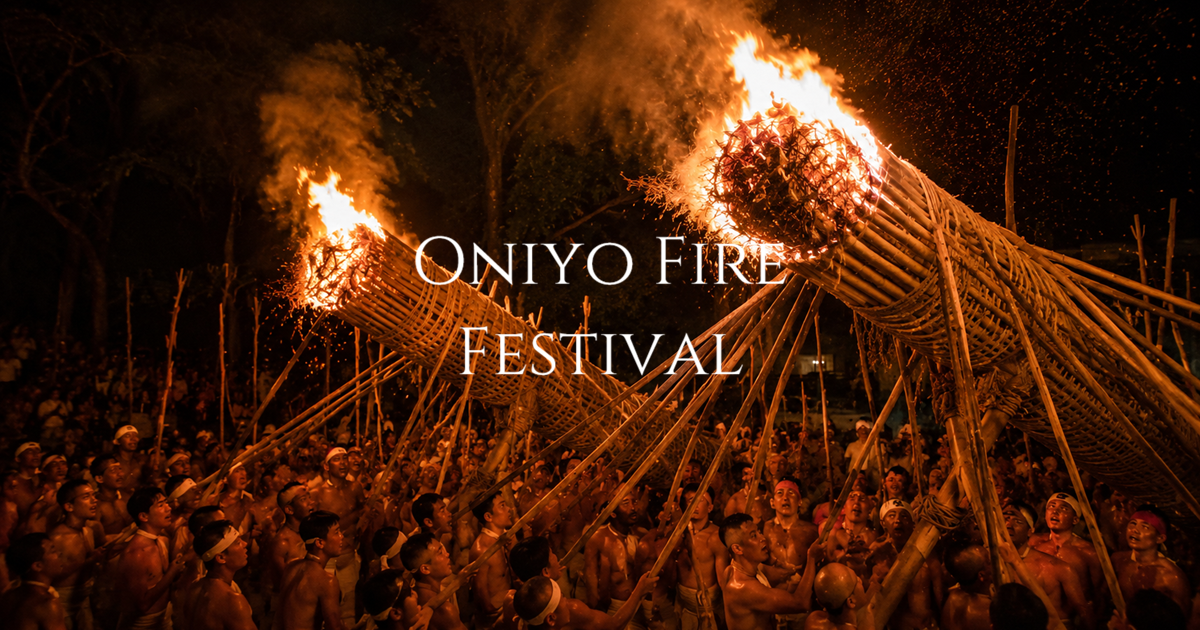
At Daizenji Tamataregū Shrine in Kurume, six torches taller than a house are lit, lifted, and carried through the dark by groups of men who cannot control them alone. The fire is not staged as a spectacle to be watched from a safe remove; it is handed to the community as a problem to be managed in real time, under smoke and falling sparks, through routes fixed by inheritance rather than convenience. What holds the ritual together is not the absence of danger but the presence of a structure built to receive it.
Purification, in this rite, is not a matter of keeping disorder at a distance. It is achieved by taking disorder in hand. The torches burn, list, shed embers, and consume the material that carries them, while a surrounding lattice of roles, timing, and shared attention keeps that instability from spreading past its intended edge. Oniyo is less a display of fire than a demonstration of what a community can do with force it has chosen not to suppress.
For more stories like this, explore our Strange Festivals & Rituals collection.
Purification Through Shared Risk at Oniyo
Oniyo is held every January 7 at Daizenji Tamataregū Shrine in Kurume, Fukuoka Prefecture, closing out the shrine’s New Year sequence. Its center is six enormous torches, each roughly thirteen meters long and about a meter across, raised and guided through the shrine grounds on long forked poles called karimata.
What separates Oniyo from a fire spectacle is where the danger is placed. The flame is not framed at a distance for viewing; it is brought inside the ritual and made to travel along routes and roles that participants must actively sustain. Purification here is not the reward for avoiding risk — it is produced by accepting risk into a structure the community is responsible for holding together, which is precisely what distinguishes Oniyo’s fire-based purification from the bodily exposure at the center of Hadaka Matsuri.
Once lit, a torch quickly exceeds what any one person could manage: its heat, weight, and instability require a group working in constant coordination. Carriers brace it from below, shifting position as the burning mass sways, drops embers, and slowly collapses into itself. The torch advances only because many separate, small adjustments are continuously folded into a single motion.
This arrangement is what gives the ritual its meaning. Fire is treated neither as a hostile force to be defeated nor as an image to be admired from safety. It is taken into a network of responsibility, where participants answer not only to the torch’s weight but to one another, to the assigned route, and to the changing behavior of the flame itself.
The name Oniyo evokes the expulsion of oni, yet no demon figure needs to appear for the ritual to function. What is being addressed is broader: the misfortune, illness, and weakened boundaries understood to gather around the year’s turning point. Fire gives this diffuse unease a form that can be physically met and worked through.
The danger used to cleanse is itself real danger. Oniyo does not resolve that contradiction; it organizes it. The community steps toward the fire, gives it a direction to travel, and takes on the ongoing task of keeping its instability from turning shapeless.
Fire as Purification Through Controlled Destruction
Fire holds an unsettled place in Japanese ritual life — it cooks, warms, and transforms offerings, but it can just as easily erase homes and boundaries in minutes. Its ritual authority comes from that same duality. Fire purifies not in spite of its destructive capacity but because of it: it can alter what ordinary cleaning cannot reach.
Oniyo keeps that destructive edge intact rather than converting fire into decorative light. The torches generate real heat, real smoke, and real physical risk. Their presence reshapes the shrine grounds themselves — visibility narrows, movement slows and tightens, and the space temporarily reorganizes around objects too large and too hot to ignore.
Purification depends on that destruction being aimed, not eliminated. The torches are meant to burn — but within limits set by route, role, and collective attention. A fire allowed to move without those limits would not purify anything; it would erase the line between what the ritual permits to be consumed and what it is built to protect.
This is the point at which Oniyo separates most clearly from Hadaka Matsuri. Hadaka Matsuri approaches purification through the body directly — cold, pressure, and the stripping away of ordinary protection. Oniyo does not ask the body to be exposed in that sense. Instead, the body is absorbed into a larger apparatus constructed to carry a destructive force without being consumed by it.
Endurance in Oniyo therefore has meaning only in relation to the group. Heat and physical strain are not private trials of nerve; they matter because they are folded into the coordinated handling of the torch. No individual effort stands alone — it exists only as a contribution to a shared order that no single carrier could produce.
Fire becomes, at once, the agent of purification and the measure of the discipline organized around it. What Oniyo demonstrates is not that instability can be removed, but that it can be given a direction, a duration, and an end.
Six Torches and the Discipline of Collective Movement
The six torches turn purification into visible labor. Before ignition, each is built from gathered plant material according to techniques held within the community rather than written down for general use. Once burning, the torch is too heavy, too hot, and too unpredictable for any single participant — its progress depends on a group able to respond continuously to shifts in weight, balance, and flame.
Carriers support the torch with karimata poles, tools that spread the burden without removing it. Pressure at one point changes the load elsewhere, so a movement by one carrier forces adjustment by several others. The torch does not move by command from a single source; it moves through a chain of corrections passed between bodies.
This produces a discipline that is not uniformity. Participants occupy different positions relative to the fire — some closer to the flame, some working through heavier smoke, some with a clearer line of sight down the route — and coordination emerges precisely because each person must track how their own movement affects everyone else’s.
A crowd carrying a heavy object can remain a set of individuals acting in parallel. The torch carriers become something else: a ritual body whose members are functionally interdependent. Strength alone accomplishes little without timing, and timing means nothing without attention to the group.
The torch is never a fixed object being transported. As it burns, its structure keeps changing — plant material collapses, weight redistributes, flame reacts to air and motion. Participants are not moving something stable through a set performance; they are holding order around something actively disappearing.
That disappearance is the point. The torch fulfills its role by being destroyed, while the knowledge needed to build, support, and guide it is what survives. Oniyo preserves tradition not by protecting an enduring object but by repeating, year after year, the transmission of disciplined action.
That knowledge lives in posture, timing, distance, and correction — learned less through explanation than through entering the physical structure that makes the ritual possible. Collective discipline is not stated as a value in Oniyo; it is enacted in the countless small adjustments that keep a burning object moving as one.
Danger Held Inside Ritual Boundaries
The festival’s danger does not make it chaotic — its force depends on the opposite condition, that risk remains organized enough to be carried by roles, routes, tools, and timing, even as the flames appear to press against those limits.
This boundary is not a fence or barrier standing apart from the fire; it is produced through the coordinated behavior of everyone present. The shrine grounds are temporarily reorganized around where the torches may pass, where carriers must stand, how the karimata poles are used, and how observers are kept apart from those in motion. Ordinary movement narrows into a pattern set by the fire’s demands.
Flame complicates this order because it refuses to stay inside its assigned object. Heat travels outward, smoke narrows sight, and sparks scatter beyond the torch’s path. The ritual boundary has to be maintained around a force whose effects continually reach past the lines drawn for it.
That excess is not a defect in the ceremony — it is part of what gives the ritual weight. A flame that produced no strain or material consequence would be a representation of purification rather than an enactment of it. Oniyo depends on participants meeting fire as something that has to be answered in the moment, not observed from behind glass.
Danger by itself, however, does not generate ritual meaning; heat and risk also attend accidents, labor, and sport. What separates Oniyo is the placement of these conditions inside a New Year observance tied to shrine ground, communal protection, and renewal — physical intensity given a beginning, a route, a responsible group, and an expected end.
Controlled and uncontrolled fire therefore carry different cultural weight. Fire left to move on its own dissolves boundaries indiscriminately; ritual fire preserves the line between what may be consumed and what must be protected, acknowledging its destructive capacity without letting that capacity dictate the form of the event.
The ceremony also resists mechanical repetition. No two performances are identical — wind, combustion, fatigue, and crowd movement all shift the conditions under which a torch is carried. The inherited structure supplies a framework, but participants must continually adapt inside it, which is why repetition here does not produce something static: each year renews the same relationship between uncertainty and order without settling it permanently. Purification has to be re-enacted because disorder is expected to return alongside ordinary life.
The fire stays dangerous, but its danger is given duration, direction, and someone to answer for it. Oniyo places instability near the ritual’s center and lets collective discipline become visible in the boundary that holds around it.
Continuity, Tourism, and Local Obligation
Photographs of towering flame and cascading sparks are how most outside audiences first encounter Oniyo. The scale of the torches produces images that travel easily on their own, detached from the longer sequence that surrounds them — and in that detachment, the festival can start to look like a spectacle staged chiefly to be seen.
That image is not false, only incomplete. Each burning torch is the visible endpoint of preparation, local organization, and knowledge built up over years of repeated participation. What appears in a photograph depends on labor that begins well before ignition and continues after the flames have gone out.
Tourism adds a different relationship to the event. Visitors may come for its reputation, its cultural designation, or simple curiosity about fire handled at this scale, and their presence can help sustain regional recognition. But observing a festival is not the same as being obligated to it.
A visitor experiences Oniyo as a single striking night. Those who prepare and carry the torches experience it as a recurring point on a local calendar — one they are expected to return to. The ritual’s meaning rests not only in what happens during the procession but in the ongoing expectation that the work will be taken up again the following year.
That distinction matters more as regional communities face demographic decline and the steady movement of younger residents toward cities. A ritual that depends on a large, coordinated group of participants must continually renew the social relationships that make that kind of labor possible at all.
Official preservation efforts can document procedure, confer recognition, and draw public attention, but they cannot manufacture the willingness to take on preparation, physical risk, and the responsibility of passing the practice forward. Oniyo continues only as long as enough people still regard that work as theirs to do.
Continuity does not require the festival to stay unchanged — safety measures, crowd management, and institutional support have all shifted its organization over time, as local festivals generally do. The harder question is what must stay structurally intact underneath those changes.
For Oniyo, that core is the relationship between destructive fire and collective discipline. The flames still have to be carried as shared responsibility, not reduced to an image composed for spectators. The festival endures because each generation is asked to take up the same practical problem again: whether enough people are still willing to shoulder a burden that leaves no permanent record of having been carried.
Conclusion
Oniyo does not purify by making fire safe. It lets destruction keep its heat, weight, and unpredictability while placing those qualities inside a structure of routes, tools, roles, and shared attention — and the ritual’s force sits precisely in that containment, where fire is allowed to transform without being allowed to become indiscriminate.
The torches are built to disappear. What outlasts them is the knowledge required to raise one, move with it, and keep its destruction inside a form the community agrees to maintain. Oniyo renews communal order not by denying danger but by proving, once a year, that danger can still be carried, directed, and brought to a close through disciplined cooperation.
Related Articles
- Onbashira Festival — Communal risk gathers around sacred timber whose weight exceeds any individual’s control, organizing order through coordinated pulling rather than fire.
- Hadaka Matsuri — Purification is pursued through the body itself: cold, crowd pressure, and the temporary loss of ordinary protection, rather than the handling of an external destructive force.
- Naki Sumo — Ritual efficacy rests in an infant’s cry, turning a sound usually hushed in daily life into a public marker of health and vitality.
Sources and Further Reading
The following works provide academic grounding in Japanese festival organization, Shinto ritual practice, and the cultural logic of purification.
- Ashkenazi, Michael. Matsuri: Festivals of a Japanese Town. University of Hawai’i Press, 1993.
- Earhart, H. Byron. Japanese Religions: Unity and Diversity. Wadsworth Publishing, 2004.
- Kasulis, Thomas P. Shinto: The Way Home. University of Hawai’i Press, 2004.
- Ono, Sokyō. Shinto: The Kami Way. Tuttle Publishing, 1962.
- Reader, Ian. Religion in Contemporary Japan. University of Hawai’i Press, 1991.
Author’s Note
My first encounter with a mountain deliberately set alight was not at a shrine, but on a television screen — a news broadcast of Kyoto’s Daimonji that I watched as a child. What stayed with me was not the shape of the fire, but a simple worry: if you set a mountain burning, how do you keep it from becoming a wildfire? Writing about Oniyo years later, I realized the question had outlasted the image itself.