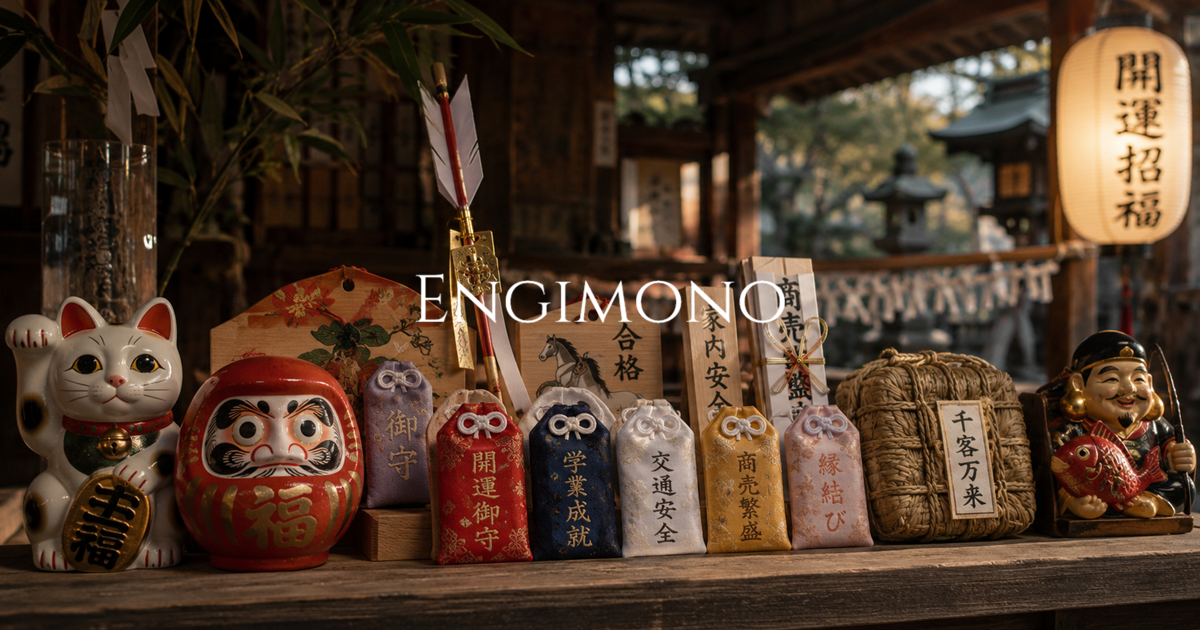
A shop register with a maneki-neko beside it, a daruma watching over a desk, a decorated kumade hung after a year-end market — these objects are common enough in Japan to pass as decoration. Each one carries a specific hope forward: prosperity called inward, effort kept visible, ambition scaled upward, or a new year received in material form. Engimono do not describe fortune so much as give it a shape that can be handed from one person to another.
For more stories like this, explore our Sacred & Taboo collection.
Engimono and the Material Form of Good Fortune
Engimono is the general term for objects treated as auspicious because their shape, name, customary use, or place of origin has become tied to a favorable outcome. The category is wide by design: religious items sold at shrines and temples sit alongside daruma dolls, maneki-neko figures, decorated kumade, zodiac ornaments, and even foods and plants whose associations were built through long repetition rather than doctrine.
What separates engimono from a protective object like omamori is less about religious weight and more about circulation. An omamori is usually carried close to the person, in relation to a particular protection or hoped-for benefit; an engimono is acquired, displayed, given, and eventually let go as a way of putting a hope into material form and moving it through a relationship or a household. The distinction is structural: omamori tends to center on the person, journey, or condition it accompanies, while engimono centers on the exchange that carries an aspiration from one hand, or one year, to the next.
This is why an engimono’s meaning is relational rather than fixed. A daruma is not auspicious on its own terms; it becomes so through its link to persistence and to a goal not yet closed. A maneki-neko turns an ordinary beckoning gesture into an invitation extended toward customers or income. A kumade repurposes the physical motion of raking into a metaphor for pulling prosperity inward. In each case, the object’s material form only carries meaning because it has been attached to a recognizable future.
Context sharpens or dulls that meaning. The same small figure beside a shop register reads differently on a household shelf. A daruma with a single eye filled in marks something still underway; both eyes completed close the interval. The physical object does not change — its placement, timing, and visible state do the communicating.
The word engi itself extends past the casual sense of “luck.” It can describe favorable circumstances, workable connections, or the alignment of conditions that allows an outcome to become possible at all. Fortune, in this framing, is not simply chance arriving or withheld — it depends on how intention, timing, conduct, and symbol line up. An engimono does not promise the desired result. It builds a material relationship with that result before anyone knows how things will turn out.
Auspicious Meaning Through Form, Sound, and Association
Engimono acquire meaning through accumulated association, not through a single teaching or text. Physical shape, gesture, sound, season, trade, and inherited habit each supply a different route by which an ordinary object becomes legible as fortunate.
Some associations start with form. A daruma’s rounded body rights itself after being pushed over, giving persistence a physical demonstration. The meaning attaches not to stillness but to recovery — the capacity to be knocked down and return upright. Perseverance becomes something the object performs rather than something it merely represents.
Others depend on gesture. The raised paw of a maneki-neko repeats the Japanese motion for beckoning someone closer, palm turned downward. Set near an entrance or a register, that gesture becomes an invitation directed at customers, money, or opportunity crossing in from outside. Fortune here is imagined as something drawn across a threshold, not something already held.
A kumade works through a related continuity between practical tool and symbolic reading. A rake gathers material toward the body; the decorated version is understood to gather prosperity the same way. The tool is not discarded in favor of the symbol — the familiar action simply becomes the metaphor.
Language supplies a separate structure of association, built on homophones and near-homophones. Sea bream, tai, echoes medetai, meaning celebratory or auspicious. Kelp, kombu, calls to mind yorokobu, to rejoice. Kaeru can mean both “frog” and “to return,” letting a frog figure carry wishes for a safe return, the return of money, or the recovery of something lost. None of these links needs to be phonetically exact to hold — their force comes from repetition, from being heard at home or in a shop until the connection becomes automatic.
Animals and plants carry meanings built through long observation rather than wordplay. Cranes and turtles are tied to longevity. Pine suggests endurance because it stays green through winter; bamboo reads as upright growth; plum blossoms open before spring has fully arrived. Combined, pine, bamboo, and plum form the auspicious grouping shōchikubai, used across decorations, food presentation, and celebratory design.
These meanings hold steady enough to be widely shared while still flexing by region, trade, or institution. A fox may point toward Inari worship, agricultural fortune, or commercial prosperity depending on where it appears. A rice bale may evoke harvest abundance in one setting and the wealth associated with Daikokuten in another. What keeps engimono legible is not a single fixed definition but a shared cultural habit of recognizing what a given form has been made to carry.
From Private Hope to Symbolic Exchange
An aspiration changes character once it is placed inside an object. It becomes something that can be purchased, given, received, displayed, replaced, or returned — and this is where engimono depart most clearly from a purely symbolic reading. Their meaning belongs as much to a system of exchange as to a system of signs.
Giving someone an auspicious object lets the giver participate in another person’s uncertain future without pretending to control it. A student preparing for an entrance exam may receive a daruma or a pencil marked for success. A new business may be presented with a maneki-neko. A household may receive a zodiac figure at New Year. None of these gestures produces the hoped-for result. What they produce is a material record that someone recognized the uncertainty and chose to stand beside it.
Commercial exchange does not weaken this meaning — it is often part of how the object enters circulation at all. Shrine precincts, festival markets, year-end fairs, neighborhood shops, and department stores all supply routes through which auspicious objects move from seller to owner. What matters is not whether money changed hands, but how the transaction situates the object within a sequence of intention and use.
Some of these exchanges are made deliberately public. At Tori-no-ichi markets, elaborately decorated kumade are purchased by business owners hoping for prosperity in the coming year, often accompanied by rhythmic clapping and shouted congratulations from the sellers. The purchaser leaves with more than an object — they leave having had a commercial hope acknowledged aloud, in front of other people. The custom of trading up to a larger kumade in a following year gives that ambition a physical scale: the bigger object does not prove growth has occurred, but it links this year’s effort to the one that came before it.
Daruma follow a different sequence built around incompletion rather than escalation. A blank-eyed daruma is typically acquired at the point a goal is set; one eye is filled in at the outset, the second only once the goal has closed. For as long as the aspiration remains unresolved, the object stays visibly unfinished. Possessing a daruma is therefore not a static act — it means entering a process, living alongside a period of effort, and eventually completing, keeping, or returning the object for ceremonial burning.
Within families, this exchange often happens quietly, without anyone naming it as religious. An object is placed in a child’s room, pressed into the hand of someone leaving on a trip, or brought home from a shrine visit. The recipient may never describe the gesture in ritual terms, but the relationship it encodes — someone noticing an uncertainty and choosing to mark it — remains intact regardless of how it is described.
Display, Placement, and the Social Life of Aspiration
Many engimono gain part of their meaning by being seen. Their placement turns a private hope into a public statement that does not require the person displaying it to say anything directly about what is at stake.
A maneki-neko positioned at a shop entrance signals a wish for customers and continuity without reading as a confession of financial anxiety, because the figure operates as an accepted commercial convention rather than a personal admission. The object lets aspiration surface while preserving the social preference for restraint around openly discussing money or ambition.
Thresholds carry particular weight in this system. Entrances are where people, income, goods, and risk cross between inside and outside, and an auspicious object placed there is doing more than decorating the space — it is addressing that circulation directly. A maneki-neko’s raised paw beckons across the boundary; a New Year arrangement receives the incoming year before it enters the household or business proper.
Workspaces host a different category of display. A daruma kept in an office can accompany a sales target, an election, a construction project, or any goal several people share an understanding of. Once colleagues recognize what the unfinished eye represents, the object converts a private intention into a shared temporal marker — the goal stays present in the room without needing to be restated at every meeting.
Domestic displays tend to follow the calendar rather than the workday. Zodiac figures appear near the start of the year and are often replaced when the cycle turns over. Decorative rice bales, the Seven Lucky Gods, cranes, turtles, and shōchikubai arrangements condense broad household hopes — health, prosperity, continuity — into temporary seasonal installations rather than permanent fixtures.
Their eventual removal belongs to the same meaning as their arrival. These objects are not intended to occupy a room indefinitely; they appear when the calendar makes a given hope appropriate to express and disappear once that window closes. Aspiration, in this sense, is regulated by timing as much as by symbolism.
Engimono also travel geographically. A regionally associated animal, craft, or agricultural product may be sold as an auspicious souvenir and carried home, where it preserves a link to its place of origin while entering a new domestic or commercial context. Movement does not necessarily strip an object of its original meaning — a figure bought for its appearance may later attach itself to a personal goal, and an inherited piece may be kept long after its precise symbolism has been forgotten, simply because it occupied the same shelf for enough years to accumulate weight of its own.
Completion, Return, and the Limits of Possession
The cultural life of many engimono includes an ending, and for some objects that ending is part of what they are for. Not every auspicious item is meant to be kept indefinitely; many are replaced, returned, or ceremonially burned once the period they accompanied has passed.
Shrines and temples routinely receive old amulets and related objects for disposal. Seasonal decorations come down after the appropriate interval, and daruma are often returned once a goal has been completed or a year has closed. None of this treats the object as permanently powerful. It treats the object’s role as belonging to a specific stretch of uncertainty that has since ended.
Not every engimono follows a formal return cycle — plenty of decorative or commercial pieces are kept, passed along, or simply discarded like any other possession. Even so, the underlying logic of renewal persists across the category. A New Year decoration draws part of its meaning from its position within the annual transition. A zodiac figure belongs to one point in a repeating sequence. A kumade bought for one year’s Tori-no-ichi may be traded up for a larger one as commercial ambition carries forward into the next.
Timing, in this system, sets a limit on accumulation. Owning more auspicious objects does not compound their effect; an object’s active role lapses once the occasion, season, or aspiration that gave it meaning has closed. Daruma make this structure especially visible: one eye marks the setting of a goal, the second its completion, and the change in the face records a passage from intention to outcome rather than claiming to have caused it. When a goal is not reached, the daruma may still be returned — failure, like success, brings the interval to a close.
Ceremonial burning gives that closing a physical form. Fire removes the object from ordinary circulation without treating it as waste; the act carries something closer to gratitude toward a thing that occupied an unstable position between commodity, symbol, gift, and religious material for as long as it was needed.
Return also keeps aspiration from collapsing into ownership. A desired future is not secured by holding onto its symbol permanently — the object can accompany effort, sharpen attention, and connect people to one another, but it cannot fix fortune in place. Their cultural logic becomes clearest when they are treated not as containers that store luck indefinitely, but as temporary participants in a process that is always heading toward a close.
Everyday Belief Without a Declaration of Faith
Engimono persist partly because they do not demand that anyone declare what they believe. A person can buy one out of custom, accept one as a gift, display one for atmosphere, or carry one for reassurance without ever settling the question of whether it has literal power.
That ambiguity is what lets several interpretations sit around the same object at once. One person may understand a given engimono through shrine or temple practice; another may value it purely for its symbolism; someone else may treat it as a family habit, a commercial convention, or a small source of encouragement. None of these readings cancels the others, and the object stays legible across all of them.
Asking whether people “really believe” in engimono tends to flatten a practice that was never organized around belief as a fixed proposition in the first place. It surfaces instead through careful placement, seasonal repetition, a reluctance to throw an old object away casually, or a quiet preference for having the symbol present rather than absent. Someone can laugh while choosing an auspicious item and still select its form with care — humor does not cancel the seriousness of the choice. Engimono occupy a space where people avoid making absolute claims yet continue to act as though symbolic preparation still matters.
This flexibility suits contemporary consumer life. Traditional motifs now show up on stationery, packaging, phone accessories, regional souvenirs, and character goods. A daruma may take on an unfamiliar color while still keeping the unfinished eye that ties it to an ongoing goal; a maneki-neko may stand at the register of a shop whose owners hold no particular religious affiliation. Commercial adaptation can flatten a symbol into a generic marker of “Japan” or “luck,” but change does not automatically empty the form — new versions can still preserve the core action at the center of the symbol: beckoning, rising, gathering, returning, or welcoming.
Engimono also suit a social environment where stating a desire too plainly can feel forceful. Announcing a wish for wealth or recognition outright can sound presumptuous; an auspicious object routes the same hope through a shared convention instead. The desire is present, but it arrives softened by symbolic form rather than spoken as a demand. This is what separates engimono from a purely motivational object: a slogan tells the viewer what to do, while an engimono works through association — it does not say “succeed,” it places success into a raised paw, a rake, or an unfinished face.
None of this replaces effort. A business owner may plan with real care and still keep a maneki-neko by the door; a student may prepare intensely while carrying something associated with passing an exam. The object does not deny that effort matters — it acknowledges, alongside that effort, that not every outcome is within anyone’s control.
Conclusion
Engimono give fortune a shape before fortune has arrived. A raised paw, an unfinished eye, a decorated rake, a seasonal ornament — each lets an uncertain future enter daily space without being mistaken for a guarantee.
Their significance lies less in what they depict than in how they move. They are selected, given, displayed, completed, replaced, and eventually returned, and it is through that movement that a private hope becomes something social: a gift marking someone else’s uncertain effort, a household noting a turn in the calendar, a business making its ambition visible for a moment, an individual carrying an unresolved goal forward through time.
The object never closes the distance between what is wanted and what arrives. What it offers instead is a way of living with that distance — placing hope within reach, without ever mistaking reach for possession.
Related Articles
- Omamori — Focuses on a specific protection or hoped-for benefit carried with a person, journey, or daily activity, in contrast to engimono’s emphasis on aspiration circulating through gift, purchase, display, and return.
- Kegare — Treats impurity as a temporary condition managed through separation and purification, in contrast to engimono’s approach of giving hope a material, exchangeable form.
- Kanamara Matsuri — Expresses fertility, protection, and prosperity through a single collective ritual event, rather than through the ongoing circulation of individually owned objects.
Sources and Further Reading
These works examine worldly benefit, shrine practice, and the material culture of belief that engimono belong to.
- Reader, Ian, and George J. Tanabe Jr. Practically Religious: Worldly Benefits and the Common Religion of Japan. University of Hawai’i Press, 1998.
- Nelson, John K. A Year in the Life of a Shinto Shrine. University of Washington Press, 1996.
- Smyers, Karen A. The Fox and the Jewel: Shared and Private Meanings in Contemporary Japanese Inari Worship. University of Hawai’i Press, 1999.
- Hardacre, Helen. Shinto: A History. Oxford University Press, 2017.
Author’s Note
As a child in Kanagawa, I spent winters spinning Oyama-goma with friends, entirely unaware that the tops were engimono at all. Only as an adult did I learn that what I had treated simply as a toy carried wishes for business prosperity, a good harvest, and a child’s healthy growth—the meaning had been there the whole time, waiting beneath the surface of the game.