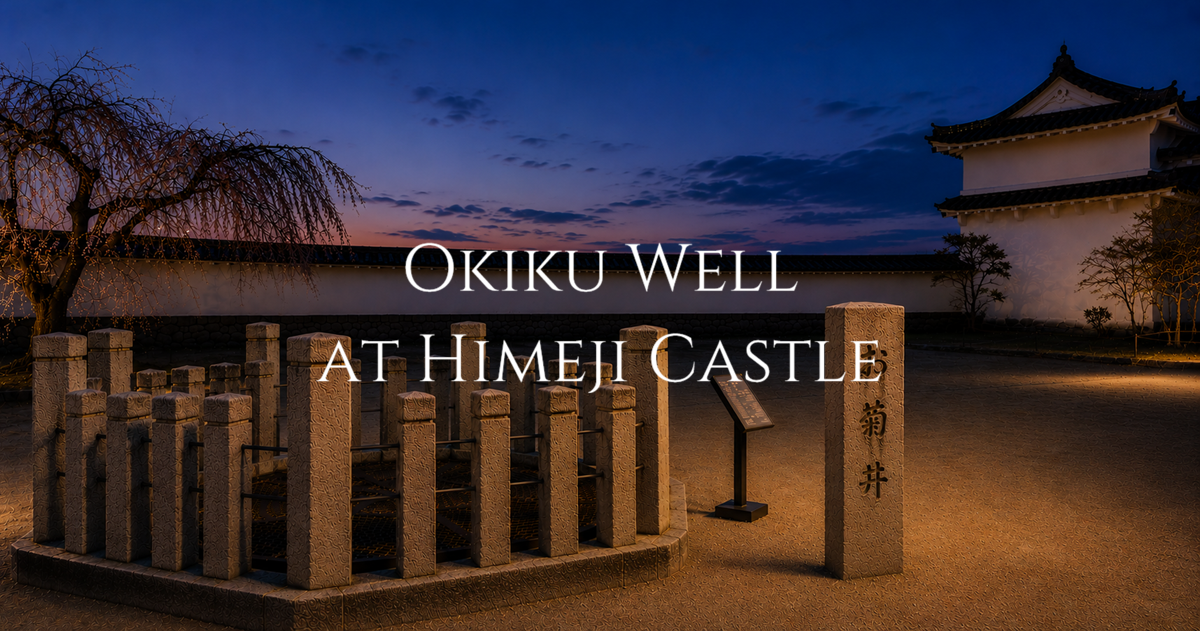
The Okiku Well at Himeji Castle is remembered not because anyone documented what happened there, but because a story found the place and refused to leave. Within the grounds of one of Japan’s most carefully preserved castles, the well holds a form of memory that official record cannot account for — one that belongs to accusation, to the silence that follows punishment, and to the long habit of returning to a location until it becomes inseparable from the narrative attached to it.
The well is unassuming in form, and that modesty is part of how it operates. Its cultural weight does not rest on spectacle. It rests on the way physical space can accumulate narrative, so that standing before the stone opening means encountering not only depth and enclosure but the imagined presence of Okiku counting from below — a count no visitor expects to complete.
For more stories like this, explore our Haunted Places in Japan collection.
A Castle Well Where the Story Returns
Okiku Well is a stone well within Himeji Castle’s grounds in Hyōgo Prefecture, associated with a servant whose death became one of the most recognizable ghost narratives in Japanese theatrical and storytelling tradition. What makes it significant as a haunted place is not simply that it provides a setting for the story, but that it functions as the point to which the narrative continues to return — the site where an unresolved account has been given physical form and kept there through repetition.
The legend follows a structure that has remained stable across centuries of retelling. A servant named Okiku works in a household or castle environment where a set of valuable plates is kept. One plate is declared missing, the accusation falls on her, and she has no institutional standing from which to dispute it. Punishment follows. In many versions she is killed and thrown into a well, and afterward her voice is heard counting the plates again — always stopping before the missing one, always beginning again.
The well at Himeji Castle has become the story’s most recognized physical address. A narrative of false accusation could have survived indefinitely through theater, printed transmission, or seasonal ghost-story tradition without requiring a specific site. The well makes the legend spatial. It gives visitors a location to stand in relation to the story — not merely a text to receive, but a place to return to, in the way the story itself keeps returning.
Himeji Castle gives that attachment additional meaning. The castle is associated with preservation, architectural authority, and the visible endurance of the past. Okiku Well introduces a different order of memory into the same grounds: unofficial, unresolved, sustained not through institutional record but through narrative repetition. It is a reminder that historical places do not preserve only what was formally documented. They also gather what was never resolved.
How Does Ghost Narrative Become Place Memory?
The Okiku narrative is not restricted to Himeji. Versions of the plate-counting ghost appear across Japanese storytelling and theatrical forms — kabuki staged the story under several titles; bunraku gave it structural weight; regional variants shifted the setting and detail while keeping the core mechanism intact. Yet the well at Himeji Castle draws these dispersed retellings toward a single physical point, and in doing so, changes how the story is encountered.
Place memory operates differently from narrative memory carried through language. A story preserved in words can move, adapt, and change with each telling. A place holds the story in position. The visitor stands before the actual well, sees the stone, and understands the legend not only as something once told but as something culturally imagined to have occurred here. The location does not provide verification. It provides shape — a frame in space that the narrative can fill.
This is why Okiku Well belongs naturally among haunted places rather than remaining solely within theater history or ghost-story traditions. Its reputation is built less on claims of direct supernatural presence than on the gradual accumulation of association. Each retelling, each visit, each photograph or written account directs attention back to the same point. Over time, the well and the story become difficult to separate, not because evidence ties them together but because repetition has made the connection feel necessary.
The form of the well contributes to this. A well is an opening between the visible surface and an unseen space below — practical in function, symbolically unstable in meaning. One can look down into it without seeing what it contains. Sound can seem to rise from below while sight fails to confirm its source. At Himeji Castle, this vertical ambiguity is set within a landscape of visible order: ramparts, layered rooflines, corridors arranged for defense and hierarchy. The well introduces a different kind of space into that environment — one that descends rather than extends, conceals rather than displays.
The Missing Plate and What Repetition Preserves
The plate gives the Okiku narrative its central mechanism, and that mechanism is worth examining carefully. A plate is small, countable, and concrete. It can be stored, inventoried, and declared absent with bureaucratic precision. The simplicity of the object makes it an effective instrument of accusation because it is easier to prove the plate missing than to prove that Okiku did not take it. The object has institutional legibility that she does not.
This imbalance is what gives the story its durability. Okiku is placed within a hierarchy in which authority determines what counts as evidence, and within that structure, her innocence has nowhere to go. The specific detail of how the plate disappears — whether it was genuinely lost, deliberately hidden, or falsely used against her — shifts across versions without affecting the underlying structure, because the structure is what the story is about.
Her death does not resolve the imbalance. It preserves it in a different form. The counting after death is not merely a supernatural flourish; it is the continuation of an incomplete procedure. The sequence moves toward resolution and stops at the same point each time. The missing plate interrupts the count, and the interruption becomes the shape memory takes. Repetition is not failure — it is the form that an unresolved event takes when it cannot be closed.
When this pattern attaches to a well, the location acquires a role in the narrative rather than remaining a background detail. The well is where punishment is imagined to have removed the body from ordinary sight. It is also where the voice returns, transformed from testimony into a recurring motion that can neither be answered nor stopped. What could not be resolved in social terms becomes fixed in spatial terms — the well holds the position the story cannot move past.
Himeji Castle and the Layering of Haunted Memory
Himeji Castle carries a specific cultural identity: it is associated with preservation, architectural achievement, and the kind of historical continuity that survives war, fire, and administrative change. Its whitewashed walls and tiered towers are among the most photographed structures in Japan, and the site is managed as a landmark of formal heritage. Within this environment, Okiku Well occupies a quieter register — not a primary attraction but a different kind of memory, one that the castle’s official identity cannot fully contain.
Formal heritage tends to organize the past into documented sequence. It explains construction dates, defensive function, and political ownership. Folkloric memory works through a different logic. It does not depend on verified record. It attaches through repetition, emotional resonance, and the persistence of a story that people continue to find worth telling. Okiku Well brings these two registers into contact within a single set of grounds.
A visitor who arrives at Himeji Castle to encounter a major architectural landmark may find themselves, in one corner of the grounds, in front of a story of accusation and death that official interpretation cannot account for. The shift is quiet but structurally meaningful. Famous sites are rarely unified by a single kind of memory; they layer different histories, some documented, some transmitted only through narrative. The well makes that layering visible.
This kind of accumulation is characteristic of haunted places in Japan more broadly. A tunnel becomes associated with danger through isolation and the pressure of enclosed passage. A forest becomes culturally weighted through silence, media representation, and accumulated association. A castle well carries a story transmitted through theatrical performance, visitor expectation, and returning attention. In each case, the haunted reputation is not established through proof but through the way different forms of memory converge at a specific location.
Visitor Memory and the Quiet Force of Recognition
Many visitors arrive at Okiku Well already familiar with the story. Some know it through kabuki or the broader kaidan tradition; others through television, manga, travel writing, or lists of haunted places in Japan. By the time they stand before the well, the location may already feel legible — the narrative has preceded them, and the site confirms what they brought with them rather than introducing something new.
This prior familiarity shapes what the encounter can be. The well does not require theatrical staging or interpretive signage to be understood. Its meaning tends to arrive in advance, delivered through media, educational encounter, or cultural osmosis. A photograph, a brief caption, a mention in a travel guide is often sufficient to activate the narrative, because the association has become culturally stable enough to require very little prompting.
The restraint of the site functions in its favor. Okiku Well sits within the castle grounds without being separated from them or marked as a special attraction. It is a physical object with historical texture, and the ghost narrative surrounds it without demanding acknowledgment. The distance between the modest object and the weight of the story attached to it leaves the imagination room to move.
Contemporary tourism gives the well additional reach. Images circulate through social media, video essays, and ranked lists of haunted destinations in Japan, often detached from detailed historical or theatrical context, but maintaining the association. The well continues to function as a recognizable symbol because the story can be condensed into a single image — a stone opening, depth, darkness below — without losing its essential structure.
Why an Unresolved Story Needs a Stable Address
Okiku Well persists because it offers an unresolved narrative a stable address. The story contains accusation, hierarchy, punishment, and a repetition that cannot be completed; the well gathers those elements into one location and holds them there. Without the well, the legend could continue through theatrical tradition and storytelling. With the well, it becomes something a person can visit — and returning to a place, in the logic of haunting, is what the story has always been about.
The imagery is compact enough to move across media and generations without losing its shape. A missing plate, a count that stops before completion, a body removed from ordinary sight, a voice that rises from below — these form a structure that can be retold in many registers while retaining its essential mechanism. The story does not depend on elaboration to survive.
Place memory allows multiple interpretations to coexist without forcing resolution. Contemporary audiences may approach the legend through the lens of social hierarchy and coercion, reading in Okiku’s position the vulnerability of those without institutional standing. Others may encounter it through theatrical history, ghost-story tradition, or the framing of regional tourism. These readings do not compete so much as layer, each adding to the accumulation of meaning that the location holds without adjudicating between them.
This may be why the site continues to feel culturally active. Okiku Well does not ask its visitors to decide whether a ghost is present. It asks them to stand before a place where a story has been given ground, repeated, and preserved — where the act of visiting is itself another instance of the attention that keeps the narrative in place.
Conclusion
Okiku Well at Himeji Castle shows how a physical location can become necessary to a story that existed long before the specific site was designated as its home. The well is not imposing, yet its modest form allows the narrative to gather with unusual density. A small opening in the castle grounds becomes a point where accusation, theatrical memory, and the logic of place converge.
The legend does not move fully into the past because the mechanism at its center has never been closed. The missing plate is still missing. The count still stops before it can be completed. The well still marks the location where the story descends from social conflict into something that can only be expressed as repetition.
Rather than functioning as a ghost site in the spectacular sense, Okiku Well demonstrates how haunted places preserve unresolved narratives by giving them somewhere to stay.
Related Articles
- Okiku — The ghost narrative at the source of the Himeji legend: how a servant’s death through false accusation became a recurring cultural form, examined through the lens of psychological repetition and grief.
- Inunaki Tunnel — A mountain tunnel where isolation, communal rumor, and the social construction of inaccessible space turn a physical passage into a site of sustained narrative.
- Kiyotaki Tunnel — A confined road space in Kyoto where modern infrastructure gathers haunted reputation through enclosure, passage pressure, and the persistence of local memory.
Sources and Further Reading
The following works provide cultural and historical context for Japanese ghost narratives, theatrical tradition, place memory, and the relationship between haunting and physical location.
- Foster, Michael Dylan. Pandemonium and Parade: Japanese Monsters and the Culture of Yōkai. University of California Press, 2009.
- Iwasaka, Michiko, and Barre Toelken. Ghosts and the Japanese: Cultural Experience in Japanese Death Legends. Utah State University Press, 1994.
- Reader, Ian, and George J. Tanabe Jr. Practically Religious: Worldly Benefits and the Common Religion of Japan. University of Hawai’i Press, 1998.
- Tuan, Yi-Fu. Space and Place: The Perspective of Experience. University of Minnesota Press, 1977.
Author’s Note
There is a kind of knowledge that arrives before explanation does. I was told as a child not to throw or hit stuffed animals — that they would be sad, that they were crying — and I received this not as instruction but as fact. The feeling outlasted the logic behind it: I kept a stuffed pig my mother had made until I was twenty-five, unable to let it go. Writing about Okiku Well brought that back — the sense that some things remain with us not because we understand why, but because letting them go would mean something we cannot quite name.