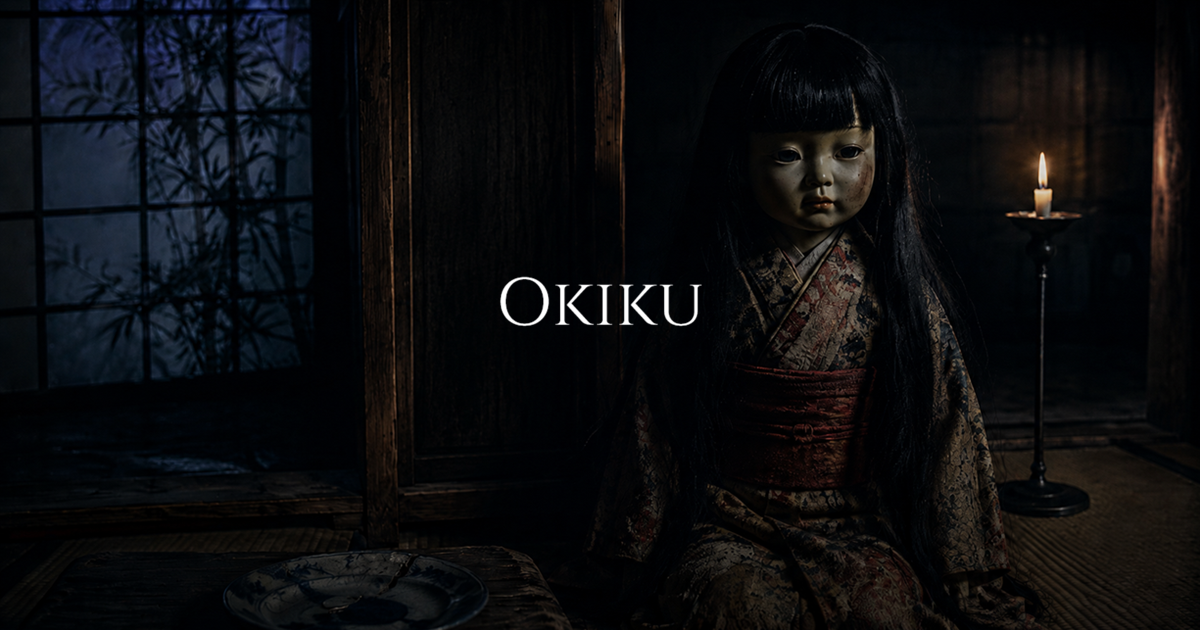
Among Japan’s ghost figures, Okiku is remembered less for how she appears than for what she cannot stop doing. Her story, closely tied to the Banchō Sarayashiki tradition, takes the loss of a single plate and turns it into a count that begins again every time it fails to finish: one, two, three, onward toward a ten that never arrives.
The premise is small, but the structure built around it is exacting. A servant is blamed, a household’s sense of order cannot restore itself, a well takes in what the living try to put out of sight, and a voice returns to measure what remains unsettled. Okiku’s grief has no speech built for explaining itself. It exists instead as repetition, restarting each time from the point where completion failed.
For more stories like this, explore our Folklore & Ghost Culture collection.
Okiku and the Shape of Unfinished Memory
Okiku belongs to the Banchō Sarayashiki legend, in which a servant’s death becomes bound to a missing dish, a well, and a count of plates that never reaches its final number. What separates her from many other Yūrei is precisely this refusal of closure: rather than a single haunting appearance, she persists as an incomplete procedure, one that a companion article on the Okiku Well at Himeji Castle treats as a matter of place, while this entry treats as a matter of psychological form.
Details shift across versions, but the shape holds. Okiku serves in a samurai household tied to a valuable set of plates. One goes missing. She is accused, punished, and killed, in many tellings after refusing a man of higher rank. Her spirit returns to count the plates aloud, moving from one to nine before the sequence collapses just short of ten.
That collapse gives the legend its logic. This is not a story that advances toward revenge in any straightforward sense; it circles an absence instead. The missing plate is never simply an object. It marks the place where accusation, household order, and private memory all fail to close, together. The count can start over, but it cannot mend what broke.
This is also why Okiku sits so naturally within Japanese ghost culture. Many Yūrei carry feeling that ordinary social forms could not hold: grief, resentment, betrayal, obligation. Okiku’s version of this is more contained. Her return does not announce chaos. It repeats a measurement.
The well belongs to this structure too, though it should not be read only as a location. Read through ghost culture rather than geography, the well matters because it gives memory depth. It is where the household’s violence was hidden, and where the voice later surfaces. What was pushed down comes back from below, not as an account of what happened, but as recurrence.
Over time, Okiku also fed into the wider visual grammar of Japanese ghosts — dark hair, pale clothing, a lowered, quiet presence, shaped through Edo-period performance and later imagery. Yet her most durable feature is not visual. It is the counting: an act repeated until unresolved grief becomes pattern.
The Missing Plate as an Unfinished Accusation
The absent tenth plate sits at the center of the Okiku legend because it converts absence into accusation. A set should be whole. A household should be able to account for what it owns. A servant should answer when asked. Once one plate disappears, the household’s order becomes unsteady, and the resulting pressure lands on whoever has the least capacity to resist it.
That compression is part of the story’s durability. The plate itself carries no special value, no sacred weight. Its importance is entirely a function of belonging to a set. Once the set breaks, the household’s need for order grows harsher than the object ever was.
Okiku’s position sharpens this. She does not enter the dispute as an equal. She stands inside a hierarchy where blame moves downward with little friction. The missing plate becomes a test she has no way to pass, because the household is not really asking for the truth. It is asking for someone to answer for the rupture.
Many tellings also fold in coercion or rejected desire. These details thicken the logic of accusation rather than complicating it: the plate may be lost, hidden, or used as pretext, but the outcome stays the same — a woman with little standing is made responsible for damage she has no power to repair. Accusation, in this story, is not a neutral search for fact. It functions as a social pressure, applied downward.
The absent tenth plate also explains the ghost’s precision. Okiku does not return with a general grievance against the world. She returns to the specific number where the world failed her, and each count reopens that same fracture. The missing object gives the grievance a shape, and that shape is exact enough to survive retelling across centuries.
This sets Okiku apart from ghost stories built on pursuit or sudden appearance. The listener already knows where the count is heading. The tension lives in inevitability rather than surprise — nine is not simply the number before ten, but the point where completion becomes structurally impossible.
Counting as Ritualized Memory
Counting is an ordinary act, but inside the Okiku legend it turns into a ritual of memory that cannot resolve. It imposes order even as it demonstrates that order cannot be finished. Each number promises progress; the sequence itself is built to break.
This gives the story its quiet pressure. A count usually settles a question — how many things are here, whether anything is missing, whether a record matches what is real. Okiku’s counting works in reverse. It confirms absence, over and over. The act meant to close the matter is the same act that keeps it open.
The repetition is not arbitrary. It has the texture of ritual with no release built in. The same motion returns, the same words are spoken, the same gap appears at the same point. The listener is not waiting to discover what happened; the listener is held inside the fact that what happened cannot be undone.
This links Okiku to a wider logic running through Japanese ghost narrative, where the dead may persist because the living world never absorbed what they carried. Mourning, apology, and memorial can place the dead within a meaningful order. When those forms fail, the ghost story imagines feeling as something that keeps acting on its own.
Okiku’s grief stays restrained, though restraint here does not read as weakness. The count is controlled because the emotional world of the household was itself controlled — rules, status, objects, discipline. Her ghost answers that system using its own vocabulary: enumeration, accountability, repetition. She counts because counting is what the household demanded of her, and because that demand, once made, has no way to end.
The number ten carries the weight of this whole structure. It is the imagined point of completion, where the set would become whole again and the story could finally stop. The legend withholds that closure. The count approaches ten without ever reaching it, and grief becomes a loop rather than an event.
That loop is why the story holds together across so many retellings. Names, settings, and motives shift; the repeated count does not. Okiku’s memory has been reduced to structure, and structure is what survives.
Servitude, Silence, and the Weight of Blame
Okiku’s ghost is often remembered as tragic, but the deeper mechanism of the legend rests on social vulnerability. She is not only someone who dies unjustly. She is someone whose position made injustice nearly impossible to answer while she was still alive.
Servitude here is not simply an employment relation. It places Okiku inside a household order governed by discipline, obedience, and reputation. The valuable plates belong to that order, and so does the expectation that someone answer when the set is broken. Her body and voice are already subject to authority before any of it becomes supernatural.
This explains why silence matters so much across versions of the legend. Okiku’s living voice does not save her. Whether she protests, refuses, or simply cannot explain herself, the structure around her has already decided where blame will land. Her ghostly voice arrives only once the system that silenced her has finished its work.
The counting then becomes something more than grief — a form of testimony, though testimony without courtroom, without a listener positioned to judge, without any final ruling. Okiku gives no full account. She repeats the evidence of what remains incomplete. The missing plate stands in for everything she could not say outright: coercion, fear, status, punishment, and the household’s need to protect its own order above her.
The story’s restraint matters here too. A more openly confrontational telling might turn Okiku into a straightforward avenger. This one is harder to resolve because it never releases her into that kind of action. Her presence stays bound to the terms of the original accusation. She counts the plates because counting is the shape the world handed her.
This also connects Okiku to a broader pattern in Japanese ghost culture, in which female spirits frequently emerge from constrained social positions. Such figures rarely express only private sorrow. They mark pressure points within the social order itself — household authority, reputation, and the narrow space historically allotted to women’s speech.
Okiku’s vulnerability is therefore not incidental detail. It is the condition that gives the repetition its meaning. The count continues because the original accusation was never answered in any way that could restore balance.
Wells, Depth, and the Return of What Is Hidden
The well in the Okiku legend is usually treated as the story’s most recognizable physical image. A Haunted Places entry can rightly linger on the site itself — its location, its reputation, the way folklore attaches to a specific piece of geography. Read as ghost culture rather than place, the well works differently. It functions less as a destination than as a symbolic structure running underneath the whole legend.
A well connects the surface of ordinary life to something beneath it — part of the household grounds, yet opening into darkness and water and depth. This makes it an effective vessel for concealed violence within folklore. What goes into a well does not vanish into distance. It stays beneath the same world that tried to put it out of view.
Okiku’s association with the well gives the legend its vertical memory. The household continues above; the missing plate remains an absence inside ordinary order. But the body, the voice, and the unresolved accusation gather below the visible surface. When the ghost returns, she does not arrive from elsewhere. She rises from inside the place that had contained her.
This is why the well and the counting belong together as a pair. Both are forms of depth — one spatial, one temporal. The well holds what has been pushed down; the count brings up what cannot be finished. Together they make the legend feel less like a single event than a condition that continues.
Water carries its own weight in Japanese religious and folkloric thought — purification, boundary, passage, contact with what sits beyond ordinary perception. Okiku’s well is not treated as a sacred site in the narrow sense, yet it draws on this larger vocabulary of water as threshold, marking the line where the living household and the unresolved dead stay connected.
The well’s silence matters as much as its depth. It does not explain anything. It receives, conceals, and eventually returns sound. The voice counting from within or near it turns a hidden event into an audible pattern — not a confession, but a recurrence the listener is made to hear.
Because of this, Okiku’s well can stay symbolically central without becoming the article’s whole subject. The deeper concern is not the location itself, but what a household — or a society, or a memory — tries to bury while still living directly above it.
From Kaidan Performance to Modern Ghost Imagery
Much of Okiku’s cultural familiarity came through performance and retelling. The Banchō Sarayashiki tradition moved through Edo-period storytelling, theater, print, and later adaptation, and within these forms, repetition was never only a theme. It was also a working technique.
A ghost counting plates gives performance its own rhythm. The audience already understands the sequence and waits for the break. Silence can gather in the space between numbers. The body can stay still while the voice carries the full weight of the scene. Rather than depending on surprise, the story asks its audience to sit inside recurrence.
This suited Okiku well to kaidan culture, where atmosphere and pacing often carry more than explicit explanation. The story’s structure is easy to hold in memory and hard to resolve. It can be told briefly, staged dramatically, or attached to a particular site, all while keeping its central pattern intact.
The legend also fed the visual vocabulary now attached to Japanese ghosts more broadly. Edo-period images and stage performance helped fix familiar signs of the Yūrei — white clothing, loosened hair, a pale presence, a body that seems partly detached from ordinary movement. Okiku belongs to this visual world, though she should not be reduced to it; her image supports the structure of return rather than defining it.
Modern horror media has largely inherited the surface elements — long hair, wells, silence, pale figures, a woman returning from concealed violence — sometimes carrying the older emotional logic forward, sometimes flattening into a general sign of Japanese ghostliness with little of the original left inside it.
Even simplified, the pattern stays legible. A female figure tied to water, concealment, and a repeated act still carries traces of Okiku’s structure. Audiences unfamiliar with the full Banchō Sarayashiki tradition can still read the grammar: something was hidden, something stayed unfinished, and the dead return through repetition rather than through speech.
This portability explains part of Okiku’s staying power. The legend moves across oral narrative, kabuki, visual art, television, manga, and film because it never depended on one fixed explanation. Its core travels light — a missing object, a silenced woman, a well, and a count that cannot reach completion are enough to restore the story’s full shape.
Conclusion
Okiku’s story endures because it gives unresolved memory a form that can be heard rather than only felt. The missing plate is not simply a lost object, and the well is not simply a place. Together with the repeated count, they build a structure in which grief, blame, and social vulnerability keep acting after death, rather than settling into the past.
The legend’s restraint carries most of its meaning. Okiku does not return as a figure of open destruction. Her presence stays quieter and more exact — a voice repeating the terms of an accusation the living world never repaired. Each count approaches order and stops exactly where order fails.
The tenth plate never appears. The count begins again, and in that beginning again, the story finds a way to remain legible long after its historical setting has receded.
Related Articles
- Okiku Well — The same legend read as place: the historical site, its physical setting, and the folklore attached to a specific location.
- Yūrei — Ghosts shaped by unresolved emotion and the difficulty of placing the dead fully outside the living world.
- Kaidan — The storytelling tradition through which structures like Okiku’s count were shaped, staged, and passed forward.
Sources and Further Reading
These works inform the treatment of Japanese ghost narrative, kaidan performance, and the cultural handling of unresolved death used throughout this article.
- Iwasaka, Michiko, and Barre Toelken. Ghosts and the Japanese: Cultural Experience in Japanese Death Legends. Utah State University Press, 1994.
- Komatsu, Kazuhiko. An Introduction to Yōkai Culture: Monsters, Ghosts, and Outsiders in Japanese History. Japan Publishing Industry Foundation for Culture, 2017.
- Addiss, Stephen, editor. Japanese Ghosts and Demons: Art of the Supernatural. George Braziller, 1985.
- Reider, Noriko T. Tales of the Supernatural in Early Modern Japan: Kaidan, Akinari, Ugetsu Monogatari. Edwin Mellen Press, 2002.
- Tyler, Royall. Japanese Nō Dramas. Penguin Classics, 1992.
Author’s Note
There was a place I was never told to avoid, and yet I avoided it. The place itself has mostly faded, but not the certainty that came with it, arriving from nowhere I can point to. I do not remember who decided that, or when. Only that some boundaries were already there before anyone explained them, like a sequence that knew where it would stop before anyone began counting.