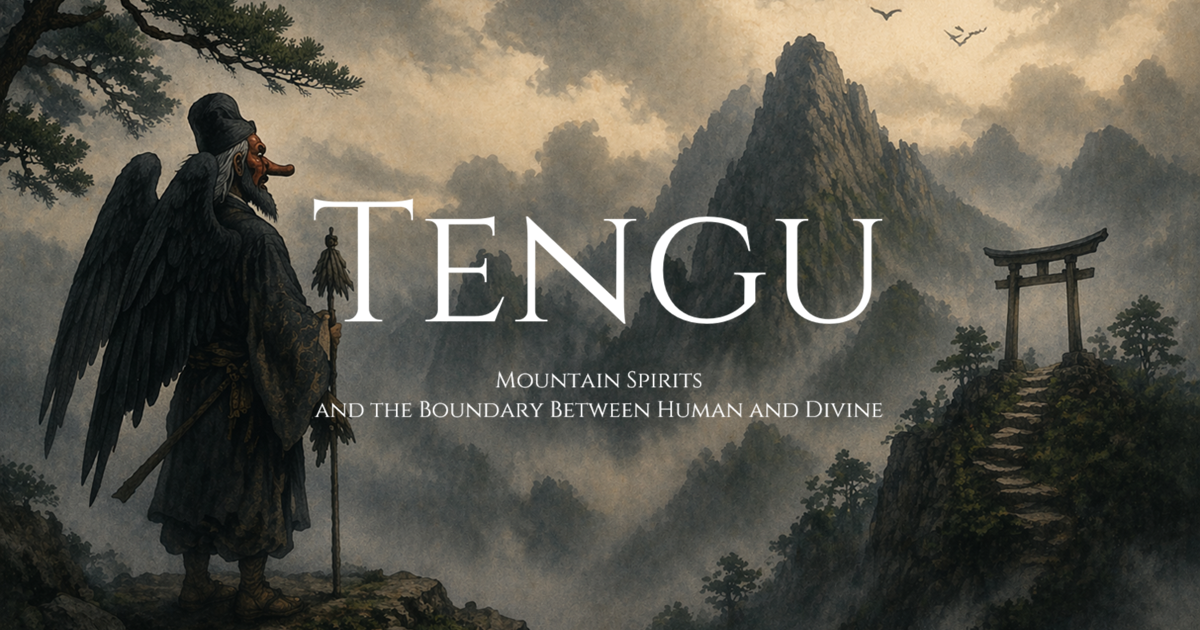
Mountains in Japan were never simply terrain. For agricultural communities, they provided water, timber, and the conditions that sustained settled life. Yet they remained outside the order of settlement — difficult to inhabit, difficult to manage, and understood as places where the familiar rules of village society did not fully apply.
The tengu belongs to that world. Associated with ascetic discipline, spiritual authority, and the risks of power acquired outside ordinary society, it occupies a position that resists stable categorization. It is not a monster in the conventional sense, nor is it a deity. It gives form to something more specific: a cultural concern with what happens to human beings who move too close to sacred knowledge, and what happens to authority when it becomes detached from humility.
For more stories like this, explore our Yōkai & Supernatural Folklore collection.
Discipline, Danger, and the Mountain Threshold
The tengu is among the most recognizable figures in Japanese yōkai tradition, yet its meaning has never been entirely settled.
The image most familiar today — a red face, a severely elongated nose, robes associated with mountain ascetics, and a feathered fan — is recognizable across masks, shrine carvings, regional emblems, and festival forms. These visual features make the figure immediately identifiable, but they do not by themselves explain what it represents.
Earlier forms of the tengu were considerably more avian. They appeared closer to birdlike beings connected with flight, height, and disruption — presences associated with elevated, inaccessible terrain rather than with human spiritual practice. Over time, this older form became layered with imagery drawn from the yamabushi, the mountain practitioners of Shugendō. The result was not a simple replacement of one image by another, but an accumulation: bird, ascetic, outsider, guardian, and unstable spiritual authority all held within a single figure.
That layered identity is central to what the tengu is. It is not fully divine, but it is not simply earthly. It may protect mountain terrain, yet it may also disorient those who enter carelessly. It may transmit martial or spiritual knowledge, yet it embodies the danger of pride and ambition that discipline alone cannot prevent.
The tengu belongs to the boundary. It takes form at the point where human aspiration begins to press against forces that exceed human control.
The Mountain Boundary Between Society and Sacred Power
The tengu cannot be understood apart from the cultural significance of mountains in Japan.
Mountains occupied an ambiguous position in the geography of traditional life. They were necessary — providing water, seasonal resources, and the environmental conditions on which agricultural communities depended. Yet they were also outside the order of settlement. The boundary between village and mountain was not only physical. It marked a transition from the cultivated and familiar to terrain that resisted ordinary social management.
To enter the mountain was to leave behind regulated space. Paths narrowed and grew uncertain. Forests closed off the sky. Weather shifted without warning. The sounds and spatial references that oriented daily life became unreliable. Human structures gave way to an environment that could not be fully controlled.
Within this geography, mountains came to be understood as places of potential transformation — spaces where discipline and contact with sacred forces became possible, but where human confidence might also become unstable. The tengu gives that ambivalence a figure. It is not simply placed within mountain settings; it expresses the authority that mountain space was understood to carry.
This is why the tengu does not feel suited to the household, the marketplace, or the village. Its proper setting is higher, older, and more remote — forest paths, temple slopes, the margins of places where ordinary social identity begins to loosen. The mountain does not merely contain the tengu. It produces the conditions that make the tengu meaningful.
Shugendō, Yamabushi, and the Danger of Spiritual Pride
The tengu’s connection to mountain asceticism is not incidental. It shapes the figure’s meaning at a fundamental level.
Shugendō was organized around the idea that mountains could serve as sites of transformation through physical hardship, ritual practice, and prolonged withdrawal from ordinary life. Its practitioners, the yamabushi, did not enter mountain environments merely to escape society. They sought discipline that would refine the self through sustained contact with difficult terrain and sacred presence.
This background clarifies why the tengu so closely resembles an ascetic figure. The robes, fan, posture, sandals, and mountain associations place it within the world of religious practice. But the resemblance is never fully stable. The tengu does not straightforwardly represent the ideal of the ascetic path. It also represents where that path can go wrong — where discipline hardens into superiority, where authority over others becomes detached from ethical restraint, and where distance from ordinary society begins to distort the self rather than clarify it.
Medieval Buddhist interpretations often connected tengu with corrupted religious practitioners — monks or ascetics whose learning, ambition, or attachment had drawn them away from genuine humility. The tengu did not signify that mountain practice was inherently suspect. It signified what mountain practice could produce when the ethical dimension was neglected.
This is the specific anxiety that the tengu holds. Ascetic training requires withdrawal, but withdrawal does not guarantee wisdom. Discipline may refine the self, but it may also enlarge the self if the practice becomes a source of pride. Authority gained through spiritual effort is real, but it is not self-validating.
The tengu stands within that instability. Its knowledge is genuine, but its relationship to humility is never assured. Through this unresolved quality, it becomes more than a mountain yōkai. It becomes a figure that tracks what spiritual power looks like when it begins to serve the one who possesses it.
How Does Sacred Imagery Give the Figure Form?
The cultural presence of the tengu is not confined to written tradition. It persists in visual and material form across shrine precincts, temple settings, and regional practices throughout Japan.
Masks bearing the tengu’s red face and extended nose appear in ritual contexts, on ema plaques, and in festival forms. Statues and architectural ornaments place the figure within sacred landscapes. Regional storytelling traditions invoke it as a marker of mountain authority — a presence that may guide, test, or unsettle those who approach elevated terrain without proper care.
The visual features carry consistent meaning. The elongated nose sets the figure apart from ordinary human proportion. The red complexion signals intensity and a certain severity — not aggression, but an authority that does not accommodate casual approach. The feathered fan connotes command over unseen atmospheric forces. Taken together, these features locate the tengu at an intersection of identities: resembling a monk without being one, functioning as a guardian without offering reassurance, inhabiting sacred terrain while remaining too unstable to be treated as simply divine.
Mount Kurama, north of Kyoto, is among the most widely known places associated with tengu tradition. Its mountain setting, forested paths, and long history of religious practice have helped preserve the tengu as a meaningful presence in the landscape rather than a purely archival figure. At sites like this, the tengu is not merely recalled from folklore. It becomes a way of reading the mountain itself — a framework for understanding why certain terrain carries a different kind of attention.
Encounter narratives tend to follow patterns of correction rather than unprovoked confrontation. Travelers become disoriented. Practitioners face unexpected tests. Those who approach sacred space with arrogance are humbled, delayed, or led to recognize their own limits. The emphasis falls not on violence but on imbalance — and on the recalibration that follows.
Through these patterns, the tengu encodes an expectation. Mountain terrain requires attentiveness. Sacred space requires restraint. Knowledge acquired outside ordinary social structures must be approached without the assumption that it belongs to the one who seeks it.
Modern Authority Without Stable Resolution
In contemporary Japan, the tengu persists less as a figure of active belief than as a cultural marker of mountains, discipline, and the uncertain nature of authority acquired outside everyday life.
Its image appears across shrine and temple settings, local festivals, regional branding, historical fiction, manga, games, and visual cultures associated with martial arts. The specific forms vary considerably, but a consistent set of associations tends to follow: height, severity, distance from ordinary social patterns, and knowledge that cannot be approached without some form of preparation or cost.
Contemporary versions frequently soften the figure. The tengu may appear as a regional character, a benevolent guide, or an eccentric mountain presence rather than a disruptive force. Yet even in these more approachable forms, something of its original character persists. It tends to remain slightly elevated, old-fashioned, or connected to knowledge that carries conditions — not freely given, not entirely safe.
This persistence depends partly on the continuing cultural distinctiveness of mountain space. Urbanization has transformed how many people encounter landscape, but mountain terrain in Japan still carries a different atmosphere from cities, plains, and settled areas. Pilgrimage routes, forested sacred sites, and remote temple precincts continue to invite a slower and more cautious form of attention. They suggest withdrawal, altered perspective, and partial release from ordinary social roles.
The tengu fits that distinction. It gives form to what the attraction of such spaces involves: the possibility of insight through distance, but also the risk that distance produces distortion. A teacher may guide but may also dominate. A sacred place may offer clarity but may also enforce its own conditions. Authority gained through withdrawal from society is real — but its relationship to wisdom, restraint, and genuine humility is never guaranteed.
The tengu holds these possibilities without resolving them. That capacity to remain ambiguous — to function as guardian, warning, and unsettling presence simultaneously — is what allows the figure to move across historical periods and media forms without losing its center.
Conclusion
The tengu is not defined by its appearance alone. Its meaning comes from the boundary it occupies — between village and mountain, human discipline and sacred authority, the aspiration to transcend ordinary limits and the distortion that such aspiration may produce.
Mountains are central to this. They offer distance from ordinary life, but not freedom from ordinary weakness. They make discipline possible, but do not prevent discipline from becoming pride. They allow contact with forces beyond the social world, but offer no guarantee that such contact leads to wisdom rather than to a more elaborate form of self-regard.
The tengu endures because it holds that uncertainty without resolution. It waits at the edge of the path — close enough to guide, but positioned in a way that makes guidance conditional. To approach it is to acknowledge that the pursuit of sacred knowledge carries costs that the seeker cannot fully anticipate, and that authority claimed through discipline must be tested against something other than the confidence of the one who claims it.
Related Articles
- Oni — A figure of excess and punishment, giving the consequences of moral disorder a bodily form through overwhelming force, exclusion, and punitive consequence.
- Kappa — A water-dwelling yōkai organized around etiquette and reciprocal exchange, mapping the fragile rules that govern contact between humans and the non-human world.
- Nurikabe — A boundary-oriented presence that transforms roads and familiar routes into spaces of obstruction, turning the act of movement itself into a site of uncertainty and interrupted intention.
Sources and Further Reading
The following works provide cultural, religious, and folkloric context for understanding tengu, mountain asceticism, and the symbolic function of yōkai in Japanese tradition.
- Blacker, Carmen. The Catalpa Bow: A Study of Shamanistic Practices in Japan. George Allen & Unwin, 1975.
- Foster, Michael Dylan. Pandemonium and Parade: Japanese Monsters and the Culture of Yōkai. University of California Press, 2009.
- Foster, Michael Dylan. The Book of Yokai: Mysterious Creatures of Japanese Folklore. University of California Press, 2015.
- Miyake, Hitoshi. Shugendō: Essays on the Structure of Japanese Folk Religion. University of Michigan Press, 2001.
Author’s Note
The tengu I grew up with was inseparable from Mount Kurama — the mountain north of Kyoto where, according to legend, the young Yoshitsune — the legendary twelfth-century warrior — trained in the martial arts under its watch through the night. That image settled early: a presence that was sacred and unsettling at once, neither fully approachable nor fully hostile. What stayed with me longer was something a primary school teacher mentioned in passing — that the tengu’s defining feature, its long nose, had led some people to suggest the figure was modeled on Western visitors. I don’t know how seriously it was meant. But the idea lodged itself: that a creature so thoroughly rooted in mountain asceticism and Japanese spiritual geography might have borrowed its most recognizable feature from an encounter with the foreign. The tengu, it turns out, has always occupied a boundary.