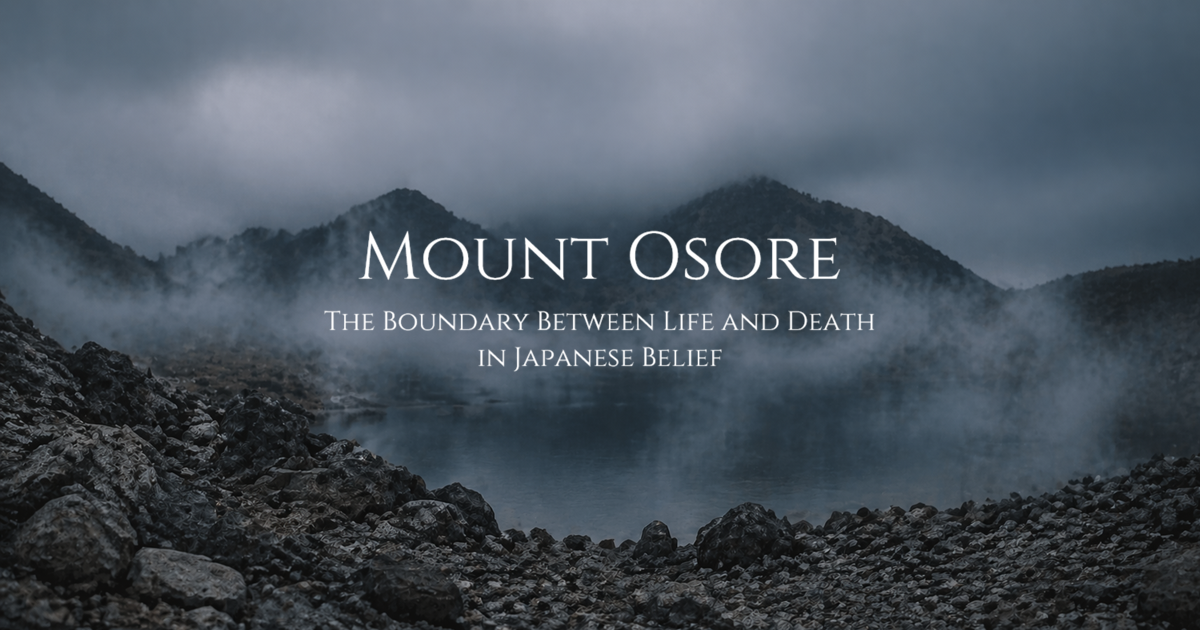
In northern Japan, Mount Osore occupies a position that few landscapes in the country share. It is not remembered primarily as a place of fear or supernatural disturbance. The mountain functions instead as a site where grief, pilgrimage, and the imagination of the afterlife have accumulated into something spatially tangible — a geography shaped less by spectacle than by the slow weight of repetition.
That accumulation comes from continuity. Generations of visitors have approached Osorezan not in search of revelation, but in search of orientation — a place where the dead could be approached through a recognizable landscape rather than through abstraction alone. What makes the mountain culturally significant is not any single story attached to it, but the way the terrain itself seems to confirm what visitors already believe.
For more stories like this, explore our Haunted Places in Japan collection.
A Boundary Landscape Between the Living and the Dead
Mount Osore stands on the remote Shimokita Peninsula in Aomori Prefecture, centered around the temple complex of Osorezan Bodaiji. The mountain has long served as a destination for pilgrimage, memorial practice, and the cultivation of relationships between the living and the dead. Its cultural position is unusual: it is neither primarily a tourist destination nor a site of fear, but a working landscape of mourning.
What gives the mountain its meaning is the alignment between its physical environment and the religious ideas that accumulated around it. Sulfur vents release steam continuously across exposed volcanic ground. Pale rock formations mark the terrain where vegetation cannot take hold. Lake Usori sits at the center of the crater, still and wide, framed by barren surroundings that seem stripped of ordinary human life.
These conditions were not merely noticed. Over time, they were interpreted. The landscape began to reflect Buddhist imagery associated with the realm of the dead — a visual parallel that made abstract cosmological ideas appear to be physically present. Visitors arriving at Osorezan did not need to be told what kind of place it was. The environment communicated its own symbolic register before a word was spoken.
The mountain therefore does not function as a haunted location in the conventional sense. It functions as a boundary — a place where the transition between life and death becomes culturally inhabitable.
Why Did the Volcanic Terrain Become a Map of the Afterlife?
The religious meaning of Mount Osore did not emerge from a single tradition or a single moment. It developed through the convergence of Buddhist cosmology, mountain asceticism, and regional practices of communicating with the dead — currents of belief that reinforced one another across centuries.
Mountains in Japan have long been associated with withdrawal from ordinary social space. They were sites of ascetic practice, places where monks undertook retreats that brought them symbolically close to realms outside everyday life. Osorezan entered this framework through the establishment of its temple complex, traditionally linked to the monk Ennin in the ninth century. The mountain became a destination for religious practice long before its volcanic character was integrated into Buddhist symbolic meaning.
That integration, when it came, was thorough. The terrain appeared to match visual descriptions associated with Buddhist depictions of the underworld — the pale earth, the sulfurous air, the absence of ordinary growth. Religious imagination no longer needed to be projected onto a neutral landscape. The landscape appeared to have already taken the correct form.
One association became particularly important: the identification of an actual river and bridge at Osorezan with the Sanzu River, the crossing that souls are believed to make after death in Japanese Buddhist tradition. Giving material form to that passage — making it visible and crossable — transformed the mountain into something more than a symbolic space. It became a place where the geography of the afterlife could be walked.
Nearby, an area associated with Sai no Kawara extends this logic. In Japanese Buddhist tradition, Sai no Kawara is connected to the souls of children who died before their parents. Visitors continue to stack stones there in acts of remembrance and care, building cairns that accumulate across seasons without instruction. These gestures are small and unannounced. Their repetition across generations is what gives them weight.
Throughout the grounds, statues of Jizō Bodhisattva appear in large numbers, dressed in bibs and caps placed by visitors over time. Jizō is understood as a protector of those in uncertain spiritual states — children, travelers, and the dead in transition. His presence does not console through warmth so much as through attention. The landscape, however stark, does not feel abandoned.
The Geography of Absence and Pilgrimage
What Mount Osore offers visitors is not proof of anything. It offers location. Death, which is otherwise impossible to place, becomes attached to a specific terrain — one that can be approached, walked through, and returned to across the years.
This spatial logic shapes the experience of grief at Osorezan in ways that are difficult to find elsewhere. The dead are not imagined as infinitely remote. They exist somewhere that continues to receive visitors, somewhere that accumulates offerings and worn stone paths and weathered statues. Pilgrimage to the mountain is not merely symbolic. It is a form of maintenance — a way of sustaining a relationship that death did not fully end.
The environment reinforces this at every point. The sulfur drifting through the air, the exposed ground, the silence that settles across volcanic terrain — these do not simply evoke absence. They organize it. The strangeness of the landscape separates Osorezan from ordinary social space without severing connection entirely. Visitors are removed from the familiar world just enough to approach what they came to approach.
Lake Usori introduces a different register. Its stillness creates an opening within the severity of the surrounding terrain, a surface that reflects rather than absorbs. The coexistence of harshness and quiet is not incidental. It mirrors the emotional structure of the site — the way grief and presence exist alongside each other without resolving into either one.
The mountain does not communicate resolution. It communicates accompaniment.
Ritual Practice and the Presence of Itako
Mount Osore remains an active site rather than a preserved one. The practices that define the mountain continue to be carried out with genuine intent, not as performances for observation.
Throughout the grounds, small acts accumulate into visible patterns. Stones are stacked near memorial statues. Windmills are placed in spaces associated with the souls of children. Handwritten messages and personal offerings appear near Jizō figures without announcement or ceremony. These gestures are modest individually, but their accumulation marks the landscape as one that continues to be tended.
The summer festival period draws large numbers of visitors to the mountain. During this time, the presence of itako spirit mediums becomes a central element of the gathering. The itako are traditionally trained practitioners, mostly women, associated with kuchiyose rituals — ceremonies in which the voice of a deceased person is directed through the medium toward the living.
These sessions are structured less around supernatural demonstration than around emotional continuity. The ritual creates a space where unresolved grief can be given a temporary form of address. Visitors do not arrive expecting proof of survival. They arrive seeking a moment of articulation — a way of speaking to someone who can no longer answer in ordinary terms.
Even outside formal ritual contexts, the mountain shapes behavior. Visitors move through the grounds quietly, pausing near volcanic areas or memorial spaces without a clear division between religious practice and simple observation. The environment establishes its own conduct. The mountain does not require instruction.
Cultural Memory Without the Need for Closure
Mount Osore persists as a cultural space because it offers a structure for approaching death without requiring certainty. It does not explain the afterlife. It provides a place where ambiguity can take recognizable form through landscape, ritual, and the accumulated weight of repetition.
This reflects something broader in Japanese religious practice — the tendency to sustain continuing relationships with the dead rather than to mark death as an absolute separation. Memorial practice, seasonal ritual, and acts of spatial attention keep those relationships active. The dead are understood as remaining near in some form, accessible through appropriate care and visitation.
Osorezan makes that logic visible. Rivers, pathways, statues, sulfur fields, and lakeshores become part of a relational geography. Grief does not need to remain internal or abstract. It can be directed outward, toward a landscape already arranged to receive it.
The mountain also holds multiple forms of belief simultaneously. Visitors arrive through different frameworks — Buddhist cosmology, regional tradition, family memory, or the kind of cultural curiosity that does not require doctrinal commitment. Osorezan does not force these into alignment. The landscape absorbs them without demanding consistency.
Its persistence does not depend on drama. The stillness of the site, the sparse terrain, and the quiet accumulation of memorial objects create an environment where reflection is possible without being required. The mountain continues to function not because it answers questions about death, but because it allows those questions to remain somewhere specific — somewhere that can be revisited.
Conclusion
Mount Osore is often described as a boundary between life and death. More precisely, it is a place where that boundary has been given cultural form through landscape, ritual practice, and the long repetition of memorial attention.
No single feature accounts for its meaning. Volcanic terrain, Buddhist imagery, pilgrimage traditions, spirit communication practices, and the quiet gestures of individual visitors reinforce one another across time. The result is a geography in which the afterlife is imaginable not as a distant realm, but as something spatially near — something that can still be approached, walked through, and tended.
The mountain does not remove uncertainty surrounding death. It gives uncertainty a place to be.
That distinction may explain its durability. Mount Osore offers neither revelation nor closure. It holds a landscape where absence continues to be approached — quietly, repeatedly, across generations — without any expectation that the distance will finally close.
Related Articles
- Aokigahara Forest — A dense volcanic forest where silence and spatial disorientation have produced a cultural association with disappearance and the boundary between life and death.
- Inunaki Tunnel — A physical threshold in Fukuoka where restricted access, circulating rumor, and the logic of forbidden space construct reputation without requiring a stable original story.
- Kiyotaki Tunnel — A tunnel outside Kyoto where atmospheric conditions, mirror-counting folklore, and the compression of transit space generate unease through the structure of the journey itself.
Sources and Further Reading
The following sources provide cultural and academic context for understanding Mount Osore, Japanese pilgrimage traditions, practices of memorial communication, and broader frameworks of death and the afterlife in Japanese religious life.
- Blacker, Carmen. The Catalpa Bow: A Study of Shamanistic Practices in Japan. Routledge, 1999.
- Iwasaka, Michiko, and Barre Toelken. Ghosts and the Japanese: Cultural Experience in Japanese Death Legends. Utah State University Press, 1994.
- Reader, Ian. Religion in Contemporary Japan. University of Hawai’i Press, 1991.
- Reader, Ian. Making Pilgrimages: Meaning and Practice in Shikoku. University of Hawai’i Press, 2005.
- Reader, Ian, and George J. Tanabe Jr. Practically Religious: Worldly Benefits and the Common Religion of Japan. University of Hawai’i Press, 1998.
Author’s Note
I first encountered Mount Osore through a television drama. What struck me was the rock — pale and exposed, nothing like the forested slopes of Kōyasan or Hieizan. Those mountains feel sacred in a way that seems directed upward. Osorezan felt like something else: a place where the ground itself had already been arranged for a different kind of arrival. The unease I felt watching it was not abstract. It was the specific feeling of a landscape that seemed to be waiting for something.
What I came to understand later is that this response is part of what the mountain has always produced. The discomfort is not incidental to the site’s meaning — it is part of how the boundary becomes perceptible.