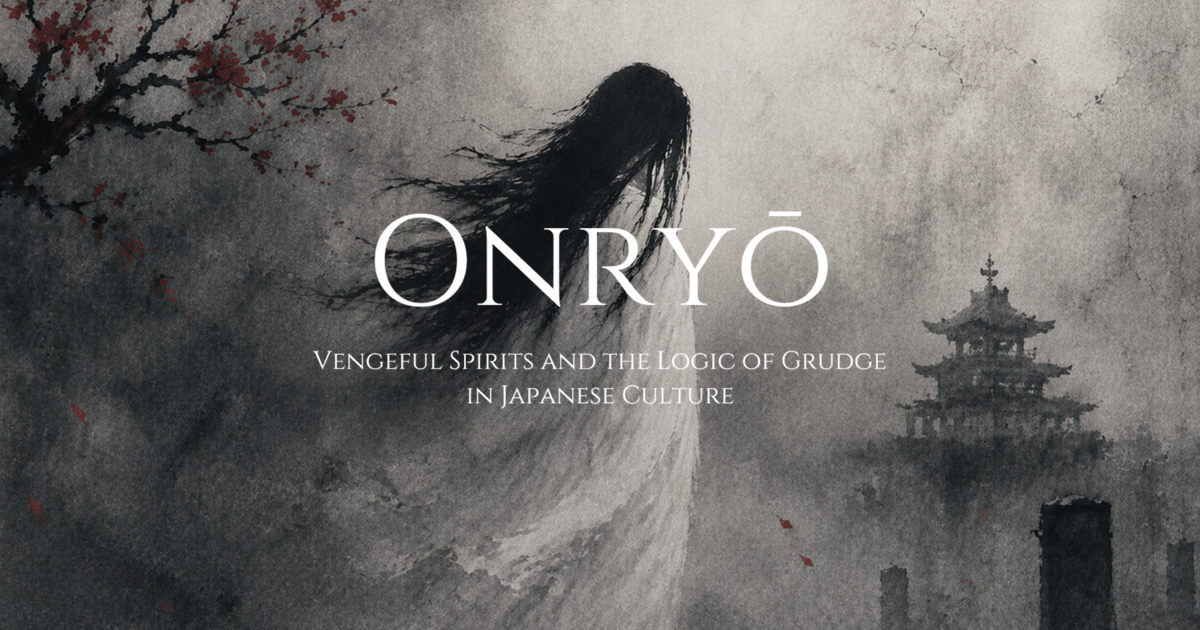
In Japanese ghost culture, not every death produces a spirit that simply lingers near the living. Some remain because mourning has stalled, because memory continues to hold them in place, or because feeling never found a form that the surrounding world could absorb. Among these figures, the Onryō occupies a distinct position: a spirit that does not merely stay, but presses outward, turning private injury into something the living can no longer treat as private.
For more stories like this, explore our Folklore & Ghost Culture collection.
Onryō and the Shape of Unanswered Resentment
The Onryō is commonly rendered as a vengeful spirit, though the term is closer to a grievance that has taken on independent force. Unlike a general Yūrei, whose unresolved feeling is usually experienced as attachment, the Onryō’s resentment is imagined as something that acts on the world it left behind, unsettling households, reputations, and the appearance of order rather than simply remaining close to the people it once knew.
The distinction is not cosmetic. Many figures in Japanese ghost tradition involve attachment, incomplete mourning, or a stalled transition between life and death. The Onryō narrows this further. What lingers is not only the person but the grievance itself — betrayal, humiliation, abandonment, or exclusion that could not be settled through ordinary means and so continues to act after death, as though the injury had simply changed its address.
Because of this, the Onryō is rarely a solitary figure. It tends to expose a relationship that failed: between a wife and a husband, a subject and an authority, a household and the member it discarded. The resentment may originate in private suffering, but the story gives it a public shape. Illness, misfortune, or repeated disturbance become the signs by which a community recognizes that an old injury has refused to stay contained.
Read this way, the Onryō belongs to a larger Japanese concern with unresolved balance. Tragedy alone does not summon the figure. What produces it is the sense that an emotional debt is still outstanding, and that the debt keeps pressing against the living. The spirit gives shape to a question most communities would rather not ask aloud: what happens to a grievance when no acceptable channel exists for answering it?
Resentment as a Force Against Social Order
The cultural logic of the Onryō begins in feeling but does not end there. What makes the figure dangerous, within its own narrative world, is that resentment stops behaving like a private state and starts behaving like a force with reach. A person is generally expected to absorb hardship, defer to hierarchy, or keep a grievance unspoken. The Onryō narrates the moment that expectation fails.
This is where the figure separates itself most clearly from broader ghost imagery. A Yūrei can express sorrow, longing, or a liminal condition between the living and the dead without disturbing much beyond its own presence. An Onryō converts feeling into pressure aimed outward. The injury is not simply remembered — it acts, reaching people who benefited, even passively, from the silence or distance that had kept the original wrong out of view.
Within this structure, resentment rarely reads as irrational excess. More often it appears as a response to an imbalance the surrounding order failed to correct: betrayal inside a marriage, an abuse of rank, a humiliation delivered by someone with authority to spare. These conditions supply the emotional material through which resentment becomes ghostly. The disturbance may be feared, but it also exposes how unstable the preceding harmony actually was.
This is also the source of the Onryō’s moral ambiguity. The spirit unsettles, and sometimes harms, yet its origin is usually an injury that the social order itself produced. The narrative resists a clean split between victim and threat, asking instead whether the disorder belongs to the ghost or whether the ghost has simply made visible a disorder that formal composure had been concealing.
Restraint and indirect expression carry real weight in Japanese social life, and that emphasis does not make conflict disappear — it can make certain kinds of pain harder to state outright. The Onryō gives narrative form to what could not be voiced safely while the person was alive. Suppressed feeling does not vanish under these terms; it changes shape, returning as something that can no longer be managed as a private matter.
Ritual Frames for Disturbance and Attachment
The Onryō draws its meaning from several overlapping religious and ritual traditions rather than a single doctrine. Shinto-influenced ideas of purity, Buddhist accounts of attachment, court-era ritual response, and popular storytelling all shaped the belief that the dead could remain active once balance had gone unrestored.
Within Shinto-associated thought, death and severe disturbance are often linked to impurity — not moral failing so much as a rupture requiring separation or purification before ordinary harmony can resume. A resentful spirit fits this pattern precisely because it marks a boundary that ritual has not yet secured: the dead have not fully departed, and the living have not fully recovered their footing.
Buddhist frameworks contribute the problem of attachment. Anger, grief, and desire can bind a being to continued suffering rather than release. Understood this way, the Onryō is not only a threat directed outward but a spirit still caught inside the very resentment that animates it — the haunting doubles as evidence of its own captivity.
These religious layers explain why response, rather than avoidance, tends to matter in Onryō narratives. Ritual pacification, memorialization, or the deliberate transformation of a dangerous spirit into an honored one recur as necessary steps, even when they arrive too late to undo the original harm. The dead, within this logic, are not simply feared or mourned; they are negotiated with, and the negotiation is what allows a community to claim that balance has finally returned.
From Household Grievance to Public Memory
Because the Onryō marks the failure of ordinary containment, its reach is rarely confined to a single house. A wife discarded by her husband, a retainer humiliated by someone above her rank, a figure of standing quietly stripped of position — each supplies the same underlying structure: a wrong that formal order was unwilling or unable to correct while the person was alive.
Political and courtly memory extended this logic outward. In aristocratic contexts, grievance was not limited to the domestic sphere; it could attach to exile, factional defeat, or disgrace at rank, and the resulting disturbance was sometimes read as a public rather than private matter. The related figure of the Goryō — spirits of the wronged dead feared as a source of calamity — reflects this same conviction that unresolved injury does not stay where it began. Where the Onryō is most often a story about resentment acting on a household or an individual relationship, the Goryō tradition shows how the identical logic could scale up to threaten the legitimacy of rank and rule itself.
What both share is a refusal to let silence stand as resolution. A household could disown a woman it had wronged; a court could exile a rival it feared. Neither could fully control what the discarded party would become in memory. The Onryō’s persistence lies in this gap between what power can suppress and what it cannot finish suppressing — the emotional residue that keeps requiring acknowledgment long after the original decision was made.
The Visual Language of the Resentful Spirit
The Onryō is recognized through a set of visual and performative conventions that make resentment legible before any story is told. These conventions took shape through theater and illustration, and later film, developing into a visual grammar that remains familiar in contemporary Japanese ghost imagery.
White clothing recalls burial garments and marks the threshold between the living body and the dead. Long black hair, loosened rather than arranged, suggests a breakdown in social presentation, especially against the controlled grooming associated with status and propriety. Pale skin, a lowered posture, and slowed movement complete the detachment from ordinary social presence — not the markings of a monster, but of someone no longer moving to the rhythms of daily life.
Noh theater renders this structure with particular restraint. Spirits return through memory or longing, and their emotional force is carried by stillness, masks, and formal movement rather than by open display. The performance does not require violence to make disturbance felt; the audience is asked to sit inside the pressure of a feeling that has not resolved.
Kabuki later intensified and popularized many of these conventions, giving broad audiences a repeatable visual shorthand for pale faces, unbound hair, and white garments carrying the weight of betrayal or unanswered wrong. Through repetition across performances, these signs became legible on their own, allowing a figure in white with loosened hair to carry the charge of resentment before a single line of the story had been spoken.
Modern Media and the Social Life of Unresolved Emotion
Contemporary Japan has not set the Onryō aside. The figure has moved into new media while keeping much of its earlier structure intact. Film, television, and manga have reshaped its surface, but the underlying premise persists: something unacknowledged continues to act.
In modern cinema, the Onryō often functions less as a speaking character than as an atmospheric presence — loose hair, obscured eyes, pale clothing, and a stillness that communicates emotional residue without requiring explanation. Much of its force now comes from restraint; the surrounding world already seems organized around avoiding the grievance, so the figure rarely needs to announce it.
Contemporary settings have also widened the range of injuries the Onryō can carry. Earlier narratives centered on betrayal, jealousy, or political disgrace; newer ones can attach the same structure to family pressure, institutional neglect, or the isolation of urban life. The wound changes shape, but the underlying pattern — what cannot be acknowledged directly returns through another channel — stays intact.
Screens and recordings have given this return new mechanisms. An image can now repeat and circulate without a fixed point of origin, extending the older logic of haunting into networks where memory moves mechanically rather than through a single ritual space. Outside Japan, the visual language of the Onryō is often received mainly as an image of supernatural fear. Within its originating context, though, the figure’s force stays tied to something more specific: the return of an injury that was never given an answer.
Conclusion
The Onryō is usually introduced as a vengeful spirit, but its cultural weight extends past revenge as an act. It gives resentment a form once resentment can no longer stay hidden or be filed safely into the past, converting private injury into a disturbance the surrounding order has to answer for.
This is what separates the figure from the wider category of Japanese ghosts. It is not simply a sign that the dead remain near the living; it is a sign that a grievance remains active inside the very order that produced it, asking whether harmony was ever genuinely restored or whether silence had only postponed the reckoning.
Across religious thought, courtly memory, theater, and modern media, the Onryō keeps returning to the same premise: some injuries cannot be closed by ordinary speech, and the pressure they leave behind eventually needs somewhere to go.
Related Articles
- Yūrei — The broader Japanese ghost figure, shaped by mourning, attachment, and an incomplete transition between the living and the dead.
- Oiwa — A single betrayal transformed through theater into a lasting cultural image of feminine resentment.
- Goryō — Politically charged spirits whose grievance exposes the fragile relationship between memory, authority, and ritual appeasement.
Sources and Further Reading
The following works ground the Onryō’s emotional, ritual, and theatrical dimensions in established scholarship on Japanese religion, death, and performance.
- Borgen, Robert. Sugawara no Michizane and the Early Heian Court. Harvard University Asia Center, 1994.
- Foster, Michael Dylan. Pandemonium and Parade: Japanese Monsters and the Culture of Yōkai. University of California Press, 2009.
- Iwasaka, Michiko, and Barre Toelken. Ghosts and the Japanese: Cultural Experience in Japanese Death Legends. Utah State University Press, 1994.
- Komatsu, Kazuhiko. An Introduction to Yōkai Culture: Monsters, Ghosts, and Outsiders in Japanese History. Japan Publishing Industry Foundation for Culture, 2017.
- Reader, Ian. Religion in Contemporary Japan. University of Hawai’i Press, 1991.
- Tyler, Royall. Japanese Noh Drama. Penguin Classics, 1992.
Author’s Note
I used to think of the Onryō as a single grievance attached to a single body. What comes back to me now is a different memory — resentment as something that could pool together, many griefs joining into one shapeless, moving thing, no longer anyone’s in particular. I could not tell you now where I first encountered it, only that the image never fully left; even now, it feels less like a figure than a gathering pressure at the edge of things.