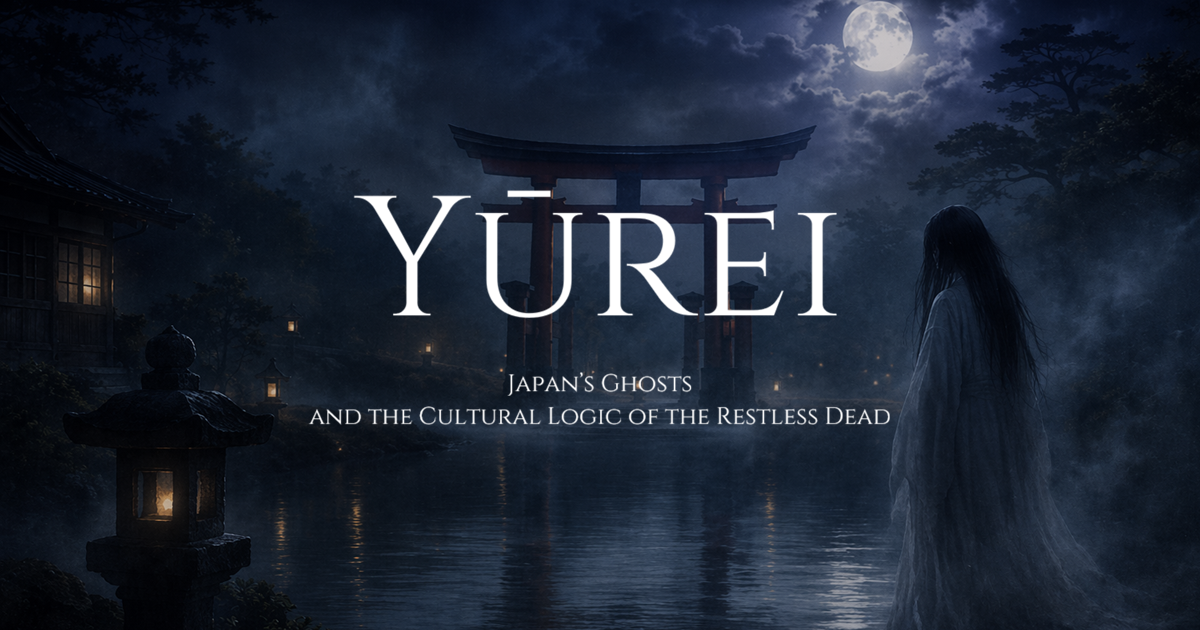
In Japan, ghosts have long been understood as evidence that certain kinds of separation resist completion. The figure of the yūrei does not simply belong to the supernatural—it belongs to the cultural logic that surrounds death, ritual, and the emotional obligations that do not end when life does. What makes the yūrei distinctive is not the fact of death, but what the spirit could not set down before it occurred.
Within this framework, the restless spirit marks a condition rather than an event. Grief, resentment, longing, or unfulfilled duty continues beyond the point at which social and ritual structures expected those emotions to dissolve. The yūrei’s presence therefore reveals less about belief in the afterlife than about the cultural difficulty of bringing certain relationships to an end.
For more stories like this, explore our Folklore & Ghost Culture collection.
Unfinished Attachment and the Restless Dead
Yūrei are spirits of the dead who remain unable to complete their movement away from the human world. The term combines yū, meaning faint or dim, with rei, meaning spirit or soul—suggesting something suspended between visibility and disappearance rather than a presence with full supernatural weight.
In traditional Japanese thought, death has not been understood as a single dividing moment. Funeral rites, memorial ceremonies, household remembrance, and seasonal observances together guide the deceased toward what might be called ancestral stability—a settled condition in which the dead no longer exist in tension with the living. When those transitions remain unresolved, the spirit may find itself caught between states, neither fully departed nor capable of return.
What defines the yūrei is not the nature of death itself, but the nature of attachment left behind.
That attachment takes many forms across the narrative tradition. Some spirits carry resentment. Others carry grief, loyalty, guilt, or the weight of a responsibility they were prevented from fulfilling. The particular emotion matters less than the inability to release it. Yūrei therefore emerge not from violence alone, but from relationships that have not reached emotional conclusion.
This places the concept within a broader cultural understanding of continuity rather than rupture. The dead are not assumed to be entirely absent from domestic life. Household altars, grave visits, memorial anniversaries, and seasonal rituals maintain ongoing connections between the generations. The appearance of a yūrei signals an instability within those systems—something that the usual structures of remembrance and transition have failed to resolve.
Among the spirit forms associated with this condition, the Onryō eventually became culturally distinct through its specific connection to resentment, emotional fixation, and the kind of unresolved grievance that transforms attachment into something more corrosive.
Death, Ritual, and the Space Between
The cultural foundations of yūrei developed through the convergence of Buddhist thought, ancestral practice, and the vernacular storytelling traditions that carried both across time. In Buddhist frameworks, the spirit does not immediately detach from worldly existence at the moment of death. Transitional states require ritual guidance, memorial prayer, and the gradual release of earthly attachment. Without those processes, instability persists beyond death itself—the spirit remains oriented toward what it has not yet been able to leave.
Alongside this, Japanese ancestral traditions positioned the dead as continuing members of the household rather than permanently separated beings. Through offerings, memorial tablets, and regular acts of remembrance, the deceased remained socially present within the living community. Obon observances reinforce the same idea—ancestral spirits return to domestic space seasonally before departing once more. Within this framework, the boundary between life and death becomes a relational condition rather than an absolute threshold.
During the Edo period, these ideas became increasingly visible in literature, theater, and visual culture. Kaidan collections circulated ghost narratives widely among urban readers. Kabuki theater gave physical and dramatic form to many of the conventions now associated with yūrei—long unbound hair, white funerary garments, lowered hands, the absence of feet. These elements were not invented for theatrical effect. They translated existing cultural concerns about mourning, emotional attachment, and ritual incompletion into a recognizable visual language.
The growing popularity of ghost narratives during this period also reflected something about the social conditions of urban life under the Tokugawa order—anxieties about illness, instability, interrupted relationships, and forms of social disruption that could not be directly addressed in public discourse. Ghost stories offered a displaced form through which those tensions could be acknowledged and held.
The figure of the yūrei, then, did not emerge from any single religious doctrine. It emerged from the point where ritual practice, theatrical representation, and collective feeling about emotional incompletion came together.
The Visual Logic of the Restless Dead
The appearance of yūrei follows a symbolic structure organized around liminality. Each element positions the spirit between conditions rather than fully inside either the human world or whatever lies beyond it.
White burial garments indicate that a transition into death has begun. In funerary practice, white traditionally signified purity and separation from ordinary social existence. When worn by a yūrei, those garments place the spirit in a state where that movement has started but has not concluded.
Long unbound hair carries a related meaning. In historical Japanese society, hair was arranged according to social expectation and personal circumstance. Loose hair implied disorder, emotional disruption, or rupture from the structures that normally organized social life. Within ghost imagery, it signals that the spirit no longer occupies stable social space—that the ordinary conventions which once governed appearance have ceased to apply.
The absence of feet may be the most structurally specific element of all.
Rather than suggesting movement, footlessness removes the figure from physical grounding. The yūrei appears suspended rather than walking—hovering between presence and disappearance. The effect is not confrontational but unresolved. The spirit does not approach. It persists.
This restrained visual structure separates yūrei from many Western ghost traditions that depend on spectacle or violent interruption. Japanese ghost imagery tends to work through silence, repetition, and emotional suspension. The spirit appears quietly and refuses to settle into absence.
Yūrei characteristically appear within spaces shaped by memory—old houses, bridges, coastlines, temples, rooms associated with emotional rupture. These locations function less as inherently haunted environments than as sites where unfinished relationships continue to accumulate symbolic weight within cultural imagination. The Ubume centers on maternal attachment and interrupted care; the Funayūrei emerge from anxieties about dying far from ritual space and familial continuity. Each variation gives form to a specific kind of relational incompletion.
Theater, Literature, and Contemporary Media
Yūrei continue to appear throughout Japanese cultural life in contexts where literal belief in ghosts carries little social force. The symbolic structure remains recognizable—in kabuki, literature, cinema, and digital storytelling—because what it expresses has not ceased to feel meaningful.
In kabuki, ghost figures are rendered through controlled physical movement and prolonged stillness. The emotional atmosphere surrounding the spirit is suspended rather than chaotic. Silence, measured pacing, and repetition build tension not through confrontation but through the refusal of resolution. The audience is not invited to witness danger—it is invited to remain inside emotional imbalance without the relief of an ending.
Kaidan storytelling traditions developed similar rhythms. Many narratives do not depend on sudden revelation. They accumulate unease gradually, circling an unresolved relationship or an interrupted transition until ordinary space becomes difficult to inhabit. Memory appears to continue occupying the environment as though it has nowhere else to go.
These structural patterns carry directly into modern media. Late twentieth-century Japanese horror cinema produced globally recognizable imagery drawn from yūrei iconography—white clothing, black hair obscuring the face, restrained movement, domestic settings rendered strange by an emotional presence that cannot be placed. Even stripped of explicit religious framing, the emotional logic remained consistent with older ideas about unresolved attachment and the failure of transition to conclude.
Digital culture has altered how these narratives circulate without changing the structure they follow. Anonymous online testimony, viral storytelling, and internet-based urban legends reproduce many of the same patterns that once moved through oral tradition. The Kisaragi Station account, circulated through an anonymous message board, follows the same rhythm of gradual disorientation and failed return that characterizes much older kaidan. The medium changes; the architecture does not.
Why the Restless Dead Continue to Matter
The persistence of yūrei within Japanese culture reflects the durability of a system in which death is understood not as a complete severance, but as a condition requiring continued negotiation between memory, ritual, and emotional attachment. Relationships between the living and the dead are sustained through remembrance and practice rather than treated as permanently closed.
Yūrei emerge where those negotiations break down.
The figure gives cultural form to anxieties about unresolved emotion, neglected obligation, and incomplete separation—conditions that no period of historical change has managed to eliminate. Grief that cannot stabilize, resentment that goes unacknowledged, relationships interrupted before any form of closure becomes possible: these are given visible presence through the image of the restless dead.
The concept also moves easily across historical periods because it depends less on formal doctrine than on emotional recognizability. Even within secular contexts, the idea that memory can remain attached to places, relationships, or unfinished experiences does not require a belief system to sustain it. The feeling is more basic than belief.
Unlike supernatural figures built around confrontation or spectacular manifestation, yūrei persist through restraint. Their presence tends to be quiet, repetitive, and indirect. They appear not as intrusions from outside reality, but as indications that something within ordinary experience has not completed its movement toward absence. That is a different kind of strangeness—one that depends not on rupture, but on continuation.
Conclusion
Yūrei are not simply ghost figures within Japanese folklore. They are cultural expressions of interrupted transition—spirits that emerge from systems of thought in which death requires ritual continuity, emotional release, and ongoing negotiation between memory and the absence it is supposed to become.
Their presence names a specific kind of difficulty: the condition in which separation has begun but has not concluded.
Grief without resolution, obligation without closure, relationships that ended without the emotional completion that would allow them to settle—these are made culturally visible through the figure of the restless spirit. The yūrei does not represent supernatural anomaly so much as a recognition that certain transitions resist the structures built to guide them.
The enduring presence of these spirits within Japanese culture suggests that absence itself is never entirely empty. Memory continues to occupy space long after formal endings have occurred, and the yūrei remains the figure Japanese culture has given to that persistence.
Related Articles
- Onryō — Where yūrei take a more specific form: spirits defined by resentment and emotional fixation, in which unresolved grievance transforms attachment into something that actively resists the transition toward ancestral stability.
- Kaidan — The narrative tradition through which ghost figures like yūrei have been transmitted and refined: stories structured through repetition, silence, and the slow accumulation of emotional imbalance rather than dramatic revelation.
- Kisaragi Station — A contemporary liminal narrative in which anonymous digital testimony reproduces the structural logic of older kaidan: gradual disorientation, failed return, and the impossibility of locating where ordinary space ended and something else began.
Sources and Further Reading
The following sources offer cultural, folkloric, and academic perspectives on Japanese ghosts, the ritual systems that surround death and memory, and the symbolic structures through which restless spirits have been understood and represented.
- Foster, Michael Dylan. Pandemonium and Parade: Japanese Monsters and the Culture of Yōkai. University of California Press, 2009.
- Foster, Michael Dylan. The Book of Yōkai: Mysterious Creatures of Japanese Folklore. University of California Press, 2015.
- Iwasaka, Michiko, and Barre Toelken. Ghosts and the Japanese: Cultural Experience in Japanese Death Legends. Utah State University Press, 1994.
- Komatsu, Kazuhiko. An Introduction to Yōkai Culture: Monsters, Ghosts, and Outsiders in Japanese History. Japan Publishing Industry Foundation for Culture, 2017.
- Reader, Ian. Religion in Contemporary Japan. University of Hawai’i Press, 1991.
Author’s Note
Every summer, my family visited my father’s parents’ house for Obon. I was too young to think much about what the season meant — more interested in running around the countryside than in the rituals surrounding it. But I remember standing at the graves: my paternal grandfather, who died before I was born; my paternal grandmother and maternal grandparents, whom I had known and then lost during those same years of childhood. They existed in photographs, in the particular way adults went quiet at certain moments. The yūrei, I think, gives cultural form to exactly that — not fear, but the strangeness of a relationship that continues without the person who made it possible.