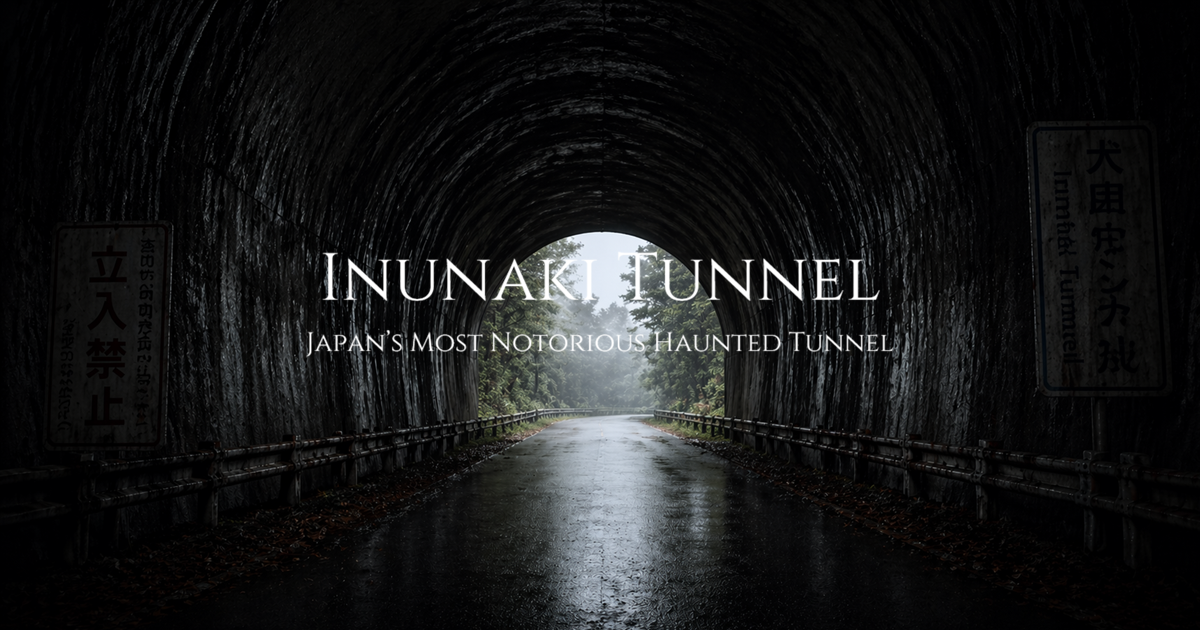
Not every haunted place in Japan becomes meaningful because someone saw something there. Some acquire their reputation simply by sitting at the edge of ordinary access — close enough to approach, far enough to resist confirmation. These are the places where rumor does not describe an event so much as fill a structural absence.
Inunaki Tunnel belongs to this second kind. Located in the mountains of Fukuoka Prefecture, it is associated with a violent incident from the late 1980s, but its reputation has never been anchored to that event alone. What has accumulated around the tunnel since then is something more diffuse: partial accounts, night visits, online retellings, the awareness that the space cannot be settled from a distance. Each layer of description leaves the tunnel less explained, not more.
For more stories like this, explore our Haunted Places in Japan collection.
Accumulated Uncertainty at the Edge of Access
Inunaki Tunnel is an abandoned mountain tunnel in Fukuoka Prefecture, and its cultural history includes a violent incident from 1988 that drew national attention. But the tunnel’s reputation has not remained tethered to that event. What has grown around it since is something the incident alone cannot account for: a diffuse, layered field of accounts that keeps returning to the site without ever fully settling it.
This is what distinguishes Inunaki Tunnel within Japan’s haunted geography. A reputation built around a single fixed claim can be tested against that claim. A reputation built from accumulated uncertainty resists that kind of resolution. The tunnel’s cultural presence does not depend on whether any specific account can be verified, because its meaning is distributed across many accounts, none of which is individually decisive.
The physical setting provides the conditions under which this kind of reputation could take hold. The tunnel sits away from ordinary urban movement, in a mountainous landscape where roads narrow, vegetation closes in, and distance from everyday social space begins to register physically before the structure itself comes into view. The approach is part of the experience. By the time the tunnel appears, the visitor has already moved through a sequence of perceptual changes that the surrounding environment has quietly organized.
In this setting, the tunnel does not need a single narrative center to become culturally legible. Its meaning comes from incompleteness. Sounds resist identification. Traces remain ambiguous. Impressions circulate as accounts that add to the existing image without resolving it. Over time, the site becomes more than the sum of its physical elements: concrete, darkness, disuse, vegetation. These features are ordinary enough in isolation. Surrounded by repeated rumor, they begin to function as interpretive cues — a kind of architecture that the stories have built over the physical structure.
Geography of Isolation at the Edge of Access
The cultural meaning of Inunaki Tunnel begins with its spatial position. The site is associated with mountains, an older road network, and infrastructure that no longer sits comfortably within the systems of movement that organize everyday life. These features matter not because they are dramatic, but because they alter the spatial conditions under which a place can be read.
Modern roads are designed to eliminate uncertainty. They organize movement, clarify direction, and keep travelers within visible networks of access and guidance. Signs, lighting, barriers, and traffic flows all work to make space predictable. When a tunnel no longer belongs fully to that system — when it has been bypassed, partially sealed, or left to fall outside routine use — it begins to occupy a different kind of spatial role. It marks the edge of organized readability rather than confirming the visitor’s place within it.
Inunaki Tunnel occupies this in-between position. It is not a remote mythic location beyond all access, but it is not part of everyday movement either. This partial accessibility is central to its reputation. A completely inaccessible place produces only abstract rumor. A completely familiar one loses the distance required for speculation. Inunaki sits between these conditions, which means the act of approaching it never quite dissolves the uncertainty already attached to it.
Mountain settings intensify this effect in Japanese cultural memory. Mountains have long carried associations with withdrawal from ordinary settlement: spaces of worship, ascetic practice, boundary crossing, and retreat. They are not simply geographic backdrops. They carry accumulated meaning as distances from social life in the most literal sense.
A tunnel through such terrain adds another register. It is a human-made passage inserted into a landscape already marked by separation — a practical structure designed to shorten distance and simplify movement. When that passage falls out of use, the spatial logic it embodied reverses. Instead of shortening distance, the tunnel begins to mark it. Instead of making movement ordinary, it draws attention to the interruption of ordinary movement. The structure remains, but the purpose it was built to serve has withdrawn.
This is why the atmosphere at Inunaki Tunnel cannot be reduced to darkness or physical decay. Those elements contribute to perception, but the deeper condition is spatial. The site is culturally effective because it stands at the edge of access without crossing into pure inaccessibility — reachable, but not integrated; visible, but not explained.
How Does Rumor Turn a Tunnel into Haunted Space?
Rumor operates differently in spaces that cannot be easily verified. A location that many people pass through regularly, under ordinary conditions and good light, quickly accumulates a practical social consensus about what it is. A remote tunnel, visited less frequently, often after dark, by people who arrive already carrying accounts of it — such a space remains open to interpretation in ways that ordinary locations are not.
At Inunaki Tunnel, this openness is structural. A person hears that the tunnel carries a reputation, approaches with that reputation already present, notices details that might be unremarkable elsewhere but resist easy explanation here, and later describes the experience in a way that adds another layer to the accumulated image. The next visitor arrives inside that image. The process does not require deliberate fabrication. Much of the force of place-based rumor comes from honest interpretation under conditions of limited information and heightened expectation.
What distinguishes Inunaki from many other haunted sites is the absence of a stable central legend. A fixed narrative can be compared, questioned, parodied, or exhausted. A looser field of accounts is more durable precisely because it does not concentrate meaning in one version that can be tested and found wanting. Different accounts emphasize different elements — the road before the entrance, the atmosphere inside, the quality of silence, the sense of being observed, the difficulty of describing what felt wrong — and these accounts need not agree factually in order to reinforce one another structurally. Each one confirms the tunnel as a place where uncertainty is the appropriate response.
Silence becomes especially active in this context. In a location already framed by rumor, the absence of obvious phenomena is not experienced as disconfirmation. It is experienced as a particular kind of evidence: the stillness that belongs to a space that has learned to withhold. This is one of the more counterintuitive features of strong haunted place reputation — the absence of anything conclusive can deepen rather than diminish the cultural meaning of the site.
Online Retelling and the Repetition of Place
In contemporary Japan, a significant portion of people encounter Inunaki Tunnel first through media. Online videos, forum discussions, social media posts, and informal investigation accounts have collectively built a visual and narrative vocabulary for the place that circulates far beyond Fukuoka Prefecture. Many people carry a recognizable image of the tunnel — an entrance in mountain darkness, a narrow approach road, a flashlight beam — before they have any direct contact with the site.
This mediated encounter changes how the place functions. Inunaki Tunnel is no longer only a local site whose reputation travels through regional conversation. It is a repeatable image, a recognizable format: the approach, the entrance, the documentation of atmosphere, the inconclusive departure. These elements can be recognized even by people with no connection to Fukuoka because the format itself has become familiar through repetition.
Online retelling preserves haunted space by making uncertainty visible without resolving it. A video can show the approach to the tunnel and record the sounds inside it, but it cannot transmit the full sensory and psychological conditions of being there. It can document, but it cannot settle. Viewers see enough to confirm that the place exists and that the atmosphere is worth documenting; they do not see enough to close the question of what the atmosphere means. This partial documentation is not a limitation of the medium so much as a feature of how the medium interacts with a particular kind of location.
The result is a cycle of mediated anticipation. People watch others approach the tunnel, imagine their own approach, and either eventually visit and add another account to the record, or never visit at all but continue to participate in the circulation by commenting, sharing, or comparing versions. Both forms of participation sustain the tunnel’s cultural presence. Physical visitation and digital engagement produce slightly different relationships to the place, but both keep it socially active.
This differs from older forms of place-based rumor, where circulation depended on local speech or printed accounts reaching a geographically bounded audience. Digital circulation allows the tunnel to be repeatedly introduced to people with no regional connection to the site. The place becomes detached from purely local geography and enters a broader network of haunted places, abandoned infrastructure, and exploratory media. Yet this wider visibility does not make Inunaki ordinary. If anything, it preserves the gap between recognition and access. Many people know the image; far fewer can evaluate the place directly.
Abandoned Infrastructure and the Memory of Use
Abandoned infrastructure carries a weight that ancient ruins or sacred sites do not quite replicate. It is not distant in the way a medieval battlefield or classical shrine is distant. It belongs to a recognizable modern world of roads, construction, and practical transportation — a world recent enough that its remnants feel like something that was expected to continue and did not.
Inunaki Tunnel was not built to be symbolic. It was built to move people through difficult terrain. The associations that have gathered around it emerged after the practical logic of the structure weakened — not because the builders intended anything other than passage, but because the passage stopped being used.
This transition from use to disuse changes how the space is read. A functioning tunnel is experienced as a brief interruption in a journey: the driver enters, passes through darkness, and emerges without dwelling on the structure itself. The tunnel matters because it allows movement to continue. An abandoned tunnel reverses this relationship. The structure itself becomes visible — walls, surfaces, the quality of enclosure — in ways it never was when it was merely functional. Elements that were background become foreground. The means of transit becomes an object of attention.
Abandoned spaces of this kind invite questions about what happened there, about the human activity that has withdrawn, about the moment when something built for continuation was set aside. Even when the practical answers are straightforward — a road was rerouted, traffic declined, the tunnel was no longer maintained — the visible remainder can feel unresolved because it continues to occupy space without a clear present function.
What Inunaki Tunnel ultimately exposes is how modern spaces can become strange when they lose their ordinary role. The unease that surrounds it is not only about what might appear inside a dark enclosed passage. It is also about the experience of encountering infrastructure after the social purpose that organized it has gone quiet.
Why the Site Resists Complete Legibility
Inunaki Tunnel endures because it combines several conditions that sustain place-based rumor without requiring any one condition to carry the full explanatory weight. Isolation makes the site feel removed from ordinary confirmation. Partial access allows approach without dissolving distance. Ambiguity allows personal impressions to circulate as meaningful accounts. Repetition gives those impressions social weight and a larger context in which they seem to belong.
The tunnel’s reputation also survives because it does not depend on a single fragile claim. A haunted place built around one decisive account is vulnerable to that account being questioned. Inunaki’s meaning is distributed — held across many incomplete descriptions that reinforce one another not by agreeing on specifics but by agreeing on the type of place this is. When one visitor reports nothing unusual, the larger image of the site is not necessarily weakened. The description of an unremarkable visit can itself circulate as one more entry in a field of accounts that has come to include unremarkable visits as a recognized category of experience.
The site also expresses a broader concern with spaces that have slipped outside ordinary systems of oversight. Much of modern life is organized through visibility: mapped routes, lit streets, mobile signals, recorded movement, constant connectivity. A location that feels removed from these systems carries a particular kind of cultural charge. It suggests the possibility that not all space has been fully absorbed into order — that access can be partially withheld, that some places continue to resist complete legibility.
Inunaki Tunnel gives form to that possibility. Its reputation is preserved not by evidence in the conventional sense, but by the repeated experience of not having quite enough evidence, and by the social habit of treating that lack as significant rather than resolving it by moving on.
Conclusion
Inunaki Tunnel is culturally important not because it offers a stable story but because it shows how haunted space can be produced through rumor itself — through the social process by which an uncertain location becomes a place people feel obligated to interpret.
Its physical features provide the conditions: mountains, disuse, partial access, darkness, and the particular atmosphere of infrastructure that no longer serves its purpose. But those features become culturally active only when taken up by repeated accounts that teach later visitors what kind of space they are approaching. The tunnel becomes haunted not in a single act of designation but through the continuous accumulation of incomplete descriptions that keep it socially present.
This is what distinguishes Inunaki from tunnel narratives built primarily around the act of passage through an uncanny route. The tunnel’s central structure is not transit through danger, but the social process by which a place that cannot be fully confirmed continues to generate new attempts at confirmation. The interpretation never finishes. The tunnel, in this sense, does not need to be resolved.
What remains is a space held open by collective uncertainty — a place whose cultural life is sustained precisely because no single account has yet been sufficient.
Related Articles
- Kiyotaki Tunnel — A tunnel narrative shaped by the uncanniness of modern transit infrastructure, where the act of passing through a functioning route generates unease rather than rumor gathering around an abandoned space.
- Aokigahara Forest — A landscape where spatial uncertainty is generated through density, silence, and disorientation rather than through abandoned infrastructure or the absence of ordinary access.
- Kisaragi Station — A digital urban legend in which the transit system itself becomes the site of spatial disappearance, transmitted through anonymous online testimony rather than accumulated place-based visitation.
Sources and Further Reading
The following sources provide cultural and academic context for understanding haunted space, rumor formation, contemporary legend, and the circulation of place-based narratives in digital environments.
- Bennett, Gillian, and Paul Smith, editors. Contemporary Legend: A Reader. Garland, 1996.
- Dégh, Linda. Legend and Belief: Dialectics of a Folklore Genre. Indiana University Press, 2001.
- Goldstein, Diane E., Sylvia Ann Grider, and Jeannie Banks Thomas. Haunting Experiences: Ghosts in Contemporary Folklore. Utah State University Press, 2007.
- Blank, Trevor J., editor. Folklore and the Internet: Vernacular Expression in a Digital World. Utah State University Press, 2009.
- Augé, Marc. Non-Places: Introduction to an Anthropology of Supermodernity. Verso, 1995.
Author’s Note
Japan’s haunted places often arrive without a clear moment of introduction. The name Inunaki Tunnel was already somewhere in my awareness before I could trace how it got there — absorbed through conversation or context I no longer remember. But writing this article brought back something older: a film I watched as a child, in which a dark tunnel opened onto a mansion where something waited. I do not remember the film clearly. What stayed was the feeling of standing at the entrance, unable to see what the passage led to. I think that image was already there by the time I learned the name Inunaki Tunnel.