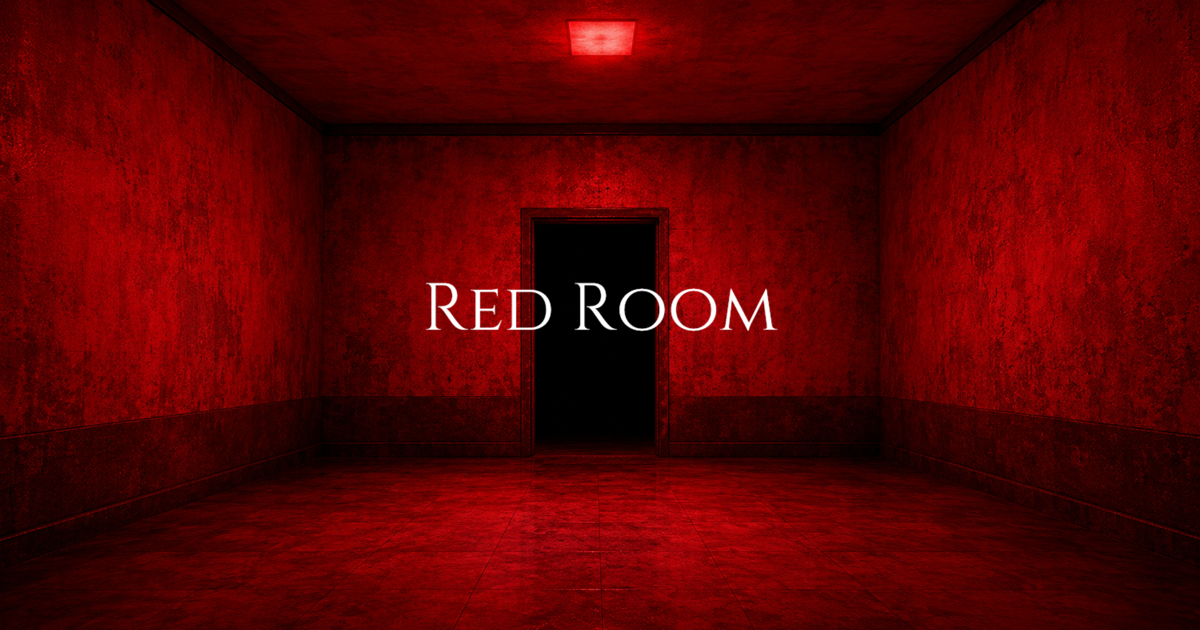
Red Room belongs to a period when the internet still felt unfinished — a space where ordinary use could tip into something unscripted without warning. Unlike legends rooted in schools, tunnels, or train platforms, this one unfolds entirely on the screen, where a pop-up window refuses to behave like a pop-up window and a simple act of closing stops producing a result.
The legend’s persistence comes from a small but specific failure: the expected relationship between a user’s action and the computer’s response breaks down. A message returns. A phrase repeats. The machine appears to keep going on its own terms. Red Room is not a story about crossing into another place. It is a story about a screen that no longer answers to the person sitting in front of it.
For more stories like this, explore our Urban Legends in Japan collection.
A Pop-Up Window That Refuses to Close
Red Room — known in Japanese as Akai Heya — describes a pop-up window that appears on a computer screen and resists the usual methods of dismissal. The message arrives incomplete, then sharpens with each return into a single recurring line: “Do you like the red room?” Closing the window does not end the sequence. The pop-up reappears, and what should have been a routine interaction becomes a loop the user did not choose to enter.
What separates Red Room from most Japanese urban legends is the absence of a setting in any conventional sense. There is no corridor, no platform, no threshold to cross. The legend takes place inside the interface — a surface ordinarily understood as responsive, suddenly behaving as if it has stopped listening to the person using it. This shift, from interface-as-tool to interface-as-actor, is what gives Red Room its lasting cultural traction even after the specific technology it describes has become unfamiliar.
The work originated as a Flash piece released in 2003 by the creator known as O-Toro. What began as a single authored animation soon separated from that origin: copies circulated through forums and personal websites, often without any indication of where they had come from, and the legend that grew around the pop-up behaved as though it had no author at all. Its components were few enough to be remembered and retold from memory: a red window, a repeating question, a window that would not close. Different versions varied in detail, but the underlying sequence stayed recognizable, which is itself part of how the legend behaved — repeating with minor variation, much like the pop-up at its center.
In O-Toro’s original work, the loop eventually resolves: the story closes with a sense of presence and a report of physical harm, and a later, unrelated “complete version” closes instead with a sudden image in the style of a jump scare. Both endings belong to the resolution of the story rather than to the experience the legend is best known for, and this article is concerned with what comes before either resolution — the loop itself, as it is experienced by the user still facing the screen. Within that loop, the disturbance is procedural rather than visual: a function that should terminate an action instead restarts it. That single irregularity, prior to and independent of how the story eventually ends, is enough to turn a familiar object — the pop-up window — into something the legend can build around.
The Interface as the Site of the Legend
Earlier Japanese urban legends tend to organize themselves around movement through space. A student walks toward an unfamiliar bathroom stall. A passenger gets off at a station that should not exist. A driver enters a tunnel with a reputation already attached to it. Red Room removes that movement. The person in the story stays seated. Nothing approaches from outside; nothing has to be reached.
This stillness relocates the legend’s geography onto the interface itself. The browser window, the pop-up, the cursor, and the click that should close the window all take on narrative weight they would not carry in a legend built around physical travel. None of these elements require explanation for a reader who has dealt with a page that loaded unevenly, an ad that would not go away, or a browser that behaved unpredictably. The legend assumes that vocabulary already exists.
The phrase itself does almost no narrative work on its own. “Do you like the red room?” offers no antagonist, no stakes, no consequence for answering one way or another. Its effect depends entirely on context — on the fact that it has appeared before, and that closing the window did nothing to prevent its return. A question that would be unremarkable as a one-time event becomes something else once it repeats on the user’s own machine, in response to the user’s own attempt to make it stop.
What results is a kind of digital pressure built from inversion. The action that should end an exchange — closing a window — instead becomes part of its continuation. Each attempt to leave confirms that leaving was not, in fact, available. The user has not been confronted by anything external. They have simply discovered that an ordinary function no longer does what it is supposed to do.
Contagion, Repetition, and the Logic of the Pop-Up
Red Room operates less like a story with a beginning and end and more like a sequence that returns. Very little is explained. What moves the legend forward is recurrence: the pop-up appears, vanishes, comes back, and edges closer to completion with each cycle.
This is where the language of contagion becomes useful — not as a literal claim about viruses, but as a description of how the pop-up and the legend share a structure. Both arrive uninvited. Both persist after an attempt to remove them. Both spread by being copied, reposted, and reenacted rather than by being explained or authenticated. The pop-up’s behavior inside the story mirrors how the story itself moved through forums and shared files: without a stable point of origin, gaining force through repetition rather than through any single authoritative version.
This is also where Red Room separates most clearly from Kisaragi Station, the legend it most resembles on the surface. Kisaragi Station is built from anonymous testimony — a poster narrates an impossible journey in real time, and other users follow along, commenting and speculating as the thread unfolds. Its unease comes from spatial dislocation: a station that should not exist, a platform on a line the poster does not recognize. The underlying question is “Where am I?”
Red Room asks something different. There is no journey, no displacement, no unfamiliar place to arrive at. The screen is already there, already in front of the user, and the question is not about location but about whether an action will produce its expected result. “Why will this not stop?” replaces “Where am I?” as the legend’s organizing anxiety. One legend depends on distance and disappearance; the other depends on proximity and recurrence. Kisaragi Station moves the user outward, into an unknown space. Red Room keeps the user exactly where they started, watching the same message return.
The Early Internet as a Plausible Setting
Red Room’s plausibility depends on a browsing environment that no longer exists in the same form. Pages loaded unevenly. Pop-ups appeared without being triggered by any visible action. Flash animations circulated through personal sites and link-sharing communities, often without indication of who had made them or why. Scripts, redirects, and unexpected downloads were a normal part of using the web, even when no one fully understood what was producing them.
Within that environment, a window that refused to close did not require a supernatural explanation to register as strange. It sat close enough to ordinary experience that the legend could present itself as something that might simply happen, rather than something that had to be believed.
The early web also blurred categories that later internet culture would separate more cleanly. A strange animation might be a joke, a dare, a piece of malware, or a story being passed along because someone thought it was worth passing along — and a user encountering it might have no way to tell which. Red Room benefited from that ambiguity. Its premise did not need to be defended, because the surrounding context already made many things seem possible.
Flash gave the legend a further advantage: it could be performed as well as described. A Flash file did not just tell the viewer about a pop-up that returned — it could simulate one, complete with timing, color, and the small interruption of a window appearing where it should not. The medium let the legend demonstrate its own premise on the very screen where it was being encountered. Few Japanese urban legends from this period had that capacity, and it is part of why Red Room traveled as effectively as it did, requiring almost no setup beyond the file itself.
Why Does the Room Resist Definition?
The phrase “Do you like the red room?” tells the user almost nothing. No speaker is identified. No explanation is offered for what the red room is, or what answering might lead to. Its force comes not from content but from delivery — specifically, from repetition.
The first appearance of the message can pass as an oddity, the kind of glitch a user might dismiss without much thought. The second appearance starts to suggest a pattern. By the time it returns again, the sentence has stopped functioning as a question in any ordinary sense. It has become something closer to a fixed condition — present regardless of what the user does in response.
Within the loop, the room itself stays undefined for the user — and this is what gives the recurring question its hold. A clearly described space, encountered at the moment the pop-up first appears, would narrow the legend’s reach, giving it a fixed shape the user could immediately confirm or dismiss. Encountered as it actually is, “the red room” names nothing the user can yet locate, refuse, or resolve. At this stage it exists only as the term attached to a recurring message, given form by repetition rather than by description — whatever the story eventually reveals it to be.
The user’s available responses are similarly constrained. Closing the window does not work. Waiting allows the cycle to continue. Engaging with the question — answering it, even mentally — gives it more attention than ignoring it would. None of these options exits the loop, because the loop was never built around a correct response. It translates a recognizable irritation — something that will not stop appearing after being dismissed — into a closed structure where every reaction belongs to the same sequence.
Digital Repetition After the Pop-Up Era
The specific technologies behind Red Room — pop-up culture, Flash animation, the loosely governed personal-web ecosystem of the early 2000s — have largely disappeared. The structure the legend describes has not followed them into obsolescence.
Contemporary digital environments are built around return: content reappears after being dismissed, recommendations follow a user across platforms, notifications arrive without having been requested, and interfaces are designed to bring attention back rather than let it go. The premise that an action might not actually end an interaction — that the system continues regardless of what the user intended — has become closer to a description of normal use than an exception to it.
Read this way, Red Room functions as an early articulation of something that became more widespread later. It imagined a digital space where dismissal did not guarantee absence, years before that experience became common to anyone using a smartphone.
Part of the legend’s continued circulation is generational. For those who remember the early web, Red Room carries the texture of that period — a sense that personal websites and shared files were both improvised and slightly untrustworthy, in ways that felt distinct from the more standardized internet that followed. For younger audiences encountering the legend later, it tends to register differently: less as a warning about a specific browser quirk, and more as a compact image of an interface that does not release its hold when asked to.
Conclusion
Red Room endures because it isolates a particular kind of digital discomfort: not the fear of stepping into a forbidden place, but the unease of discovering that an interface assumed to be obedient might not be. The legend does not ask the user to go anywhere. It asks them to notice that closing something does not always mean it is gone.
Its materials are minimal — a window, a question, a failed attempt to dismiss it — yet they are sufficient to convert repetition into a kind of enclosure. The red room is not a location described by the message. It is the condition that emerges once a screen continues after the user has tried to end the exchange.
As an internet-era legend, Red Room marks a point where the unsettling space stopped needing to be a physical one. It could now be the device already on the desk, indistinguishable from ordinary use until the pattern of its behavior made that ordinariness difficult to trust.
Related Articles
- Kisaragi Station — A railway-themed digital legend built on anonymous testimony and the disorientation of an impossible journey, where the central anxiety is spatial rather than procedural.
- Kuchisake-onna — A street-level legend organized around a forced question and the instability of an ordinary encounter, sharing Red Room’s reliance on a repeated phrase but rooted in physical space rather than the screen.
- Teke Teke — A railway-centered legend driven by bodily fragmentation and the memorability of its retelling, illustrating how infrastructure rather than software can become the site of urban unease.
Sources and Further Reading
The following sources address how legends circulate without fixed authorship, how digital environments shape contemporary folklore, and how repetition functions as a structural device in vernacular narrative.
- Bennett, Gillian, and Paul Smith, editors. Contemporary Legend: A Reader. Garland, 1996.
- Blank, Trevor J., editor. Folklore and the Internet: Vernacular Expression in a Digital World. Utah State University Press, 2009.
- Dégh, Linda. Legend and Belief: Dialectics of a Folklore Genre. Indiana University Press, 2001.
- Shifman, Limor. Memes in Digital Culture. MIT Press, 2014.
Author’s Note
These days, it feels like almost every news site greets you with a pop-up, and closing one often brings another. Sometimes the close mark does not seem to be what it claims; a click meant to dismiss something can open an advertiser’s page instead. Writing about Red Room made me think about how familiar this has become — how the loop adapts once people learn to recognize it, and how something the legend imagined as uncanny now seems to operate in plain sight.