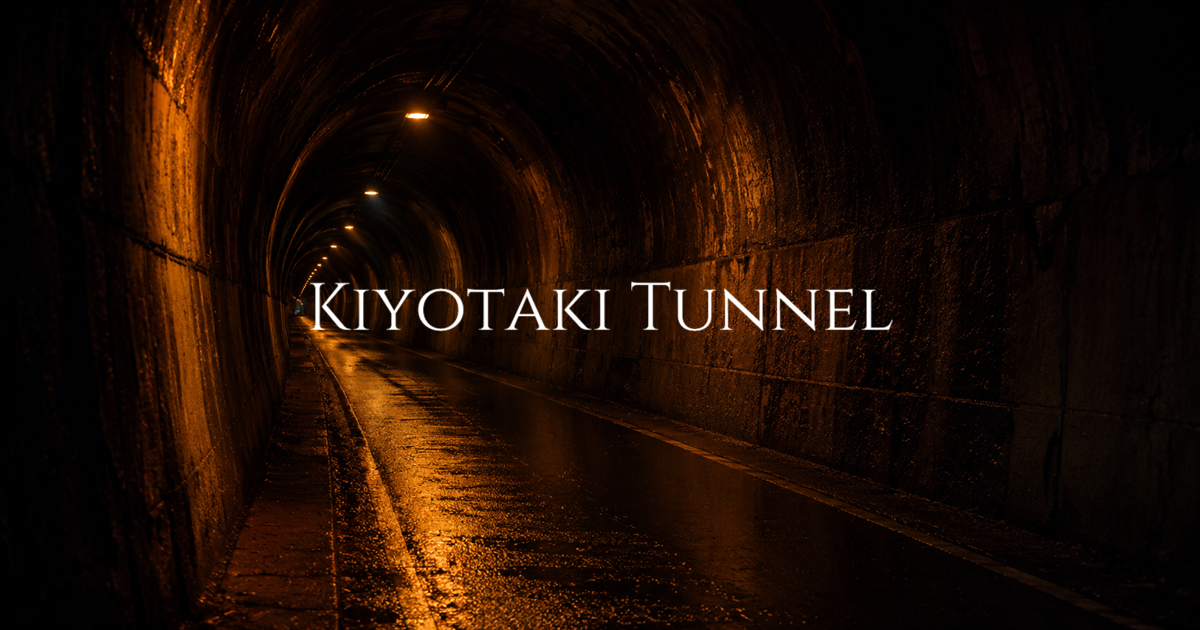
Kiyotaki Tunnel sits at Kyoto’s mountain edge, where ordinary roads begin to feel separated from the city they still belong to. Its reputation as a haunted place does not rest on a single fixed legend or a clearly preserved origin story. Instead, it has formed around the experience of passage itself: entering a narrow piece of infrastructure, losing sight of the surrounding landscape, and emerging into a place already shaped by rumor.
What makes Kiyotaki Tunnel culturally important is the way it unsettles the boundary between practical space and imagined space. It remains a functioning road, used for movement through the mountains, yet repeated stories and visits have given that movement another layer of meaning. The tunnel is not outside modern life. It is modern life briefly made strange by enclosure, expectation, and the feeling that ordinary direction has become interpretive.
For more stories like this, explore our Haunted Places in Japan collection.
A Functioning Road That Feels Like a Threshold
Kiyotaki Tunnel is a road tunnel on Kyoto’s western mountain edge, near the route toward Kiyotaki and the wider Arashiyama area. It is not an abandoned ruin, a sealed-off disaster site, or a location defined by one authoritative ghost story. It is ordinary infrastructure whose haunted reputation has developed through atmosphere, repeated visitation, and the expectation that certain passages are never only practical.
That distinction is essential to understanding Kiyotaki Tunnel. It is often grouped with other haunted tunnels in Japan, but its cultural logic does not depend on prohibition, restricted access, or a dramatic origin narrative. Kiyotaki matters because it demonstrates how a usable road can become difficult to experience as merely usable once rumor has settled into the space.
The tunnel’s physical setting helps explain why that transformation has endured. It stands away from central Kyoto’s more legible tourist geography, in a zone where roads narrow, slopes rise, and wooded terrain begins to change the scale of movement. Entering the tunnel removes the surrounding landscape from view. Sound becomes closer, visibility contracts, and the traveler is held for a short time inside a passage with only one clear direction.
Those conditions alone do not create a haunted place. Many tunnels produce enclosure, darkness, and echo without becoming culturally marked. Kiyotaki Tunnel became recognizable because its physical atmosphere entered a cycle of retelling. Visitors arrived with expectations, noticed the tunnel through those expectations, and then contributed their own impressions to its public identity. The reputation grew through the relationship between infrastructure, sensory experience, and repeated narration.
How Does Infrastructure Become Haunted Space?
A tunnel is built to solve a practical problem. It shortens distance, cuts through terrain, and allows movement where the landscape would otherwise slow or redirect the road. Yet the same structure also produces enclosure. Unlike a bridge, which carries the traveler across open space, a tunnel places the traveler inside the mechanism of passage itself.
Kiyotaki Tunnel draws much of its atmosphere from that contradiction. It belongs to modern infrastructure, but the experience of passing through it does not feel entirely neutral. The mountain is not erased simply because a road has been driven through it. The tunnel creates a narrow, controlled route through a setting that still feels apart from the city. The road promises ordinary access, while the enclosed space makes that access feel momentarily unstable.
This is why tunnels so easily become associated with haunted reputation. They give transition a physical form. There is an entrance, a period of confinement, and an exit that cannot be reached except by continuing forward. For a short time, the traveler is neither fully in the place they left nor fully in the place they are approaching. The structure is designed for movement, but it also suspends ordinary orientation.
Kiyotaki Tunnel does not need elaborate architecture to produce this effect. Its force comes from plainness: concrete, artificial light, narrow walls, and the absence of surrounding landscape. These features are familiar enough to seem ordinary, yet compressed enough to make perception sharpen. The traveler notices sound, distance, shadow, and direction in ways that open roads rarely require.
Modern infrastructure often carries an assumption of clarity. Roads are meant to organize space, signs are meant to reduce uncertainty, and tunnels are meant to make passage more efficient. Kiyotaki Tunnel becomes culturally meaningful precisely where that promise of clarity weakens. The structure remains useful, but usefulness no longer exhausts what the place seems to hold.
Kyoto’s Mountain Edge and the Feeling of Isolation
Kyoto is often imagined through continuity: temple precincts, ritual calendars, old streets, and forms of memory that appear carefully preserved. Kiyotaki Tunnel belongs to another part of that landscape. It sits near the city’s western edge, where the urban image of Kyoto thins into mountain roads, wooded slopes, and routes that feel less publicly legible.
This geography matters because haunted places often gather meaning at edges. The boundary here is not simply between city and nature. It is between mapped familiarity and reduced orientation. Central Kyoto offers names, landmarks, train lines, and cultural explanations. The approach toward Kiyotaki changes that rhythm. Roads narrow, curves interrupt sightlines, and darkness can make even a nearby place feel removed.
The tunnel intensifies this shift by enclosing the road at the moment when the landscape already feels less open. Entering it changes how the body reads space. Vision contracts. Sound comes closer. The outside world is postponed until the exit appears. Even from inside a car, the passage can feel oddly intimate because the tunnel limits choice while making forward movement more noticeable.
This is not the same isolation found in abandoned ruins or inaccessible locations. Kiyotaki Tunnel remains part of an ordinary route. Local drivers use it, visitors reach it without crossing into a forbidden zone, and the road continues to function as infrastructure. Its isolation is experiential rather than absolute: a brief separation produced by terrain, enclosure, and atmosphere.
That tension gives Kiyotaki much of its cultural weight. The place is close enough to Kyoto to be visited, filmed, ranked, and retold, yet distant enough in feeling to support the impression that something changes at the threshold. It shows how a haunted place does not need to stand outside everyday geography. Sometimes it appears where the ordinary map continues, but the experience of space begins to shift.
Local Memory and the Experience of Passage
Stories about Kiyotaki Tunnel do not settle into one definitive version. Some accounts describe a change in atmosphere. Others mention silence, echo, strange timing, or the feeling that the tunnel is different after dark. The details vary, but the variation is not a weakness in the reputation. It is part of how the place continues to function.
Modern haunted places often develop before their stories become stable. A location is named first; explanation comes later, and sometimes never arrives in a fixed form. People hear that Kiyotaki Tunnel is haunted, then visit not to verify a single narrative but to test whether the atmosphere corresponds to what they have already imagined. The site is experienced through expectation before it is interpreted through evidence.
The tunnel’s structure gives that expectation material to work with. Headlights move across the walls. Tires echo differently in enclosed space. Moisture, shadow, and passing vehicles can appear more pronounced than they would on an open road. None of these details require supernatural explanation. Their importance lies in how easily ordinary perception becomes marked once a place has been given a haunted name.
The social form of the visit reinforces this process. Many trips to reputed haunted locations happen in groups, often by car and often at night. People speak on the way there, fall quiet during the approach, respond to small details inside the space, and turn those responses into a story afterward. The experience is not produced by the tunnel alone. It is produced by the group’s anticipation, restraint, laughter, silence, and later retelling.
Kiyotaki Tunnel therefore works less like a fixed legend than a repeatable cultural script. The visitor approaches, enters, notices the atmosphere, interprets the body’s response, and carries the experience back into conversation or online circulation. The story survives because the script can be performed again without needing a final answer.
Digital Circulation and the Afterlife of Place
Kiyotaki Tunnel’s reputation has been strengthened by digital circulation, where haunted places are listed, filmed, mapped, compared, and revisited through personal accounts. Earlier forms of rumor depended more heavily on local conversation, magazines, television programs, or direct transmission between acquaintances. Online platforms allow a specific location to become recognizable before most people have any physical relationship with it.
This changes the order of experience. A visitor may first encounter Kiyotaki Tunnel as a search result, a video thumbnail, a ranking entry, or a comment thread. By the time the person arrives, the tunnel has already been framed as a place to be watched closely. The physical site is no longer approached as neutral infrastructure. It is approached as a location whose atmosphere has already been described by others.
Digital repetition also favors suspense without resolution. Many videos and accounts follow a familiar sequence: the road, the approach, the entrance, the passage, the reaction, and the exit. Often nothing definite occurs. Yet the lack of resolution does not weaken the site’s reputation, because the format depends on anticipation more than conclusion. Each version preserves the possibility that the next visit might register something clearer.
Kiyotaki Tunnel is especially suited to this mediated form because its visual grammar is easy to understand. A narrow road, a darkened entrance, artificial light, and a disappearing line of sight all translate quickly into images and video. The tunnel does not require elaborate explanation to be legible as a threshold. Its meaning can be recognized almost immediately, even by viewers who know little about the surrounding geography.
At the same time, digital circulation does not simply invent the atmosphere from nothing. It amplifies qualities already present in the site: enclosure, separation, darkness, repetition, and passage. Kiyotaki Tunnel continues to matter because physical space and mediated expectation reinforce each other. The tunnel is visited because it is already known, and it becomes better known because people continue to visit.
Why an Open Route Still Resists Neutrality
Kiyotaki Tunnel persists because its reputation does not depend on a settled origin story. Some haunted locations are organized around a named incident, a specific prohibition, or a narrative of danger attached to restricted access. Kiyotaki works differently. Its reputation remains flexible because the tunnel offers an atmosphere that can receive many accounts without being reduced to one explanation.
Its ordinariness is central to that durability. A dramatic ruin can become visually fixed, and a famous historical site can become enclosed by its own explanation. Kiyotaki Tunnel stays close to daily life. It resembles other tunnels, other mountain roads, and other pieces of infrastructure that people may pass through without thinking. That resemblance makes the haunted reputation more unsettling, because it places uncertainty inside an ordinary route rather than outside it.
The tunnel also carries an older symbolic pattern in a modern form. Japanese narratives often give weight to places between categories: mountain paths, bridges, riverbanks, shorelines, village edges. Kiyotaki Tunnel belongs to that family of boundary spaces, but its materials are contemporary. Concrete walls, road markings, headlights, and traffic replace older imagery without removing the underlying structure of passage.
This is where its distinction from other haunted tunnels becomes clearest. Kiyotaki is not primarily a story about forbidden entry or inaccessible terrain. It is a story about a place that remains open, usable, and still difficult to experience as neutral. The tunnel’s cultural force lies in the transformation of access into ambiguity — not in spite of its ordinary function, but because of it.
People continue to visit because the site offers a controlled encounter with uncertainty. It is close enough to reach, ordinary enough to enter, and charged enough to interpret. The experience can be shared without being resolved, which allows Kiyotaki Tunnel to continue circulating as one of Kyoto’s haunted spaces.
Conclusion
Kiyotaki Tunnel shows how a modern structure can become haunted without separating itself from ordinary life. It is not defined by ruin, ritual prohibition, or a single dominant story. Its meaning gathers where infrastructure, landscape, rumor, and expectation meet inside a narrow passage at Kyoto’s mountain edge.
The tunnel was built for movement, but its reputation turns movement into attention. Entering it briefly removes the traveler from open space and places the body inside a structure where sound, light, direction, and anticipation become more noticeable. The experience is physically simple, yet the cultural frame around it gives that simplicity weight.
What lingers around Kiyotaki Tunnel is not certainty about what occurred there, but the sense that some spaces become more than their function. A road can remain a road and still gather stories. A tunnel can continue to carry traffic while also holding the unease of passage, repetition, and the momentary feeling that the city has withdrawn.
Related Articles
- Inunaki Tunnel — A tunnel landscape where the social construction of haunted space through rumor and collective exclusion defines how inaccessible infrastructure acquires meaning.
- Aokigahara Forest — A forest landscape where silence, disorientation, and accumulated memory create a different model of haunted space through sensory subtraction rather than passage.
- Mount Osore — A boundary landscape where geography, mourning, and ritual imagination give physical form to the nearness of death.
Sources and Further Reading
The following sources provide academic perspectives on contemporary legend, haunted experience, digital folklore, and the cultural interpretation of modern passage spaces.
- Bennett, Gillian, and Paul Smith, editors. Contemporary Legend: A Reader. Garland, 1996.
- Goldstein, Diane E., Sylvia Ann Grider, and Jeannie Banks Thomas. Haunting Experiences: Ghosts in Contemporary Folklore. Utah State University Press, 2007.
- Dégh, Linda. Legend and Belief: Dialectics of a Folklore Genre. Indiana University Press, 2001.
- Blank, Trevor J., editor. Folklore and the Internet: Vernacular Expression in a Digital World. Utah State University Press, 2009.
- Augé, Marc. Non-Places: Introduction to an Anthropology of Supermodernity. Verso, 1995.
Author’s Note
Tunnels produce a specific kind of thinking that is not quite fear. The calculation arrives without drama: if the structure failed, there would be no time to understand it. The same thought sometimes crosses my mind on a long flight — not as dread, but as an acknowledgment of physics, noted and set aside. What stays longer is simpler: the wish to be through, the slight pressure of enclosed space, and the moment when the exit finally appears in the windscreen.