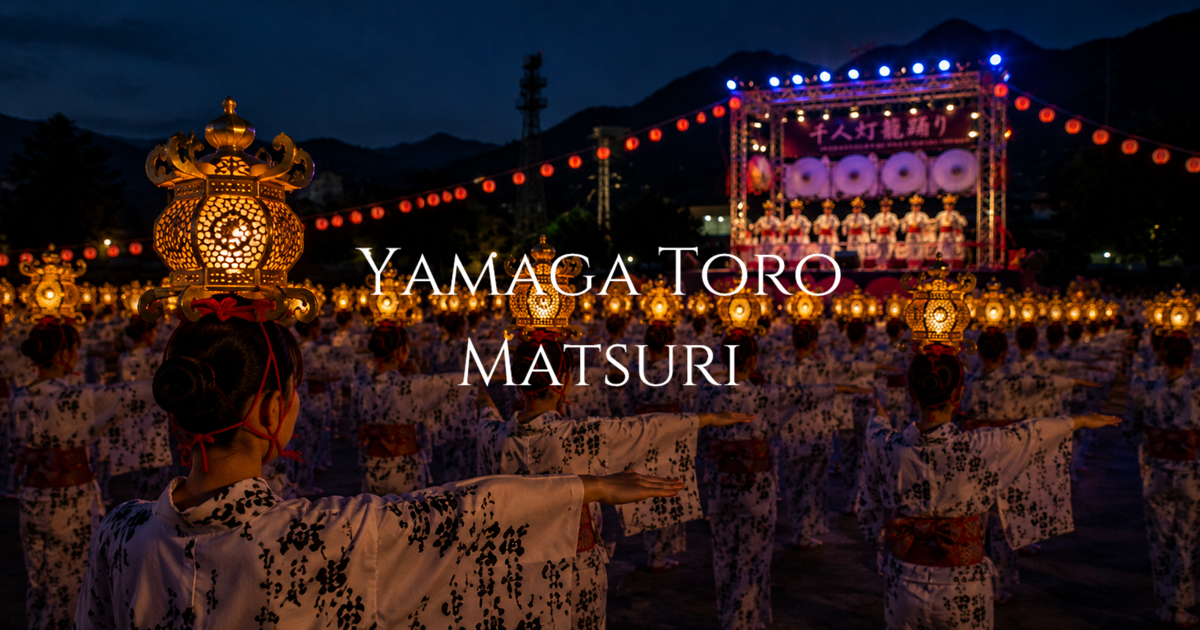
Yamaga Toro Matsuri is often remembered as a single image: rows of paper lanterns drifting above dancers through summer darkness. The more durable fact of the festival, though, is not the lanterns themselves but what their light does to perception. Streets that are crossed in seconds on an ordinary evening begin to feel longer. Distance stops being measured by convenience and starts being measured by pace. For a few hours, a working town in Kumamoto is read through rhythm and shared attention rather than through traffic and destination.
That shift depends on restraint rather than spectacle. The lanterns are dim by design, and the dancers carrying them do not perform as individuals competing for notice. Soft light, repeated movement, and careful spacing pull bodies, buildings, and darkness into a shared order that exists only while it is being actively maintained. Light does not make the town more visible so much as it changes the terms on which the town is seen.
For more stories like this, explore our Strange Festivals & Rituals collection.
The Discipline Behind Yamaga’s Weightless Lanterns
Yamaga Toro Matsuri is a summer festival in Yamaga, Kumamoto Prefecture, built around a nighttime procession in which women balance illuminated paper lanterns on their heads while moving through synchronized dance formations. What distinguishes it from other lantern-centered festivals elsewhere in Japan is not the presence of light but the specific discipline the ritual demands: fragile, architecturally shaped lanterns kept upright entirely through the dancers’ controlled movement, with no support beyond balance itself.
The dancers advance, turn, and pause with almost no visible correction, which allows the lanterns to appear detached from the bodies beneath them. That impression of weightlessness is deceptive. Each lantern stays level only because its dancer continuously adjusts to the pace of the women around her. A single performer can hold her own balance; the festival’s visual order only appears once dozens of individual corrections align into one continuous movement.
The lanterns are built from washi paper and glue, without metal fittings, shaped into miniature reproductions of shrines, gate towers, and domestic buildings. They read as small architecture, but their strength comes from surfaces thin enough to be lifted on a human head. This is the tension the festival is organized around: forms that look permanent, made from material that tears under careless handling.
The choreography does not resolve that tension by protecting the lanterns. It exposes them. Rather than keeping the objects still, the dance places fragile paper structures directly into motion, spacing, and darkness, so that vulnerability becomes visible rather than hidden.
Light as Guidance and Hospitality
Local tradition ties the festival to a story about Emperor Keikō, whose party was said to be lost in dense fog until villagers came out carrying torches to guide them through. The story’s cultural weight has little to do with whether the events occurred exactly as told. It lies in what the story assumes light is for: not to dispel darkness, but to make a group visible enough that another group can find its way through it.
That relational quality survives into the modern procession, even though the specific circumstances have long since changed. The lanterns no longer lead an imperial party through fog. What they still do is establish lines and intervals that an eye can follow through an otherwise unfamiliar arrangement of a familiar street. Guidance, in this sense, is less a memory being reenacted than a structural habit that has outlasted its original occasion.
The procession also reorganizes who is oriented toward whom. Dancers calibrate their pace against each other; spectators turn to follow one moving field of light rather than the usual scatter of shopfronts and signage. Streets that are normally used for private errands become shared routes, and hospitality is expressed less through greeting than through spatial preparation: traffic is cleared, ordinary lighting is allowed to recede, and the town makes physical room for a different pattern of movement.
Lanterns recur throughout Japanese summer observance as markers of passage, gathering, and remembrance, though their specific meaning shifts by context. At Yamaga, the lantern is not tied to one fixed symbolic reading. It functions instead as a structure that brings bodies, streets, and attention into temporary alignment, regardless of what any individual viewer takes it to mean.
Paper Architecture and the Discipline of Balance
The Yamaga lantern sits at an unusual point between precision and fragility. Washi paper is cut, folded, and glued into detailed three-dimensional forms modeled on shrines, gates, and traditional buildings, producing an object that reads as solid architecture while depending entirely on thin surfaces and careful joints for its shape. The craft does not reproduce a building’s weight. It reduces architecture to outline, proportion, and surface, translating walls into planes of paper and windows into openings for light.
Once lit from within, the lantern becomes harder to read as a single solid object. Light passes through the paper as much as it reflects off it, blurring the line between the structure’s interior and its exterior, so that the form looks fully present and slightly insubstantial at once.
Carried above a dancer’s head, this small architecture takes on a different scale. It is visually dominant but physically dependent on a body that must not assert itself too strongly. Control here is not demonstrated by overpowering the lantern’s weight; it is demonstrated by the absence of unnecessary force. A sudden correction or a visibly effortful adjustment breaks the composure the dance is built to display.
Balance is not only a private skill, held by one dancer alone. Each woman regulates her own posture while staying attentive to the formation moving around her, so that stability is produced vertically, through control of the lantern, and horizontally, through spacing and shared timing with her neighbors. This is why the dance resists being understood as a sequence of individual performances. Skill becomes visible precisely at the point where it stops drawing attention to itself and folds into the collective rhythm instead.
When Streets Become Ceremonial Space
Public streets ordinarily organize practical movement, interpreted through speed, access, and destination. During Yamaga Toro Matsuri, the streets themselves are not altered, but the conditions under which they are perceived shift deliberately. Traffic is restricted, spectators gather along set routes, and ordinary illumination recedes behind the procession’s own light, so that a street remains recognizably part of the town while its usual function is temporarily set aside.
The first change is one of tempo. A route normally crossed without thought becomes a space traversed slowly, where progress is measured by cadence rather than efficiency, and pausing carries as much weight as advancing. The second is a change of what draws the eye. Daily attention on a street is dispersed among signage, vehicles, and storefronts; during the procession, it is drawn instead toward repeated points of light and the intervals between them, so the town becomes legible through rhythm rather than through landmark.
Darkness is what makes this reorganization possible. The lanterns do not illuminate every surface equally, and buildings, road edges, and spectators drift in and out of visibility as the procession moves past. What results is a more selective field of attention: nothing is entirely cut off from ordinary life, but not everything remains equally present at once. Shops and intersections stay in the background while the lanterns determine, for the length of the procession, what the eye is asked to prioritize.
This produced space is neither fully sacred nor purely theatrical, and it has no fixed boundary. It depends on the town’s existing infrastructure and disappears once the procession ends, because it was never located in the street itself. It exists through coordinated behavior — pace, visibility, and the willingness of both performers and spectators to inhabit a familiar route differently for a set number of hours.
Rhythm, Tourism, and the Limits of the Image
Photographs of Yamaga Toro Matsuri tend to emphasize symmetry: repeated lanterns forming lines and circles, dancers appearing unified beneath them, the whole scene reading almost as a still composition rather than an event unfolding over time. The procession itself is never actually still. Its order is produced through continuous, largely invisible adjustment — walking, turning, holding distance, correcting pace against a neighbor — that a finished photograph compresses into apparent harmony.
The choreographed procession itself is a comparatively recent invention, first devised in 1957 by the city government, tourism board, and a local women’s association as a way to draw visitors to the older lantern tradition — which makes its dependence on photographic circulation less an external pressure than a condition built into the form from the start.
That gap matters because the festival now circulates primarily through tourism promotion, television segments, and short-form digital media, formats that communicate the lanterns’ visual appeal efficiently while separating the finished image from the duration required to produce it. A photograph can preserve the lantern’s illuminated form, but it cannot reproduce the gradual slowing of the town as daylight fades, or the way repeated gestures accumulate into a shared tempo over the course of an hour.
Aerial footage introduces a different kind of distance, turning dancers into elements of a geometric pattern and making the event easier to grasp as one complete visual arrangement. At street level, by contrast, perception stays partial: spectators see nearby dancers, lanterns entering and leaving their field of view, and fragments of a formation too large to take in from any single position. That partiality is not a limitation of the event so much as part of its intended effect — it asks those present to sense an order larger than what any one viewpoint can hold, recognized through repetition rather than possessed as an image.
Tourism nonetheless sustains the festival’s contemporary visibility, bringing visitors and regional recognition, and the lantern has become an emblem of Yamaga across exhibitions and civic design. The more useful distinction is not whether this exposure makes the festival authentic, but which elements of it travel easily and which do not. The lantern’s form circulates well in a photograph or a tourism poster. The slow reorganization of attention that gives the lantern its meaning does not.
Repetition, Craft, and Regional Continuity
A festival organized around fragile objects cannot be sustained through preservation alone. Lanterns require repair or remaking each year, dancers rehearse the formation anew, and routes are prepared again from scratch, which means the festival’s continuity is not stored in any single finished object but produced repeatedly through labor.
Lantern making sits at the center of that labor. The craft depends on cutting, folding, and proportion, but also on judgment that resists being written down — how washi paper responds to humidity, how much pressure a joint can hold before it fails — knowledge that survives mainly because it keeps passing through practiced hands rather than through instruction alone. The dance carries a parallel kind of continuity: choreography can be documented on paper, but the timing that keeps a formation intact, and the precise relation between one dancer’s gesture and her neighbor’s pace, has to be relearned through repetition with other bodies each season.
This makes the festival’s persistence as much social as technical. Craftspeople, performers, neighborhood associations, and civic volunteers sustain an event whose public appearance occupies only a single night of the year, while the relationships required to produce that night extend well beyond it. Yamaga Toro Matsuri functions as regional identity through this ongoing participation rather than through any inherited artifact or fixed historical site — the town represents itself less by what it has kept than by what it keeps redoing.
That process has to accommodate change as much as continuity. Demographic pressure, shifting patterns of work, and the festival’s own circulation through tourism and digital media all shape the conditions under which it continues, and none of these pressures can simply be refused. What cannot be preserved through outward appearance alone is its internal pace — the measured relationship among lantern, body, and street that no amount of photographic circulation can substitute for. Visitors may encounter Yamaga first through a promotional image, but the event itself still has to be rebuilt every year through craftsmanship, rehearsal, and darkness.
Conclusion
Yamaga Toro Matsuri makes a case that ritual space does not require permanent boundaries or monumental architecture to exist. It can be produced through a temporary, renewable agreement about how to move, where to look, and what to allow to recede from view.
The lanterns change the town not because they illuminate it but because they redistribute what is visible and what is not, and how one body is positioned in relation to another for the length of a night. Darkness is not removed from the street; it is given a structure to move through.
That structure depends on refusal as much as on light — the refusal of brightness, of individual display, of anything that would interrupt the collective spacing the dance is built on. When ordinary traffic returns, the ceremonial order it created disappears from view. What the town retains is not that single transformed night but the capacity to produce it again, provided the same alignment of light, movement, and attention is rebuilt from the ground up each year.
Related Articles
- Yamaboko Junko — Kyoto’s monumental floats organize an entire city through scale and civic procession, where Yamaga works through miniature paper architecture carried on a single body.
- Oniyo Fire Festival — Large torches place danger and controlled fire handling at the center of purification, a contrast to Yamaga’s emphasis on restraint and fragility.
- Owara Kaze no Bon — Obscured faces and slow, repeated music reshape Yatsuo’s streets through concealment rather than the illuminated visibility that defines Yamaga’s procession.
Sources and Further Reading
The following works provide anthropological grounding in Japanese festival structure, ritual space, and the everyday religious practices that shape events like Yamaga Toro Matsuri.
- Ashkenazi, Michael. Matsuri: Festivals of a Japanese Town. University of Hawai’i Press, 1993.
- Nelson, John K. A Year in the Life of a Shinto Shrine. University of Washington Press, 1996.
- Plutschow, Herbert. Matsuri: The Festivals of Japan. Routledge, 1996.
- Reader, Ian, and George J. Tanabe Jr. Practically Religious: Worldly Benefits and the Common Religion of Japan. University of Hawai’i Press, 1998.
Author’s Note
I’ve always thought of the lanterns as the ones casting their spell over Yamaga, and when I watched the footage again on my laptop one evening, that still felt mostly true. But this time I found myself noticing the music underneath—less creating the atmosphere than quietly drawing it out, as if giving the light something to lean on.