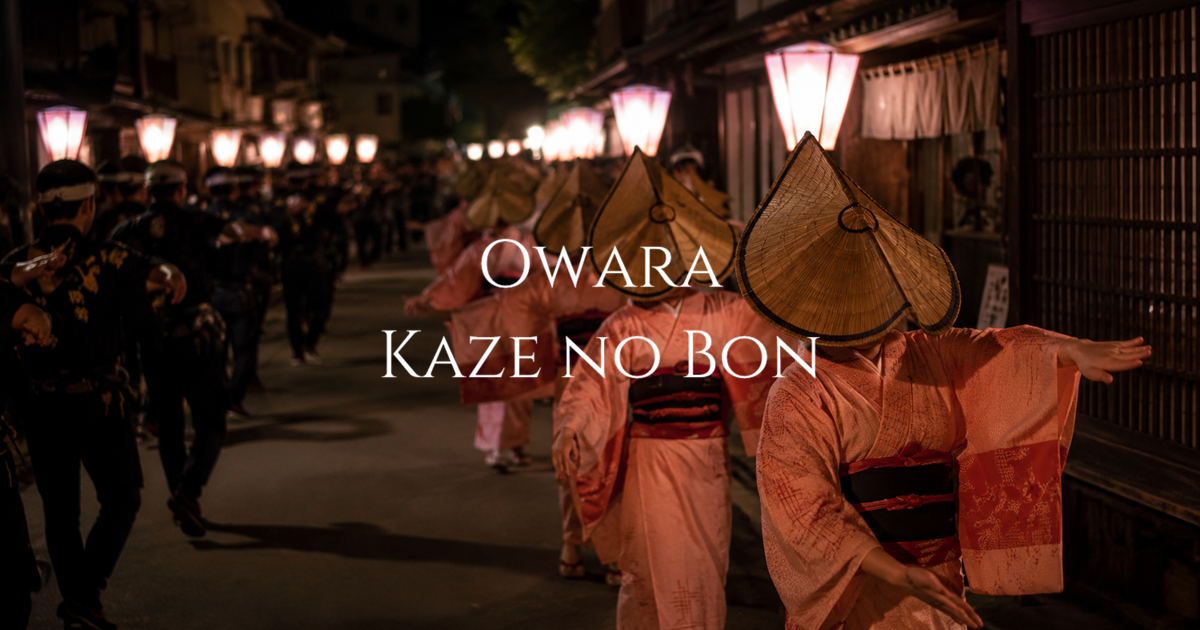
Owara Kaze no Bon takes place at a threshold where summer has not fully withdrawn and autumn has not yet arrived. For three nights each September, dancers move through the sloping streets of Yatsuo beneath woven hats, accompanied by voices, shamisen, drums, and the bowed kokyū. The festival is often remembered for the elegance of this scene, but its deeper logic lies elsewhere: repeated, unhurried movement lets a community inhabit seasonal change rather than simply watch it pass.
The dance does not preserve summer or announce autumn with any finality. It gives temporary shape to the interval between the two, and in doing so turns wind, music, familiar streets, and inherited gesture into a shared method for carrying memory forward, even as the festival quietly accepts that neither season nor community returns unchanged.
For more stories like this, explore our Strange Festivals & Rituals collection.
Owara and the Structure of Dispersal
Owara Kaze no Bon is a three-night festival held from September 1 to 3 in the Yatsuo district of Toyama City, where neighborhood groups perform local song and dance through the town after dark. What separates it from a staged folk performance is not costume or music alone but the way seasonal anxiety, neighborhood continuity, and the physical terrain of Yatsuo are folded into a single recurring structure, one that treats the arrival of autumn as something to be enacted rather than announced. That structure is also what distinguishes Owara from festivals built around a single communal climax: here, meaning accumulates through dispersal, not convergence.
Its best-known form is the machi-nagashi, in which dancers and musicians move through the streets rather than gathering on a stage. Men and women perform distinct choreographic patterns, and the deeply angled amigasa hats worn by many dancers partially conceal their faces. The music centers on Etchū Owara Bushi, carried by shamisen, taiko, and the bowed kokyū, whose sustained, wavering tone gives the whole performance a restrained, unsettled character.
The street itself is the festival’s defining space. Groups appear at different hours in different districts, and waiting becomes part of the experience: a road stands empty, then slowly fills with sound before the dancers come into view, then falls quiet again as the procession moves toward another part of town.
This dispersed structure keeps the event from organizing itself around one climactic scene. No single appearance contains the whole festival, and no spectator occupies a position from which everything can be seen. Owara is encountered in fragments — a melody rounding a corner before its source appears, a hand turning beneath the brim of a hat, a procession receding up a slope.
That fragmentation mirrors the transition the ritual is built to hold. Autumn does not arrive at one identifiable moment; it becomes perceptible through small shifts in wind, light, sound, and bodily sensation. Owara gives those gradual changes a social rhythm, letting the community move through seasonal transition together instead of reducing it to a date on a calendar.
Wind at the Edge of Harvest
The word kaze places wind at the center of the festival’s identity. Early September falls close to the rice harvest, and it has also long been associated with destructive storms. For an agricultural community, wind was never simply a marker of the season changing. It belonged to the same unstable conditions under which a year’s labor could be secured or lost within a single night.
Owara Kaze no Bon is often linked to prayers that damaging winds would pass without harming the crop. This does not mean every element of the present festival descends unchanged from one agricultural rite; its current form developed through overlapping layers of local song, dance, neighborhood organization, and public performance. Even so, the relationship between seasonal wind and human vulnerability continues to give the event its underlying direction.
Wind cannot be seen, yet its effects are immediate. It bends the rice plants, shifts the temperature, carries sound across the valley, and announces weather before the weather fully arrives. A ritual built around wind responds to something that can be felt without ever being held. The community cannot command it — only acknowledge its presence and set a shared rhythm alongside it.
The dancers do not imitate wind. Their measured movements construct a human order next to a force that remains outside anyone’s control, and repetition gives that uncertainty a form without pretending to master it.
This is part of why the festival avoids any sense of triumph. Owara’s restraint does not stage victory over the conditions being addressed; it lets the seasonal world keep its independence. The dance recognizes that harvest has never rested on labor alone, but also on weather, timing, and circumstances no community can fully govern.
Modern forecasting and infrastructure have changed the practical relationship between agriculture and weather, but they have not erased the older memory of exposure. That memory survives not as fixed doctrine but as timing, sound, and bodily discipline — repeated each September by a community shaped by the knowledge that seasonal change can sustain a year and threaten it in equal measure.
Slow Dance as Seasonal Time
Festival dance is often associated with release or the temporary suspension of ordinary restraint. Owara Kaze no Bon works through a different temporal logic. Its movements are slow, measured, and sustained, letting the body register transition without pushing it toward any climax.
At this pace, repetition never dissolves into momentum. Each turn of the wrist, shift of balance, and measured step stays visible long enough to be noticed. The choreography returns to familiar patterns, but small differences in posture, spacing, street width, and musical phrasing keep one passage from becoming an exact copy of the next.
This is how the festival carries memory forward. The past is not preserved only through stories told about earlier performances — it is transmitted through bodily timing itself: when to step, how long to hold a position, where a phrase bends, when movement settles back into rhythm. Dancers and musicians inherit duration as much as choreography.
The festival’s annual recurrence gives that embodied memory a wider frame. Owara is not performed once and fixed as a finished form. It returns at the same point in the seasonal cycle, received by different bodies, voices, weather, and audiences each time, so that continuity depends on repetition without exact duplication.
Its placement in early September sharpens this effect. Summer has not disappeared. Heat can still linger, cicadas may still be heard, daylight may still feel strong — yet the evening air, the insect sounds, and the shortening days already signal that the season has crossed an internal boundary.
The festival does not resolve that overlap by declaring autumn’s arrival. It stays inside the uncertainty between persistence and departure. The music is often called melancholic, but the feeling is not simple sadness; it comes from sensing that a season is still present even as it has already begun to belong to memory.
The slow dance does more than suit that atmosphere — it produces it. By refusing haste, Owara gives seasonal transition enough duration to become a shared experience rather than background change.
Concealed Faces and Collective Memory
The amigasa worn by many dancers narrows the visible field of the face; depending on its angle, the hat can conceal the eyes almost completely. This has become one of Owara’s most recognizable visual features, but its role reaches beyond appearance.
A partially hidden face limits the immediacy of individual expression. Spectators cannot easily read a smile, strain, or direct reaction in each dancer’s features. Attention shifts instead to posture, hands, costume, spacing, and the relation between one body and the group — the dancer stays visible, but personality no longer governs the image.
This partial anonymity supports the festival’s communal structure. Owara is sustained through neighborhood organizations, each carrying its own responsibilities, styles, and inherited practices. Individual skill matters, but the performance does not isolate exceptional dancers from the collective form; what carries forward is a shared discipline learned and repeated across generations, not one person’s expression of it.
The hats also produce a distinctive relation between nearness and distance. Dancers may pass within arm’s reach of spectators, yet their faces stay partly withheld — physically present without becoming fully available to the gaze watching them.
That distance matters for an event increasingly encountered through photography and travel media. Lanterns, old streets, and concealed dancers can easily flatten into a familiar image of regional Japan. The lowered hats complicate that consumption: they offer a memorable form while withholding the facial intimacy most images are built to capture.
Collective memory works through a similar balance of presence and absence. Communities do not preserve every person, moment, or explanation. They retain selected songs, movements, dates, routes, and responsibilities, while other experiences fade beyond recovery — what survives is not a complete record of the past but a form that can be entered again.
The concealed face gives this structure a visible shape. Present dancers occupy positions once held by others without impersonating them; their identities are neither erased nor made central. Each becomes a temporary bearer of a rhythm that preceded them and may continue after them.
The festival’s melancholy emerges partly from this uneven relationship with time. The dance returns; the people performing it change. Continuity does not prevent loss — it gives loss a recurring form, one in which the absent remain neither fully present nor entirely gone.
Yatsuo as a Calendar of Place
Owara Kaze no Bon cannot be separated from the geography of Yatsuo. The town rises along sloping roads lined with narrow streets, wooden façades, and shifts in elevation that continually shape what can be heard and seen. The festival does not occupy a neutral performance space; it moves through a lived environment whose physical limits set its pace.
The slopes slow both dancers and spectators. Corners interrupt sightlines. Buildings contain and redirect sound, so a song may be audible before its source appears, while another group disappears from view yet stays present through music descending from a higher street. The town creates layers of nearness and distance that no open venue could reproduce.
These spatial effects turn Yatsuo itself into a seasonal calendar. The festival’s dates are fixed, but its return is also registered through changes within the town — lanterns prepared, costumes brought out, instruments heard in rehearsal, routes anticipated, neighborhood responsibilities resumed. The season becomes attached to streets and houses rather than existing only as an abstract division of the year.
For residents, memory may therefore be spatial before it is historical. A particular slope recalls waiting for a procession. A doorway holds the memory of relatives who once watched from there. A street corner becomes tied to the moment the kokyū first came into hearing. Such memories need no formal commemoration to endure; the festival reactivates them through repeated use of the same ground.
The neighborhood structure preserves difference within the larger community. Local groups do not reproduce one uniform performance — variations in costume, music, movement, and responsibility let each district recognize itself while still taking part in the same event. Collective memory is sustained through these smaller units rather than imposed as a single identity.
This becomes especially important as regional communities face demographic change. Buildings can be restored and streets promoted as heritage, but physical preservation alone cannot sustain the relationships that give a place its social continuity. A town remains culturally inhabited only when people still know who teaches, rehearses, prepares, performs, watches, and takes responsibility for the next recurrence.
The festival’s calm surface depends on labor that visitors may never see: musical training, costume care, route coordination, rehearsal, negotiation between neighborhoods. Owara’s restraint is not the absence of effort — it is the visible result of a community repeatedly aligning itself with the same streets at the same point in the year.
Tourism, Continuity, and the Difficulty of Slowness
Owara Kaze no Bon now draws visitors from far beyond Yatsuo. Its nighttime setting, distinctive music, and concealed dancers have made it one of Japan’s most visually recognizable regional festivals. This attention supports local visibility and economic activity, but it also changes the conditions under which the ritual is encountered.
Tourism tends to favor schedules, managed viewing, crowd control, and performances available at predictable times. These arrangements help visitors unfamiliar with the town, but they can also direct attention toward what can be presented clearly and consumed efficiently. A ritual dispersed across narrow streets, uncertain waiting periods, and partial views resists that kind of packaging.
Some of Owara’s most important qualities are precisely the ones that resist it. Silence cannot be scheduled the way choreography can. The approach of music from another street may carry more weight than the moment dancers finally come into full view, but that experience cannot be guaranteed from a fixed vantage point — a procession glimpsed briefly and imperfectly may stay longer in memory than a complete staged performance ever could.
The festival therefore sits inside a tension between visibility and continuity. Public recognition helps sustain it, but an emphasis on visual beauty risks detaching the dance from seasonal anxiety, neighborhood labor, and inherited musical relationships. The image survives; the structure beneath it becomes easier to overlook.
Owara should not be treated as an untouched survival outside modern life. Its present form includes adaptation, media circulation, public presentation, and changing expectations among residents and visitors alike. Tradition here is not the absence of change but an ongoing judgment over what may change without dissolving the local relationships that make the festival possible in the first place.
Slowness plays a central role in that negotiation, but what resists packaging most is not pace alone — it is the same dispersal that defines the festival’s ritual structure. Owara does not fix where a performance begins, lets sound arrive before its source, withholds any vantage from which the whole event can be seen, and turns waiting itself into part of the encounter. A visitor hoping to see everything runs against the festival’s own logic rather than against slowness in the abstract.
That resistance gives Owara a particular relevance now, when attention is more often organized around completeness — seeing all of something, missing nothing. The festival offers no full escape from that expectation, but its structure quietly refuses it, asking the viewer to accept a transition encountered only in fragments, on terms the festival sets rather than the viewer.
Conclusion
Owara Kaze no Bon gives seasonal change a human pace without claiming that time can be held still. Wind stays beyond anyone’s control, summer keeps receding, and communal memory cannot preserve every person or every moment. The festival answers by placing those losses inside movements that can be learned, repeated, and handed forward.
Its melancholy is not the feeling of a vanished past. It comes from letting past and present share the same streets without forcing them into sameness — each dancer enters an inherited rhythm, carries it briefly, and leaves it open for another body to take up.
When Owara returns each September, Yatsuo does more than repeat a familiar festival. For three nights, it opens a narrow interval in which seasonal change can be recognized as something shared, embodied, and still in motion.
Related Articles
- Onbashira Festival — Massive felled timbers and a near-vertical descent turn cyclical shrine renewal into a public trial of coordinated risk, a far more physically confrontational form of communal continuity than Owara’s measured street procession.
- Hadaka Matsuri — Dense, near-naked physical contact makes purification visible through bodily exposure, contrasting with Owara’s concealment of the face as its central ritual gesture.
- Kanamara Matsuri — Fertility symbols move through public procession to carry private hopes about health and birth, a ritual logic built around explicit display rather than the withheld, partially hidden presence at the center of Owara.
Sources and Further Reading
These works provide broader frameworks for understanding Japanese festival organization, the relationship between local religious practice and community life, and the ways regional communities sustain seasonal continuity through recurring ritual.
- Ashkenazi, Michael. Matsuri: Festivals of a Japanese Town. University of Hawai’i Press, 1993.
- Reader, Ian, and George J. Tanabe Jr. Practically Religious: Worldly Benefits and the Common Religion of Japan. University of Hawai’i Press, 1998.
- Reader, Ian. Religion in Contemporary Japan. University of Hawai’i Press, 1991.
Author’s Note
The clearest sign of the season turning was never the calendar—it was the frogs. On the bus from campus to the station, cutting through the rice fields at night, there was a week each year when their chorus gave way to crickets, though the air itself had not cooled at all. It felt as though the sounds outside had noticed the season changing before my body had.