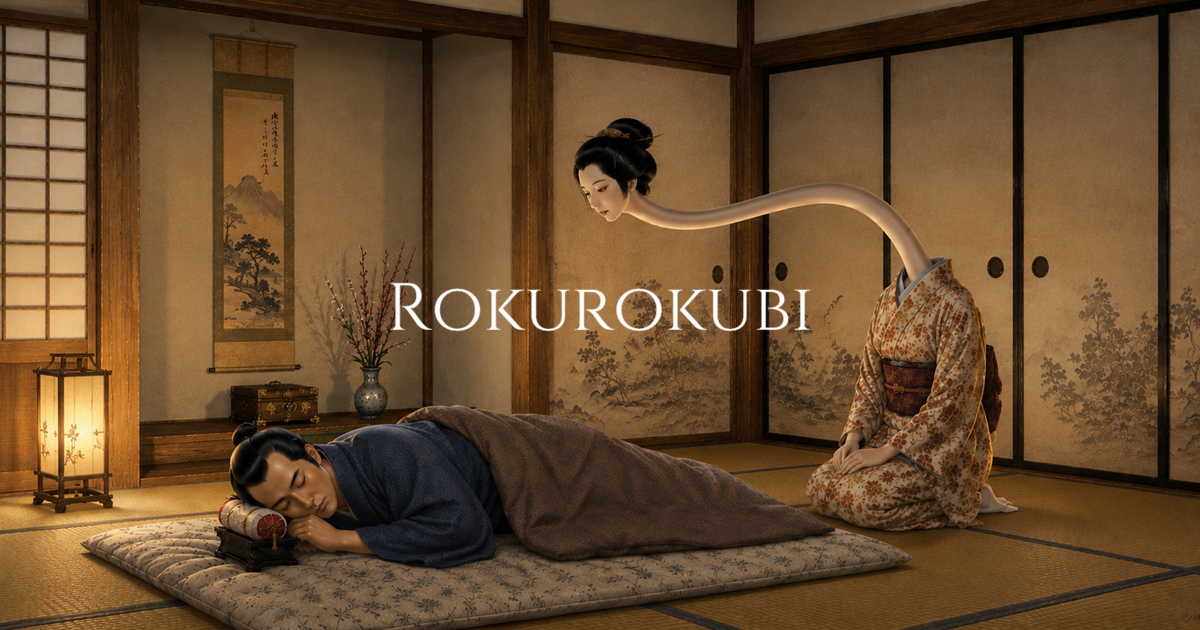
Rokurokubi rarely begin as strangers. Before the neck stretches, before the room turns strange, the figure is already known: a wife preparing a meal, an innkeeper closing up for the night, someone whose ordinary presence has never invited a second look. The transformation, when it comes, does not arrive from a forest path or a shrine boundary. It surfaces from inside the house, after the household has gone quiet, when the body is no longer being held in its daytime shape.
That proximity is what gives the figure its particular unease. A Rokurokubi’s neck extending across a darkened room is not primarily a display of supernatural power. It is a sign that the ordinary — a home, a sleeping body, a person already known — may carry a fracture that ordinary recognition cannot account for.
For more stories like this, explore our Yokai & Supernatural Folklore collection.
What Is a Rokurokubi?
A Rokurokubi is a figure from Japanese yōkai tradition usually described through a neck that stretches to unnatural length during the night, though some regional variants describe a head that detaches from the body entirely while the sleeper remains unaware. What separates Rokurokubi from a fox or tanuki is not the presence of transformation but its location: where kitsune and tanuki reveal otherness through disguise, performance, or outward social play, Rokurokubi disclose it through a partial fracture inside the domestic body itself, with no audience and no intended display.
This distinction shapes nearly everything about how the figure functions. Rokurokubi narratives are rarely stories of deliberate deception. The person at the center may live as a wife, a servant, an innkeeper — any ordinary member of a household, indistinguishable by day. The transformation becomes visible only under specific conditions: sleep, darkness, privacy, or the misdirected glance of someone who was never meant to see.
The stretched neck itself is visually economical but culturally precise. It does not swap the human body for another form, the way a full animal transformation would. It takes one recognizable part of the body and extends it past what proportion allows. What results is not metamorphosis so much as distortion — the human figure stays present, but the internal logic that once held it together has come loose.
This is what makes Rokurokubi difficult to place cleanly within yōkai tradition. They are not distant. They do not live at the edge of the human world; they live inside it, sharing a room, a meal, a routine. Their stories work by holding intimacy and unknowability together at once — by suggesting that someone already familiar may still contain a part of themselves that ordinary recognition simply cannot reach.
Edo-Period Yōkai Culture and the Night Interior
Rokurokubi gained wide visibility during the Edo period, when yōkai moved through illustrated books, printed tale collections, and an expanding urban print culture. Strange beings during this period were not confined to local rumor. They became images — namable, drawable, exchangeable across regions, genres, and audiences.
Within that print culture, the neck-stretching figure carried strong visual clarity. A long neck required no elaborate plot; it communicated distortion at a glance, simple enough for illustration and yet open enough to hold several meanings simultaneously. Viewers did not need explanation to register that a body had gone past its proper limit.
The setting mattered as much as the body did. Many Rokurokubi accounts locate the transformation inside houses, inns, or sleeping rooms — spaces of lodging, labor, and domestic routine, not wilderness or abandoned ground. The interior itself becomes the site where certainty gives way.
Night reshapes what that interior means. A room legible by day, filled with social roles and daytime conversation, grows less stable once the household falls quiet. Lamplight narrows the field of vision. Sleeping bodies remain present but withdrawn from speech and performance. In that stillness, the transformation does not need spectacle. It only needs to be seen by someone still awake.
Some accounts frame the figure through karmic consequence or spiritual imbalance. But the structure that recurs most consistently is not punishment — it is exposure. Something concealed, whether moral, emotional, or bodily, surfaces once conscious restraint has loosened its hold. Edo-period images of Rokurokubi often read as composed rather than chaotic for this reason: a candlelit room, a sleeping figure, a neck extending through darkness. The scene is built around imbalance inside stillness, not disorder. The household stays recognizable. What shifts is the viewer’s confidence that recognition was ever enough.
The Domestic Body as Hidden Fracture
The cultural weight of Rokurokubi depends on the transformation staying partial. Full metamorphosis would resolve the figure into a cleaner category — an animal, a demon, something categorically apart. Rokurokubi remain unsettling precisely because they do not move far enough away to be sorted so easily.
The stretched neck keeps the face, the head, the identity intact. It disrupts proportion badly enough that recognition becomes unreliable without erasing the person underneath. That is the fracture at the center of the figure: nothing is replaced, but nothing can be fully trusted either.
Domestic life sharpens this fracture because it runs on accumulated trust. People inside a household come to be known through repetition — voice, gesture, routine, the small predictabilities of shared meals and shared silence. That repetition can create an illusion of completeness, as though a person becomes knowable simply because their behavior has become familiar.
Rokurokubi narratives quietly undercut that assumption. They imagine an otherness that has no need to hide somewhere unfamiliar, because it has already settled into everyday life. The figure cooks, speaks, rests, occupies the same social role as anyone else in the house. Its difference surfaces only when the ordinary mechanisms of recognition — attention, presence, daylight — happen to fail.
The neck itself does symbolic work here. It is the joint between head and body, the connection that carries face to voice, thought to appetite, presence to person. When it stretches past what the body should allow, that connection reads as strained rather than severed. The person remains one figure, but the unity has become difficult to take for granted. In some regional variants, the same instability appears in a more literal form: the head separates from the body outright rather than merely extending toward it, a version often read as a looser binding between the physical self and something closer to a wandering spirit. Both versions share the same underlying claim — that body and self are not as fused as daily life assumes.
Read this way, the image can function as a bodily register of unspoken domestic tension. In a household governed by routine and expectation, a great deal goes unsaid — exhaustion, resentment, longing, grief, absorbed into silence rather than voiced. Rokurokubi give that pressure a physical form without turning it into confession. The body discloses what the social person has learned not to.
The frequent association between Rokurokubi and women belongs to this same structure. Many historical depictions place the figure within domestic roles defined by restraint and observation. This is not a claim that women are somehow closer to strangeness. It is that the yōkai gives shape to anxieties about hidden interiority within the household — what is held back, what is managed, and what might surface once outward control is no longer being watched.
Set against Kitsune and Tanuki, the contrast sharpens further. Kitsune transformation tends to work outward — through seduction, disguise, and the deliberate blurring of religious and social categories. Tanuki transformation leans toward play — humor, instability, a shapeshifting that performs for an audience even when no audience is present. Rokurokubi transform in a narrower, more enclosed register. The otherness here is not aimed outward as performance. It is disclosed inward, inside a proximity that was never meant to be interrupted.
Sleep, Secrecy, and the Unwatched Self
Sleep is one of the defining conditions in Rokurokubi narratives. The transformation typically occurs when the person is not fully conscious, or when the social self has withdrawn from view entirely. This sets the figure apart from beings whose otherness depends on choice. A Rokurokubi may not be performing deception at all. The body may act without the sleeper’s knowledge, in a state the waking self cannot later account for.
That uncertainty is where much of the narrative ambiguity lives. If the transformed person has no awareness of what occurs, the division running through the story is not between truth and disguise. It is between the self that participates in social life and a self that has slipped past its own conscious reach. The yōkai becomes a figure of involuntary disclosure rather than concealment.
This touches a broader folkloric concern: identity is never entirely available, even to the person carrying it. Social life depends on the working assumption that people can present themselves coherently to others. Rokurokubi complicate that assumption by imagining a body that exceeds what its own consciousness can govern.
The sleeping body carries a particular vulnerability here. It cannot explain itself, defend its own appearance, or correct how an onlooker interprets what they see. Most Rokurokubi accounts turn on someone else witnessing what was never meant to be witnessed. The observer becomes central to the story — the transformation only takes on meaning once another person encounters the hidden body and is forced to reconsider everything they assumed before.
A quiet ethical tension follows from this. To watch someone asleep is already to see them outside the terms of ordinary social exchange. To watch their body transform is to step into a deeper, less sanctioned kind of knowledge. The narrative interest tends to sit not in confrontation but in discovery — the moment private otherness becomes visible to a witness who will not easily set it aside.
Read in domestic terms, this becomes an anxiety about intimacy itself. Proximity to another person does not dissolve mystery; it may deepen it. The more familiar someone becomes, the more disorienting it is to discover that some part of them has stayed out of reach the entire time. The sleeping room, in this sense, functions as a threshold — daylight order on one side, an unwatched and unarranged self on the other.
Modern Rokurokubi and the Persistence of Ordinary Otherness
Contemporary depictions of Rokurokubi frequently soften or stylize the figure. In manga, anime, games, and illustrated yōkai catalogs, the long neck often reads as a visual signature rather than a marker of domestic or moral instability — a distinctive trait within a wider cast of supernatural characters rather than a comment on hidden fracture.
Even so, the underlying structure survives stylization because it does not depend on menace to register. A figure whose neck exceeds the body’s own frame communicates distortion instantly — the same excess that once signaled domestic fracture now reads as visual signature, but the excess itself has not been designed away.
Rokurokubi also belong to a broader pattern of yōkai preservation happening across museums, exhibitions, and illustrated reference works, where figures like this are increasingly framed as cultural heritage rather than as claims about literal belief. Within that framing, Rokurokubi are useful precisely because they demonstrate how an older supernatural image can retain social and psychological weight without losing its visual simplicity.
For audiences encountering the figure for the first time, the introduction is usually visual: the stretching neck, the drifting head, the body left behind. Within the deeper context of Japanese cultural history, though, the more durable interest sits in where the transformation happens rather than what it looks like. Rokurokubi are not simply strange in appearance. They are strange in the middle of ordinary life, which is a different and more persistent kind of unease.
Contemporary life still runs on curated surfaces — workplace composure, family roles, the disciplined self presented online and in person. The suspicion that something less manageable might exist beneath those surfaces has not gone out of date, which is part of why the figure continues to translate into modern settings without needing much adjustment.
Rokurokubi can be read today as an image of strained continuity: the person appears to remain the same, while some part of them extends past the frame others have placed around them. The transformation does not require spectacle to register. It is enough that the familiar body no longer quite fits the room it is standing in.
The Familiar Body and the Limits of Recognition
Rokurokubi endure because they make a quiet problem visible. Human recognition depends on surfaces — faces, posture, routine, tone of voice — and these signs, while necessary, are never complete. The Rokurokubi gives that incompleteness a shape.
The long neck works because it alters very little and, at the same moment, alters everything that recognition depends on. The person is still there. The face may still be legible. The room may still look ordinary. But proportion has shifted past the point where trust holds steady, and that small shift is enough to change what the entire scene means.
This is also why the domestic setting stays essential to the figure rather than incidental to it. If Rokurokubi appeared only in wilderness, they would belong to the geography of the unknown, at a comfortable distance from daily life. By appearing inside homes and inns, they attach uncertainty to social life itself — the household becomes not a refuge from strangeness, but one of the places where hidden difference is most likely to surface.
Interpretive flexibility has helped the figure last. Older frameworks connected Rokurokubi to karma, secrecy, or spiritual disorder. Later visual culture treated the long neck as an iconic, largely self-contained design. Contemporary readers may see psychological division, gendered restraint, or the outer limit of intimacy itself. None of these readings displaces the others — the image is spare enough to hold all of them without straining.
How little actually happens in most Rokurokubi accounts says something on its own. The figure rarely attacks, chases, or causes lasting harm; the encounter is typically confined to being seen, nothing more. That gap between the size of the visual impression and the smallness of the consequence is itself instructive. If the figure needed violence to unsettle, its meaning would sit closer to spectacle. Because it does not, the unease has to come from somewhere else — from the imbalance itself, not from anything the imbalance goes on to cause.
Conclusion
Rokurokubi are remembered by image — the stretching neck, the drifting head — but their cultural weight rests on the intimacy of the transformation, not its strangeness. They do not stand apart from everyday life as distant supernatural beings. They surface within it, close enough to unsettle the trust that domestic familiarity depends on.
Their stories return to a quiet instability: a person can be known through routine and remain partly hidden anyway. A room can be entirely ordinary and still become a place of disclosure. A body can keep its recognizable form while showing that recognition was never as complete as it felt.
Rather than treating transformation as spectacle, Rokurokubi make it intimate — otherness not arriving from elsewhere, but already present within the household, the sleeping body, the face across the room. The long neck stretches across more than physical space. It marks the fragile distance between what social life allows people to see and what may be sitting quietly beside them the whole time.
Related Articles
- Kitsune — Fox transformation works outward through seduction, disguise, and religious ambiguity, making its otherness performative rather than domestic.
- Tanuki — Tanuki shapeshifting turns on humor and social play, an instability that entertains rather than exposes a hidden household self.
- Tsukumogami — Animated objects show how ordinary things accumulate presence over time until the line between tool and being begins to loosen.
Sources and Further Reading
The following sources provide historical and cultural grounding for Japanese yōkai tradition, Edo-period visual culture, and the interpretation of supernatural figures within domestic life.
- Foster, Michael Dylan. Pandemonium and Parade: Japanese Monsters and the Culture of Yōkai. University of California Press, 2009.
- Foster, Michael Dylan. The Book of Yōkai: Mysterious Creatures of Japanese Folklore. University of California Press, 2015.
- Komatsu, Kazuhiko. An Introduction to Yōkai Culture: Monsters, Ghosts, and Outsiders in Japanese History. Japan Publishing Industry Foundation for Culture, 2017.
Author’s Note
The image I return to is not the stretched neck but an ordinary room that stays exactly as it is while the body inside it stops feeling ordinary. In my early twenties, lying in bed at night, I would sometimes feel a weight pressing down from above — the air turning heavy, breath becoming difficult, the room unchanged the whole time. Once, within that same weight, I felt both arms held in place. After a few times, I learned to recognize it coming. I was never certain whether I was asleep, or simply believed I wasn’t.