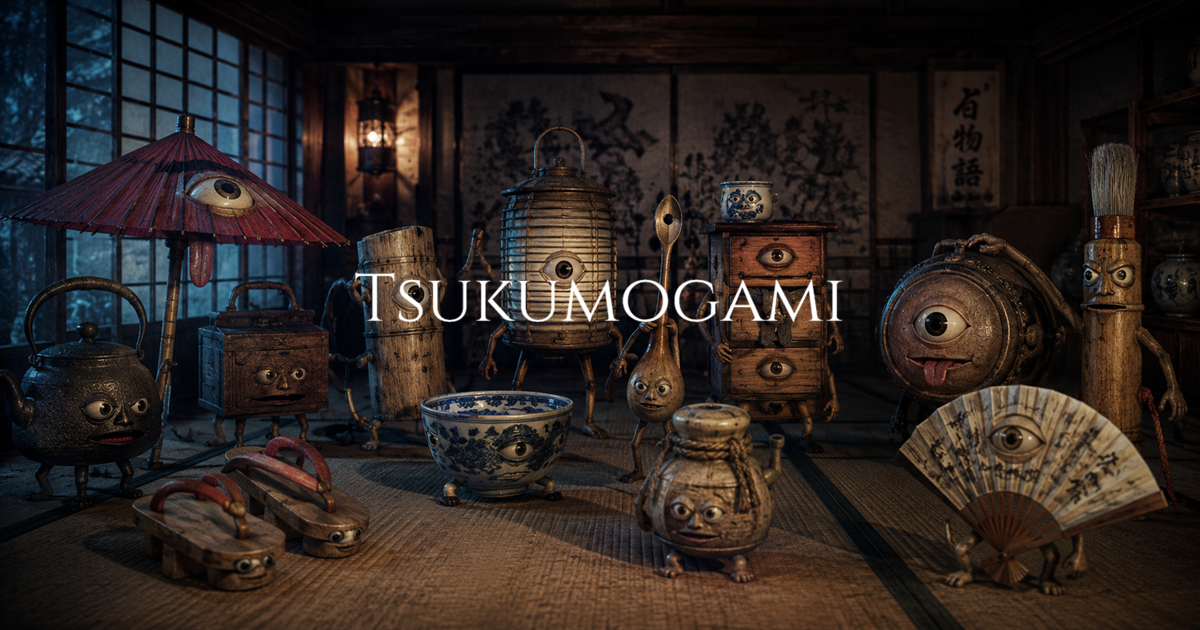
In Japanese material life, an object does not always stay where function leaves it. A kettle, a writing brush, a paper umbrella, or a worn sandal may begin as something purely useful, but use itself is a kind of accumulation. Hands return to the same surface, the same weight, the same small repair, until the object carries a history that is no longer separable from the people who kept it.
Tsukumogami give that accumulation a visible form. They are the yōkai of aged household things — tools, instruments, and utensils that are said to acquire awareness after long use, long enough that the line between possession and presence becomes difficult to hold. The idea is not that every object is secretly alive. It is that long contact with human routine leaves something behind, and folklore gives that residue a shape.
For more stories like this, explore our Yokai & Supernatural Folklore collection.
What Is Tsukumogami?
Tsukumogami are yōkai said to emerge from ordinary tools and household objects after an extended period of use, conventionally placed at around one hundred years, though the figure functions less as a measurable threshold than as a way of marking time too long to summarize. An umbrella, a lantern, a kettle, a sandal, a biwa — any object handled, repaired, and kept long enough — becomes a candidate.
What separates tsukumogami from most other yōkai is where they come from. They are not visitors from mountains, rivers, or the edges of settled land; they originate inside the house, built from the same objects that furnish a kitchen or a storeroom. This domestic origin is what distinguishes tsukumogami within the broader yōkai tradition — their strangeness arises not from distance but from overfamiliarity, from an object known so well that its sudden animation feels less like an intrusion than a correction.
Visually, tsukumogami tend to preserve the object’s outline rather than abandon it. An umbrella stands on a single leg and opens one eye. A lantern grows a face across its paper surface. A sandal gains a stride. The form has to remain legible as the object it once was, or the figure stops working as a tsukumogami and becomes simply a generic monster wearing an object’s shape. That tension between recognizability and transformation is the genre’s defining feature, and it is also why tsukumogami rarely register as threatening in the way other yōkai do. Their presence does not announce danger. It announces that something ordinary has been looked at for too long to remain ordinary.
Old Objects and the Folkloric Weight of Time
Tsukumogami belong to a broader pattern in Japanese folk thought in which the boundary between animate and inanimate is treated as a matter of degree rather than a fixed line. Stones, trees, mountains, and crafted objects are not automatically granted the same status as living beings, but none of them are automatically excluded either. What separates a thing that simply exists from a thing that has acquired presence is usually duration — how long it has been touched, used, and kept within a circle of human attention.
The hundred-year marker carried by tsukumogami folklore should be read in this light. A century is long enough for an object to outlast the person who first owned it, to pass through different households, and to survive shifts in fashion, family structure, and need. Reaching that age does not transform the object physically. It changes what the object is allowed to mean. An item that has outlived its original context becomes difficult to categorize as merely useful or merely junk, and folklore steps into that ambiguity.
Illustrated handscrolls from the medieval period depict this shift directly: discarded tools, thrown out or simply replaced, gather and rise up together, animated by the neglect of the households that once depended on them. The humor in these scenes does not erase their logic. The objects that had quietly enabled daily life are shown reasserting a kind of standing, precisely at the moment they were treated as disposable. Their transformation is less an invasion from outside than an account being settled from within the house itself.
Material Memory in Household Life
The clearest way to understand tsukumogami is through the idea of material memory — not memory in the cognitive sense, but the traces that long use leaves in an object’s surface. A worn handle, a mended seam, a softened edge: these are not stories, but they invite people to construct stories around them, because they record contact in a way words usually do not.
In households where tools were repaired rather than replaced, that record accumulated visibly. A cooking pot, a writing brush, a chest, a farming implement might remain in active use across more than one generation, carrying a value that price alone could not capture — the labor of its making, the scarcity of its materials, and the specific hands that had worn it down in specific ways.
Tsukumogami formalize that informal weight. The animated object is not given meaning from nothing; it is given a body for a meaning that domestic life had already assigned it. A tool used daily becomes identified with the work it made possible. A damaged item carries an implicit memory of the moment it broke, and of whoever decided it was still worth keeping. This is also why tsukumogami stories tolerate humor without losing their edge — the spectacle of a walking umbrella is funny precisely because it exposes how constantly people depend on objects while almost never acknowledging the dependence. Once the object moves on its own, that quiet asymmetry becomes visible, if only for a moment.
Neglect, Disposal, and the Ethics of Care
A large share of tsukumogami narratives turn on abandonment rather than ordinary aging. The object becomes animate specifically because it has been thrown away, broken without repair, or simply forgotten — and that detail gives the folklore an ethical undertone that pure age-based stories do not carry on their own.
The logic here is relational rather than environmental in any modern sense, although it can be read that way today. An object that has served a household for years is not treated, within this worldview, as something that can be discarded without consequence. It has taken part in meals, seasons, and routines; throwing it away carelessly breaks something more specific than a habit of storage. The animated, complaining, or vengeful object in these stories exaggerates a discomfort that already exists around discarding things that have shared time with people.
That discomfort has a quieter institutional counterpart in Japan’s tradition of object memorial rites. Across the country, ceremonies exist for needles, dolls, brushes, and similar implements that have reached the end of their working life. A needle memorial, in which used needles are pressed into soft material such as tofu or konnyaku, does not require anyone present to believe the needle is conscious. The gesture is the point: the object is thanked and released rather than simply thrown out. Tsukumogami dramatize, in narrative form, what these rites handle through ritual — the sense that ending an object’s usefulness without acknowledgment leaves something unresolved.
Visual Form and the Familiar Made Animate
Tsukumogami imagery depends on restraint as much as imagination. If the transformed object stops resembling the thing it once was, the figure loses what makes it a tsukumogami rather than a generic monster. The yōkai exists specifically in the narrow space between object and person, and that space only holds if the object stays visible inside the figure.
This is why most tsukumogami illustrations favor partial animation over full transformation. A face appears on a lantern’s paper surface. An umbrella grows one eye and one leg rather than a full body. A sandal develops a gait without losing its shape. These additions are modest by design, but they shift the object’s standing — it can now look, move, or respond, while remaining unmistakably the thing it was.
Because each object enters the tradition with its own field of associations — a lantern carries fragility and light, a biwa carries performance and touch, a writing brush carries discipline and repetition — tsukumogami figures inherit distinct personalities from the items they come from, without needing additional explanation. This is also part of why the motif travels easily into manga, games, and design today: the underlying structure is simple to reproduce. What is harder to carry over is the sense of accumulated time that gives the structure its original weight. Strip that away, and what remains is a mascot wearing the memory of a yōkai.
Modern Objects and the Afterlife of Use
Contemporary Japan presents tsukumogami with a different material environment than the one in which the tradition formed. Mass production and short replacement cycles have made many objects easier to discard than to repair, and household tools rarely accumulate the kind of multigenerational history that once supported the folklore’s hundred-year marker.
That shift has not made tsukumogami irrelevant; if anything, it has sharpened the discomfort the tradition was always describing. People do not expect an old umbrella to stand up on its own, but many still hesitate before discarding a school bag, a notebook, or a childhood toy that holds a period of life no longer accessible elsewhere. The folklore gives shape to that hesitation without requiring anyone to believe in animated objects literally.
Digital devices complicate the pattern further. A phone or laptop holds messages, photographs, and records in a form closer to literal memory than any wooden chest or worn kettle ever could. Replacing the hardware does not resolve the difficulty of discarding what it contains, because the attachment is no longer only sentimental — it is archival. Tsukumogami do not need to be reimagined as digital spirits to remain a useful lens here; the underlying question the tradition keeps asking, of when an object stops being merely an object, simply migrates into a new material context, carrying the same unresolved unease about use, attachment, and disposal.
Conclusion
Tsukumogami give material form to a question that long use raises about almost any object: at what point does a thing stop being only a possession? Their animation is not best read as a literal claim about spirits inhabiting tools. It is a cultural account of how human time settles into matter — into handles, hinges, paper, and cloth — until the object can no longer be approached as empty.
Their persistence has less to do with belief than with proximity. Tsukumogami are not figures from distant or unfamiliar places; they emerge from storerooms, kitchens, and the corners of ordinary houses, which is precisely why their logic still holds. The old object speaks, in this tradition, not because it has become foreign, but because it has remained close to human life for longer than convenience usually allows.
Related Articles
- Kappa — A water-bound yōkai whose folklore organizes bodily risk, etiquette, and conduct around rivers.
- Kitsune — A shape-shifting fox spirit whose ambiguity centers on disguise, intelligence, and the instability of trust.
- Tanuki — A transformation-based yōkai whose humor turns on social impersonation, adaptability, and unstable appearances.
Sources and Further Reading
The following sources address yōkai classification, animated object traditions, and the cultural frameworks surrounding everyday material life in Japan.
- Foster, Michael Dylan. Pandemonium and Parade: Japanese Monsters and the Culture of Yōkai. University of California Press, 2009.
- Foster, Michael Dylan. The Book of Yōkai: Mysterious Creatures of Japanese Folklore. University of California Press, 2015.
- Komatsu, Kazuhiko. An Introduction to Yōkai Culture: Monsters, Ghosts, and Outsiders in Japanese History. Japan Publishing Industry Foundation for Culture, 2017.
- Reader, Ian, and George J. Tanabe Jr. Practically Religious: Worldly Benefits and the Common Religion of Japan. University of Hawai‘i Press, 1998.
Author’s Note
I think of myself as someone who takes care of things — a fountain pen, a hand-wound watch, objects I expect to keep for years. But the one I keep returning to is a square of denim cut from the knee of jeans I wore during overnight shifts at a delivery center in my student years. The knee wore through again and again, no matter how it was patched, and my mother mended it more than once before I finally stopped wearing the jeans altogether. I never threw them out exactly. I cut away the patched square and kept that instead, as if the rest of the jeans had been disposable, but that one mended piece never quite was.