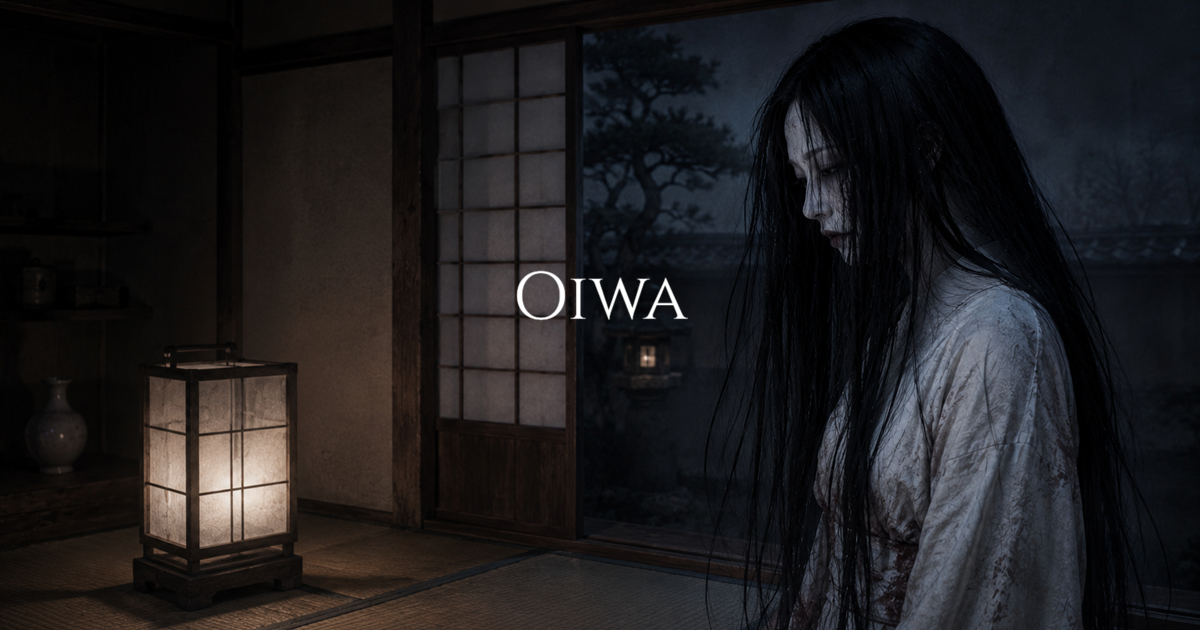
Betrayal, in Japanese ghost tradition, does not always stay contained inside the relationship where it occurred. Oiwa’s story is one of the clearest examples of how a private wound can move outward and settle into shared cultural memory, carried by a play, an image, and a name that outlived the household where the injury began. She is remembered less as an isolated ghost than as a structure through which betrayal itself became legible across generations.
For more stories like this, explore our Folklore & Ghost Culture collection.
Oiwa as a Betrayal Story in Japanese Ghost Tradition
Oiwa is the central figure of Tōkaidō Yotsuya Kaidan, first staged in Edo in 1825 as a kabuki play by Tsuruya Nanboku IV. She belongs to the broader category of Onryō, spirits whose suffering does not dissolve at death but returns to press against the living, yet what separates her from that general category is specificity: her haunting is anchored to one betrayal, one household, one act of concealment, rather than to resentment in the abstract. Where Yūrei carry the weight of an unfinished self and Onryō embody resentment as a force disturbing social order, Oiwa’s story shows how a single, named injury can be repeated across performance and image until it becomes a durable public reference point — a case study in how personal betrayal is absorbed into cultural memory rather than simply into supernatural belief.
The narrative follows Tamiya Iemon, whose ambition leads him to deceive, poison, and abandon Oiwa in pursuit of a more advantageous marriage. Across the play’s variants, the specifics shift, but the underlying arrangement does not: harm is done quietly, inside a domestic space where it can be denied, and the ghost appears only once that denial has run its course. Oiwa does not return because death itself demands it. She returns because the injury was never allowed to surface while she was alive to name it.
This produces a haunting that exposes rather than disrupts. The outward appearance of a stable household, a respectable husband, and an orderly marriage remains intact for as long as the betrayal stays hidden. The ghost does not introduce chaos into a peaceful world; she reveals that the peace was already false. What the supernatural element supplies is visibility — a way of making an unspoken rupture visible to an audience that ordinary social language would otherwise let pass unremarked.
Because that structure could be staged, printed, and retold, Oiwa moved well beyond the boundaries of a single performance. Kabuki, popular prints, later literature, and eventually film treated her not as one ghost among many but as a recognizable shorthand for the wronged woman whose injury refuses to be absorbed by silence.
Yotsuya Kaidan and the Edo Culture of Retelling
Tōkaidō Yotsuya Kaidan took shape at a moment when kabuki was tightly woven into the concerns of Edo’s urban population — debt, status anxiety, fragile household loyalty, and the precariousness of anyone without independent standing inside a family structure. Ghost stories performed on the Edo stage were rarely detached from these pressures. They tended to concentrate them, giving ordinary social strain a form dramatic enough to be recognized as consequence rather than misfortune.
Oiwa’s suffering belongs to this social world before it belongs to the world of spirits. Her vulnerability as a wife with limited leverage, and Iemon’s freedom to pursue advancement at her expense, are conditions the audience would have recognized directly. The haunting carries weight only because its human cause is already legible.
Kaidan performance in this period did more than entertain audiences with tales of the dead. It gave shape to an anxiety that obligation, once broken, might exceed the capacity of ordinary social mechanisms to contain it. Ideas of karmic consequence, folk belief in restless spirits, and the theatrical conventions of recognition and reversal combined to produce a genre in which the dead returned as evidence of imbalance rather than as arbitrary intrusion.
What made Oiwa’s version of this pattern especially durable was repetition through performance. A kabuki production preserves more than plot — it preserves gesture, pacing, image, and the specific rhythm of dread building toward disclosure. Audiences learned not only what happened to Oiwa but how her return was supposed to feel, and that shared expectation is what allowed the story to travel. Her name, her altered face, and the atmosphere of Yotsuya Kaidan became signs that could be invoked without restaging the entire play — a compressed reference to a particular kind of wrong: intimate betrayal that resists burial.
This continuity has been reinforced institutionally as well as narratively. Theatrical companies staging Yotsuya Kaidan have historically observed customs of visiting sites associated with Oiwa before production begins. Such practices are better understood as an expression of accumulated cultural weight than as a simple statement of belief; they show how respect, unease, and inherited memory can persist together even where literal conviction is uncertain.
The Onryō Form and Feminine Resentment
Describing the Onryō as a vengeful spirit understates what Oiwa’s story actually stages. Her resentment is not directed retaliation so much as the reappearance of an injury that ordinary social order declined to acknowledge while it was still contained. Betrayal, physical harm, and abandonment accumulate until they can no longer remain a private matter between two people.
This is where the story’s feminine dimension becomes structurally important, not incidental. Oiwa sits within a long lineage of narratives in which women harmed by husbands, families, or the arrangements that governed their dependency return with a force their living circumstances denied them. These stories are not primarily about women becoming dangerous after death. They register unease about a social order in which a woman’s suffering could be minimized while its consequences kept accumulating regardless.
Oiwa’s resentment is therefore inseparable from the conditions that produced it: patriarchal authority within marriage, the economic incentives behind Iemon’s ambition, and the ease with which private harm could be kept from public view. The ghost appears at the point where recognition has failed entirely — resentment becomes presence because there is nowhere else for the injury to go.
Her visual form carries this argument into the body itself. Disordered hair, white clothing associated with death, and a disfigured face are not incidental horror imagery but a way of making emotional rupture legible without dialogue. In most versions, the disfigurement results directly from Iemon’s own poison, so the injury he inflicted to clear a path toward remarriage becomes the visible sign that returns to identify him. Her face stops belonging only to her suffering; it becomes the surface where the truth of the marriage is finally written out.
This is part of why Oiwa’s image carried lasting authority within Japanese ghost culture. The long-haired female ghost in pale clothing, marked by some visible injury, did not originate with her alone, but her theatrical visibility gave that composite image unusual staying power — a way of representing resentment that did not require it to be spoken.
The Stage, the Face, and the Memory of Injury
Kabuki shaped how Oiwa would be remembered by making memory theatrical rather than descriptive. The ghost in Yotsuya Kaidan is not simply reported to the audience; she is staged through transformation, timing, and the physical charge of live performance. The audience does not learn that betrayal carries consequences — it watches those consequences enter the room.
This distinction matters because performance gives a private injury a public scale. Each staging reactivates the same betrayal, but never purely as a domestic matter between two people. What happened inside one marriage becomes something an audience collectively witnesses and, through repetition, collectively remembers.
The visual motifs surrounding Oiwa work by compressing narrative into image. Loosened hair signals disorder and a body no longer arranged for ordinary social presentation. White clothing marks death and ritual passage. The altered face turns internal injury outward. Together these elements position Oiwa between categories — wife and ghost, victim and accuser — occupying the threshold where social resolution has already failed rather than a space of pure fantasy.
That threshold position is central to Japanese ghost imagery more broadly, but Oiwa occupies it with unusual clarity because her injury has a specific cause and a specific human source. The haunting is not atmosphere without origin; it is memory attached to a face.
The stage also gave Oiwa’s image a life beyond the theater. Woodblock prints and later illustrated retellings could rely on an audience’s prior recognition of her, so that even a fragment — a name, a face, a reference to Yotsuya Kaidan — carried the full structure with it. Betrayal, disfigurement, and return did not need to be retold in full each time; they traveled as compressed cultural shorthand.
From Kabuki Ghost to Modern Japanese Horror
Oiwa continues to circulate across theatrical history, folklore scholarship, and popular media, without settling into a single fixed version. Some modern retellings foreground psychological guilt on Iemon’s side; others emphasize the intensity of the ghostly body itself; still others locate Oiwa within a broader lineage of wronged female ghosts recognizable across film, television, and seasonal ghost-story culture. Beneath these variations, the same underlying arrangement persists: betrayal produces a residue that does not simply dissipate with time.
This pattern gained wider visibility as Japanese ghost imagery reached international audiences from the late twentieth century onward. The long-haired female ghost in white has become globally recognizable, at times detached from the specific theatrical and religious context that originally shaped it. Oiwa is not the sole source of that image, but she stands as one of its central anchors — one of the figures through which resentment, femininity, and disfigurement were joined into a single recognizable form.
Within Japan, however, Oiwa’s significance has not been absorbed entirely into that wider visual genealogy. Her association with Yotsuya Kaidan keeps her tied to a specific performance history and to the ongoing practice of treating the play with ritual caution before staging it. That caution persists even where literal belief in her return is secondary, suggesting that cultural memory here is sustained as much through behavior as through interpretation.
A story built on private betrayal does not usually last this long by frightening audiences alone. It tends to persist because it gives durable shape to a problem that does not resolve on its own. Oiwa offers exactly that: a way of treating betrayal not as a single event but as something that keeps reorganizing memory long after the household involved has tried to move past it.
Cultural Memory and the Afterlife of Betrayal
Many kaidan describe the dead returning, but Oiwa’s story shows something more specific: how one emotional wound becomes embedded in collective memory rather than remaining a private matter of grief. Her haunting stays attached to its cause — a marriage, a household, a body, a name — rather than drifting free into generalized dread.
That attachment is what gives the story its clarity. The betrayal is intimate rather than abstract, domestic rather than distant, and it is carried forward not through official record but through theater, image, and repeated performance — the forms culture relies on when an injury does not fit comfortably into public moral language.
Oiwa also endures because she resists a single stable role. She is wronged without being made harmless; her return unsettles rather than restores balance gently. This refusal to resolve into either pure victim or pure avenger is part of what allows the story to be read simultaneously as a warning about betrayal, a reflection on the fragility of women’s position within marriage, and a meditation on how memory survives violence.
That the injury comes from the person closest to her sharpens all of this. Betrayal becomes memorable precisely because it violates the relationship where trust should have been most secure, and the story’s persistence across two centuries suggests how far that particular violation travels beyond its original moment. Each retelling adjusts costume, staging, and emphasis, while the underlying relation between concealed harm and its eventual return remains legible.
Oiwa is not simply a famous ghost. She is one of the forms through which Japanese ghost tradition remembers betrayal as something that outlives the person it happened to — active still in the stories, gestures, and images through which it continues to be encountered.
Conclusion
Oiwa’s place in Japanese ghost tradition rests on how thoroughly her story converts an intimate betrayal into lasting cultural form. As an Onryō, she is not resentment in general but resentment given a specific name, face, and theatrical history — one that expands outward from a single damaged marriage into a broader way of thinking about concealed injury and its return.
Across Tōkaidō Yotsuya Kaidan, its staging traditions, and its later visual afterlife, Oiwa demonstrates that the dead in kaidan rarely stand apart from the living. They return through obligations broken, harms concealed, and silences maintained past the point where they could hold.
Her story is less a tale of vengeance than a record of what betrayal leaves behind — a private wound that continues to surface wherever memory declines to stay buried.
Related Articles
- Yūrei — A ghost defined by unfinished emotion and personal incompletion rather than by a named grievance against another person.
- Onryō — Resentment treated as a general disruptive force moving outward from unresolved grievance into the social order.
- Kaidan — The narrative tradition of structured ghost storytelling through which stories like Oiwa’s were preserved and repeated across generations.
Sources and Further Reading
The following academic works provide context for Oiwa, Yotsuya Kaidan, and the Onryō tradition within Japanese ghost culture.
- Iwasaka, Michiko, and Barre Toelken. Ghosts and the Japanese: Cultural Experience in Japanese Death Legends. Utah State University Press, 1994.
- Reider, Noriko T. Tales of the Supernatural in Early Modern Japan: Kaidan, Akinari, Ugetsu Monogatari. Edwin Mellen Press, 2002.
- Keene, Donald. Japanese Literature: An Introduction for Western Readers. Grove Press, 1955.
- Addiss, Stephen, editor. Japanese Ghosts and Demons: Art of the Supernatural. George Braziller, 1985.
Author’s Note
What stayed with me while writing about Oiwa was how much this reads as something carried inside Iemon rather than something returning from outside him. The poison was meant to make the future easier to enter, but what gathered there instead was guilt and fear, quietly taking her shape. The haunting feels less like Oiwa coming back than like something in him that never left.