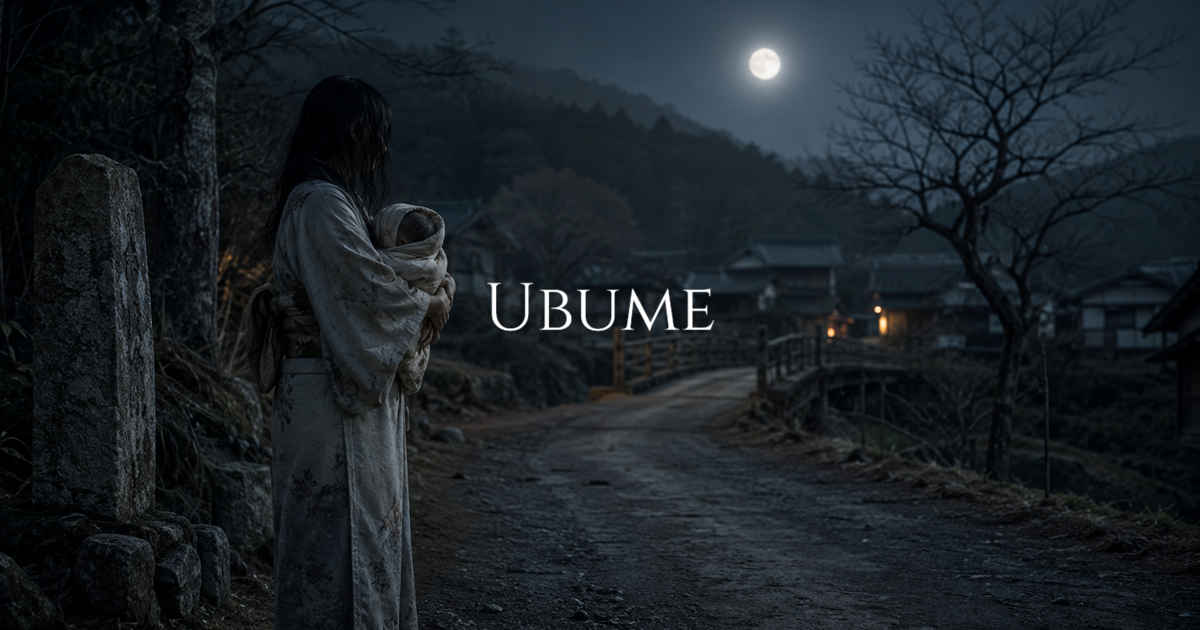
Ubume is usually introduced as the ghost of a woman who died in pregnancy or childbirth, but the detail that gives her story its shape is not her death. It is what she does afterward. She appears holding an infant, stops someone who happens to be passing, and asks that person to take the child from her arms. The encounter is not primarily about a mother’s grief. It is about a duty of care that has to move from one set of hands into another before it can continue.
For more stories like this, explore our Folklore & Ghost Culture collection.
The Story and Cultural Meaning of Ubume
Ubume is a figure associated with women who die during pregnancy, in the course of childbirth, or before their infants have been safely settled into the household. She is typically encountered at a threshold — a roadside, a bridge, the edge of a settlement — where a traveler can be stopped and asked something. In the most common version of the story, she is holding a baby, and she asks whoever has stopped to hold it, even briefly.
What defines Ubume against other figures in Japanese ghost tradition is not that a dead mother returns, but that her return is structured as a handoff: she does not linger to reclaim what she has lost, she works to place it into someone else’s care. That single distinction — care redirected outward to an unrelated stranger, rather than an unresolved bond turned back toward the self or toward whoever caused the harm — is what separates Ubume from both the Yūrei who cannot settle and the wronged, vengeful dead exemplified by Oiwa.
Once the exchange has taken place, Ubume may vanish. The person holding the bundle often finds that it has grown unaccountably heavy, or that what they are holding is not an infant at all but stones, leaves, or some other object standing in for one. In some tellings the growing weight becomes a trial of endurance; in others, the encounter yields a blessing, a sudden strength, or the discovery of a real child who can still be saved.
No single version of Ubume is authoritative. She is described variously as a ghost, a yōkai, a transformed woman, or a being shaped by Buddhist cosmology, and her form shifts by period and region. What stays constant across these variations is the transaction at the center of the story: a mother who can no longer continue her work hands that work to someone else.
This is what keeps Ubume distinct from the Yūrei in the broader sense. A Yūrei’s presence is typically explained by incomplete funerary rites, an attachment too strong to release, or a relationship between the living and the dead that has never been settled. Ubume’s unfinished condition is not purely emotional. It is logistical. A child still has to be held, protected, and brought into human society, and someone has to do it.
She is equally distinct from Oiwa, whose suffering is bound to the person responsible for it and who returns as consequence. Ubume rarely searches for anyone in particular. Her address is general — whoever is on the road — and what she is asking for is not an accounting of wrongdoing but a response to what remains after her death.
Childbirth at the Boundary of Life and Death
Pregnancy and childbirth sit uneasily inside most cultural systems for the same reason: the start of one life runs close to the possible end of another. Before modern obstetric care narrowed that risk, childbirth was inseparable from ordinary domestic life, and the arrival of a child could not be fully separated from the danger it posed to the person delivering it.
Ubume gives that overlap a fixed shape. She is not simply a dead woman, and she is not simply a mother with a child. She exists at the point where those two states — the end of a life and the beginning of one — occur too close together to be sorted into separate categories.
This has consequences for how death is normally handled. Funerary practice generally moves a person away from ordinary social relations and toward a new status — ancestor, memorial presence, one of the settled dead. Childbirth moves the opposite direction, drawing a new person into the household and starting a chain of obligations that will run for years. In Ubume’s story, these two movements collide directly. The mother is gone, but the infant has not yet been absorbed into family or community, and there is no established process for what happens in between.
The unease this produces is not only spiritual. It marks a break in the transmission of care itself. The woman’s body can no longer feed, carry, or protect anyone, but the obligation that those acts once carried has not disappeared along with her. The ghost occupies exactly that gap — between a duty and the person who was supposed to fulfill it.
Older visual and textual depictions sometimes mark this cause of death specifically, through disordered clothing, exposed skin, or blood at the waist. Detached from their original context, such details can look like they exist to unsettle. Their function was also, in part, documentary: making visible a category of death — maternal death — that household life did not always have a ready way to acknowledge.
Early modern print culture helped fix Ubume as a recognizable type within the visual vocabulary of ghosts and yōkai. The maternal body became a site where childbirth, death, ritual impurity, and obligation could all be represented in a single image, moving something that had occurred inside the household into a shared cultural record.
Even so, Ubume resists being flattened into a symbol of bodily contamination alone. Her actions stay oriented toward the child. Even where her body carries the marks of a dangerous crossing, the narrative keeps returning to preservation rather than to defilement. The mother’s death is what creates the ghost, but it is the child’s continuing vulnerability that gives the ghost something to do.
The Weight Placed in Living Hands
The pivotal action in an Ubume story is the moment of transfer. It may take only seconds, but it changes what the person accepting the bundle is. A traveler who had no connection to the situation a moment earlier becomes responsible for something they cannot yet make sense of.
The request itself tends to be understated. The woman asks the passerby to hold the child for a while, or to wait nearby, or to carry the bundle while she steps away briefly. She rarely explains who she is. Much of the story’s pressure comes from how difficult the request is to refuse — turning away a woman holding an infant would itself feel like a failure of basic conduct, whatever the circumstances.
The meaning of the exchange changes once the bundle starts to grow heavier. A gesture that looked like a small, temporary favor turns into something closer to a test of endurance. What the stranger discovers is that accepting a child is not the same act as caring for one; acceptance is instantaneous, but care is not.
The increasing weight makes physical an obligation whose real scope was hidden at the moment it was accepted. Taking a child into one’s arms opens onto feeding, protection, kinship, social recognition, and years of continued dependence — none of which is contained in the initial gesture. The supernatural weight compresses all of that unseen future into a single, immediate burden.
When the bundle turns out to hold a stone rather than an infant, the shift does not necessarily empty the encounter of meaning. Stone carries its own associations — permanence, memorial, the world of the dead. In versions shaped by Buddhist imagery, it can also recall Jizō, the guardian of children and travelers associated with beings caught between states. Read this way, the child in Ubume’s arms is no longer only one lost infant. It stands in for a wider category of children whose place in the household was never secured.
In some accounts, the person who keeps holding the burden is said to gain unusual strength. This is not simply a reward for compassion. The strength is tied specifically to the willingness to keep carrying something that has become harder than it first appeared — the stranger does not arrive with that strength, but produces it through the act of continuing.
The transfer keeps Ubume from being contained within a story of maternal attachment alone. The narrative starts with a mother, but she cannot complete it by herself. Completion requires a second party, someone whose connection to the child is created not by blood but by response to a request.
That absence of kinship is what gives the encounter its wider force. The passerby has no prior obligation to this particular infant, and yet vulnerability creates a claim on them anyway. What Ubume is really testing is whether care belongs only to family, or whether it can be handed, with no preparation at all, to whoever happens to be willing to take the weight.
Maternal Attachment as a Transfer of Obligation
Japanese ghost traditions generally describe the dead as held near the living by unresolved attachment — strong emotion binding a spirit to a place, preserving a relationship past the point of death, or keeping the dead from settling. Ubume belongs to that broader field, but the direction her attachment takes is unusual.
She does not stay beside the child in the way an attached spirit might linger beside an object or a grievance. She works out what will happen once she is no longer able to stay at all.
This sets her apart from a spirit whose attachment expresses itself as possession or refusal. Ubume may begin a story holding the child, but the decisive act is her attempt to give it up. Her continued presence is expressed through the act of letting go, not through holding on.
That is the contradiction at the center of the figure. Motherhood is treated as a bond strong enough to outlast death, and the purpose of that survival is very often to move the child beyond the mother’s own reach. She returns because she can no longer provide care, and because the care still has to be provided by someone.
Read this way, the story frames maternal care as an obligation rather than as an emotion in isolation. Love here does not appear only as grief or as resistance to separation. It appears as an active effort to secure someone else’s continued survival, carried out at the exact point where the mother herself has stopped being able to participate in it.
The figure of Ubume can also expose how narrowly maternal responsibility was concentrated in a single body. When she appears, fathers, relatives, and household structure are typically absent from the scene. A duty that should belong to a network has been left to one woman, and death has not released her from it.
The stranger’s intervention briefly rebuilds that missing network. The passerby cannot take the mother’s place, but the act of receiving the child demonstrates that care is able to move past the person who was originally expected to provide it. What had been a private matter becomes, for a moment, a shared one, the instant a second pair of hands accepts the weight.
Folklore leaves this without a single verdict. Ubume can be read as evidence of an idealized maternal bond and, at the same time, as an exposure of what that bond demands. Her persistence past death raises a quieter question: what kind of obligation is being imagined here, one with no built-in end point?
The story does not resolve that question by weakening the tie between mother and child. It gives the tie another form. Maternal care outlasts the mother not because she keeps possession of the child, but because she manages to make someone else responsible for it.
From Maternal Ghost to Protective Presence
Ubume does not stay confined to stories of roadside encounters. In some regional and religious traditions, she becomes associated with safe delivery, lactation, and the protection of vulnerable children — a spirit produced by maternal death gradually repositioned as a presence the living approach for help.
This shift fits a wider pattern in Japanese religious practice. Beings marked as dangerous or unsettled are not automatically pushed outside the boundary of sacred space. They can be named, ritually addressed, enshrined, or given a defined role through which their force becomes something a community can use. Protection here does not require erasing the danger; it can be built on top of a working relationship with it.
For Ubume, the movement from ghost to protector is already present in the story’s own logic. Her concern was directed at children from the start, so a protective role does not replace her earlier identity — it extends it. The mother who once searched for someone to carry her child becomes a figure other mothers approach on behalf of their own children.
Offerings connected to milk, sweets, clothing, or infant health keep this meaning tied to the body rather than letting it drift into abstraction. These are not symbolic gestures detached from daily life; they belong to feeding, recovery, and the ordinary, repeated labor through which an infant survives its first years. Through practices like these, Ubume’s identity as a supernatural figure is pulled back into domestic routine.
This repositioning also gave communities a way to respond to deaths that disrupted the expected continuity of a household. Childbirth was supposed to extend a family forward. Maternal death could turn that same moment into a rupture instead. Directed ritual attention allowed a household to acknowledge both losses at once — the mother who died, and the child whose life had not yet been secured.
Buddhist practice around children who died before birth or in infancy adds a further layer. Jizō, closely associated with children and travelers, offers a compassionate figure for lives situated at uncertain boundaries. Where the child in an Ubume story becomes a stone or a small votive image, maternal grief is joined to a broader religious framework built around protection and passage.
No single doctrine governs how these associations line up. Ubume moves across oral narrative, temple legend, print culture, Buddhist devotional practice, and later yōkai classification, and her meaning shifts with each setting. What holds steady is the direction of the movement: a figure defined by interrupted protection is gradually entrusted with protecting others.
Popular summaries tend to compress Ubume into the single memorable image of a woman handing over an unexpectedly heavy infant. That image works, but leaning on it too heavily can flatten the rest of the story. The bundle’s importance is not that it conceals a trick. It is that it makes an otherwise abstract obligation something a person can physically feel.
Considered across this longer arc, Ubume is neither only a tragic mother nor only a protective spirit. She occupies the point where the two meet. The same unfinished obligation that keeps her from disappearing is eventually what allows a community to approach her for help.
Why Ubume Still Carries Cultural Weight
Ubume continues to make sense even in settings where the older religious framework around her has weakened. Pregnancy still places hope beside real uncertainty. Parenthood still begins before its consequences can be fully known. Care still outlasts particular people, and responsibility still has to pass from one set of hands to another when the first person can no longer continue.
The figure also holds onto something that formal records tend to lose. Maternal mortality can be counted, but a statistic does not show how a community pictured the unfinished relation between a dead woman and the child she left behind. Folklore gives that gap a scene instead: a road, a request, a bundle, and a stranger deciding whether to take it.
Ubume does not require literal belief in a ghost waiting at a crossing to remain meaningful. She persists because she gives shape to a problem that remains legible even outside a religious framework — what happens when care is interrupted but the need for it does not go away with it.
Her ambiguity is part of what keeps her culturally legible. She can be pitied, avoided, respected, or sought out for protection, depending on the telling. She may be one specific mother or a broader category of spirit. She may test the person who stops for her, reward their endurance, hand them a stone instead of a child, or lead them toward an infant who can still be saved.
Across all of these variations, the transfer at the center stays fixed. Something has ended for the mother. It has not ended for the child. Because the dead cannot finish the work themselves, the living are pulled into finishing it for them.
This is what lets Ubume extend past a narrowly maternal story without losing her connection to the maternal body that produced her. Her figure starts in the specific danger of childbirth, but the question attached to her reaches further: who becomes responsible once the person expected to provide care no longer can?
Folklore answers this without recourse to law or formal duty. It puts the weight into someone’s arms and lets what happens next show what acceptance actually requires.
Conclusion
Ubume is not best understood as a mother who cannot accept her own death. She is a figure through whom death exposes how much care depends on being transferred. Her return is aimed outward, at another person, and the story stays incomplete until someone living takes on part of what she can no longer carry herself.
This is what separates her from the unresolved presence associated with many Yūrei, and from the returning injury embodied by Oiwa. Ubume is not primarily drawing the living back toward the circumstances of her death. She is drawing them forward, into the life that has to continue after it.
The child in her arms might become a stone, a votive image, an unbearable weight, or a living infant recovered in time. In every version, the bundle makes an abstract responsibility something a person can hold. What outlasts the mother is not only the memory of her death, but a claim that care has to land somewhere.
Whether the stranger accepts that claim out of compassion, obligation, confusion, or simple difficulty in refusing is left open by the story. Its real point sits elsewhere. Care does not always begin with kinship, preparation, or certainty. Sometimes it begins the moment another person is the only one left who can carry it any further.
Related Articles
- Yūrei — Covers the broader category of the Japanese dead whose presence continues because ritual, emotion, or a relationship with the living remains unsettled, without the specific transfer of care that defines Ubume.
- Onryō — Centers on resentment returning to the living as consequence, contrasting with Ubume’s movement away from retaliation and toward continued protection.
- Oiwa — Follows a named ghost whose bodily suffering and betrayal stay bound to the person responsible for them, unlike Ubume’s appeal to an unrelated stranger who must respond to what remains.
Sources and Further Reading
These works give the folkloric, religious, and cultural grounding needed to read Ubume as both a maternal ghost and a figure through whom care passes from the dead to the living.
- Foster, Michael Dylan. Pandemonium and Parade: Japanese Monsters and the Culture of Yōkai. University of California Press, 2009.
- Iwasaka, Michiko, and Barre Toelken. Ghosts and the Japanese: Cultural Experience in Japanese Death Legends. Utah State University Press, 1994.
- Reader, Ian, and George J. Tanabe Jr. Practically Religious: Worldly Benefits and the Common Religion of Japan. University of Hawai’i Press, 1998.
- Stone, Jacqueline I., and Mariko Namba Walter, editors. Death and the Afterlife in Japanese Buddhism. University of Hawai’i Press, 2008.
Author’s Note
I don’t remember a single moment of learning about Ubume — it feels like something I had always half-known. The closest I can come to a beginning is a hardcover in my elementary school’s classroom library, wrapped in a handmade paper cover that one of my classmates had made for it. By then, the cover was dirty and torn at the edges from passing through other children’s hands all year, and the book sat among the others that everyone seemed to read eventually anyway.